Samaaro + Your CRM: Zero Integration Fee for Annual Sign-Ups Until 30 June, 2025
- 00Days
- 00Hrs
- 00Min


Key Takeaways (TL;DR)
1
2
3
→
Bottom Line:
Developer marketing wins on credibility built in repos, terminals, and Discord channels, never on volume metrics from the booth.
You sent your top BDR to KubeCon with an eleven-step email sequence primed to fire after every badge scan. By Day 2, your domain was in three Slack channels with 2,000+ engineers under the subject line “don’t email these people.” Welcome to developer marketing: the only B2B channel where doing more actively makes things worse.
This is what most developer event marketing programs produce. The booth got built. The badges got scanned. The sequence fired. The engineering community noticed, screenshotted, shared, and quietly removed the vendor from the list of tools they recommend internally.
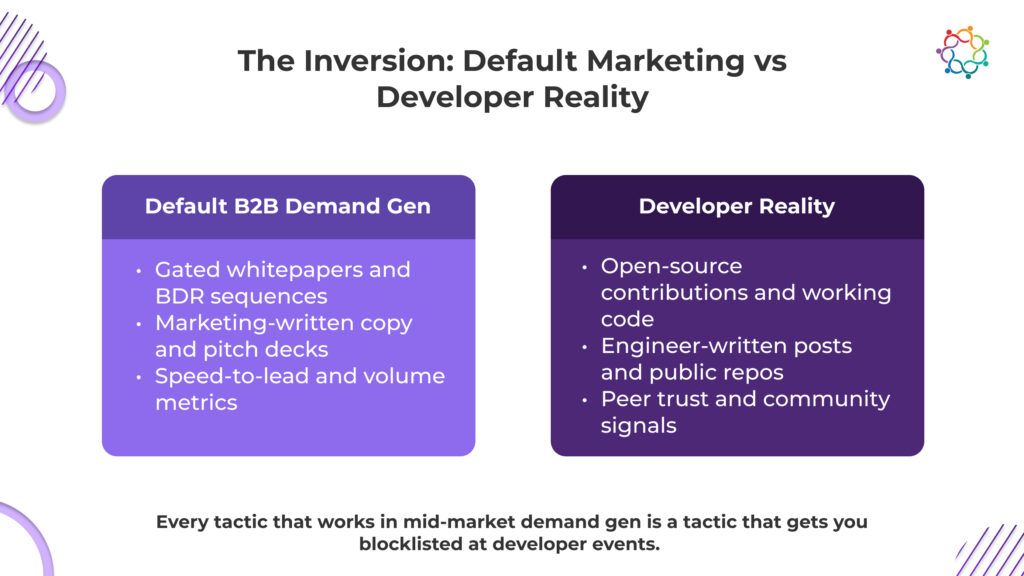
Developers have built a community-wide immune system against marketing. Every tactic that works in mid-market demand gen, sequences, gating, pitch-led booth conversations, BDR follow-ups, is a tactic that gets you blocklisted at developer events. This guide covers the six decisions that separate vendors developers respect from vendors developers ignore.
This is that framework: six parts built around how developers actually evaluate and recommend tools, applied across major conferences, community meetups, and hackathons. Each part addresses a default B2B marketing instinct that costs developer-focused companies a meaningful pipeline every year.
Most developer marketing programs fail because they apply mid-market demand gen muscle to a community that rejects it on contact.
The structural reality.
Developers buy and recommend tools peer-to-peer. The buyer is rarely a single decision-maker. The influence loop is the team, the community Discord, the Hacker News thread, and the engineer in the next seat who has actually shipped something with the tool.
The trust threshold.
Developers trust GitHub stars, working code, public postmortems, and other engineers. They do not trust testimonials, analyst reports, or branded content.
The “this feels like marketing” reflex.
Any signal of corporate language, gated content, sales script, or non-engineer presence triggers immediate dismissal. A developer who detects marketing on a vendor page will close the tab in seconds and tell three colleagues about it on Slack within the hour.
The implication.
Every tactic has to subtract marketing signal and add engineering credibility. This is the inverse of how most B2B marketing functions are trained.
Common trap: treating developer marketing as a cooler version of B2B SaaS demand gen.
The volume tactics that work for marketing managers, the gated whitepapers, the BDR sequences, and the pitch-led webinars, are the exact tactics developers use to identify vendors not worth engaging with. Subtracting marketing signal is the whole job.
Content is the developer’s first contact with the brand. Get the content rules wrong and nothing downstream, booth, demo, follow-up, recovers it.
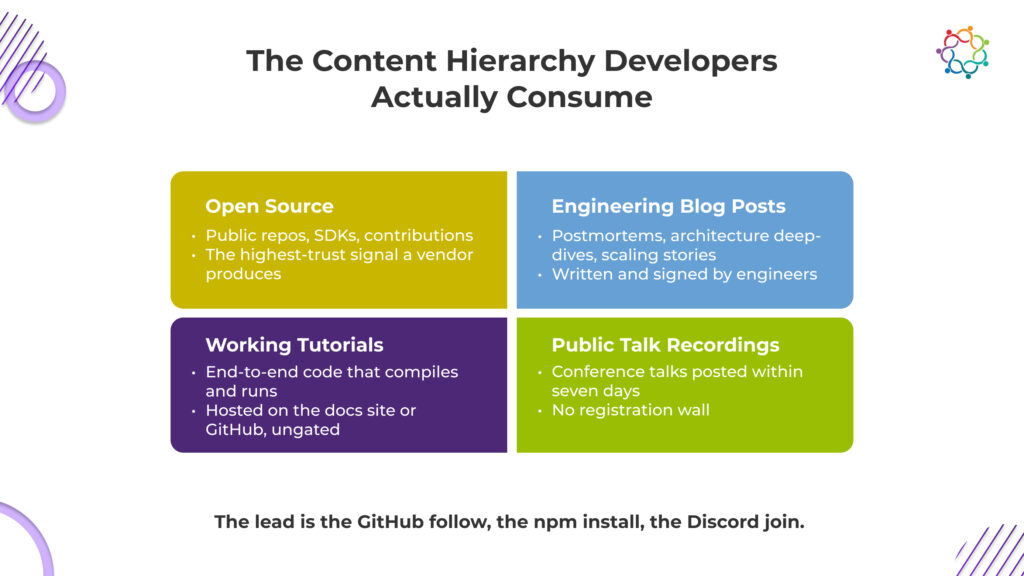
The content hierarchy developers actually consume.
The content that actively repels developers.
Gated technical whitepapers. “Top 10 trends in developer experience” branded content. Webinars hosted by marketing leaders pitching the platform. Anything written in the third person about the product team’s “innovation journey.” Each of these is read as a signal that the brand is run by people who do not ship code.
The content-event flywheel.
Thirty days pre-event: original technical post tied to the talk theme. Published on the engineering blog, syndicated to Hacker News, dev.to, and the relevant subreddit.
During the event: live tutorial, demo, or workshop, with the code in a public gist before the session ends.
Post-event: full talk recording posted publicly within seven days, no gate. Slides as a public repo. Code as runnable, not as screenshots.
Common trap: gating technical documentation.
Developers either find the content elsewhere within ninety seconds or write a Hacker News post about your gated docs that costs more brand equity than a year of inbound. Technical content for developers must be ungated. The lead is the GitHub follow, the npm install, and the Discord join. Not the form fill.
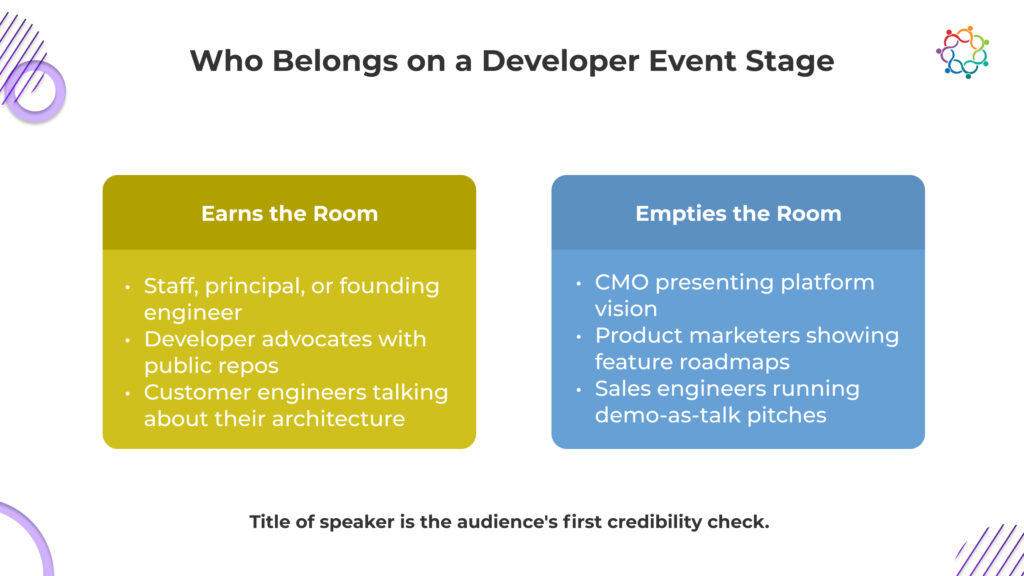
Stage access is the highest-leverage decision a developer event sponsor makes. The wrong speaker on stage burns the entire investment. The right speaker can produce more downstream credibility than the booth, the sponsorship, and the follow-up combined.
Who belongs on a developer event stage?
Who does not belong on a developer event stage?
Talk content that earns the room.
A technical problem and how it was solved, with the tradeoffs and the things that broke. Live code that compiles, runs, and occasionally fails on stage. Developers respect transparency about failure modes far more than they respect a perfect happy-path demo.
An open-source contribution announcement or a real benchmark with the methodology shown. A teardown of an interesting architectural decision, yours or a customer’s. Anything that gives the audience something they can take back to their own codebase on Monday.
Talk content that empties the room.
Slide-heavy decks with product screenshots and customer logos. Sponsored “thought leadership” with no executable code. Anything that ends with a CTA to book a demo.
Common trap: stage time as a content marketing channel.
Putting the CMO behind the mic at a developer conference is the canonical mistake. Developer audiences tolerate vendor stage time only when the speaker has earned the room through code shipped, problems solved, or research published. The speaker’s title is the audience’s first credibility check, and the second is whether their hands actually touch a keyboard.
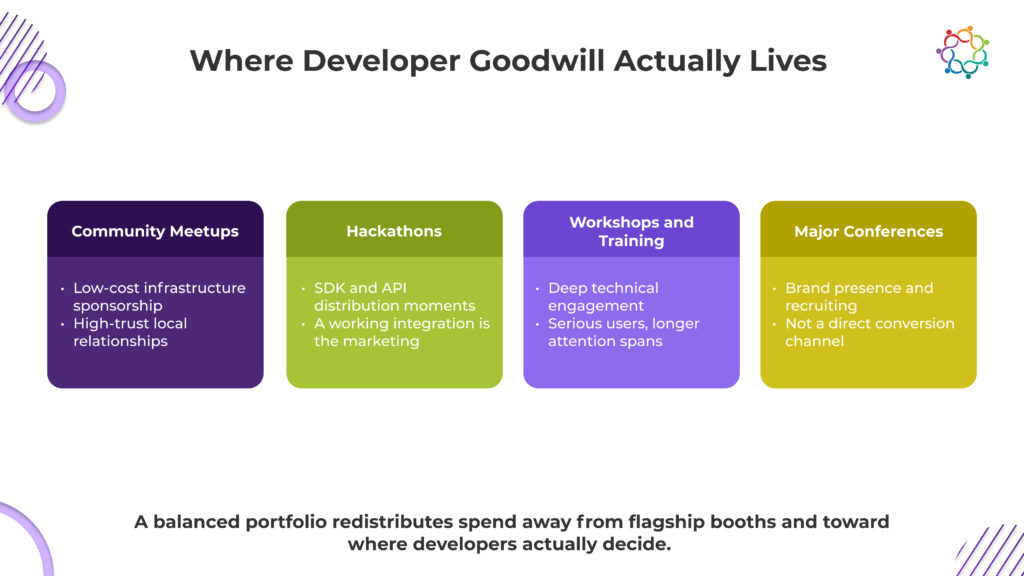
The default developer event budget allocation is the biggest conference, biggest booth, most BDRs. Almost every time, the default is wrong. The highest-trust developer engagement happens at smaller, community-led events where vendor signal is low, and engineer attention is close.
The event categories and what each is good for.
The sponsorship decisions that build goodwill.
Sponsoring meetups with infrastructure costs (venue, food) without speaking-slot demands. Funding open-source maintainer travel to events. Underwriting hackathon prizes without insisting on logo dominance. Coffee or breakfast sponsorship that is literally just “here is coffee,” with no captive presentation attached.
The sponsorship decisions that burn goodwill.
Buying mainstage keynotes at developer conferences with no technical content. High-tier sponsorships paired with a generic booth and three BDRs. A $200K “diamond” tier with no developer-relevant content is the canonical waste. Hackathon sponsorships that gate the API behind a sales conversation.
Common trap: over-indexing on flagship conferences.
Allocating the vast majority of the developer event budget to one or two flagship conferences is the default move and the default mistake. The events where developers actually decide what to recommend, the meetups, the hackathons, the workshops, are the events with the lowest vendor signal and the highest per-dollar trust return. A balanced portfolio redistributes spending away from flagship booths toward community programs.
Developer audiences read every piece of vendor copy as a credibility check, and most B2B marketing language fails the check in the first sentence. The booth blurb, the talk abstract, the LinkedIn promo, the registration form description, all of it gets scanned by developers actively looking for reasons to disengage.
The vocabulary that signals “marketing wrote this.”
Synergy. Leverage. Empower. Revolutionize. Transform. Solution. Platform-as-a-service, when you mean an API. “Industry-leading,” “best-in-class,” “next-generation,” empty modifiers that signal the absence of substance. “Reach out to learn more,” the universal close that developers parse as “we want a sales call.”
The vocabulary that signals “an engineer wrote this.”
Specific verbs tied to what the code actually does: queries, indexes, parses, deploys, retries, and caches. Concrete benchmarks with methodology: “p99 latency dropped from 240ms to 38ms after we rewrote the buffer pool.” Direct admission of tradeoffs: “This works well below 10K req/sec; above that, you’ll want a different topology.”
The tone calibration.
Written in the first person plural by a named engineer with a public GitHub. Acknowledges what the tool does not do as readily as what it does. Cites repos, not customer logos. Treats the reader as a peer engineer who will fact-check every claim.
Common trap: brand-team copy without engineering review.
A single line of marketing language in a developer event description costs trust before the developer ever attends. The fix is operational: every piece of developer-facing event copy gets an engineering review pass before it ships. Twenty minutes of an engineer’s time on the booth blurb is worth more than three weeks of brand-team revisions.
The booth demo is where the developer either decides the tool is interesting or walks away within thirty seconds. Most vendor demos fail because they were designed for a buyer who wants to see features, not a developer who wants to see code.
Demo principles that work for developer audiences.
Demo anti-patterns developers will walk away from.
The “break it on stage” principle.
The most credible developer demos include something failing live and being debugged. Showing how the tool handles an edge case is more persuasive than ten happy-path features. Honest demos build credibility that survives the booth conversation and shows up in the Hacker News thread two days later. Pretending everything works is the marketing instinct. Acknowledging where it breaks is the engineering one.
Common trap: demo as a feature tour.
Designing the demo to maximize feature surface area shown in five minutes is the canonical failure mode. Developers do not want a feature tour. They want to see one realistic problem solved end-to-end with code they could write themselves. Depth on one path beats breadth across ten, every time, in every developer audience that has ever walked up to a booth.
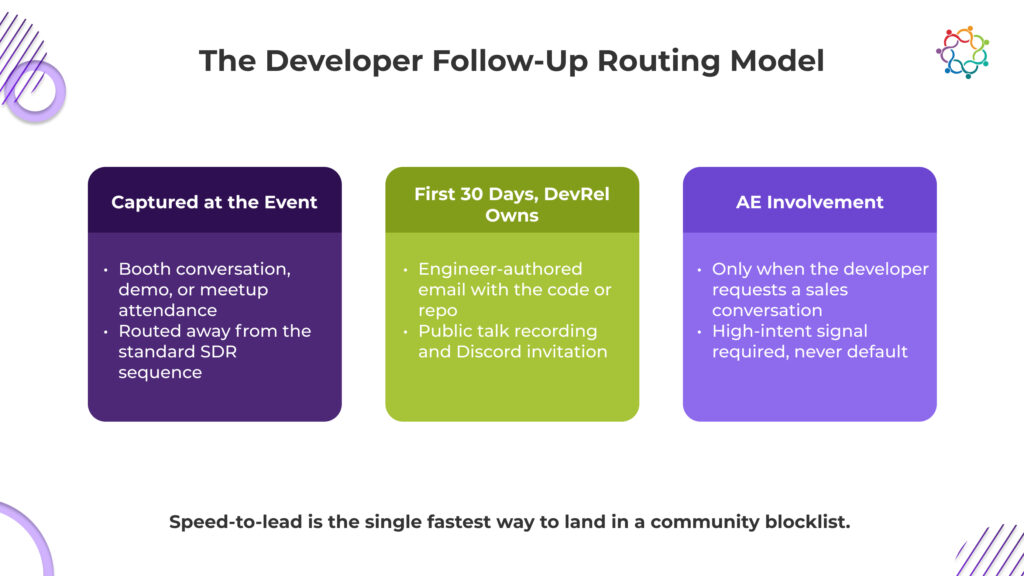
Most developer event programs unravel here. The team that built the booth correctly, sent the right engineer to the stage, ran a credible demo, and earned a hundred genuine conversations, then routes every captured email into the same BDR sequence the marketing site uses. Within forty-eight hours, the brand equity built over six months is in three Slack channels.
The follow-up logic that works.
One email, from a named engineer (not a BDR), with the working code or repo from the demo attached. A link to the public talk recording will be posted when it is available; no gate. An invitation to the public Discord or Slack, not “a quick thirty-minute call.” For high-intent signals (booked a 1:1, asked a specific implementation question), a follow-up from a developer advocate, not the AE.
The follow-up logic that destroys goodwill.
Multi-step BDR sequences with merge tags. “Hey {first_name}, just bumping this thread.” Cold call attempts to mobile numbers captured at registration. Marketing emails to corporate accounts that get auto-shared in the recipient’s engineering Slack channel. Every one of these is a story a developer will tell at the next meetup.
The right routing.
Common trap: speed-to-lead reflex on developer captures.
Routing developer event captures into the same automated sequences that handle inbound from the marketing site is the single fastest way to land in a community blocklist. Developers who attended a meetup, downloaded an SDK, or asked a question at a booth need a fundamentally different follow-up motion. The default sales infrastructure is the wrong tool for the job.
Every developer marketing decision is a credibility test, and the default B2B marketing instinct fails the test on contact. Ungated content. Engineers on stage. Smaller events. Engineering-written copy. Terminal-first demos. Follow-up routed away from BDRs. The vendors developers recommend aren’t the loudest at the conference. They’re the ones whose engineers showed up, shipped something useful, and stayed in the Discord afterward.
If your team sponsors KubeCon, four meetups, and a hackathon every year, and the post-event reporting still cannot tell you which engineers turned into actual users at month three, the gap usually sits in the developer-attribution layer, not the developer experience. Samaaro is built for the reporting layer that closes it.