Samaaro + Your CRM: Zero Integration Fee for Annual Sign-Ups Until 30 June, 2025
- 00Days
- 00Hrs
- 00Min

1
2
3
→
Bottom Line:
Cybersecurity event marketing wins on credibility in the nine months around the event, not on volume at the booth.
You spent $400,000 on the RSA booth: the lounge furniture, the espresso bar, the hourly demos, and the stilt walker for some reason. The badge scanner fired 1,200 times. Three months later, your AE has had real conversations with eleven of those scans. Not one is a CISO.
This is what most cybersecurity event marketing programs produce. The booth got built. The badges got scanned. The CISO walked past, declined the meeting request, and ignored the post-event email. The renewal of next year’s RSA booth is somehow already approved.
Cybersecurity event marketing requires a different playbook from general B2B demand gen. CISOs do not engage with vendors at events the way other buyers do. They attend to talk to peers, not vendors. Engaging them takes peer trust, executive-level tactics, and follow-up architecture that survives a procurement cycle longer than most marketing tenures.
This is that playbook: five parts built around how security buyers actually buy, applied across RSA, Black Hat, and the smaller, higher-trust events that matter beyond them. Each part addresses a specific failure mode that costs cybersecurity vendors a meaningful pipeline every year.

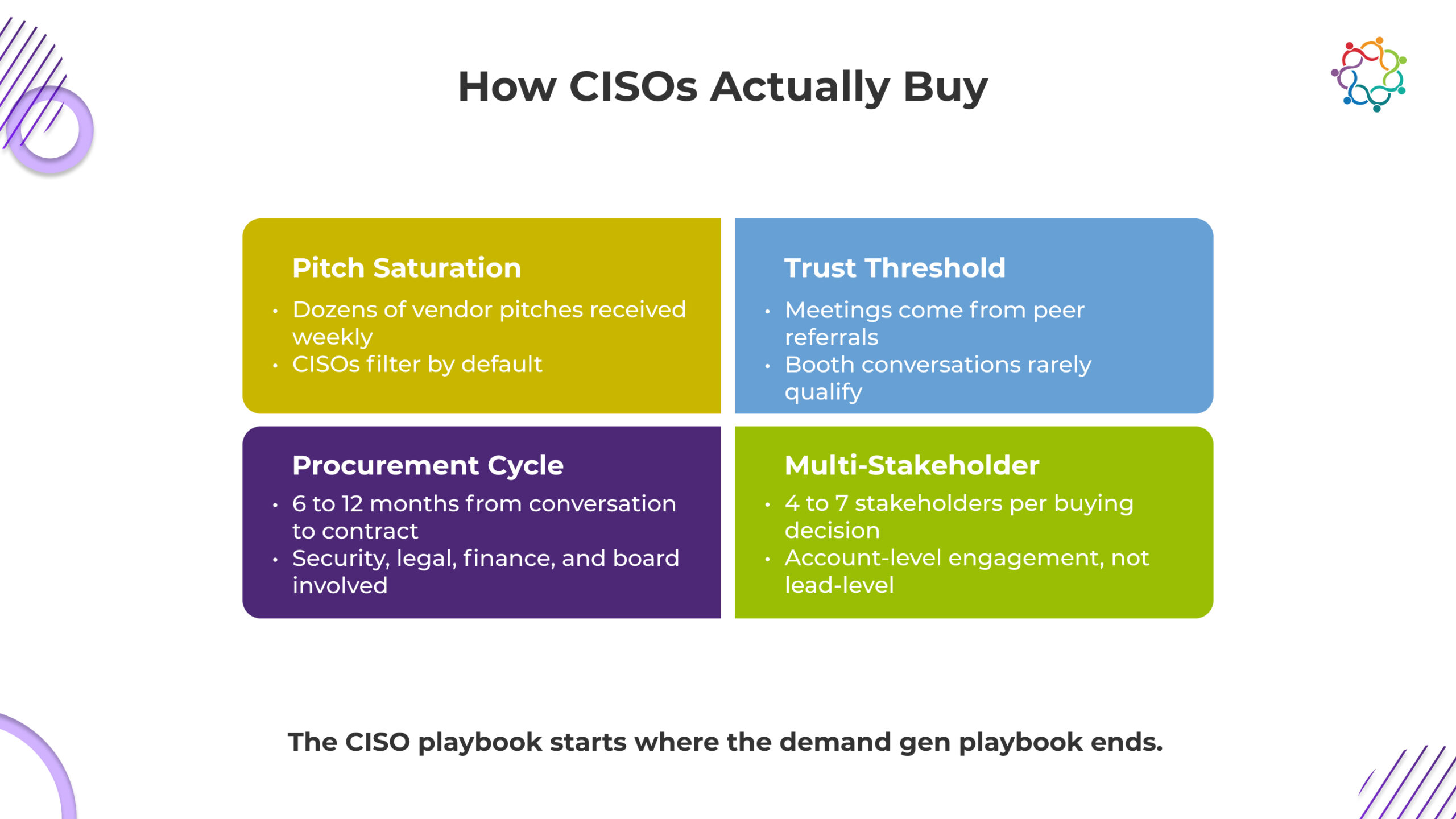
Most cybersecurity event marketing programs fail because they ignore how CISOs actually buy. The tactics that work on every other B2B audience get filtered out before the CISO reads the email.
The structural reality.
Enterprise CISOs receive dozens of vendor pitches per week, sometimes more than fifty. The default state of a senior security leader at a conference is not curiosity. It is fatigue.
The trust threshold.
Security buyers do not take a meeting based on a booth conversation. They take meetings based on three things: a peer they trust referred the vendor, an analyst they respect named the vendor in a report, or the technical depth in the conversation gave them something they cannot get from a content library.
The procurement reality.
Most enterprise security purchases run six to twelve months from the first conversation to a signed contract. Security review, legal review, and finance sit between the vendor and the contract. The follow-up architecture later in this article anchors to a nine-month cycle, the midpoint of that range. Compress or stretch the touchpoint logic based on where a specific deal sits in the band.
Common trap: treating CISO engagement as fast demand gen.
The volume tactics that work for marketing managers, the booth scans, the weekly nurture sequences, and the generic content are the tactics CISOs actively filter out. The CISO playbook starts where the demand gen playbook ends.

Booth strategy is the most-asked question in cybersecurity event marketing, and the honest answer is uncomfortable: at RSA and Black Hat, the booth is a brand presence and a practitioner education channel, not a CISO acquisition channel.
The honest booth audience reality.
RSA Conference draws over forty thousand attendees, dominated by security practitioners, analysts, and vendors. CISOs are a small percentage of that crowd, and most of the senior security leaders who do attend are routed through invite-only side programs rather than working the show floor.
Black Hat is more research-led, with deeper technical content and a stronger operator presence. Enterprise CISOs attend in lower numbers than at RSA. Different audience. Different play.
In both cases, the booth’s real job is to reach practitioners, engineers, and senior managers who influence CISO-level decisions, not the CISO directly.
Booth design that signals technical credibility.
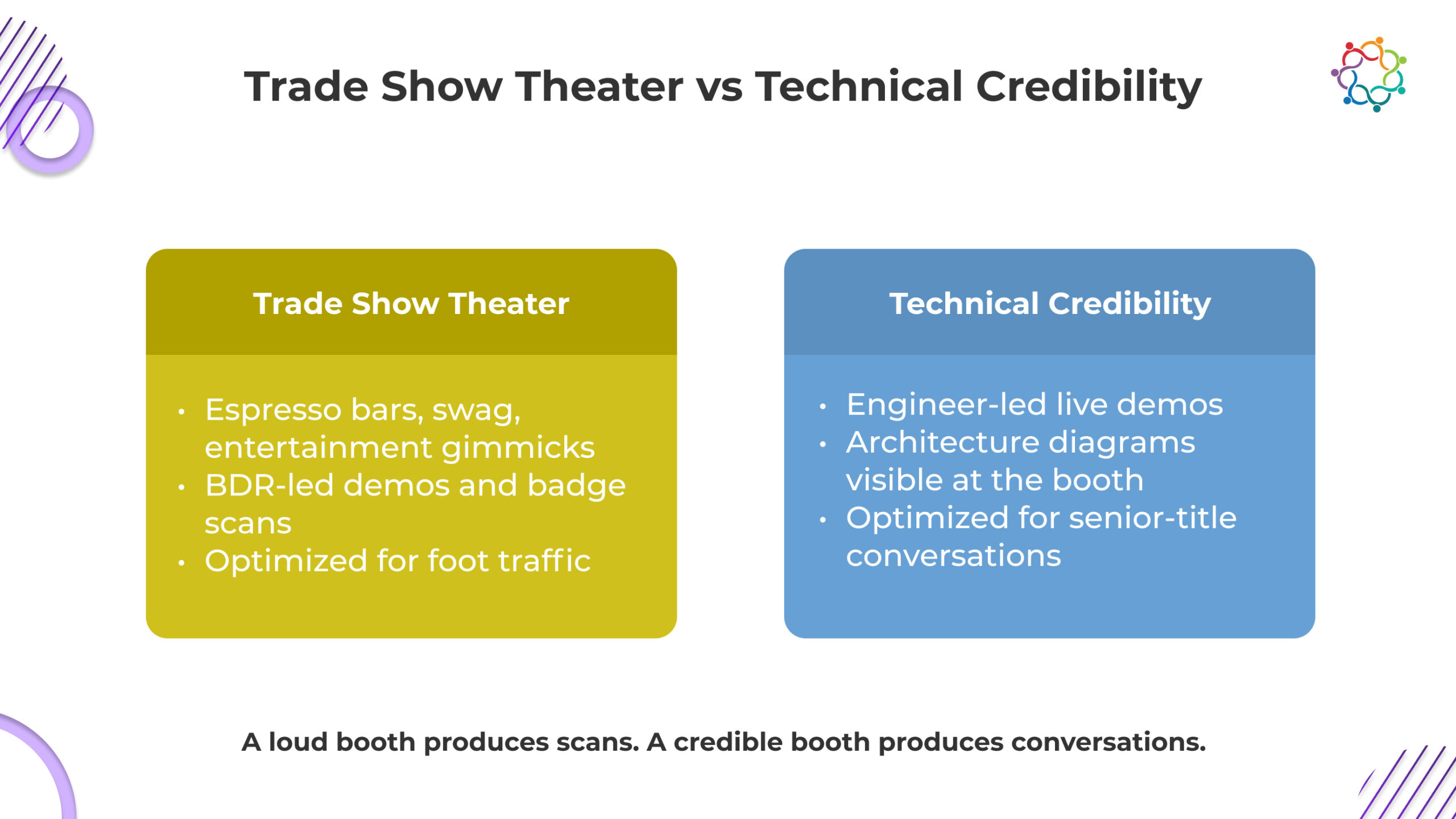
No espresso bars. No swag wars. No entertainment gimmicks. Senior security operators and CISO advisors read these as evidence that the vendor does not understand the audience.
Live technical demos run by engineers, not BDRs, for at least four hours of every show day. Architecture diagrams and technical whitepapers are visible at the booth, not buried inside a QR code. A clearly named technical lead at the booth at all times, identifiable by badge color or signage.
Common trap: maximizing foot traffic with consumer-marketing tactics.
Cybersecurity buyers, especially senior ones, distrust booths that feel like trade show theater. A loud booth produces scans. A credible booth produces qualified conversations. Optimize for credibility, not crowd.
The right booth metric.
Volume metrics flatter the report. Credibility metrics predict the pipeline. Track both, but defend the budget on the second.

Almost all real CISO engagement at RSA and Black Hat happens off the show floor. The booth is a presence. The dinners, the private briefings, and the analyst side events are where the conversations actually start.
The CISO dinner playbook.
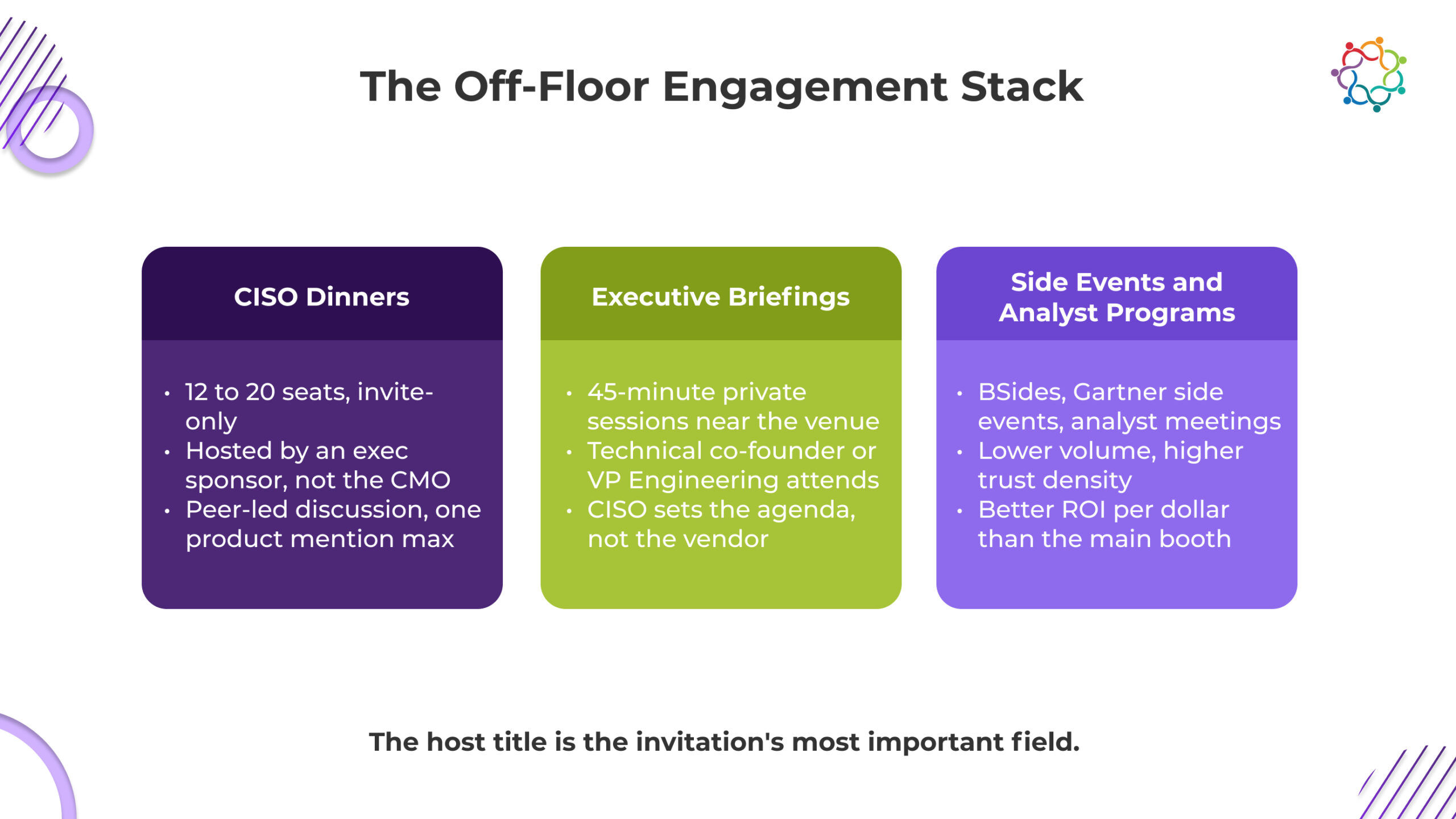
Twelve to twenty seats. Invite-only. Hosted by an executive sponsor: CEO, technical co-founder, or CISO advisor. Not the CMO. Not the AE.
Peer-led discussion topic, not a vendor pitch. A moderated conversation on a current security challenge: AI risk, zero trust operational reality, board-level cyber metrics. One product is mentioned a maximum of once, near the end, in response to a question.
Co-host with a customer CISO when possible. Peer validation is the entire mechanism.
Executive briefing programs.
Pre-scheduled forty-five-minute private sessions held in a hotel suite or quiet venue near the conference, not on the show floor. The agenda is the CISO’s, not the vendor’s. Start with their priorities, not the product roadmap.
The right attendee from the vendor side is a technical co-founder, a CISO advisor on retainer, or a VP of Engineering. The AE attends only if the prospect specifically requests it. Follow-up commitment is locked in the room, not after the call.
Side events, BSides, and analyst meetings.
BSides Las Vegas, running alongside Black Hat, draws senior practitioners at lower volume and higher quality. Analyst-hosted side events at RSA, run by Gartner and Forrester, attract enterprise CISOs in numbers that the main show floor does not. Sponsor or co-host these where access aligns with ICP. The ROI per dollar tends to outperform the main booth.
Common trap: AE-hosted dinners.
CISOs decline AE-hosted dinners and accept executive-hosted dinners with the same vendor and the same agenda. The host title is the invitation’s most important field. A dinner hosted by your CEO and a customer CISO will fill. A dinner hosted by your AE team will not.
CISOs evaluate vendors through content long before they take a meeting. By the time a CISO walks up to the booth, they have already formed an opinion about whether the vendor is technically credible.
The content hierarchy CISOs actually consume.
The content that does not move security buyers.
Generic “top ten cybersecurity trends” articles. Branded ebooks with surface-level industry commentary. Webinars hosted by marketing leaders pitching the product. Anything that reads like it was written by someone who has never worked in security operations.
The content-event flywheel.
Pre-event: technical research published thirty days before the show to seed credibility before the booth opens.
During the event, live technical demos and analyst meetings are anchored to that research, so the booth conversation extends the content rather than restarting it.
Post-event: customer case studies and analyst report citations distributed in the executive follow-up, not the AE follow-up.
Common trap: producing demand-gen content for security buyers.
Generic ebooks and trend reports do not move CISOs. They actively erode credibility. Security buyers see the title and recognize the genre, and the vendor’s brand gets quietly downgraded in their mental category map. Content for security buyers must be technical, original, and peer-validated. There is no middle ground.

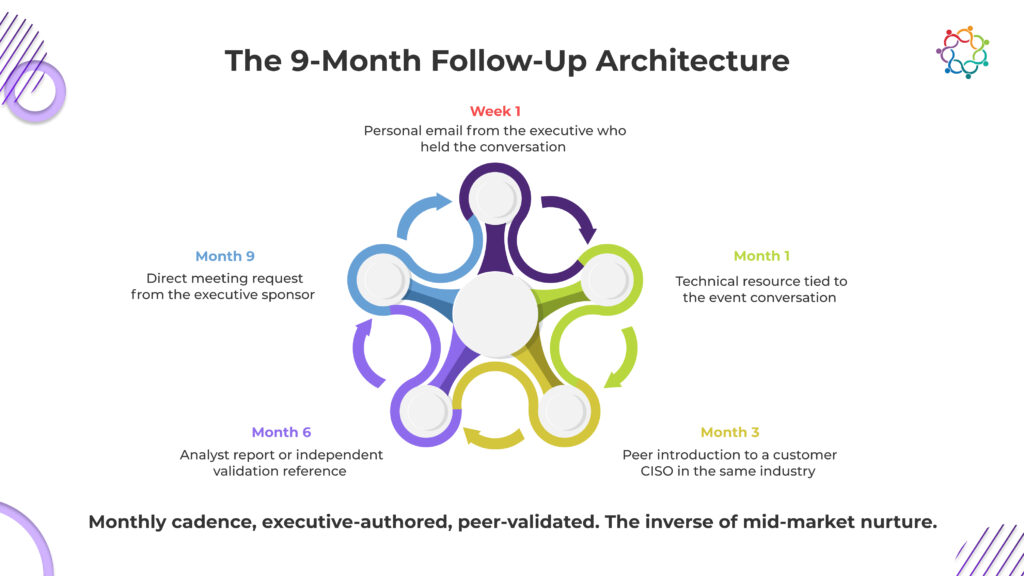
Cybersecurity follow-up is fundamentally different because the buying cycle is fundamentally longer. The nine-month architecture below maps to the midpoint of the six-to-twelve-month enterprise security range. Compress to a six-month variant for faster cycles. Stretch to twelve for longer enterprise deals.
The nine-month follow-up architecture.
The ownership question.
AE-led follow-up over nine months produces near-zero engagement. Executive-sponsor-led follow-up at months one, three, and nine produces engagement. The AE handles the month-six touch.
The CISO will recognize the AE name from week four onward. But the executive name from the original booth conversation is what buys the meeting in month nine.
The CRM infrastructure.
A custom field for the CISO procurement stage, separate from the standard sales pipeline stage. Multi-touch attribution that captures every interaction across nine months: emails, content downloads, event attendance, and peer references. Account-level engagement view, not lead-level. Enterprise security buying involves four to seven stakeholders, and every one of them touches the account.
This is the operational layer Samaaro is built for: account-level engagement tracking across long enterprise cycles, native CRM sync, and the kind of reporting an executive sponsor can read in sixty seconds before walking into the month-nine meeting.
Common trap: weekly marketing nurture after a CISO conversation.
CISOs unsubscribe within two emails. The right cadence for senior security buyers is monthly, low-volume, high-relevance, executive-sent. The frequency for CISOs is the inverse of the frequency for mid-market.

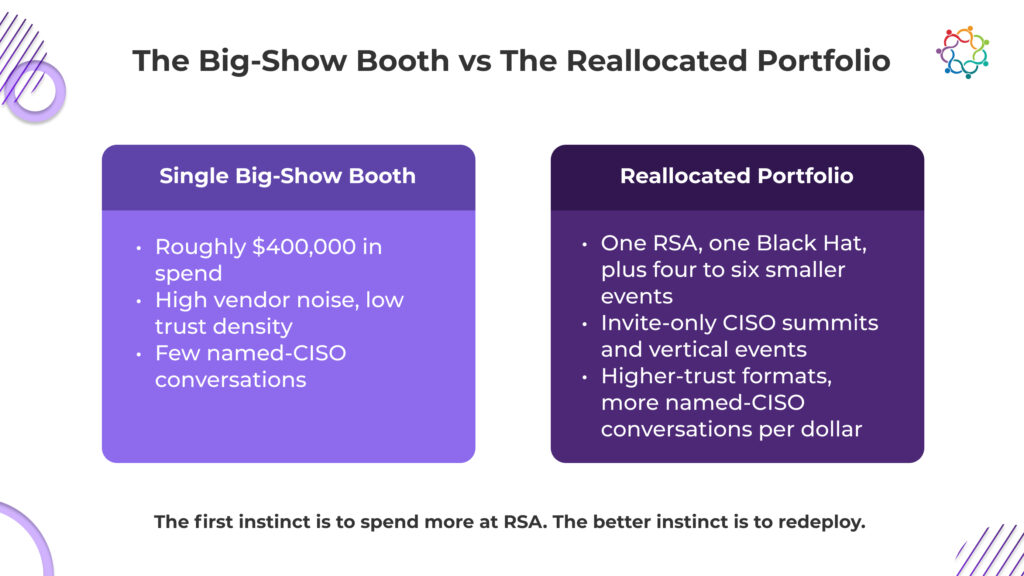
Most cybersecurity vendors over-index on RSA and Black Hat and underinvest in the events where CISOs actually engage. Reallocating a meaningful share of the event budget downward, away from the big two and toward higher-trust smaller programs, is one of the highest-leverage decisions a security CMO can make.
The under-leveraged event categories.
The cost-per-CISO-conversation argument.
In our experience working with cybersecurity vendors, a CISO summit sponsorship in the roughly thirty-thousand to fifty-thousand dollar range routinely produces more named-CISO conversations than an RSA booth costing close to ten times that amount.
The reason is structural. Smaller invitation-only events have higher trust density, lower vendor noise, and longer-format conversations. A CISO at Evanta is there for two days of peer dialogue and is willing to take a structured vendor meeting. A CISO at RSA is there to avoid vendor meetings.
The budget reallocation principle.
The first instinct is always to spend more at RSA. The better instinct is to spend less at RSA and redeploy to events where CISOs actually engage. In our experience, a meaningful share of cybersecurity event budgets is misallocated on under-performing big-show booths.
The right portfolio for most enterprise security vendors is one RSA presence, one Black Hat presence, and four to six smaller high-density events.
CISOs do not buy at events. They validate vendors at events as part of a long, multi-stakeholder buying journey. The framework above is the operating system for that reality: peer-led booth credibility, executive-hosted side events, technical content, nine-month executive-led follow-up, and a portfolio that goes beyond the big two. The vendors who win the CISO buying cycle aren’t the loudest at the show. They’re the most credible in the nine months around it.
If your team runs RSA, Black Hat, and four CISO summits a year, and the reporting cannot tell you which conversations turned into a month-nine pipeline, the gap sits in the cross-event attribution layer. Samaaro is built for the reporting layer that closes it.

Samaaro is an AI-powered event marketing platform that enables marketing teams to turn events into a measurable growth channel by planning, promoting, executing, and measuring their business impact.
Location


© 2026 — Samaaro. All Rights Reserved.