Samaaro + Your CRM: Zero Integration Fee for Annual Sign-Ups Until 30 June, 2025
- 00Days
- 00Hrs
- 00Min

1
2
3
→
Bottom Line:
Filling rooms is a math problem solved by sequencing, segmentation, time-zoned sends, and funnel drop-off measurement, not better copy.
Your event is 14 days out. You’ve sent one beautifully designed invitation to your full marketing database. Open rate landed at 18 percent, click-through at 1.4 percent, and registration conversion at 0.3 percent. You have 47 sign-ups against a target of 400. The boss wants to know what happened. What happened is what always happens with a single send-and-pray invite.
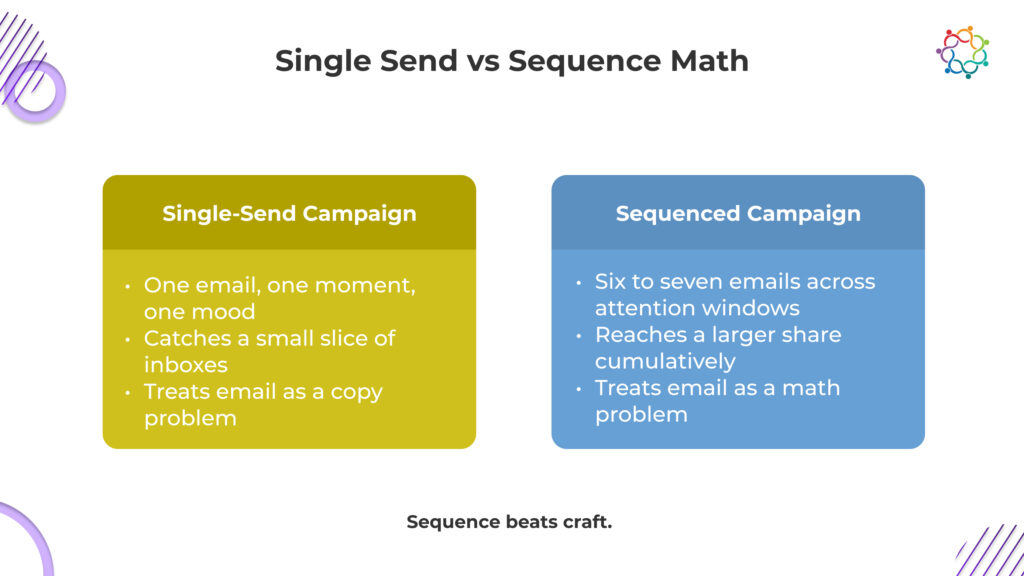
This is what most event registration email campaigns produce: one email, one moment, one slice of the inbox, and a registration count that misses the target by a factor of eight. The marketing team blames the list. The list does not deserve the blame.
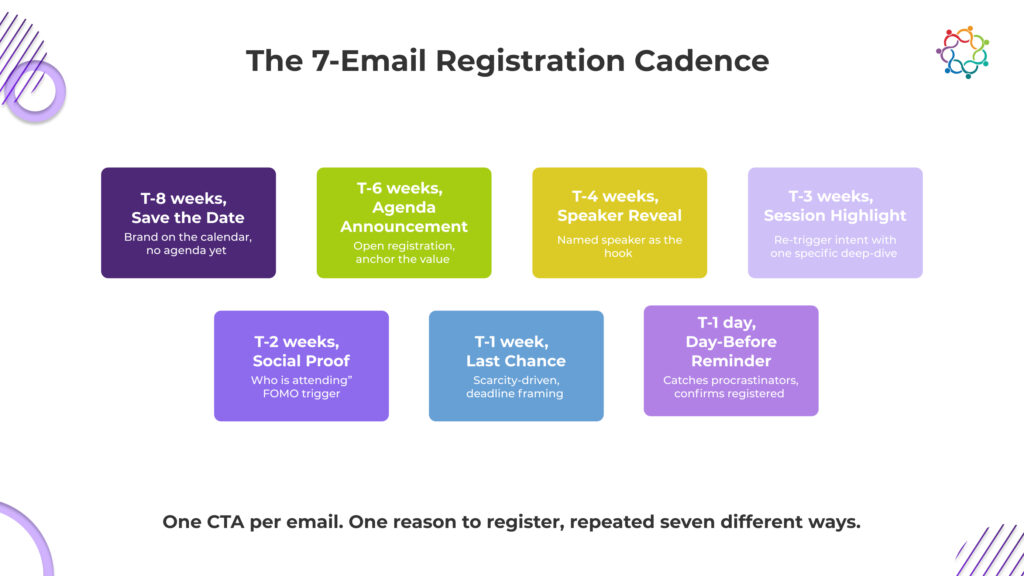
The fix is structural. A registration campaign is a sequence, not a send, designed to drive sign-ups across the natural attention windows of a B2B audience: announcement, agenda reveal, speaker reveal, session highlight, social proof, last chance, day-before reminder.
This guide covers the segmentation, the seven-email cadence, the subject line patterns, the time-zoned send timing, and the funnel drop-off math that separates a 0.3 percent conversion from one that actually fills the room.

Most B2B demand gen teams already know one email does not fill a room. What they often miss is why a sequence works, and how to think about the math underneath it.
The single-send failure mode.
One email hits one moment, in one mood, on one device. Most of the audience misses it. The recipient who would have registered on Tuesday morning is in a meeting. The one who would have clicked on Thursday afternoon is on a flight. A single send reaches a small fraction of the addressable audience at any given moment of attention.
The attention reality.
B2B knowledge workers commonly receive dozens of emails per workday, often well over a hundred for senior roles, as consistently reported across HubSpot, Litmus, and Mailchimp benchmarks. A single send catches a small fraction on open, and converts a smaller fraction of that.
The compounding effect of sequencing.
Each email in a multi-step cadence reaches a different slice of the audience at a different moment, and registrations build cumulatively across the sequence. A well-built sequence routinely outperforms a single-send campaign by several multiples.
Common trap: blast it once and see what sticks.
Email sequences are not a copy problem. They are a math problem. Sequence beats craft, every campaign, every time.
Segmentation is not a nice-to-have for event registration. It is what determines whether the sequence reads as relevant or as spam. In our experience, the same copy can convert several times higher against a well-segmented list compared to a generic one.
The four segments most B2B events need.
Segmentation logic that improves conversion.
The exclusion rules.
Suppress anyone who has already registered. This happens more often than it should and produces unsubscribe spikes every time. Suppress unsubscribes and recent hard-bounces. Suppress competitors and ex-employees flagged in the CRM.
Common trap: one segment, one email.
Sending the same event invitation copy to “all marketing-qualified contacts” as a single segment produces generic copy, weak relevance, and unsubscribe rates that exceed registration rates. Segmentation is the multiplier on every other decision in the sequence, from subject line to send time.

The canonical cadence below is built for a major B2B event with a six-to-eight-week registration window. Compress for short-cycle events. Lengthen for flagship conferences with longer runways. The pattern that matters is the sequence of intent triggers, not the exact week numbers.
The framework runs across seven scheduled sends plus one auto-trigger. Each scheduled send is built around a specific attention trigger: save-the-date, agenda, speaker, session, social proof, last chance, and day-before reminder. Each one earns the registration of a different slice of the audience.
The sequence.
Plus one auto-trigger: post-registration confirmation.
Sent immediately on registration. Includes the calendar invite, the agenda link, a “what to expect” preview, and one piece of pre-event content. Treat it like the welcome email it actually is.
Common trap: compressing to two emails and a reminder.
Compression is acceptable for short-cycle events such as webinars under four weeks out. For major B2B events, the full seven-step cadence consistently outperforms any compressed version. The gap shows up most clearly in late-week registrations from procrastinators that a two-email cadence simply does not capture.

Subject lines decide whether the email is opened. Body copy decides whether the open becomes a click. Both follow a small set of patterns that consistently outperform the alternatives.
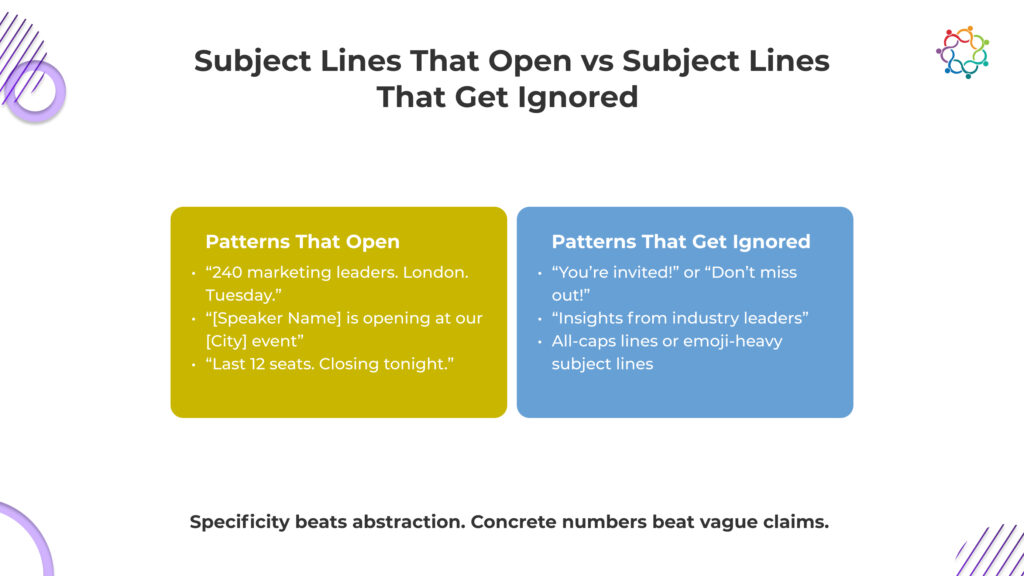
Subject line patterns that consistently outperform.
Subject line patterns that underperform.
Generic enthusiasm: “You’re invited!” “Join us!” “Don’t miss out!” These signal mass-send. Vague benefit: “Insights from industry leaders.” “Network with peers.” These signal absence of substance. Excessive emoji or all-caps: most spam filters quietly route these into the promotions tab.
Body copy patterns that convert.
Open with the value, not the brand. “Two hours. Three operators sharing what’s working in late-2026 demand gen” beats “We’re excited to announce…” every time.
One CTA per email, repeated twice. Once mid-copy, once at the end. Multiple competing CTAs split attention and depress conversion.
Mobile-first formatting. Short paragraphs. Single column. One button. The majority of B2B email opens happen on mobile, and a desktop-only layout breaks the moment of intent.
Sender name is a person, not a company alias. “Sarah Chen at Samaaro” outperforms “Samaaro Events” by a meaningful margin, in our experience.
Common trap: brand voice over substance.
B2B audiences register for events because of the value of the room, not the cleverness of the marketing. Strip the brand-voice flourishes and lead with what is actually happening: who, what, where, why anyone should care. The audience is doing the math on whether the time investment is worth it. Copy that helps them do that math wins.

Send timing is the layer most teams under-engineer. The same copy converts at meaningfully different rates depending on when it arrives. Three rules drive the decision.
The day-of-week logic.
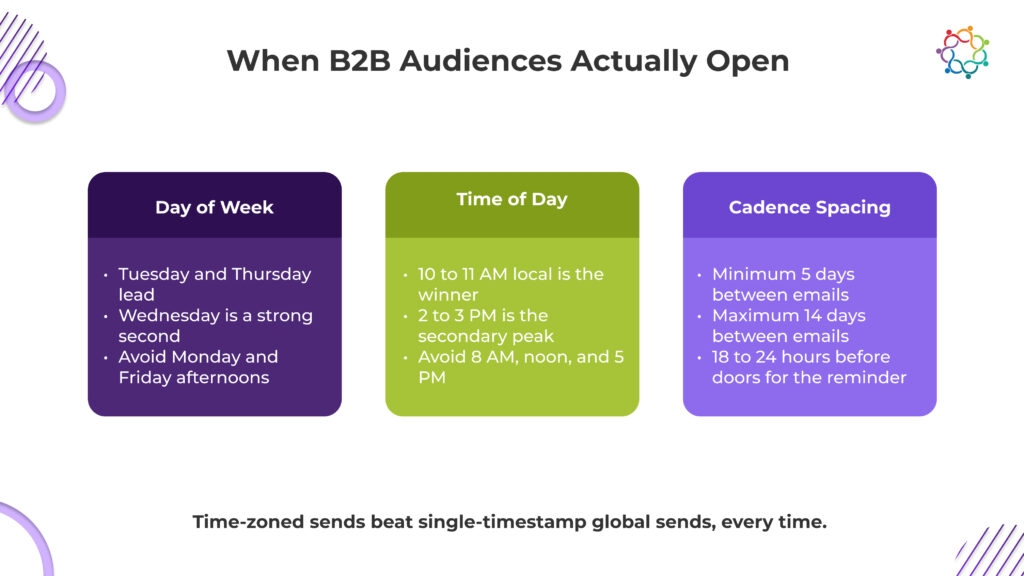
Tuesday and Thursday consistently outperform Monday and Friday across most B2B audiences, by a meaningful margin in our experience and as widely reported across HubSpot, Litmus, and Mailchimp benchmarks. Wednesday is a strong second. Avoid Monday morning, when inbox triage dominates, and unsubscribe rates run highest. Avoid Friday afternoon, when mental checkout has already begun.
The time-of-day logic.
10:00 to 11:00 AM in the recipient’s local time zone is the consistent winner across B2B audiences. 2:00 to 3:00 PM is the secondary peak, post-lunch and pre-meeting block. Avoid 8:00 AM (inbox triage). Avoid 12:00 PM (lunch ignored). Avoid 5:00 PM (end-of-day filter).
Time-zone send logic matters more than absolute time. Never send a global list at a single timestamp.
The cadence-spacing logic.
Minimum five days between emails in the sequence. Closer spacing triggers unsubscribes faster than it triggers registrations. Maximum fourteen days between emails. Wider gaps lose narrative continuity. The day-before reminder is the only exception. It sits eighteen to twenty-four hours before the doors.
Common trap: one timestamp for a global list.
A single 10:00 AM Eastern Time send hits the West Coast at 7:00 AM, London at 3:00 PM, and Singapore at 10:00 PM. Three different inboxes, three very different moments of attention. In our experience, and as documented in B2B email benchmark studies, time-zoned sends consistently outperform single-timestamp global sends, often materially so on open rates.

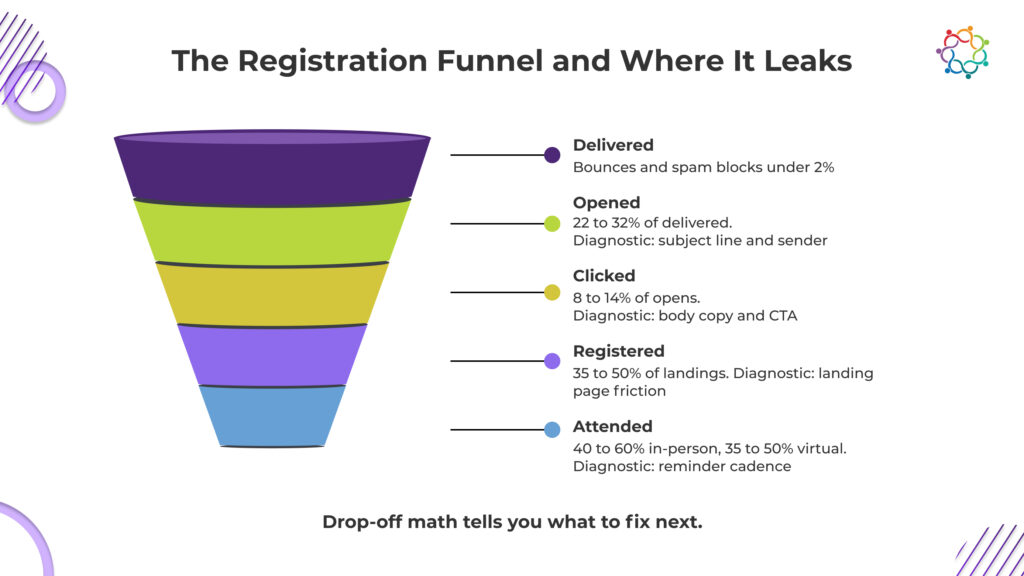
Most teams measure send volume and registration count. The diagnostic insight lives one layer down, in the drop-off math between each stage of the funnel.
The benchmark ranges below reflect commonly reported figures across HubSpot, Litmus, and Mailchimp B2B email reports, alongside our own observations across B2B event programs. They are directional anchors, not universal truths. Meaningful variance is normal depending on audience tier, event type, list quality, and industry. The diagnostic logic underneath the ranges is what matters most.
The funnel stages every team should track.
The diagnostic logic.
Each failure has a specific fix, and the funnel math tells you which one.
Common trap: registrations as the headline metric.
A campaign that converts 200 registrations from 10,000 sends is performing very differently from a campaign that converts 200 from 4,000 sends. Drop-off math is what tells you what to fix next. Headline registration counts hide the fix.
Event registration is a sequence problem, not a copy problem. Segment up front. Run a seven-email cadence. Lead subject lines with substance, not enthusiasm. Send to time zones, not to a single timestamp.
Measure drop-off at every funnel stage. The teams that consistently fill rooms aren’t the ones with the best copy. They’re the ones with the best sequence, sent at the right time, to the right segment, against the right metric.
If your team is running six or more events a year and the registration reporting still arrives as a single number with no funnel breakdown, the gap sits in the campaign analytics layer. Samaaro is built for the reporting layer that closes it.

Samaaro is an AI-powered event marketing platform that enables marketing teams to turn events into a measurable growth channel by planning, promoting, executing, and measuring their business impact.
Location


© 2026 — Samaaro. All Rights Reserved.