Samaaro + Your CRM: Zero Integration Fee for Annual Sign-Ups Until 30 June, 2025
- 00Days
- 00Hrs
- 00Min

Key Takeaways (TL;DR)
1
2
3
→
Bottom Line:
Brands that own a moment show up unexpectedly, in the right place, doing something the audience cannot ignore.
Drift opened a coffee shop in San Francisco the week of Dreamforce 2018. Free coffee, real baristas, branded merchandise, and a sign that read “Sponsored by Drift, Conversational Marketing.” For three days, attendees walked four blocks from Moscone to Drift’s coffee shop instead of sitting through Salesforce-vendor expo sessions. Drift wasn’t a Dreamforce sponsor. They didn’t have a booth. They captured more brand attention than companies that paid hundreds of thousands of dollars to be there.
B2B pop-up events and brand activations are the most under-utilized format in B2B marketing, and the most over-applied. The companies that get this right turn pop-ups into the highest-leverage brand moments of the year. The companies that get it wrong build expensive installations nobody photographs.
This guide covers when pop-ups are the right format, where and when they work, how to design the engagement, how to capture leads without breaking the experience, and how to follow up without ruining the magic. The framework runs across five decisions, and every one of them runs in inverse order to the traditional B2B event playbook.
Most B2B pop-up failures trace back to teams misclassifying the format and applying booth or event playbooks.
The format definition.
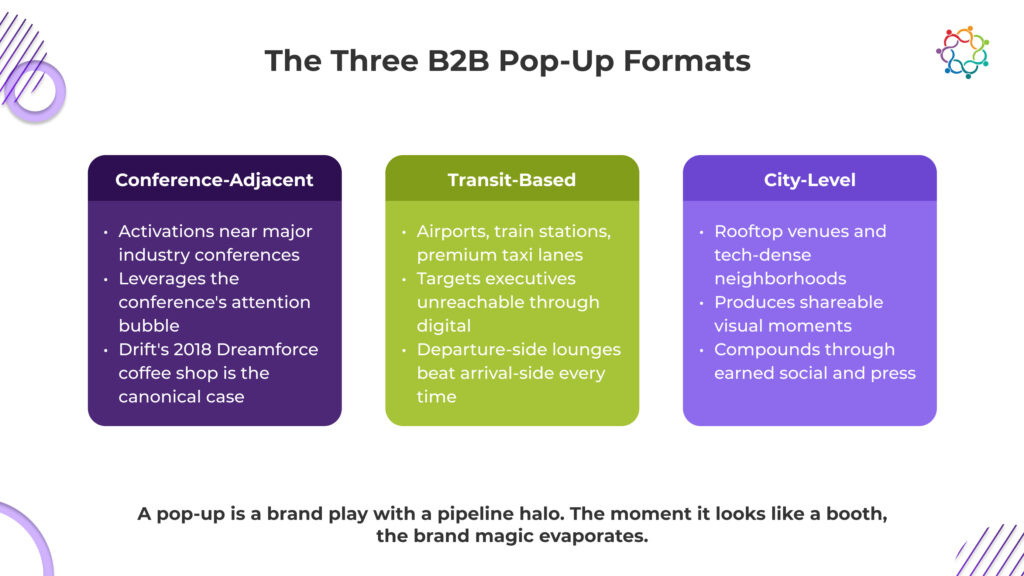
A pop-up is a temporary, location-based brand experience designed to capture attention in environments where the audience already exists. It is not a stand-alone destination event. The pop-up is going to the audience.
The three primary formats.
Conference-adjacent activations sit near major industry conferences and leverage the attention bubble. Drift’s 2018 Dreamforce coffee shop is the canonical example: a vendor with no Dreamforce sponsorship captured the conference’s attention from four blocks away.
Transit-based activations target executives in transit. Airports, train stations, premium taxi lanes. The canonical pattern is a B2B vendor placing a branded lounge at a major hub airport during a business-travel-heavy week.
City-level activations are rooftop bars, urban art interventions, and branded street takeovers in tech-dense neighborhoods. The pattern is timing a rooftop activation to coincide with a target city’s major conference week.
The brand-format reality.
Pop-ups are a brand play with a pipeline halo, not a pipeline play with brand benefits. Measurement, design, and capture decisions all run inverse to traditional B2B event playbooks.
Common trap: treating a pop-up like a booth in a different location.
The whole premise of a pop-up is its un-event-like quality. The moment it operates like a trade show booth, the brand magic evaporates, and you have built an expensive sandwich board.
Most pop-up failures happen when the format is the wrong choice. The decision framework runs across four scenarios where a pop-up wins.
Scenario 1: You want to dominate a conference you didn’t sponsor.
Drift at Dreamforce 2018 is the canonical play. Conference-adjacent activation captures the conference’s attention bubble at a fraction of the sponsorship cost. It works when your audience is already concentrated, the sponsorship economics don’t make sense for your category position, and you have a creative concept strong enough to pull attendees off the show floor.
Scenario 2: Your buyer is in transit and unreachable digitally.
Airport lounges, premium taxi-lane activations, and lounge takeovers at business-travel hubs reach senior buyers unreachable through standard digital channels but who spend hours in airports. It works when your ICP is C-suite or VP-level and your category benefits from visual brand recall.
Scenario 3: You need a brand moment, not a pipeline event.
City-level rooftop activations and brand-experience installations produce shareable visual moments that compound through earned social and press. The format works when brand awareness is the goal and pipeline measurement isn’t the primary scorecard for the program.
Scenario 4: You want to bypass an industry event your competitor dominates.
Host a parallel CISO dinner during RSA, an airport activation during a competitor’s user conference, a rooftop event the same week as the competing flagship. The format shifts the attention narrative without paying for the competitor’s stage. It works when a competitor owns an industry moment, and direct sponsorship is impossible.
Common trap: choosing a pop-up because it sounds creative.
When a regular event would have produced more pipeline at a lower cost, the pop-up is the wrong call. Pop-ups underperform traditional events in direct lead generation. If pipeline volume is the primary scorecard, choose the event.
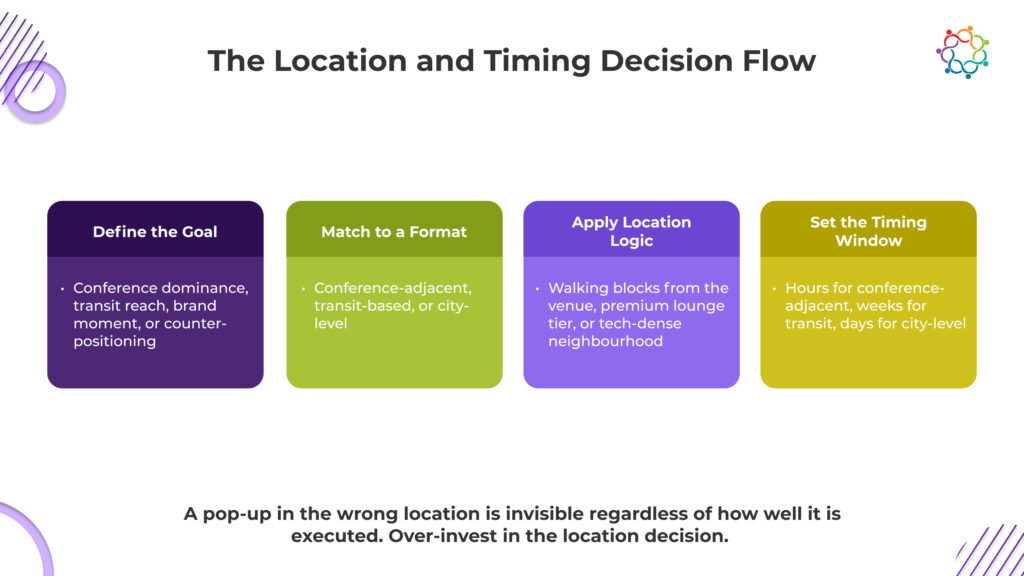
Location and timing are not just logistics. They are the entire creative concept.
Conference-adjacent locations.
Within 4 to 6 walking blocks of the conference venue: close enough to draw attendees during breaks, far enough to feel intentional. Visible from the conference attendees’ natural foot path between the hotel and the venue. The right venue has strong existing character (a coffee shop, a bar, a gallery), rebranded for the activation period, never a generic event space.
Transit-based locations.
Domestic versus international terminals matter because most B2B targets sit in business-class international lanes. Departure-side activations beat arrival-side; departing travelers have time to engage, arriving travelers are in transit. In our experience, premium airline lounges in target hub airports (Polaris-tier business class, Centurion-style premium clubs) outperform generic terminal billboards on per-impression engagement, often by a wide margin.
City-level locations.
Tech-dense neighborhoods where ICP density is naturally high: SoMa in San Francisco, Williamsburg in New York, Shoreditch in London, Powai in Mumbai. Rooftop venues outperform street-level for brand-experience moments, because vertical visibility plus social-share aesthetics multiply earned reach. Avoid generic event venues. Choose locations with intrinsic atmosphere.
Timing logic.
Conference-adjacent activations open the morning of day one, close the evening of the last full day, and peak around day two mid-morning when conference attendees start looking for breaks. Transit-based activations run 4 to 8 weeks for high-impact moments, longer if the location supports it. City-level activations run 3 to 7 days for a brand moment, longer if it becomes a recurring program.
Common trap: choosing a location because it is available.
A pop-up in the wrong location is invisible regardless of execution. Location selection isn’t one decision among many. In our experience, it’s the single highest-leverage decision in the activation, often determining whether the rest of the program lands or vanishes. Over-invest in this decision.
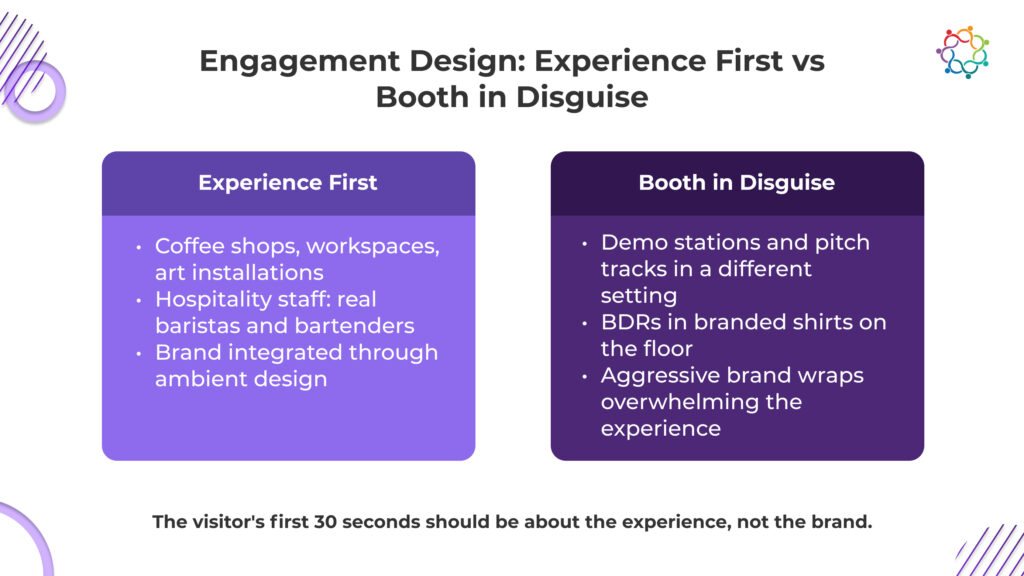
Pop-ups live or die on the experience design, and the design rules are inverse to traditional booth design. The brand instinct is to lead with the logo. The activation instinct is to lead with experience.
Experience first, brand second.
The activation must deliver standalone value (great coffee, free workspace, beautiful art, useful service) before any brand engagement begins. Branding is visible but not dominant: logo and messaging integrated into the design, never plastered over it. The visitor’s first 30 seconds should be about the experience, not the brand.
Engagement formats that work.
Engagement formats that fail.
The team on the floor.
Real hospitality staff: real baristas, real bartenders, real curators, not BDRs in branded shirts. One or two senior brand representatives on the floor at all times, available to engage when conversation arises naturally. AEs and BDRs are barred from the floor unless the activation has a defined sales-meeting room separated from the experience space.
Common trap: letting lead-capture instincts overwhelm the experience.
The visitor walks in expecting a coffee shop and discovers a thinly disguised booth. The experience betrays itself, the brand moment burns, and the photos that get shared are about how it felt off, not how it felt special.
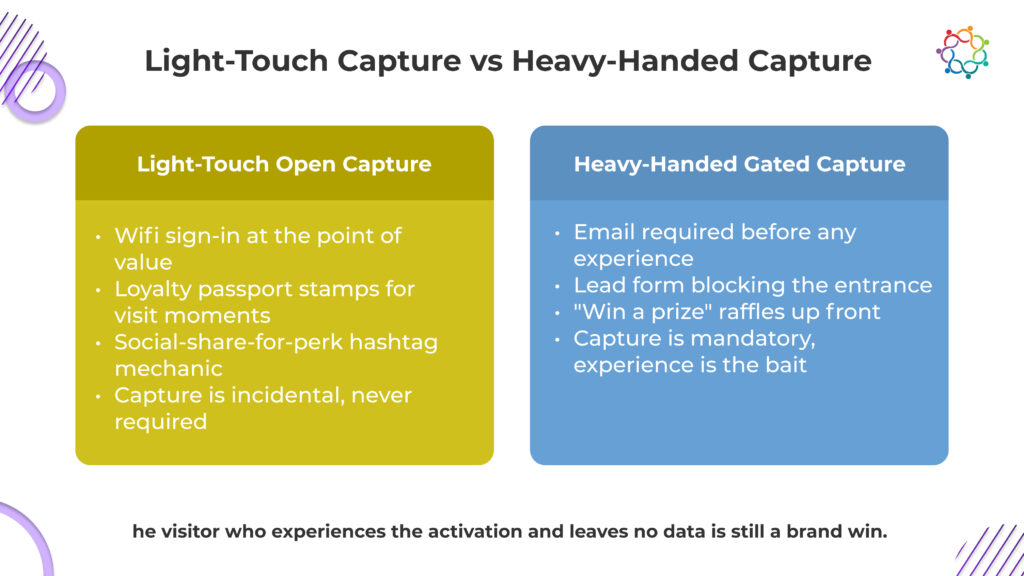
Marketing leadership wants leads. The brand experience demands the opposite. The reconciliation is in the design.
Light-touch capture mechanics.
The capture-design rule.
Capture must be incidental to the experience, never required for it. The visitor who experiences the activation without leaving data is still a brand win. In our experience, a pop-up that captures a high volume of leads through a gated experience produces materially lower brand lift than one that captures fewer leads through an open experience. The audience reads the gate as theater.
The qualification overlay.
Segment captured leads by ICP fit using domain enrichment (Apollo, Clearbit, or similar) after the event.
The data-storage discipline.
All captured data is tagged with the specific activation, location, and date. Multi-touch attribution is maintained for downstream pipeline tracking. Visitor count and engagement depth are tracked alongside lead capture because both are scorecard metrics for an activation, not just one.
Common trap: treating lead capture as the success metric.
A pop-up’s primary scorecard is brand lift, organic share, earned media, and long-tail influence on existing pipeline, not lead volume. Optimizing for capture quantity sabotages the brand outcome that the activation was designed to produce.
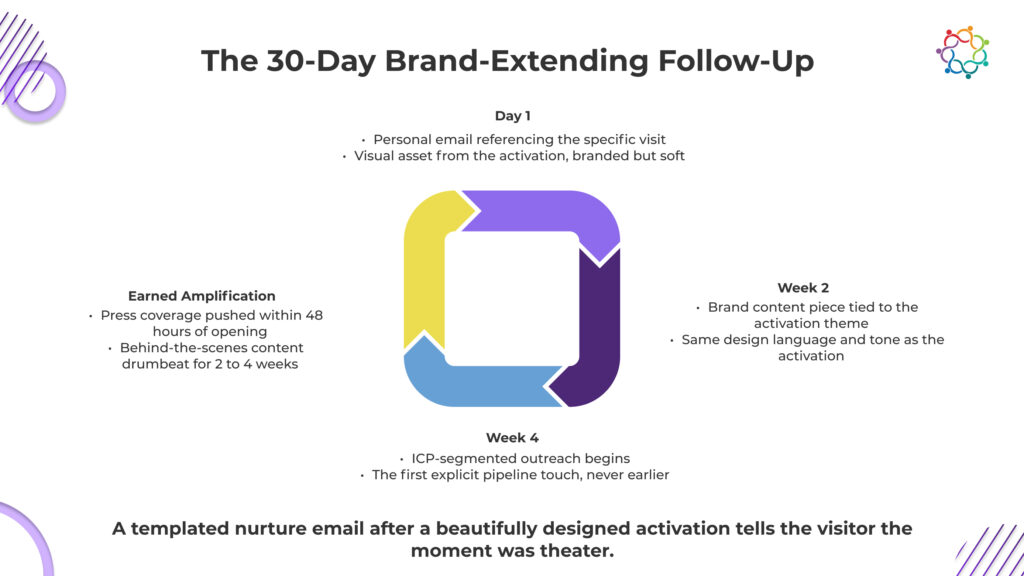
The follow-up has to extend the brand experience, not contradict it. Activations unravel when visitors get routed into the standard B2B nurture sequence the day after.
Day 1.
Personalized email referencing the visitor’s specific activation experience, not a generic “thanks for visiting.” A photo or visual asset from the activation, branded but soft. Optional invitation to share their visit on LinkedIn with the activation hashtag.
Week 2.
A brand content piece tied to the activation theme, with no product pitch. Continued visual continuity from the activation: same design language, same tone. The visitor should recognize the brand by aesthetic, not by logo.
Week 4.
ICP-segmented outreach. ICP companies receive a soft AE-led message that references the activation. Non-ICP receives a newsletter signup or content piece. The first explicit pipeline-oriented touch happens here, not earlier.
The earned-media amplification.
Press coverage of the activation is pushed within 48 hours of opening, when the news value is highest. Social-share moments curated and amplified through the brand’s own channels. Influencer or industry-voice content (when authentic, not paid) repurposed across the first one to two weeks.
The post-activation content drumbeat.
Behind-the-scenes content (build, design, team) is released across two to four weeks after the activation closes. “What we learned” thought-leadership content from the brand or design team. The activation is memorialized in the company’s brand portfolio for future credentials and pitch decks.
Common trap: routing activation visitors into the standard B2B nurture.
A visitor who attended a beautifully designed coffee-shop activation and then gets a templated “see how our platform increases sales productivity” email is being told the activation was a theater. The follow-up has to extend the experience, not betray it.
Pop-ups and brand activations are a brand format with a pipeline halo. The operational decisions are inverse to traditional event playbooks. Choose the format only when the scenario fits. Pick locations with intrinsic atmosphere. Design experience-first. Capture lightly. Follow up in a way that extends the moment.
The brands that own a moment aren’t the ones that showed up the biggest. They’re the ones who showed up unexpectedly, in the right place, doing something the audience couldn’t ignore.
If your team is running activations and the post-event report reads the same as a regular booth’s, the gap usually sits in capture and attribution, not in the creative concept. Samaaro is built for the reporting layer that ties activation engagement back to the pipeline.