Samaaro + Your CRM: Zero Integration Fee for Annual Sign-Ups Until 30 June, 2025
- 00Days
- 00Hrs
- 00Min

1
2
3
→
Bottom Line:
Hackathons stay brand expenses instead of pipeline channels when teams skip ABM design, signal capture, feedback routing, and tiered nurture.
Your company sponsored a hackathon last weekend. 200 developers showed up, 80 teams submitted, three projects won prizes, and your CEO took a photo with the winners. Marketing budgeted it as a “recruiting and community” line item. You collected 200 emails, half of which are personal Gmail addresses. Six months later, exactly zero pipeline has been attributed back.
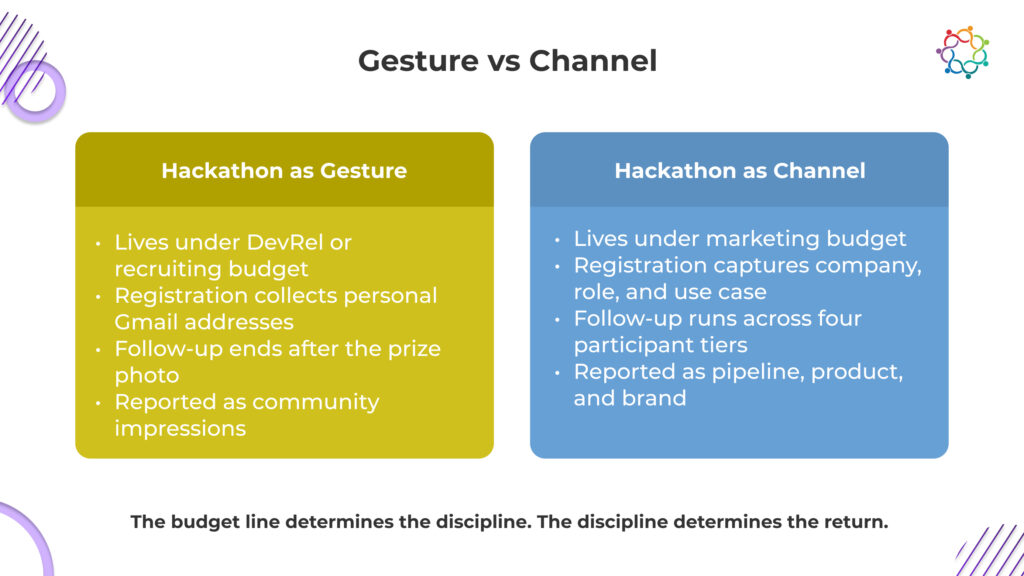
B2B hackathon marketing fails on the classification, not the execution. Hackathons aren’t a recruiting event with marketing benefits. They are a marketing channel with recruiting benefits. A well-designed hackathon produces pipeline, product feedback, and brand authority simultaneously.
This guide reframes the hackathon as a marketing investment and walks through the four operational decisions that turn it from a community gesture into a measurable channel: ABM design, lead capture, product feedback routing, and post-event nurture.

Most B2B hackathons underperform as marketing because the planning team treats them as something else entirely.
The line-item problem.
Hackathons sit under “community,” “DevRel,” or “recruiting” budgets, not marketing. The metrics follow. The team measures sign-ups, t-shirts handed out, and Twitter mentions. The CFO sees a brand expense, not a pipeline channel.
The design problem.
Most B2B hackathons aren’t designed around ICP use cases. The challenge gets framed as “build something cool with our API” rather than “solve the problem our enterprise customers actually pay us to solve.” The projects built have no commercial relevance to pipeline.
The capture problem.
Registration forms collect personal email addresses, GitHub handles, and t-shirt sizes. They don’t capture company affiliation, role, team size, or buying signal. The team walks away with 200 emails that look like a list and behave like a graveyard.
The follow-up problem.
Winners get a prize. Runners-up get a thank-you email. The other 180 participants get nothing. Within a week, 99 percent of the audience evaporated.
Common trap: accepting that hackathons don’t drive pipeline.
A hackathon is one of the highest-intent moments a developer ever has with your platform. They spent 24 to 48 hours voluntarily building with your product. That signal should not evaporate on the Monday after.

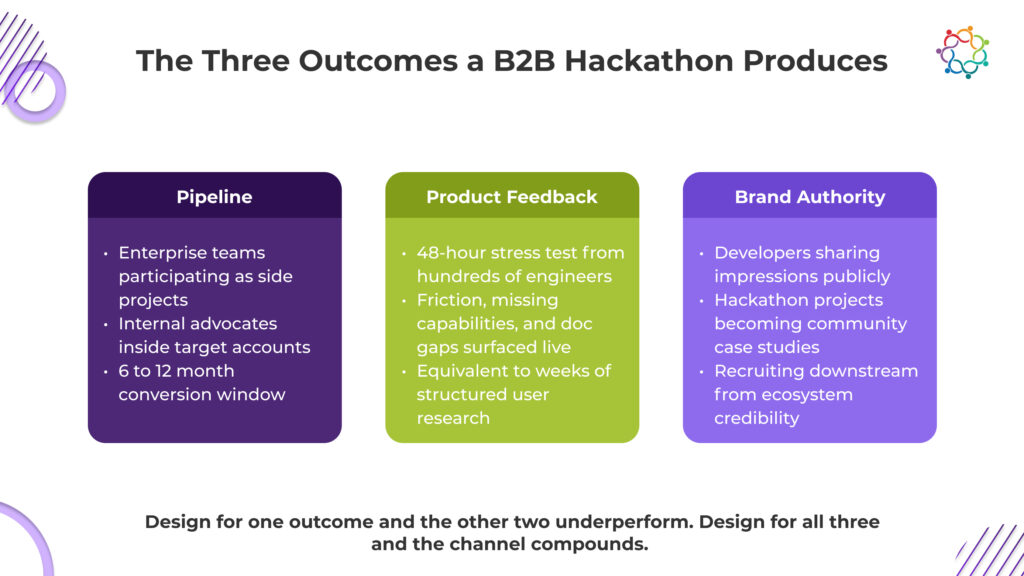
Once a marketing leader sees the three measurable outcomes, the budget allocation argument becomes obvious. The hackathon isn’t a brand gesture. It’s three distinct revenue inputs running in parallel.
Outcome 1: Pipeline.
Direct pipeline shows up as enterprise teams who participated as a “side project” but represent target accounts moving into evaluation. Indirect pipeline shows up as developers who became internal advocates and surfaced your tool to their architecture team. The conversion timeline is typically 6 to 12 months, longer than a webinar lead, shorter than cold-traffic inbound.
Outcome 2: Product feedback.
The hackathon produces a 48-hour stress test of your platform by 200 simultaneous engineers. Which APIs are frictionless? Which docs confuse? Which capabilities are missing? In our experience, this is the most valuable product input most teams get in any single 48-hour window of the year.
Outcome 3: Brand authority.
Developers who tried your platform and came away impressed share that experience publicly, on social, in Slack groups, on Hacker News. Hackathon projects often become community case studies, demos, and starter templates that continue earning value long after the event. The downstream recruiting return justifies the hackathon long after the marketing return is measured.
Common trap: optimizing for one outcome.
A hackathon designed only for a brand produces no pipeline. A hackathon designed only for pipeline produces resistance from the developer community, who can smell a sales funnel from registration. The strongest hackathons are designed across all three outcomes simultaneously.
Most hackathons fail at pipeline because the challenge wasn’t designed to attract ICP-aligned use cases. The challenge design is the targeting decision, and everything downstream is a consequence of getting it right or getting it wrong.
The challenge design.
Frame the problem statement around the use case your platform actually solves at scale, not “build anything cool with our API.” When ICP includes multiple personas, use a multi-track structure: an enterprise track for security and scale, a startup track for speed, vertical tracks for FinTech, HealthTech, or whichever industries the ICP requires. Weight judging criteria toward commercial viability and architecture quality, not just creativity. Provide a real-world dataset or scenario that mirrors what enterprise customers face.
The ABM acquisition layer.
Pre-event outreach matters more than open-call promotion. Reach engineering leaders at target accounts directly: “We’re running a hackathon. Would your team like to participate?” The conversion rate from named-account outreach to enterprise team participation is meaningfully higher than from general developer marketing. As an alternative, sponsor internal hackathons run inside target accounts, which preselect for engineers building production use cases. A third path is co-hosting with a partner already inside your ICP.
Prizes that drive ICP participation.
Cash prizes only modestly drive enterprise engineers. Their day rates often exceed the prize value, and the team is participating on company time anyway. The prizes that move enterprise participation are non-cash: executive briefings with your CTO, dedicated platform credits, conference passes, and on-site workshops. Layer in prizes designed for brand recognition within the participant’s company, such as “winning team presents at our next conference,” which produces internal advocacy long after the event ends.
Common trap: designing the challenge in isolation from ABM strategy.
A challenge that doesn’t filter for ICP attracts a participant pool dominated by individual builders, not the enterprise teams that produce pipeline. The challenge design IS the targeting decision.

Standard developer event capture does not work at hackathons. The engagement signals are different and richer. A list captured at webinar depth cannot be qualified afterward.
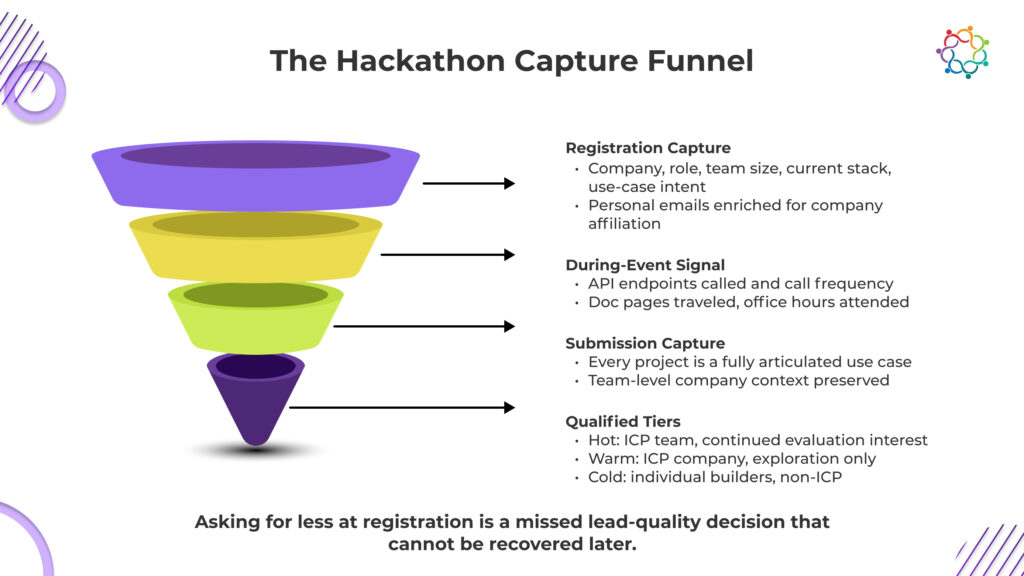
The registration capture.
Capture more than name and email at registration. Ask for company, role, team size, current stack, and the use case the registrant is hoping to explore. For personal email addresses, flag the record for follow-up enrichment via Apollo or ZoomInfo to surface company affiliation. Capture every team member’s company at team formation, not just the team captain’s, which is where most hackathons surface hidden ICP overlap that would otherwise be missed entirely.
The during-event signal capture.
The hackathon generates an intent signal continuously across 48 hours. Capture it deliberately: which API endpoints each team is calling and how often, which docs pages drove traffic and surfaced friction, which teams showed up to office hours and what they asked, and what the final submissions tell you about how each team understood the use case. Every project submission is a fully-articulated use case in your platform, often more detailed than a customer’s first discovery call.
The qualification rubric.
Common trap: treating registration like a webinar form.
A hackathon registration is a moment when developers are genuinely engaged and willing to share more. Asking only for name and email here is a missed lead-quality decision that cannot be recovered later. The richer the registration capture, the cleaner the qualification afterward.

The 48-hour window of a hackathon produces more product insight than weeks of structured research, but only if the team captures and routes it. A Notion doc that nobody opens after the event isn’t a feedback loop. It’s a journal.
The on-site feedback infrastructure.
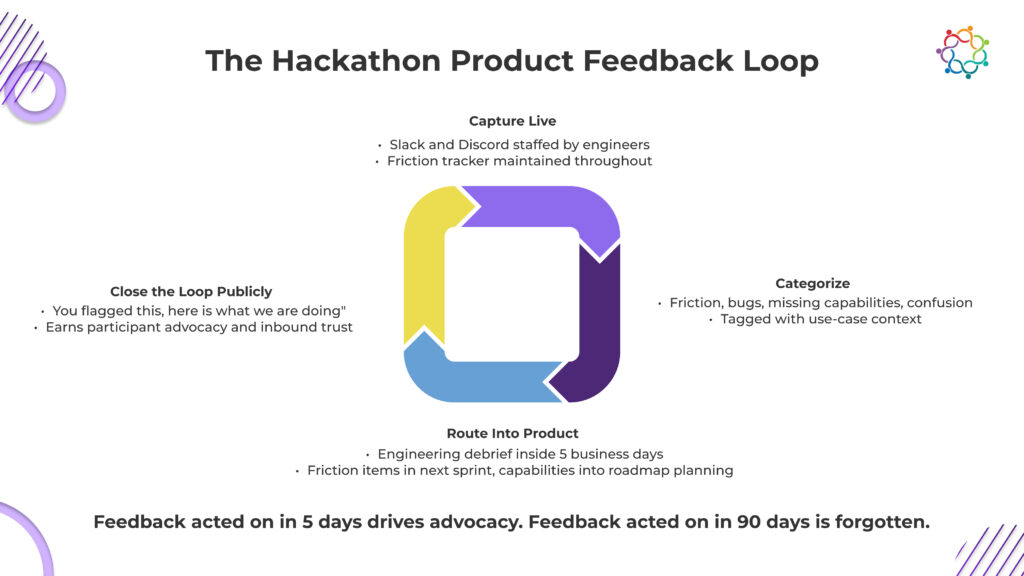
Run a dedicated Slack or Discord channel staffed by engineers, not just DevRel, so technical questions get technical answers in real time. Maintain a “friction tracker” during the event that logs every question, bug report, missing capability, and doc gap as it surfaces. Block out office hours where product managers can sit with teams and observe how they’re actually using the platform. Deploy a post-event survey to all participants within 24 hours, structured around specific platform areas.
The categorization framework.
The routing back into the product.
Run a post-hackathon debrief with engineering leadership within five business days, not five weeks. Prioritize friction items in the next sprint cycle. Review missing-capability requests at the next roadmap planning session. Publish a public response to participants: “You flagged this, here’s what we’re doing about it.” That closes the loop and earns advocacy that no marketing campaign can manufacture.
Common trap: product feedback that lives in a Notion doc nobody reads.
A hackathon’s product insight has a roughly 30-day decay curve. Feedback acted on in five days drives advocacy. Feedback acted on in 90 days is forgotten by the participant who flagged it, and the company has burned a relationship that the hackathon was supposed to build.

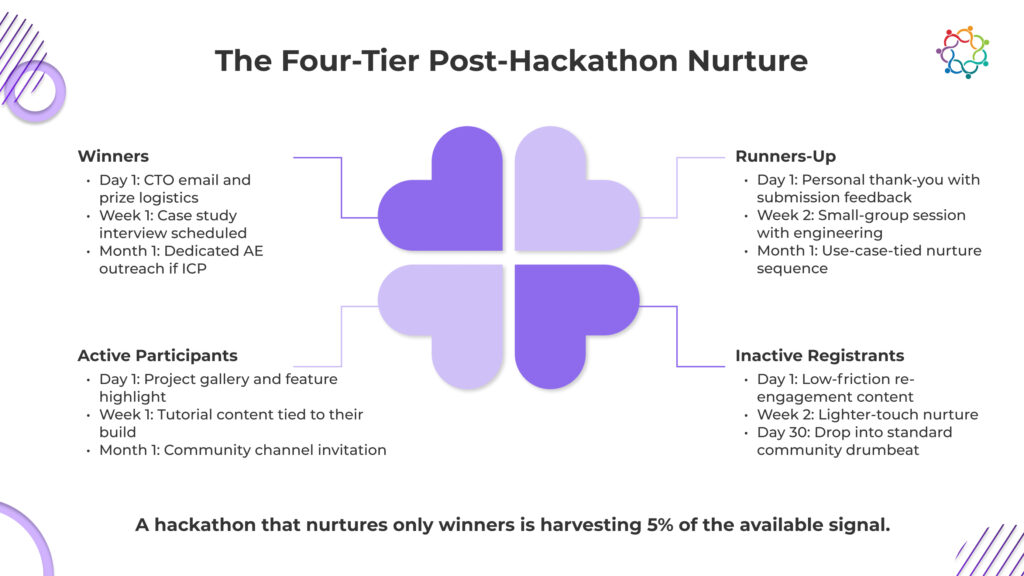
Most hackathons evaporate the audience within a week. The right nurture converts participants into customers over the following 6 to 12 months. The mistake is concentrating the follow-up on winners. Winners are 5 percent of the audience. The other 95 percent is where the program either scales or stalls.
Winners (top three teams).
Runners-up (fourth to tenth).
Active participants (submitted but didn’t place).
Inactive participants (registered but didn’t submit).
The ABM overlay.
Any participant from a target account, at any tier, gets routed to the AE within 48 hours. Engineering manager or senior IC participation from a target account is a Hot signal regardless of submission outcome.
Common trap: nurturing only winners.
Runners-up and inactive participants together represent 95 percent of the audience. A hackathon that nurtures only winners is harvesting 5 percent of the available signal.
Hackathons are a marketing channel with three measurable outcomes: pipeline, product feedback, and brand. The line-item misclassification is what makes them underperform. Design the challenge around ICP. Capture a richer signal at registration. Route product feedback into engineering within five days. Nurture all four participant tiers. The companies whose hackathons consistently produce pipeline aren’t running a different event. They’re running the same event with marketing accountability and a CRM that can tell the CFO what it earned.
If your team is running hackathons and the pipeline attribution column on the post-event report is still empty, the gap usually sits in the capture and routing layer, not the event itself. Samaaro is built for the reporting layer that closes it.

Samaaro is an AI-powered event marketing platform that enables marketing teams to turn events into a measurable growth channel by planning, promoting, executing, and measuring their business impact.
Location


© 2026 — Samaaro. All Rights Reserved.