Samaaro + Your CRM: Zero Integration Fee for Annual Sign-Ups Until 30 June, 2025
- 00Days
- 00Hrs
- 00Min


Key Takeaways (TL;DR)
1
2
3
→
Bottom Line:
Post event survey software earns its keep by collecting responses in the moment and putting every source in one view.
The Feedback Form Goes Out and Almost Nobody Opens It
You run a 400-person summit. It goes well. You need to know which sessions landed, so you send a survey. Three days later you have 28 responses, and the post event survey software did nothing wrong.
Most teams see that, decide attendees don’t care, and move on. Nobody asks why 372 people ignored it.
Response rates aren’t random. They’re set by when you ask, how long the form is, and whether anyone knows what happens to the answers. Teams with strong response rates haven’t found more engaged attendees. They’ve fixed a process most teams never diagnosed. Figures here are illustrative, not published benchmarks.
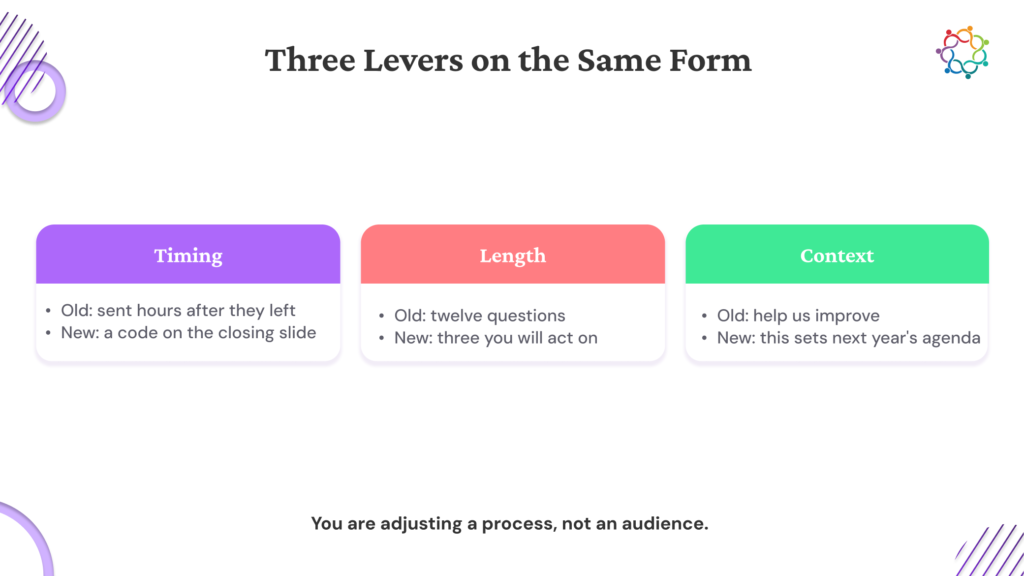
Collect in the room, not after. A survey arriving two hours after close is competing with dinner. Someone walking out of a session still has it in their head and the phone already in their hand. Put a QR code on the closing slide, ask one rating and one open question, cap it at 30 seconds. This does more than the other two combined, because it closes the recall gap and the friction gap at once. It also puts collection on the run sheet, which is what treating evaluation as a timeline looks like in practice.
Cut the form to three questions. Most forms run 10 to 15 questions across venue, catering, speakers, networking and next year’s topics. Attendees see the scroll bar and close the tab. The 2023 Cochrane review of questionnaire response, covering 88 trials of electronic questionnaires, found the odds of response about half again higher for shorter versions. Pick three answers you’ll act on. “Which session was most useful?” “What should we cover next?” “Will you come back?” Fewer answers from far more people beats a full picture from twelve.
Say what the feedback is for. “Help us improve” is filler and attendees read it that way. “Your answers decide which speakers we invite back” is a reason. The same review found that stressing the benefit of responding raised the odds of response by around a third, and that offering to share the results did something similar. One sentence changes how the form reads.
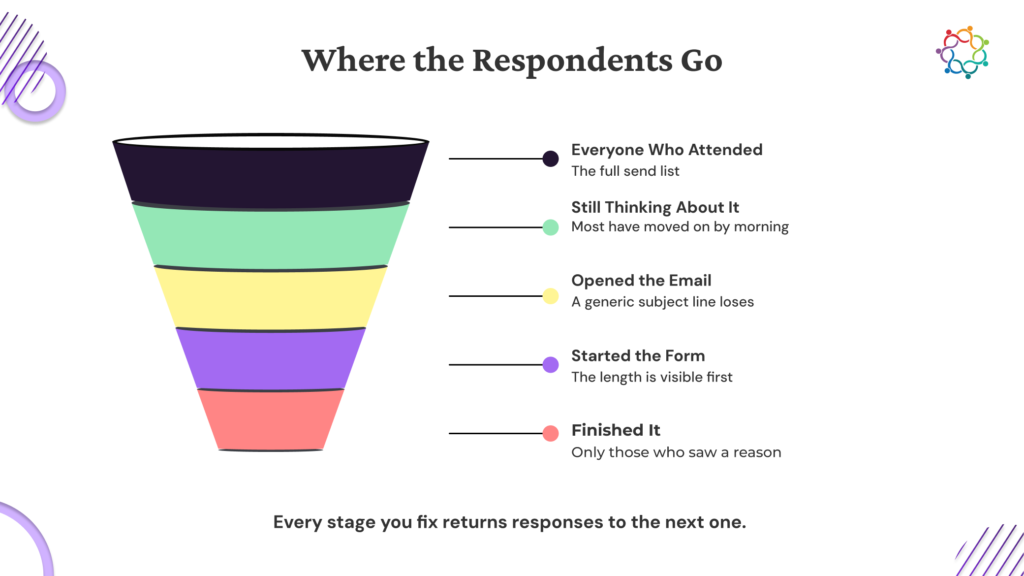
Three things break the form, in order. Timing goes first: by the time a post-event email lands, the attendee has left and the session has blurred into the day. Length goes second, because a long form reads as a request for twenty minutes rather than one. Context goes third, since nobody spends effort when the destination of that effort is unclear.
The fourth problem is that most teams never run the diagnosis. Low response gets filed as normal instead of tested. Nobody moves the send time or rewrites the preamble to see what changes. Even the questions themselves go unexamined, which is why the answers come back thin.
| Low-response event | High-response event | |
| When you ask | Email at 7pm, after everyone has left | QR code on the exit signage at 4:45pm |
| How much you ask | 12 questions covering everything | 3 questions you’ll act on |
| What you tell them | “Please share your feedback” | “This decides next year’s agenda” |
| What you get back | 30 responses, mostly complaints | 140 session-level ratings |
| What you can do with it | Guess which sessions worked | See 3B rated 4.8 and 2A rated 3.2 |
The right-hand column isn’t a better audience. It’s the same event with three variables changed. The difference bites hardest in the last row, where one team has a pattern and the other has anecdotes. Matching the method to the question makes that row usable.
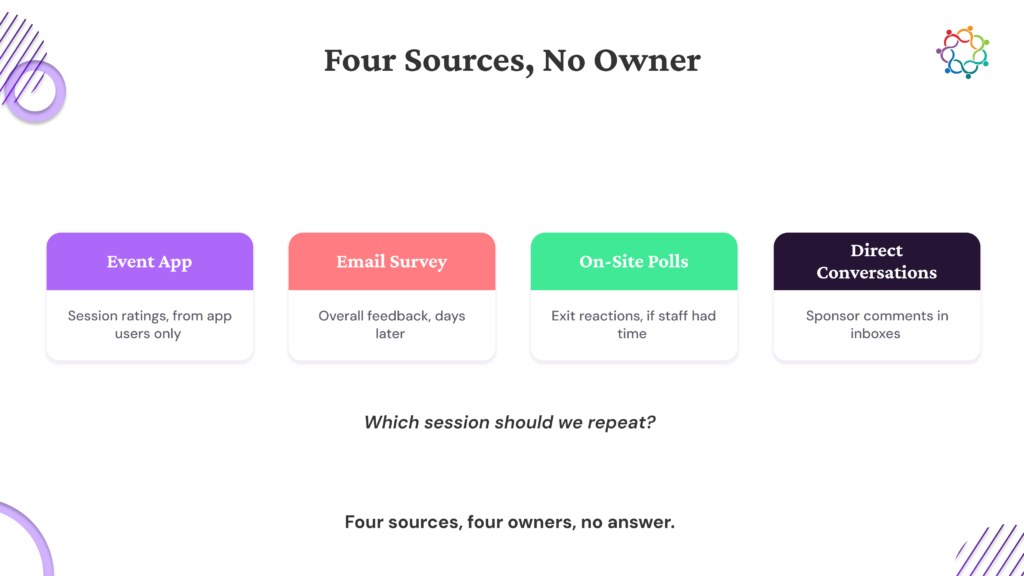
Teams that fix timing and length still get stuck, because feedback lands in four places. Session ratings sit in the event app. The overall survey sits in an email tool. Sponsor comments arrive as messages and hallway conversations somebody meant to write down. NPS lives somewhere else again. Marketing has one slice, ops has another, nobody owns assembling them.
So the data exists and the answer still doesn’t. You can’t tell whether 3B beat 2A because the ratings and the comments never sat in the same table. A week passes, the reconciliation never happens, and the team decides feedback isn’t worth collecting. That’s the wrong conclusion, but a fair read of the evidence.
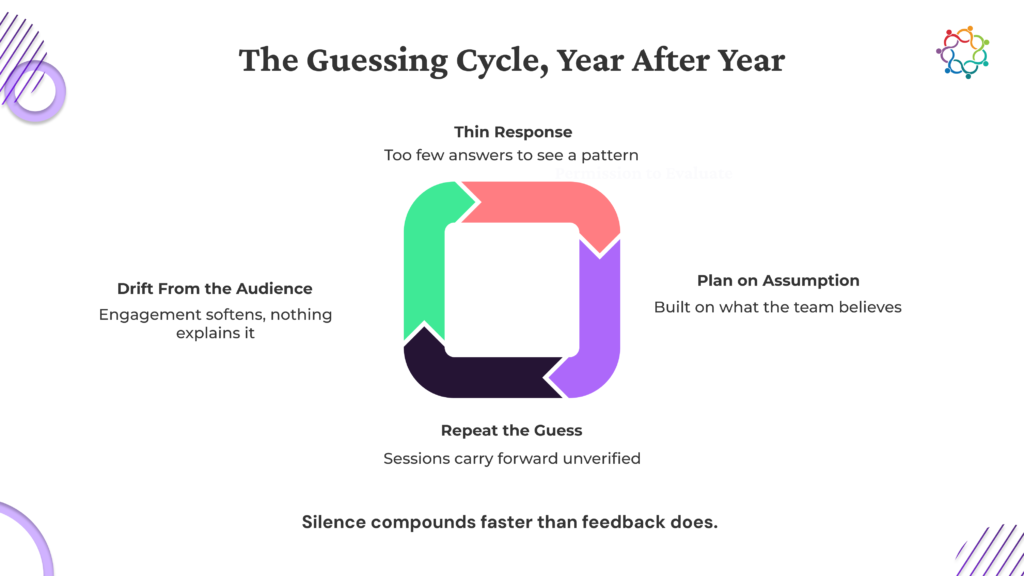
Without usable feedback, four things go missing.
The cost compounds. Year one you guess. Year two you repeat the guess. By year four attendance is sliding and nobody can explain why, because there’s no record to read it from.
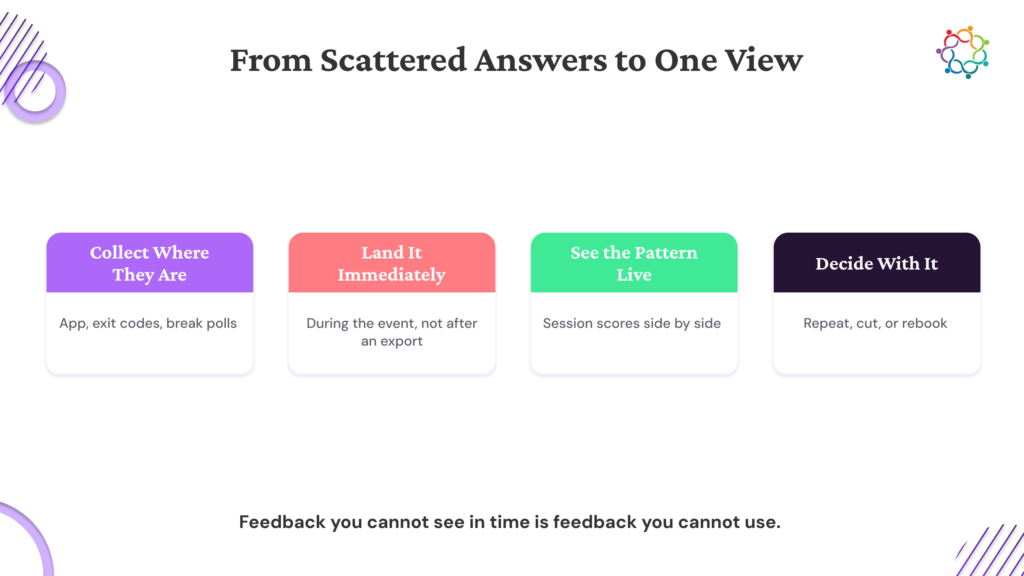
You can’t hand-assemble feedback from four systems while an event is running.
What works is one place where responses land as they arrive, whatever route they came in by, with analytics that update during the event rather than after it. The point is not seeing a number sooner. It is that the number is complete, because nothing is sitting in a second system waiting to be exported.
That’s the requirement. Not a better form builder. A place where every response arrives in the same table.
The form goes out and nobody opens it. Teams treat that as the nature of surveys. It’s a signal the process needs work, not that the audience doesn’t care.
Before your next event, change three things. Collect while people are still in the building. Cut the form to three questions you’ll act on. Tell attendees what their answers decide. Then measure against last time.
If the responses still scatter across four tools, that’s the next fix. Post event survey software that collects in real time and consolidates every source turns responses into something readable. Worth a conversation with Samaaro if consolidation is the part you’re missing.
What is post event survey software?
It collects attendee feedback through forms, QR codes, app prompts and email, then consolidates responses into one view. The value sits less in the form builder than in getting every source into one readable place.
Why don’t people fill out event feedback forms?
Three reasons, usually together: the form arrives after attendees have moved on, it’s too long to start, and nothing explains what the answers are for. Fix all three and rates move.
When should you send an event feedback survey?
During the event, right after each session while the experience is fresh. A survey sent hours later competes with everything else in the inbox and loses.
How many questions should an event feedback survey have?
Three or four you’ll act on. Longer forms get abandoned, and research on questionnaire length supports keeping them short. Fewer answers from more people is the better trade.
Can an event app collect session feedback?
Yes, and it’s one of the stronger collection points because attendees already have it open. What matters is that app ratings flow into the same system as your other feedback.