Samaaro + Your CRM: Zero Integration Fee for Annual Sign-Ups Until 30 June, 2025
- 00Days
- 00Hrs
- 00Min

Key Takeaways (TL;DR)
1
2
3
→
Bottom Line:
Bigger registration numbers don’t fill the room. A well-timed communication sequence does.
A Full List Is Not a Full Room
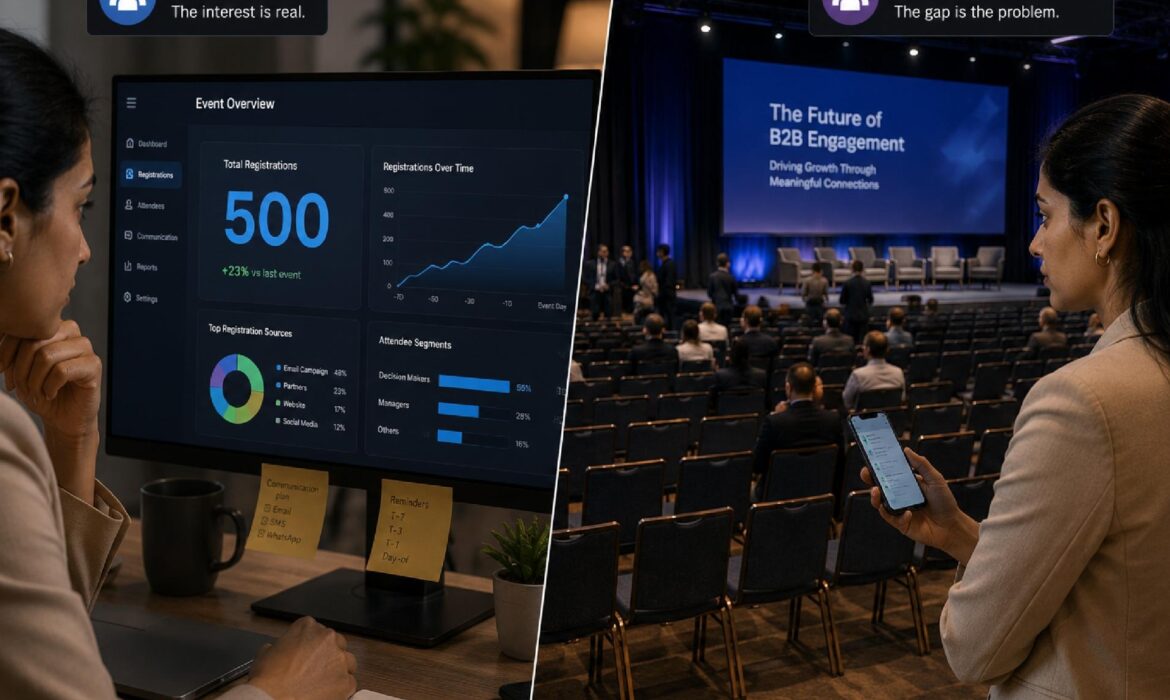
The registration report looks like a win. Six hundred sign-ups, well past target, and the team celebrates.
Then the doors open and the room holds three hundred. The webinar console shows half the expected logins. The number that felt like success turns out to have been a forecast, not a fact.
Registrations are a promise. Attendance is the promise kept.
The distance between the two, the gap between the list and the room, is where most events quietly lose their impact. Closing it has less to do with getting more registrations and more to do with what happens between the sign-up and the start.
Registrations don’t equal attendance because registering is a low-effort promise made in advance. Attending requires showing up at a specific time against everything else competing for that slot. The share of registrants who actually attend is the attendance rate, and communication in the run-up is the main lever that moves it.
This blog walks through what the gap is, why it happens, how communication closes it, how to measure the attendance rate honestly, and where the attendance rate ends and attendance quality begins.
The registration-to-attendance gap is the difference between the number of people who signed up and the number who actually showed up.
Expressed as a rate, the attendance rate is the share of registrants who attend.
Why is the gap normal? Some drop-off is expected in every event, and it varies widely by format. Free versus paid changes the rate. In-person versus virtual changes it. How far ahead registration opened changes it. A virtual event with a long lead time will typically see a larger gap than a paid in-person one with a short window.
What matters is not eliminating the gap, which is impossible, but shrinking it as far as the format allows. Know your own baseline so you can tell a good turnout from a poor one.
This blog is about that rate: how many people show up.
A separate question, which people show up and how valuable they are, comes later. That’s attendance quality, and it’s a different thing entirely.
People don’t register intending to skip. The gap opens for ordinary reasons, and naming them points straight at the fix.
Every one of these is addressable with the right message at the right moment. That’s what the rest of this piece is about.
Because the gap is caused by fading intent, competing time, and last-mile friction, the lever that closes it is communication in the run-up.
Not more top-of-funnel registrations. Not bigger lists. Communication.
The mechanism is simple. Well-timed reminders keep the event present as attention fades. Confirmations and calendar adds lock the slot before the calendar fills. Clear day-of logistics removes the friction that causes last-second drop-off.
Each message counters one of the reasons people skip.
Here’s the important shift for teams: chasing a bigger registration number to offset no-shows treats the symptom. A registration list twice as large with the same weak follow-up just produces a bigger gap.
Closing the gap is cheaper and more reliable than inflating the top of the funnel, because it works on the intent you already captured.
This is the payoff of running communication as a coordinated plan rather than a single send.
The attendance-protecting sequence maps to the reasons people skip.
An instant confirmation with a calendar link captures the slot while intent is warm. A reminder in the week before keeps the event present and adds a reason to attend. A final-day nudge carries the practical details that remove doubt. A day-of message and a short pre-start nudge recover the people who meant to come and got distracted.
The through line: every touch either strengthens intent or removes friction. Each sits at a moment where attendance is genuinely at risk.
How deep to go on timing, how many touches, and exactly when, is the subject of its own blog. Which channel carries each touch is another question. This section is about what the sequence protects, not the precise schedule.
The point is that the gap doesn’t close by accident. It closes because every stage in the run-up is covered and every message has a clear job.
The attendance rate is only useful if it’s measured against reality, not against a hopeful definition.
The rate is checked-in attendees divided by registrants. The numerator has to come from an actual record of who arrived, not an assumption that everyone who registered showed.
For in-person events, that record is on-site check-in. A QR scan or badge print at the door that captures who actually walked in. For virtual events, it’s verified logins and time attended, not just the invite list. The measurement has to be as concrete as the registration count, or the rate is guesswork.
Once you know your true attendance rate by event type, you can spot which formats and which communication sequences hold their own. You have a real baseline to improve against.
Track it. It changes everything about how you run the next event.
Filling the room is the goal of this blog, but attendance only counts for the business if it connects to pipeline.
That connection depends on data flowing, not on the turnout alone.
Every touch and every check-in has to feed one attendee record that syncs to the CRM. When it does, sales can see who attended, what they engaged with, and follow up with context the same day. The event’s contribution to pipeline can be reported rather than guessed.
When it doesn’t, a strong attendance rate stays trapped as a vanity number.
How that attribution actually works, connecting event touches to pipeline across systems, is its own subject. That’s covered in the event attribution definition.
One distinction keeps this topic honest.
Attendance rate answers how many registrants showed up.
Attendance quality answers a different question: were they the right people, and did their presence translate into real interest and pipeline?
The two are not the same, and a high rate is not automatically a good outcome.
A room full of low-intent registrants can have a great attendance rate and produce nothing.
Communication, the subject here, is the main lever on the rate. Getting the right people to register in the first place, and judging the value of who attended, is attendance quality. It’s covered separately.
This blog closes the gap on the people you already have. That’s the foundation. What you do with them once they’re in the room is another conversation.
The fastest way to a fuller room is not more registrations. It’s closing the gap on the intent you already captured, with the right messages at the moments people are deciding whether to show.
Registrations are a promise. Attendance is the rate that promise converts at. Coordinated communication is the lever that moves it.
Put your registration number next to your checked-in number for your last three events.
The gap between them is not a marketing problem at the top of the funnel. It’s a communication problem in the final two weeks.
For the full blueprint on the reminder cadence that lifts your show-up rate, and which channels carry each reminder, those are covered in the dedicated blogs in this series.
Ready to turn registrations into attendance? Talk to the Samaaro team about running the confirmation and reminder sequence that fills your room.