Samaaro + Your CRM: Zero Integration Fee for Annual Sign-Ups Until 30 June, 2025
- 00Days
- 00Hrs
- 00Min


Key Takeaways (TL;DR)
1
2
3
→
Bottom Line:
Without measurable alignment, execution drifts quietly, and organizational performance erodes before anyone notices why.
There’s a real gap between how successful an internal event looks and how aligned the organization actually is afterward. Town halls, leadership rollouts, communication sessions, these usually look like they worked: strategy gets articulated, priorities sound clear, attendance is strong, and the room feels engaged. From leadership’s seat, that reads as alignment.
Execution tells a different story. Teams interpret the same priorities differently, decisions drift from the intended direction, and initiatives lose focus over the following weeks. Awareness got created. Shared understanding didn’t. Leadership assumes that delivering a message is the same as achieving alignment, but nobody’s actually measuring how employees interpreted it, so that gap stays invisible until it isn’t.
These events rarely fail at communication. They fail at alignment, which is a different problem entirely. Awareness is not alignment, and without a system to capture how a message actually landed, misalignment spreads quietly until execution starts to fracture and performance takes the hit.
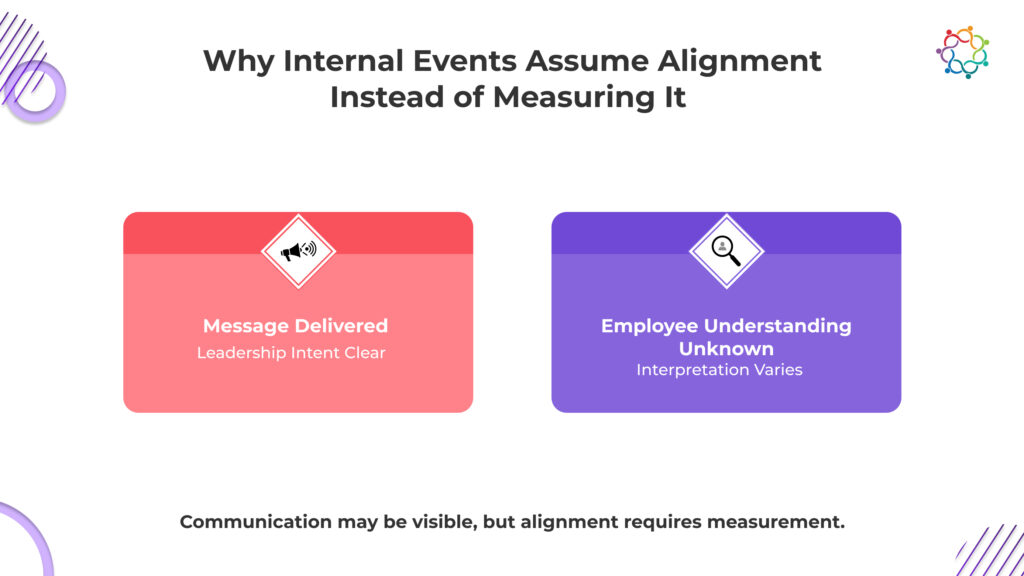
These events exist to broadcast leadership’s intent. Strategy gets explained, goals get presented, expectations get defined. The assumption underneath all of it is that communicating something clearly is the same as achieving alignment around it.
It isn’t. Communication is visible, easy to see and easy to feel good about. Alignment isn’t, and organizations rarely build a way to actually check how employees interpreted what they just heard. Misalignment tends to show up quietly, unnoticed until it surfaces as inconsistent execution or misplaced priorities weeks later.
Leadership typically judges these events on delivery metrics, attendance, engagement scores, a good Q&A, rather than on whether alignment actually happened. Employees, meanwhile, are working from partial context and filling in the gaps with their own assumptions. That’s the real structural flaw behind why a well-run event can still fail to produce the outcome leadership expected. Attendance alone was never proof of alignment. Without measuring interpretation and comprehension after the fact, execution quietly drifts from what leadership actually intended.
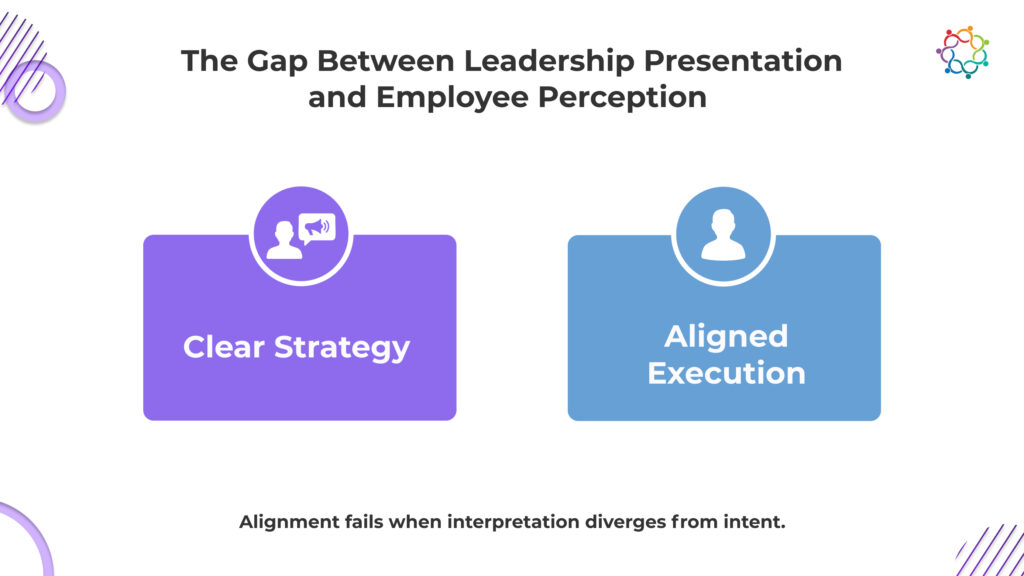
Even a genuinely clear presentation doesn’t guarantee everyone understood it the same way. The gap opens up right at the point where communication meets interpretation. Leadership speaks from a strategic vantage point. Employees filter that message through their own daily workload, department priorities, and whatever’s already on fire that week.
That perceptual difference is driven by a few key things. Contextual interpretation affects the priorities when people weigh up a message against their own daily commitments. Competing objectives mean leadership messaging sometimes doesn’t align with a department’s existing focus, so workers selectively hear what fits. Cognitive framing is how we interpret new information based on past experience and existing beliefs.
The more information we must process, the more difficult it is to remember a key message when it drops in the middle of all the other things demanding our attention. And message abstraction, a high-level vision that never gets transformed into something operational, allows employees to take a go at what it means for their own work.
The result is misalignment nobody can see. Leadership watches heads nod and takes that as engagement, but nodding doesn’t prove understanding. Misinterpretation compounds quietly across teams, and it’s what eventually fragments execution and slows initiatives down. The problem was never unclear messaging. It’s that interpretation goes unmeasured and unchecked long after the room has emptied.
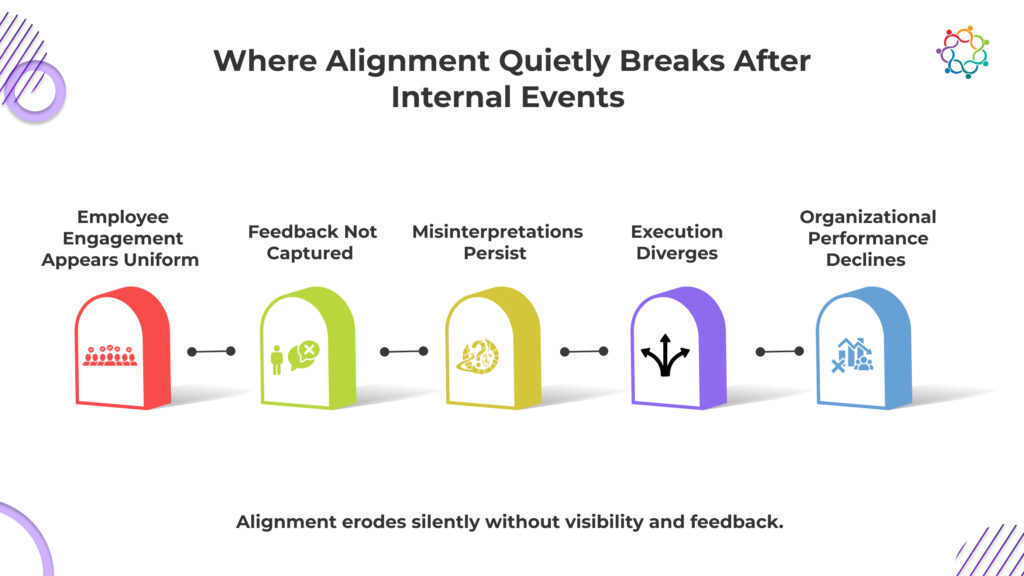
Alignment doesn’t fail in the moment of communication. It erodes afterward, across a few specific points.
4.1 Engagement Visibility Failure
During the event, participation looks uniform. Leadership sees engaged faces and active Q&A and reads that as alignment. Often it’s just compliance. Once the event ends, there’s no way to see who actually internalized the message and who quietly checked out. That blind spot is exactly where execution starts to fracture later.
4.2 Feedback Loop Absence
Most internal communication captures feedback superficially, if it captures any at all. A generic survey rarely reveals how someone actually interpreted a message, which means misinterpretations sit uncorrected because there’s no mechanism to catch them. Every event without real feedback becomes an expensive experiment in invisible misalignment.
4.3 Execution Divergence Across Teams
Interpretation gaps eventually show up in action. Teams prioritize differently, decisions start to contradict each other, and strategic focus splinters across the organization. Projects duplicate effort or stall entirely. Leadership sees the outcomes without seeing the fragmentation that caused them, and each misaligned decision compounds the next.
4.4 The Hidden Performance Cost
This isn’t theoretical. Misalignment wastes resources, delays real projects, and drags down productivity. Employees act on assumptions instead of validated priorities, and leadership’s actual goals quietly stop being met. The cost usually only becomes visible once productivity has already slowed and initiatives have already stalled, well after the interpretation gap that caused it first opened.
Most organizations judge these events by the wrong signals: a smooth presentation, polished slides, strong attendance. That’s a dangerous read. Attendance doesn’t equal understanding, and visibility doesn’t equal alignment. Execution is what actually reveals the truth, and it often shows teams acting inconsistently while strategic goals quietly fail.
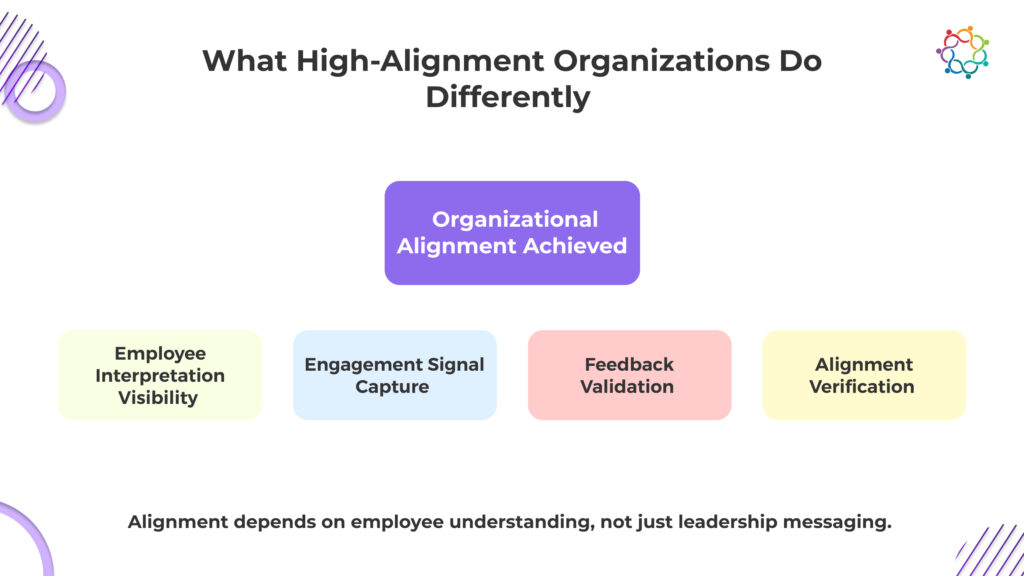
Lower-alignment teams optimize for attendance, message delivery, and leadership visibility. Higher-alignment organizations optimize for something different: whether employee interpretation is actually visible, whether engagement signals are real, and whether alignment gets validated rather than assumed.
That distinction matters more than it sounds. Applause and a completed survey can convince leadership everything worked, but neither one proves alignment actually happened. Organizations that take this seriously demand real evidence of understanding and hold alignment accountable at every level, treating internal events as a diagnostic tool rather than a performance.
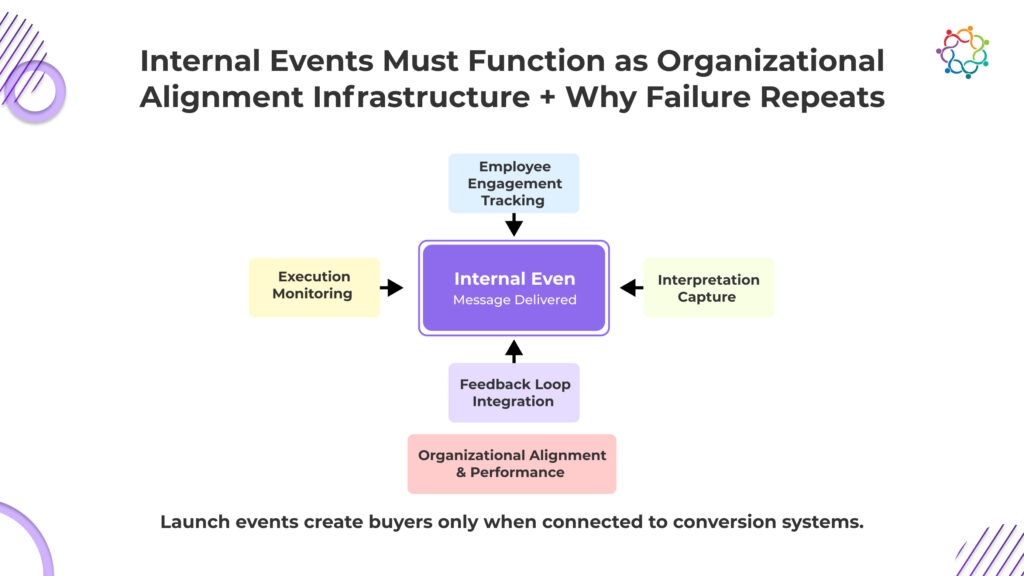
Most organizations still treat these events as one-off communication moments. Delivering a message clearly doesn’t guarantee it was understood, and it certainly doesn’t guarantee it gets executed. Without a system that checks interpretation, alignment can fail quietly even after a flawless presentation.
The shift internal events actually need is from performance to infrastructure, treated as an ongoing system for reading how employees internalize a strategy, not a single broadcast moment. Skip that shift, and alignment gaps multiply without anyone noticing until execution has already fractured.
An event management platform built to capture that kind of post-event signal, real feedback, comprehension, follow-through, gives leadership something to actually check alignment against instead of reading the room and hoping. That matters especially for fast-moving tech organizations running frequent internal rollouts, where the gap between one town hall and the next leaves little room to catch misalignment before it compounds. Every internal event disconnected from that kind of system risks wasted effort and fragmented execution down the line.
Alignment breakdown isn’t an accident. It’s built into how these events get judged in the first place: by attendance, not by whether employees actually align around what was said. Leadership celebrates visibility and quietly overlooks whether real understanding happened.
Communication gets mistaken for alignment, and applause gets treated as proof. As long as the system keeps rewarding message delivery over clarity, every event that prioritizes optics over interpretation just entrenches the same gap further. Without redesigning how these events get structured and measured, this pattern repeats with every single one.
Events deliver a message and look successful doing it. Attendance is strong, the deck is polished. Execution tells a different story, one where alignment stays invisible and misinterpretation spreads quietly while teams act on assumptions instead of clarity.
Communication alone was never going to be enough. High-performing organizations demand real evidence of understanding, and they treat internal events as alignment infrastructure, not a scripted moment. For anything built for event marketing or an internal rollout specifically, this distinction is what separates a strategy that stays an announcement from one that actually becomes coordinated execution.
If alignment can’t be measured, it can’t be enforced, and execution will keep drifting from intent every time. Reach out to Samaaro to talk through what that looks like for your next internal event.