Samaaro + Your CRM: Zero Integration Fee for Annual Sign-Ups Until 30 June, 2025
- 00Days
- 00Hrs
- 00Min


Virtual exhibitions took off fast, especially once the pandemic pushed businesses online almost overnight. They’ve stuck around since, and for good reason: a virtual exhibition reaches a genuinely global audience and shows off a product without worrying about square footage or a venue’s capacity limit. That reach comes with a real tradeoff, though, since nobody can walk up and physically handle the product, and that’s exactly where the showcase itself has to work harder.
This piece looks at how businesses can showcase products creatively inside a virtual exhibition, why that showcasing actually matters, and what it takes to make the most of the format. Virtual exhibitions have gone from a workaround to a norm, and getting creative with product presentation isn’t optional anymore if the goal is to actually stand out among dozens of competing booths in the same digital hall.
A virtual exhibition trades physical interaction for convenience and reach. That tradeoff makes product showcasing more important, not less. Without someone able to physically pick up and examine a product, the showcase itself has to do that work, building an experience immersive enough to leave a real impression and drive actual sales, rather than one that just technically checks the box of “having a booth online.”
Without a body in the room, high-quality images, video, and 3D models are what carry the weight a physical booth would otherwise handle. Done well, they give a visitor a genuinely clear sense of the product, and that clarity is what turns browsing into engagement.
A strong showcase does more than look good. It generates lead data, since letting someone actually interact with a product captures real signal about their interest and behavior, the kind of signal a static brochure page never produces. That data is what shapes sharper marketing and a better customer experience down the line, and both of those loop back into sales.
A virtual exhibition costs less to run and reaches more people than a physical one ever could. What it gives up is the ability to physically handle a product. Product showcasing is what closes that gap, at least partially, by making the digital version as visually engaging and interactive as the format allows.
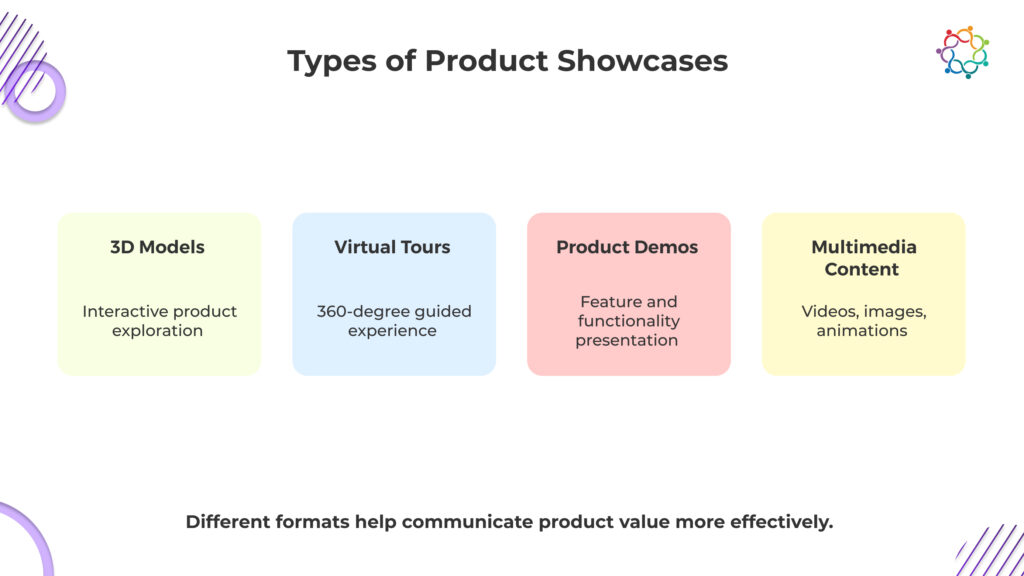
The right showcase format depends entirely on the product and what the business is actually trying to achieve. A few approaches cover most cases, and picking the wrong one usually means investing in interactivity a product doesn’t actually need.
A few questions are worth answering before settling on an approach:
Weighing all of these together is what actually points to the format that fits the product and the audience, rather than picking whatever looked impressive in a demo reel.
A genuinely immersive showcase comes down to a well-designed virtual booth, real interactivity, and a bit of gamification layered on top, each piece reinforcing the others rather than working in isolation.
A 3D or virtual walkthrough works especially well for a property exhibition, where dimension and layout matter more than almost anything else being shown.
A bit of gamification makes a showcase more memorable. Quizzes and surveys tied to the product or industry boost engagement while also collecting genuinely useful feedback. A simple game, a spin-the-wheel, a query submitted for a lucky draw, adds a bit of excitement that gets people interacting instead of passively scrolling.
Social features matter too. Live chat lets a visitor ask a real question and get a real answer. Social media integration gives visitors an easy way to share the booth and extend its reach organically. Encouraging user-generated content, a photo, a short video, incentivized appropriately, adds a layer of authenticity a brand’s own marketing can’t manufacture on its own.
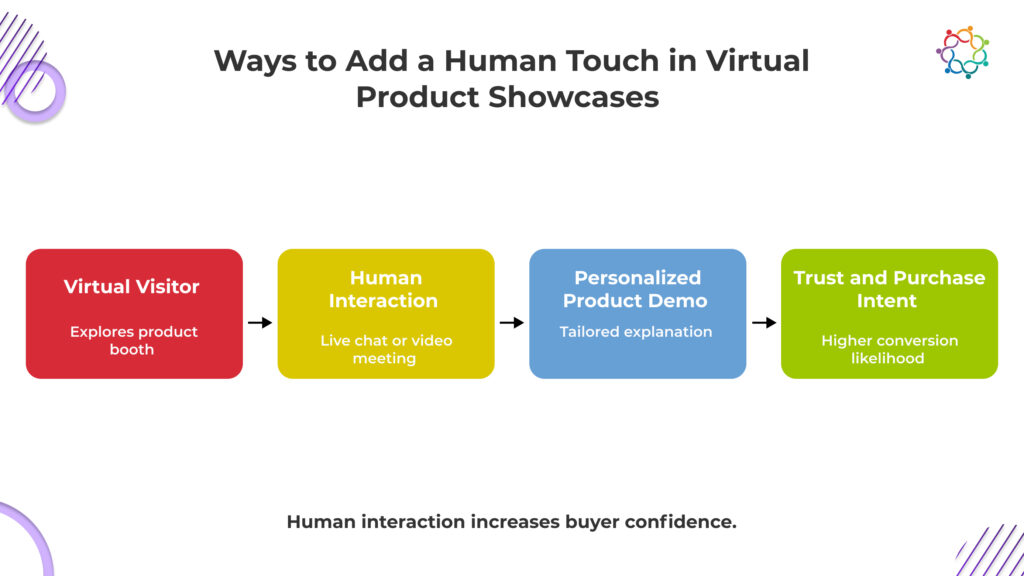
Even in a fully virtual setting, the human element still matters. Personal interaction shapes the customer experience just as much online as it does at a physical booth, sometimes more, since it’s the one thing a purely digital format doesn’t provide by default.
Importance of Personal Interaction in Product Showcasing
Ways to Add a Human Touch in Virtual Product Showcases
Best Practices for Adding a Human Touch Without Losing the Virtual Experience
A virtual exhibition gives a business global reach without the constraints of physical space, but that reach only pays off if the product showcase itself is actually good. Real showcasing, high-quality visuals, genuine interactivity, and a human touch layered in deliberately, is what turns a browsing visitor into an engaged one, rather than someone who clicks through a few images and moves on to the next booth.
Event technology built to support this kind of showcase, product demos, interactive booths, live chat, and lead capture all working together, makes it possible to run a virtual exhibition that actually performs rather than one that just exists online. That matters especially for technology companies running product-heavy showcases where the visual and interactive experience carries most of the persuasive weight.
Choosing the right approach comes down to the same factors covered above: the product itself, the audience, the budget, and how much interactivity the format actually needs. Get that right, and event marketing inside a virtual exhibition stops being a compromise and starts genuinely competing with the in-person alternative.
Curious what this looks like for your next event? Book a demo with Samaaro today.