Samaaro + Your CRM: Zero Integration Fee for Annual Sign-Ups Until 30 June, 2025
- 00Days
- 00Hrs
- 00Min


Bottom Line:
Training events are not cost centers; they are growth stabilizers that protect revenue by strengthening adoption before renewal risk appears.
In most enterprises, training is categorized as support, not strategy. Budgets sit under enablement or customer success. Growth discussions center on acquisition, upsell, and pipeline acceleration. Yet the majority of revenue risk and expansion potential exists after the sale.
Training events rarely appear in growth narratives because they do not create visible spikes in revenue. They operate differently. They stabilize usage, increase confidence, and reinforce value realization over time. That compounding effect influences renewal confidence and expansion readiness more consistently than many front-end initiatives.
When customers fail to adopt deeply, churn risk increases. When users lack confidence, expansion stalls. Training addresses both conditions at their source by strengthening capability and reducing uncertainty.
The issue is not execution. It is a classification. When training is viewed as a cost center, its influence on retention leverage and sustained product adoption remains invisible.
This blog explains why training events influence growth outcomes more reliably than many acquisition efforts and how learning translates into usage, retention, and long-term expansion.
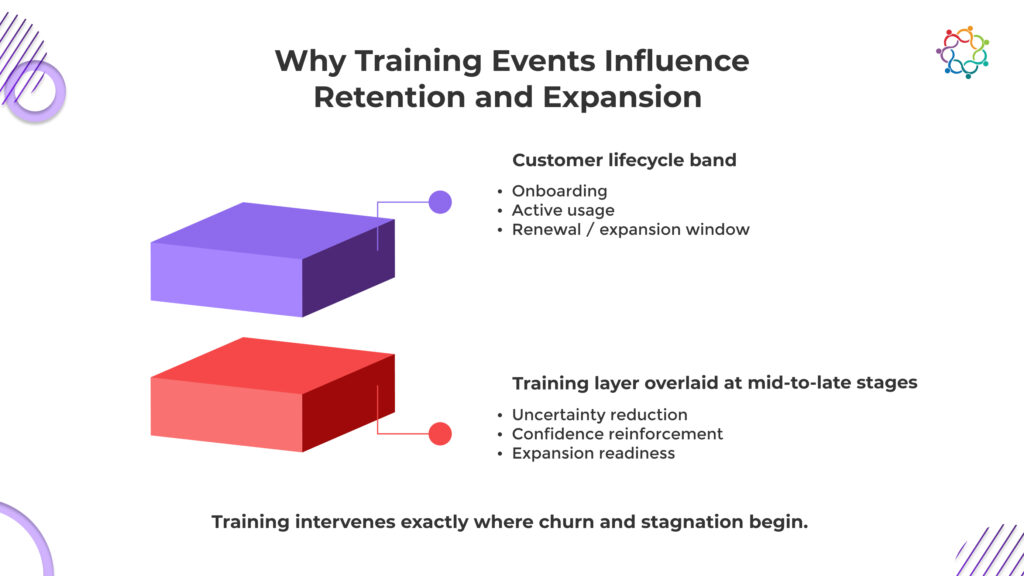
Retention does not fail because customers are unhappy. It fails because they are uncertain. When users are unsure whether they are extracting full value, renewal becomes a financial risk rather than a logical continuation. That uncertainty rarely begins in the final quarter of a contract. It forms months earlier through shallow adoption and inconsistent usage.
Expansion follows the same pattern. No stakeholder approves additional investment in a product that the team has not fully mastered. Without demonstrated value realization, upsell conversations stall. What looks like budget resistance is often capability hesitation.
This is where structured learning initiatives intervene. They reduce ambiguity, increase confidence, and strengthen usage maturity before renewal or expansion conversations begin. They influence the decision environment long before commercial discussions take place.
If retention and expansion are core growth metrics for your organization, then ignoring the mechanisms that shape user confidence is a strategic blind spot. Growth does not hinge only on selling more. It depends on whether customers feel competent enough to continue and confident enough to expand.
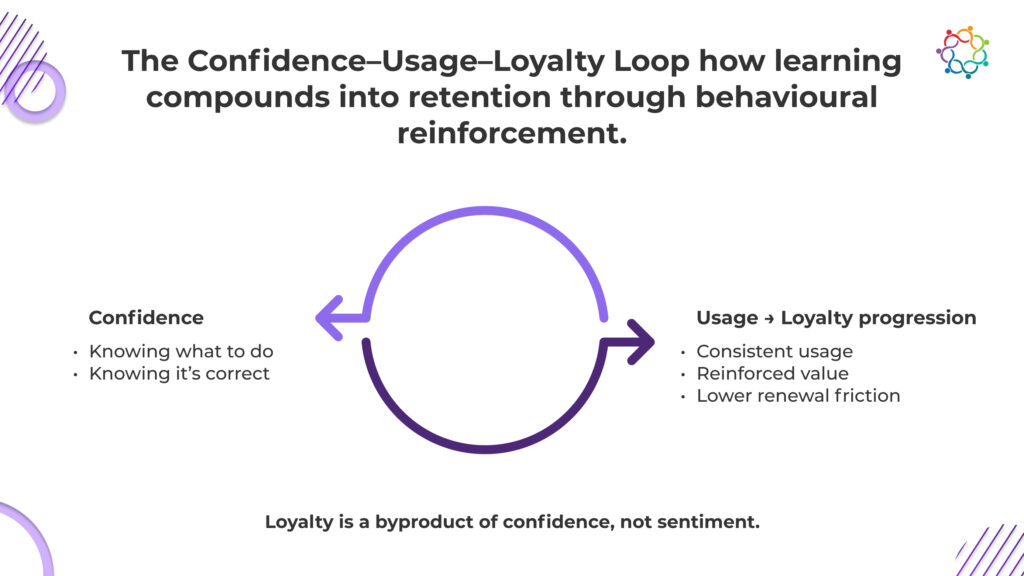
Training’s impact on growth is best understood as a loop where confidence leads to consistent usage, which then reinforces loyalty. This Confidence–Usage–Loyalty Loop is a practical framework for linking enablement efforts to measurable outcomes.
Users often hesitate to fully adopt a product when they are unsure of its correctness or impact. Even minor uncertainties, such as whether a process is being followed correctly, can prevent engagement. This lack of confidence translates into inconsistent or shallow usage, which limits the value realized from the product. Structured training events address this gap by:
Confidence is not an abstract psychological outcome. It can be quantified by behavioural measures, including higher participation in advanced workflows, fewer support enquiries, and increased feature utilisation. Users are unlikely to investigate more sophisticated features without this base, which would impede adoption and growth prospects.
Once users gain confidence, consistent usage becomes the primary mechanism for reinforcing value. Regular engagement with the product allows users to:
Sporadic or inconsistent usage, on the other hand, erodes perceived necessity. A feature that is rarely accessed or incorrectly used appears optional, diminishing the overall product impact. Training events create structured opportunities for consistent engagement, ensuring that the value proposition remains visible and reinforced across teams.
Loyalty in enterprise customers is rarely a matter of affection or brand attachment. It emerges from competence, trust, and the ability to achieve measurable outcomes. Trained users become internal advocates for the product, influencing renewal discussions and supporting expansion decisions.
Key takeaways of this loop:
In this way, training events create growth structurally, ensuring that loyalty emerges from competence rather than marketing sentiment.
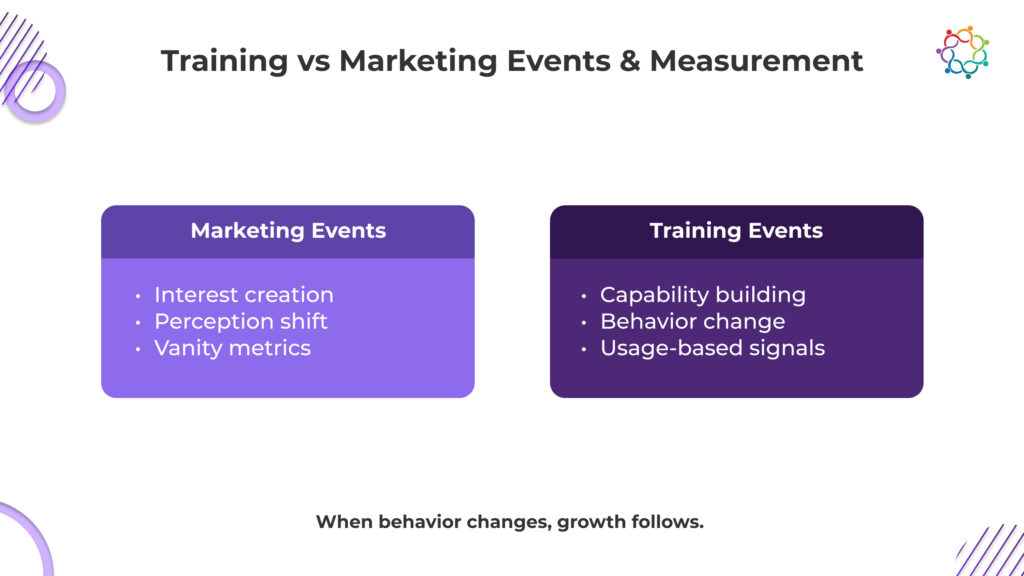
A fundamental misunderstanding that limits investment in training is the tendency to evaluate it with marketing KPIs. Marketing events are designed to create awareness, momentum, and interest. They change perception. Training events, by contrast, create capability and independence. They change behavior.
The critical distinction lies in intent and measurable outcomes:
Businesses constantly underestimate the impact of training when they use marketing assessment frameworks. Positive satisfaction ratings and high attendance are frequently seen as indicators of success, but they don’t account for the compounding impacts of increased confidence and utilisation.
Leaders may align expectations and measure training in a way that accurately reflects its economic importance by being aware of this distinction. It guarantees that enablement initiatives are viewed as a direct contributor to retention and growth results rather than as a support role.
Evaluating training through traditional satisfaction surveys or attendance figures provides limited insight. Leaders must shift focus from vanity indicators to metrics that demonstrate real growth impact.
Many organizations rely on the following metrics:
While these numbers indicate activity, they do not demonstrate whether participants gained confidence, applied new skills, or increased product usage. Measuring presence rather than progress creates an illusion of impact, leading to misallocation of resources.
Metrics that genuinely correlate with growth include:
Rather than emphasising sentiment, these measurements show changes in behaviour. They demonstrate how training promotes adoption, lowers barriers, and helps users accomplish their goals.
Behavioral shift becomes visible when engagement is structured and tracked. In one global training seminar, 95% of attendees completed digital session check-ins and contributed over 600 structured feedback entries. Participation at that depth does not measure attendance; it reveals learning engagement and signal quality that can be tied back to adoption maturity.
Organisations can justify strategic investment and measure the economic benefit of training events by concentrating on these variables.
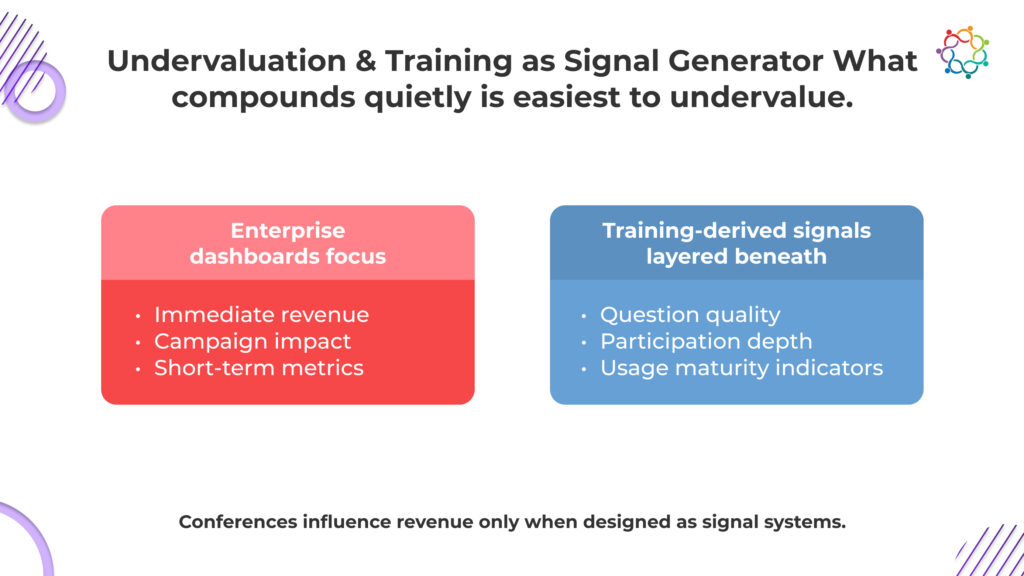
Despite clear evidence of impact, enterprises often undervalue training campaigns due to structural and organizational blind spots.
During budget reviews, the initiatives with delayed visibility are the first to be cut, even when they compound revenue over time. This undervaluation reinforces the misconception that training is discretionary, when in reality it is structural to retention and expansion.
Recognizing the delayed yet compounding nature of training impact is essential. Enterprises that ignore it optimize for immediate optics while weakening long-term growth stability.
Beyond immediate adoption, training events provide unique insights into customer health and behavior. Participation patterns, questions asked, and session engagement serve as reliable signals for account maturity and risk.
In this way, training functions as an intelligence platform. It surfaces some of the cleanest behavioral signals in the entire customer lifecycle, helping leaders proactively manage risk and identify growth opportunities.
Real growth does not only come from winning new customers. It comes from keeping and expanding the ones you already have. That happens when customers clearly understand your product, use it correctly, and see consistent results.
When people feel confident, they use more features. When they use more features, the value becomes obvious. When value is obvious, renewal feels natural, and expansion feels logical.
If you ignore capability building, you create doubt. Doubt slows usage. Slow usage weakens retention.
Companies that compound revenue over time do not only sell effectively. They systematically increase customer capability.
For organizations reassessing how capability building influences retention and expansion, explore how structured Training Events & Seminars contribute to long-term engagement.
If this perspective challenges how your organization currently evaluates training investments, you can continue the conversation here.