Samaaro + Your CRM: Zero Integration Fee for Annual Sign-Ups Until 30 June, 2025
- 00Days
- 00Hrs
- 00Min


Key Takeaways (TL;DR)
1
2
3
→
Bottom Line:
A booth lead outside the CRM is a maybe, sitting in a spreadsheet, not a lead.
A week following the trade fair, marketing operations retrieves the funnel report. Everyone agreed that the booth went well and produced a ton of leads, yet the CRM indicates very little. But, the leads are not lost. In the space between the booth and the CRM, they are either half-entered, sitting in a scanner export, or unassigned. They are useless to sales and invisible to the funnel until they close that gap.
By altering the procedure, the quickest teams cut the booth-lead-to-CRM time in half. The bottleneck was always the handoffs, not the effort. The majority of the work is done by six changes: get booth lead capture into a CRM-mapped system; decide in advance what constitutes an MQL for a booth lead; sync to the CRM during the event rather than the following day; assign an owner and a deadline for the handoff; capture clean data at the source; and make every lead visible as soon as it lands.
Every modification accomplishes two goals simultaneously. The output of the booth is both quicker and more apparent since it eliminates a delay and brings the lead into view earlier. What the successful teams do differently is as follows.
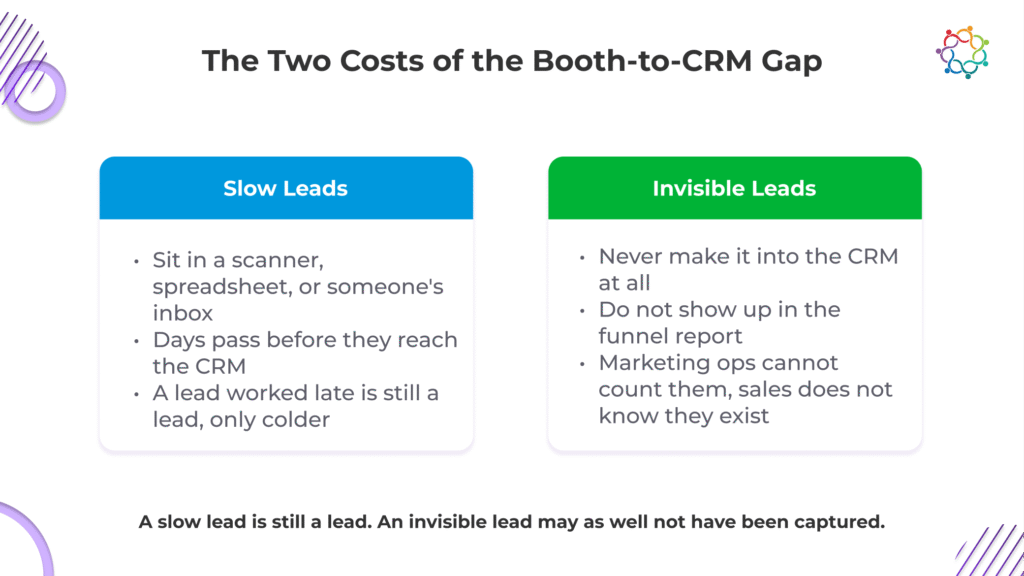
Between the conversation at the booth and the lead existing as a real, typed CRM record, there is a gap. If you have ever asked why booth leads are not in the CRM weeks later, that gap is the answer, and it costs you in two ways:
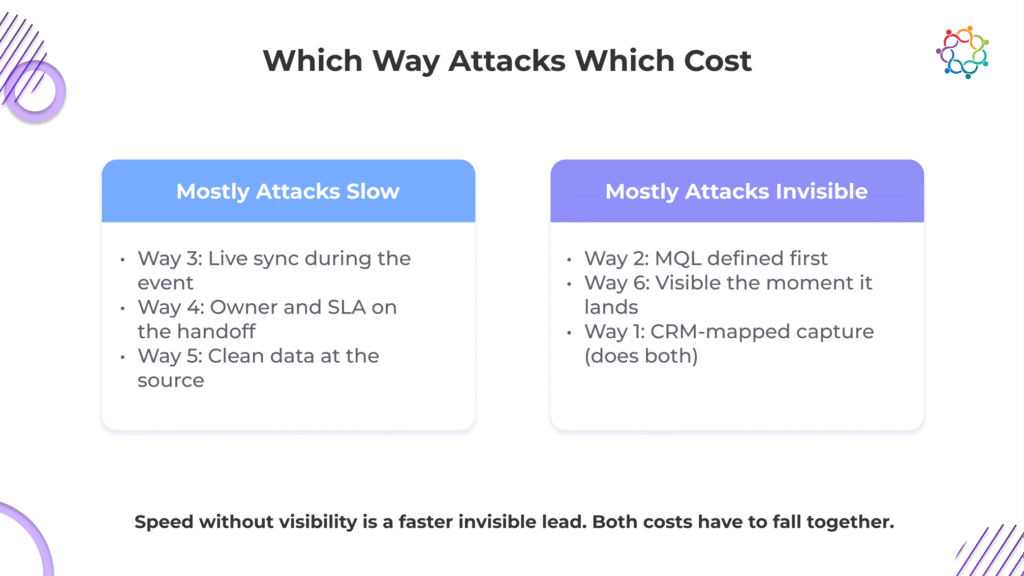
Of the two, invisible is the bigger problem, and the one teams underestimate. A slow lead is still a lead. An invisible lead may as well never have been captured, and the event looks like it underperformed because much of its real output never entered the system that measures it. A widely cited industry figure, often credited to the Center for Exhibition Industry Research, holds that around 80 percent of trade show leads are never followed up on, much of it because the lead never made it into a system anyone works from.
So cutting booth-to-CRM time is about more than speed. It is also about making the booth’s output visible and countable, and the six changes below do both. For the wider program this booth-to-CRM leg sits in, see our B2B Field Marketing Playbook.
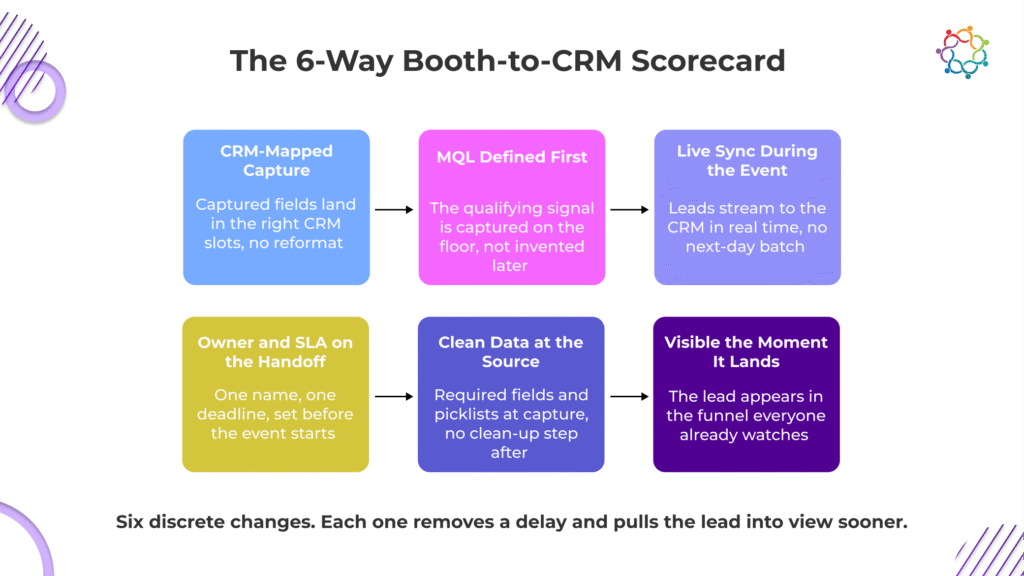
A collected lead will come as a CRM-ready record rather than a CSV that needs to be reformatted if you capture leads into a system that is already mapped to your CRM fields. The lead enters the CRM in the correct format the first time since the name, company, title, and intent instantly arrive in the appropriate fields and picklists, eliminating the need for the export-and-reformat process.
One thing to watch: a generic scanner that dumps a flat CSV is not mapped at all. It just hands you a reformatting job under a different name. Mapped means the fields line up before the lead ever moves.
This is the change that attacks invisibility head-on, and it is the core of how to make event leads visible as MQLs. It happens before the event, not after. Agree with sales and marketing ops, what makes a booth lead an MQL, then capture that signal on the floor. The signal can be small:
Whatever form it takes, the lead then arrives in the CRM already classified. Marketing ops does not sit down to triage a pile of untyped contacts, working out which ones count. The lead is born an MQL, or it is not, and either way, it is countable the moment it lands. That is the difference between a booth that produces a vague list and one that produces a measured set of qualified leads the funnel recognizes on arrival.
Why this matters so much for the invisibility problem: an unclassified lead, even one sitting in the CRM, still does not register as event output in the way leadership counts it. Classify it at the booth, and it shows up as exactly what it is.
One thing to watch: the bar has to be agreed upon before the event, with both sales and marketing ops in the room. A definition invented afterward, once the leads are already in, is just relabeling, and it tends to flatter the numbers. Decide what counts while you can still capture the signal cleanly, on the floor, in the moment the conversation happens.
Stream leads to the CRM continuously as they are captured during the event, rather than saving them for one big upload the day after. By the time the event ends, the leads are already in the CRM and visible, because there is no batch waiting to be processed: the next-day upload lag simply has nothing to lag. This is the most direct way to get trade show leads into the CRM faster.
The live-connection mechanics here overlap with the same capture-and-sync workflow your post-event follow-up runs on, so rather than repeat them, this is the one-line version: the funnel updates during the show, not after it.
One thing to watch: this needs a live connection that streams on its own, rather than a sync button someone has to remember to press at the end of a long day on the floor. If the sync depends on a person remembering, it is not really during-event sync.
The most common delay in getting booth leads to the CRM is not technical at all. It is that no one owned the handoff, so it simply waited. Decide, before the event, who owns getting booth leads into the CRM and by when, with a deadline as concrete as booth setup has: in the CRM, classified, within the day. Among trade show lead capture best practices, this is the one teams skip most and regret most.
This matters more the more distributed your team is. A demand generation leader at a large B2B company described running events across regions in five words: “We were running NA from India.” When the people staffing the booth, the people who own the CRM, and the reps who work the leads sit in different offices and time zones, an unowned handoff does not just wait; it falls into the gap between teams, and nobody notices until the funnel report is empty. A named owner closes that gap on purpose.
In the event plan, the booth-to-CRM handoff should have an owner and an SLA written down, the same way the booth logistics do. It is treated as a real deliverable with a named person accountable for it, rather than a task that quietly happens only if someone finds the time.
One thing to watch, and it is the whole point: “the team will handle it” is not an owner. A team is everyone, which in practice means no one. The fix is unglamorous, and it works every time. One name, one deadline, written into the plan before anyone travels.
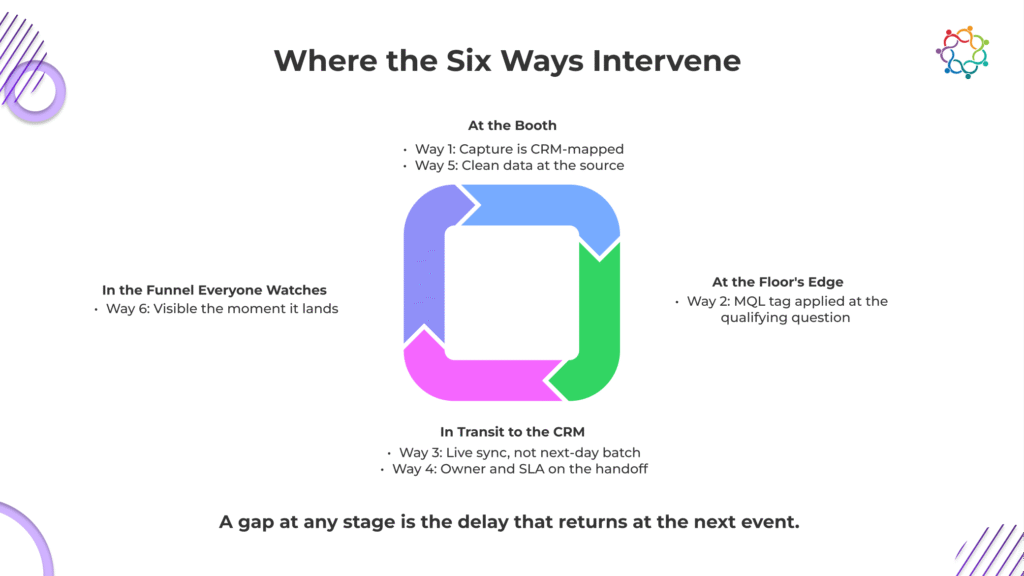
Capture clean, structured data at the point of capture, including required fields, dropdowns, and validated entry, so there is no clean-up step before the lead can enter the CRM. The clean-up step only exists because the captured data was messy. Make it clean at the source, and the step has nothing to do with it. This is the part of the booth lead capture process that quietly pays off downstream.
Capturing clean data is one of the things worth checking when you choose field marketing software, and the clean-and-match work it removes later belongs to your post-event follow-up, so this piece keeps it to the principle.
One thing to watch: do not over-ask at the booth. A long form kills both conversations and produces rushed, junk entries. Capture the few fields that matter, cleanly, rather than many fields, badly. Clean and short beats complete and messy every time.
This is the change that actually closes the invisibility gap. Make sure each captured lead shows up immediately in the same CRM and funnel view that marketing and sales already watch, as a tracked MQL, rather than a row buried in a scanner app. The moment the lead lands, it appears in the funnel report marketing ops pulls and in the rep’s own queue, carrying its MQL status, so nothing about the booth’s output hides in a side tool. Reducing lead capture to CRM time only pays off if the lead is visible when it arrives.
The reason this is its own change, and not just a restatement of the others, is that a lead can be captured cleanly, mapped correctly, synced live, and still be invisible if it lands somewhere no one is looking. Visibility is a question of destination as much as speed. The lead has to arrive where the funnel is actually watched.
Being in a system and being visible are two different states. A lead can sit in a capture app, technically stored and perfectly intact, and still be invisible to every person who needs to act on it, because none of them ever open that app. The funnel everyone tracks is the only place that counts.
One thing to watch: when you evaluate any setup, ask where a freshly captured lead shows up, and to whom, in real time. If the honest answer is a dashboard inside the capture tool that marketing ops and the reps do not live in, the lead is still invisible. Visible means it appears in the funnel that the whole team already works from, the moment it is scanned.
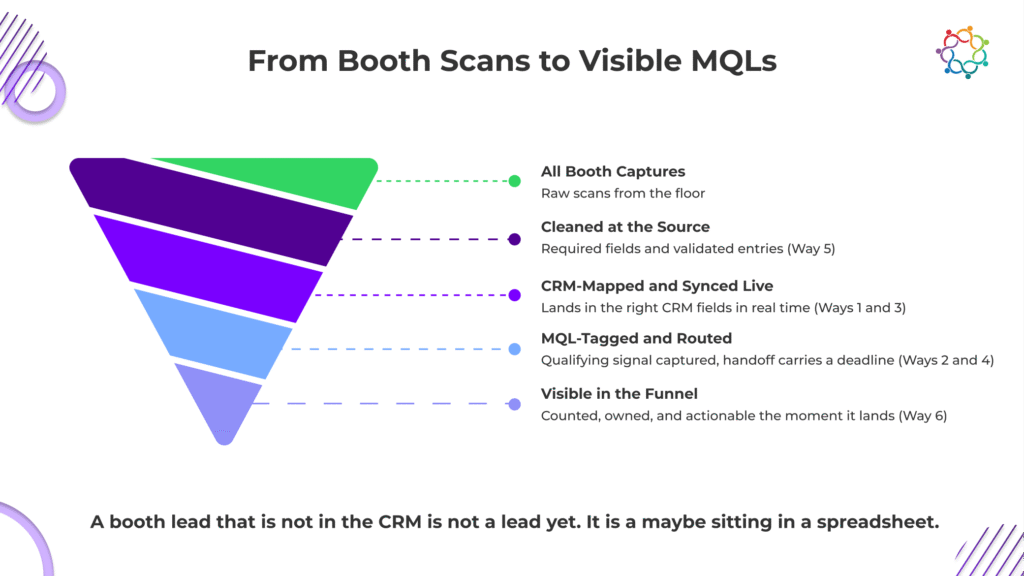
Leads slow down and become invisible in the booth-to-CRM gap. The quickest teams narrow this gap by altering the process, which includes mapping capture, an agreed-upon MQL definition, live sync, a named owner, clean data at the source, and visibility as soon as a lead lands. The week following the event, the winning teams have a booth-to-CRM path so short that there is hardly any distance left to cover.
A booth lead that is not in the CRM is not a lead yet; it is a maybe sitting in a spreadsheet.
Want to see a booth-to-CRM path that runs in real time, with the lead visible the moment it is scanned? For the full window that follows, the post-event follow-up workflow compresses the rest the same way. Book a 30-minute walkthrough.