Samaaro + Your CRM: Zero Integration Fee for Annual Sign-Ups Until 30 June, 2025
- 00Days
- 00Hrs
- 00Min

Key Takeaways (TL;DR)
1
2
3
→
Bottom Line:
Registration takes two days because six steps are manual, sequential, and undocumented.
Event registration closes Friday afternoon. Your team has until Tuesday morning when the event begins. That is the registration week, and it is going to consume significant time from someone on your team.
A small event feels manageable. A mid-sized event breaks someone’s schedule. A large event requires dedicated coordination resources.
This piece maps the six steps that happen during registration week so you see where the time actually goes and why it repeats every event. Event marketing automation is built for exactly this moment.
A SaaS event coordinator processes mid-sized registrations: 200 to 300 people. Confirmations go to each one.
What confirmations require: someone writes the email copy or selects from a template, someone schedules the send, someone checks whether it actually went out. Different people need different messages (speakers, sponsors, attendees), so there is not one confirmation, there are several. Bounce handling is manual.
It feels like part of registration. It is not. It is something that happens after registration closes and makes registration feel complete in people’s minds even though downstream work remains.
Attendees need to know they registered and what happens next. That communication matters. Sending it manually makes it slow. Automated confirmations turn this from a day’s work into a minute’s setup.
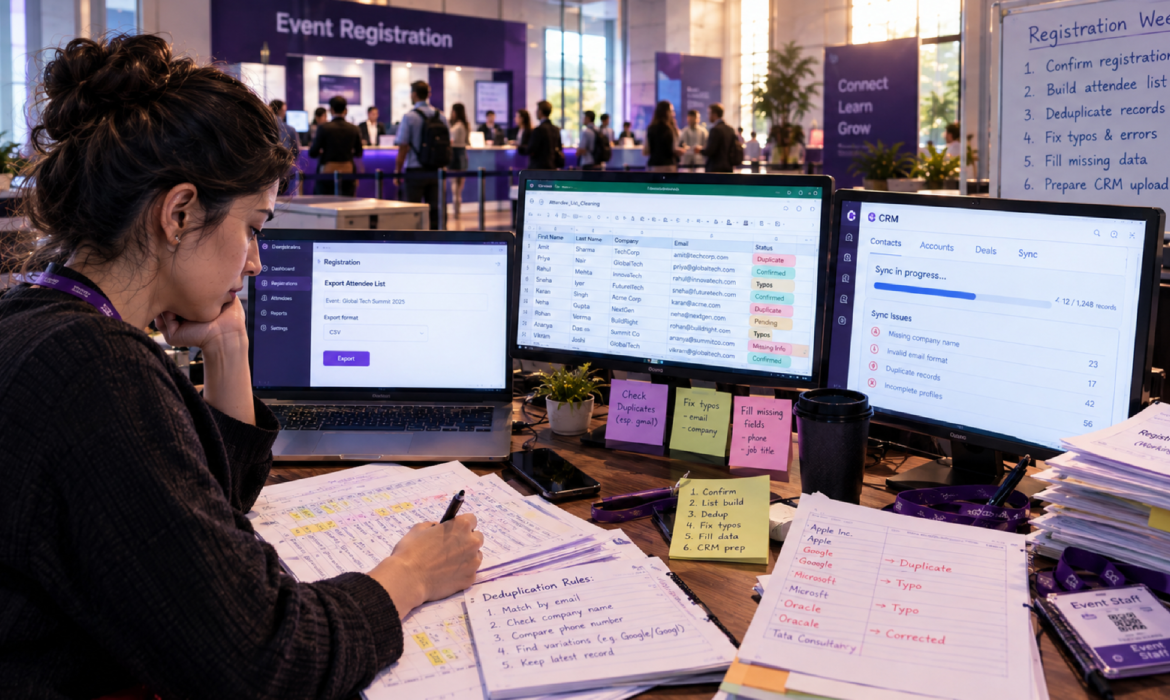
Where the list lives initially: in the registration system, unsorted, with whatever people typed. Export the attendee list. Build it in a spreadsheet because the registration system doesn’t have the structure you need.
What happens next: cross-check names for duplicates (person registered twice, person registered as ‘John Smith’ one time and ‘John J. Smith’ another). Correct typos from signup forms. Fill in missing company data by hand.
Why each step is needed: duplicates skew numbers and confuse follow-up. Typos break account matching. Missing company data means follow-up has no context.
The cost scales with size. A small event takes a few hours. A mid-sized event (300+ people) typically takes a full day or more. The work is not complex, but it is repetitive and hand-crafted for every event because every registration system is different, every spreadsheet structure is different.
Registration lives in one tool. Your CRM lives in another. Sales uses the CRM. So someone has to move the data.
What it looks like: export from registration, reformat for CRM, upload to CRM, check for errors, fix the broken ones, verify counts match.
Why it is not automatic: different systems have different field names, data types, and requirements. A phone number in one system might format differently in another. An account name in one system might need parsing into company and subsidiary in another.
The hidden cost is critical. If the sync breaks or someone skips it, follow-up sales work never happens. Registrants live in the registration system but sales works from the CRM, so they never see each other. Nobody owns the sync, so it gets delayed or skipped.
Every step in registration is a rule. If someone registers, send this. If they don’t confirm, nudge them. If their account name has a typo, fix it. If they’re a duplicate, merge them. These are rules.
Why it stays manual: the process is so obvious it doesn’t feel like it needs documentation. Everyone knows what to do. Except everyone does it slightly differently, so new coordinators learn by watching, not from a guide.
Not that your team is disorganized, but that your team is running an undocumented process and expecting new people to learn it by osmosis.
Each new coordinator takes a week to get up to speed. Each event, someone invents a slightly different approach and the next person wonders why. The process is invisible because nobody complains about it. It is just ‘the job.’
Event registration takes two days because six steps are manual, sequential, and connected by a person, not by a system.
Before the next registration period, document what your team actually does, in order, for every registration that comes in. That document becomes the blueprint for automating your event registration process.
To see how registration platforms and automated workflows run that blueprint, talk with Samaaro.
Why does registration processing take so long?
Because six steps (confirmations, list building, dedup, typo fix, data fill, CRM sync) are manual, sequential, and undocumented. Each step is rule-shaped and automatable, but none of them run automatically.
What is the biggest time sink during registration week?
Building and cleaning the list takes the most hours. Dedup, typo correction, and filling missing data are all manual. A 300-person event is 4 to 6 hours of spreadsheet work.
Can you automate event registration confirmations?
Yes. Confirmations are if-then rules: if someone registers, send this email. Different confirmations for different groups (speakers, sponsors, attendees) run on the same principle and trigger automatically.
Why doesn’t the CRM automatically sync with the registration system?
Different systems have different field names, data types, and requirements. Phone numbers, account names, and other fields need reformatting. That translation work is currently manual but can be automated.
What is the first step to reduce registration time?
Document what your team actually does during registration week, step by step. That document becomes the workflow you can then automate, removing the manual work and coordination cost.

Samaaro is an AI-powered event marketing platform that enables marketing teams to turn events into a measurable growth channel by planning, promoting, executing, and measuring their business impact.
Location


© 2026 — Samaaro. All Rights Reserved.