Samaaro + Your CRM: Zero Integration Fee for Annual Sign-Ups Until 30 June, 2025
- 00Days
- 00Hrs
- 00Min


Key Takeaways (TL;DR)
1
2
3
→
Bottom Line:
The fastest-closing ABM teams are not the ones with the best account lists; they are the ones who know exactly when an account shifts from aware to ready.
Your ABM team identified 200 target accounts last quarter. Sales built sequences, launched outreach, and ran the plays. Response rate: 4 percent.
Of the accounts that responded, most conversations began with “tell me what you do,” not “we have been evaluating options.” After three months of targeted outreach, the first sales call is still just an introduction.
This is not a targeting failure. The accounts were right. The ICP was tight. The outreach was personalised. The failure is a timing failure, and it is one that most ABM programs never acknowledge because timing is harder to measure than coverage.
ABM is exceptional at answering who to engage. It is structurally weak at answering when an account is actually ready to engage.
The result is predictable. Sales enters account conversations before those accounts have built the internal context or alignment to evaluate a solution. The first call does work that should have happened weeks earlier, and pipeline entry gets pushed back by exactly that margin.
The gap is not between marketing and sales. It is between account identification and account readiness. ABM closes the first with data and segmentation. Almost nothing in a standard ABM program is designed to close the second.
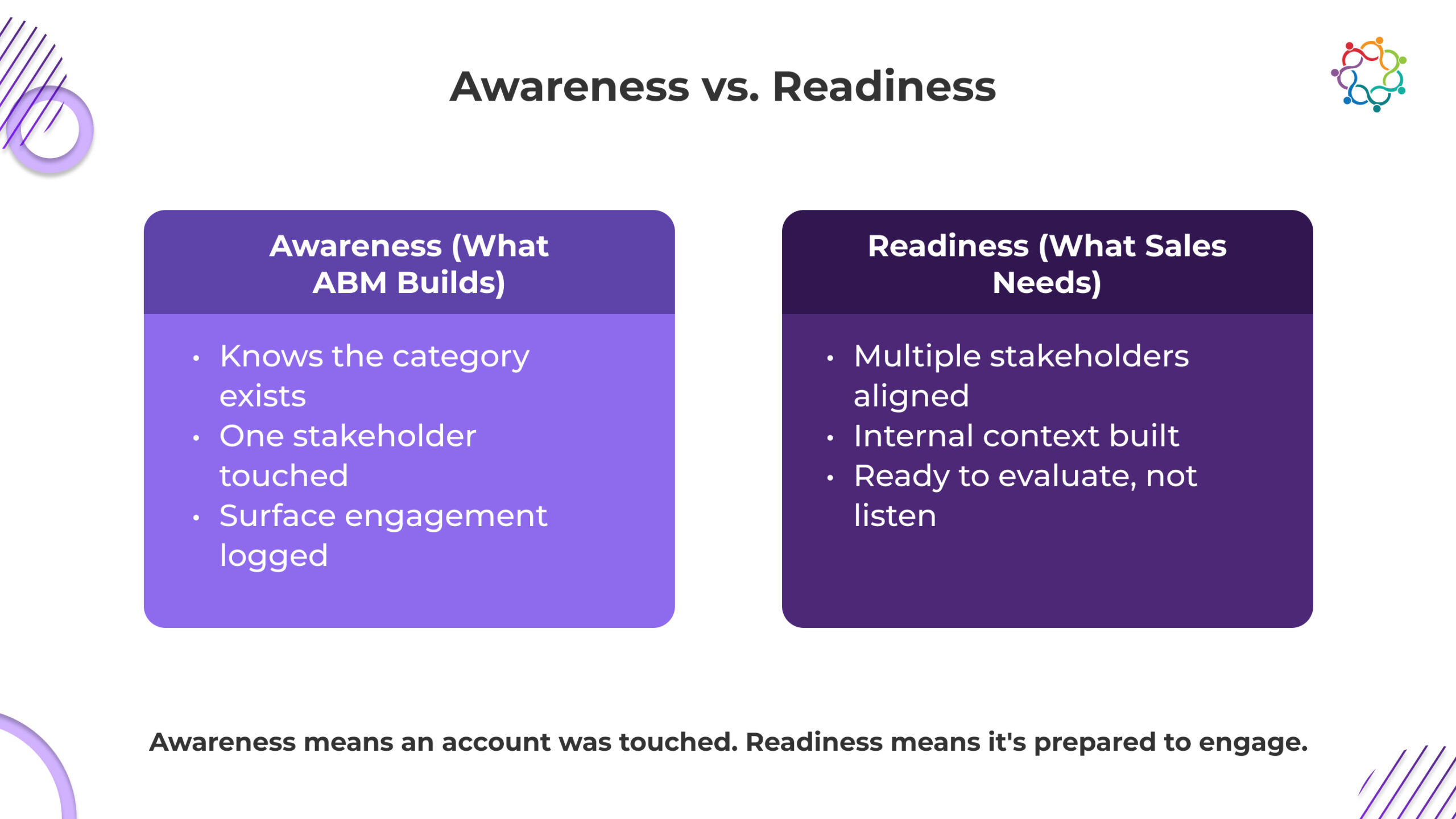
Readiness is not awareness, and conflating the two is where most ABM pipelines stall before they start.
An account is aware when it knows your category exists. An account is ready when its buying group has built enough shared context to evaluate a vendor rather than just inquire about one. The gap between those two states is wide, and outreach alone cannot close it.
Awareness is not a buying signal.
An account that recognises your category exists has learned something. Its buying group has not necessarily built anything. Recognition lives in individual heads. Readiness lives in the shared context that a group of stakeholders has developed together, enough that they can look at a vendor and evaluate rather than inquire. That is a different state, and no amount of individual exposure produces it automatically.
Traditional ABM optimises for coverage, not readiness.
Most programs measure engagement as ad impressions, email opens, content clicks, and whitepaper downloads. These metrics are useful for tracking activity. They are useless for determining whether a buying group is prepared to evaluate a solution at the depth a sales conversation requires. Surface interactions tell you an account was touched. They say nothing about whether the people inside that account are aligned, informed, or ready to have a productive vendor conversation.
Skipping readiness transfers the burden to sales.
When ABM moves accounts from targeting straight into outreach without building readiness, the first sales call becomes a teaching session. The second call does what the first should have done. By the third, the account may have moved toward a competitor whose marketing did the conditioning work ABM skipped.
Readiness has to be built deliberately.
It does not emerge from enough ad frequency or enough follow-up emails. It requires structured, multi-stakeholder engagement that gives a buying group the context and confidence to evaluate rather than just listen.
The channel that builds readiness most efficiently is one that most ABM programs treat as an afterthought.
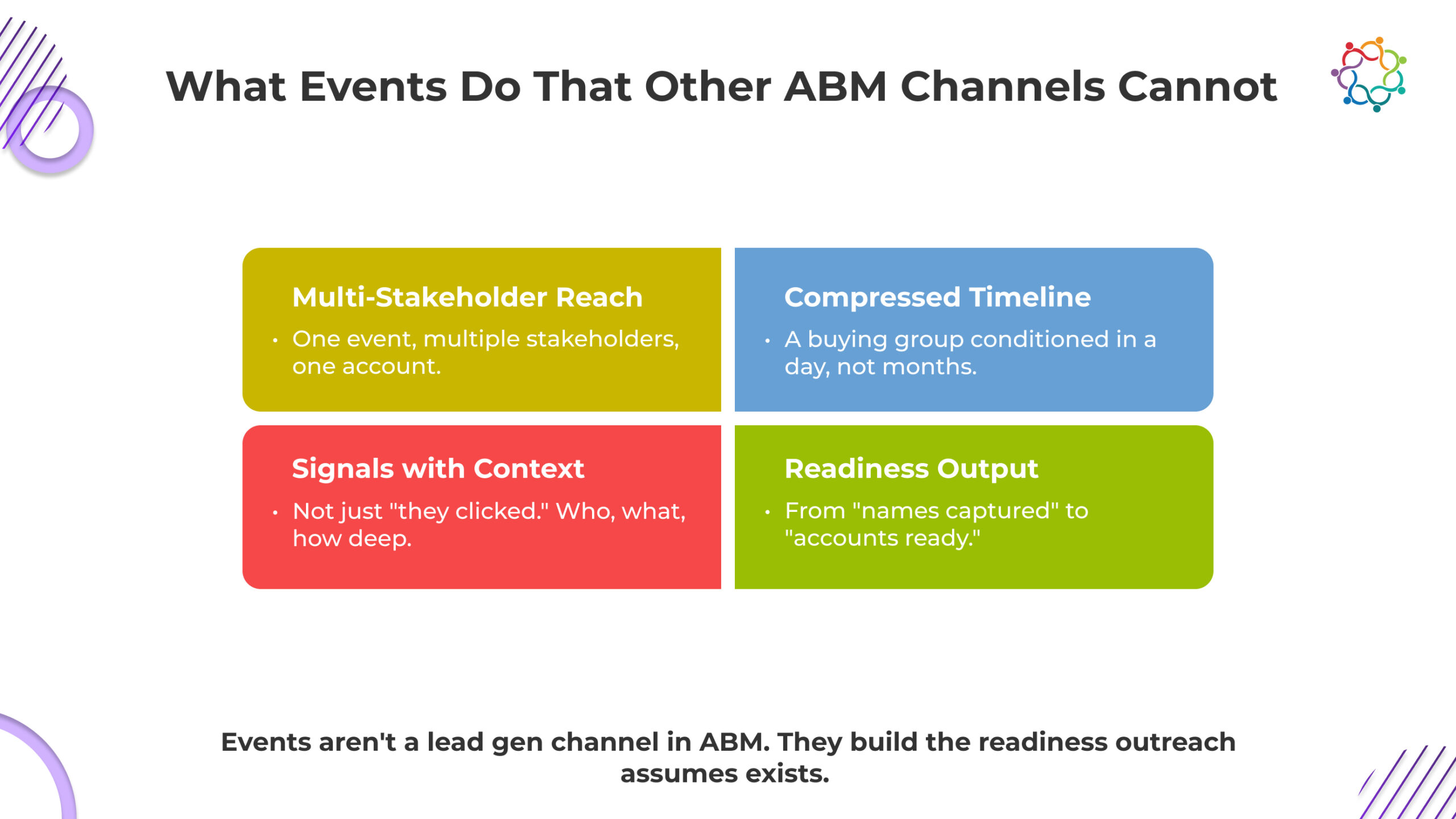
Events are not lead generation channels in an ABM context. They are pre-sales conditioning systems, and the distinction changes everything about how they should be planned, measured, and connected to the wider ABM motion.
Lead generation asks how many names were captured. Conditioning asks which accounts now have enough context and multi-stakeholder exposure to engage sales in a genuine evaluation conversation. These are fundamentally different questions.
What events can do that no other ABM channel replicates:
Event-led ABM positions events as the mechanism that moves accounts from aware to ready before sales enter the picture. This is not a supplementary tactic. It is the structural layer that most ABM programs are missing entirely.
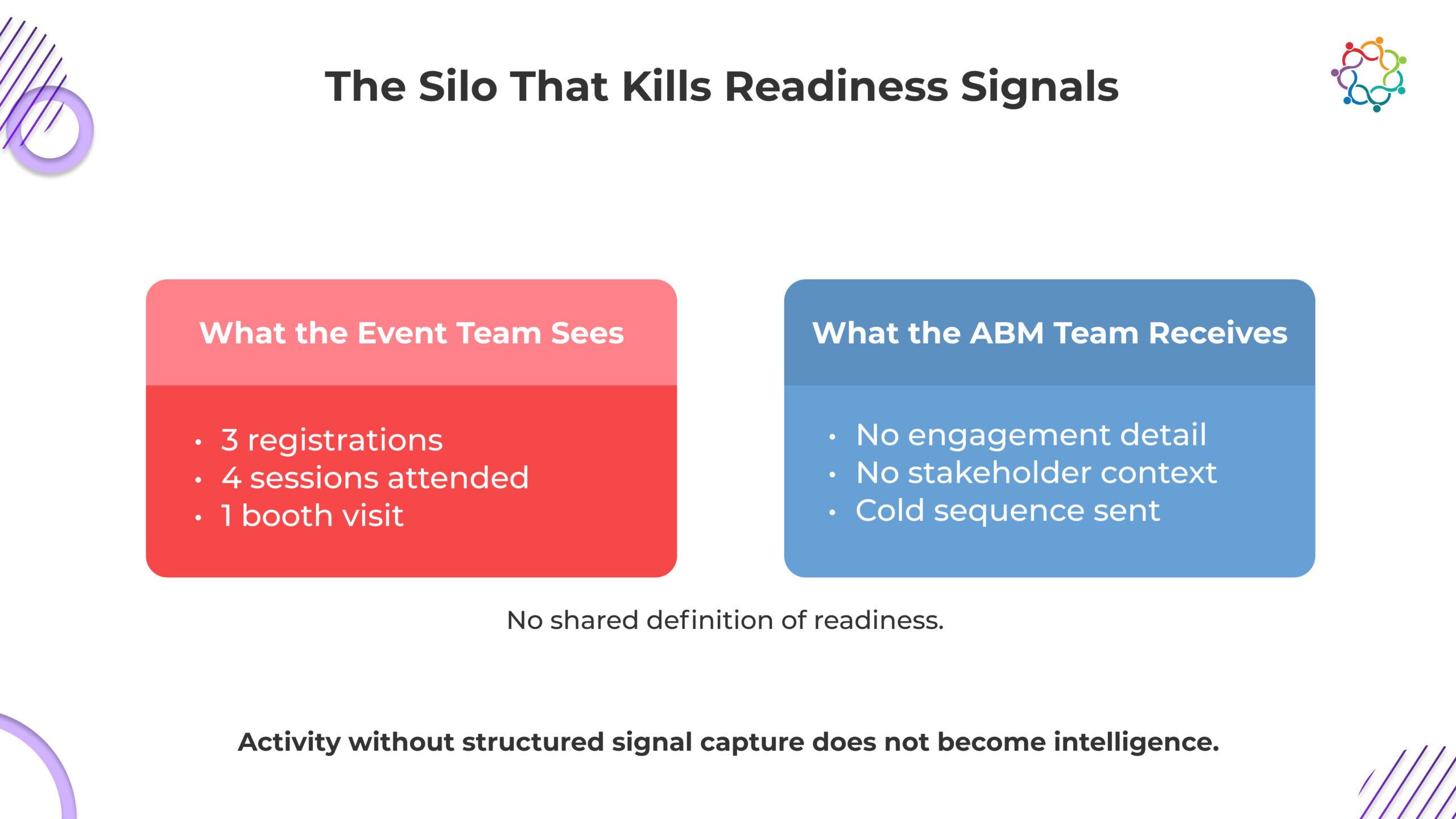
The event-ABM connection breaks in practice not because events fail to generate signals, but because those signals never reach the systems that could act on them.
Events live in one team’s remit. ABM lives in another. The event team measures registrations, attendance rates, and session satisfaction scores. The ABM team measures account coverage, pipeline sourced, and outreach response rates. Neither operates with a shared definition of account readiness, and neither has a shared system for tracking it across the account lifecycle.
A shared readiness definition might be as simple as this: an account is ready when two or more stakeholders from the buying group have engaged with event content at depth and the account’s deal stage in the CRM reflects active evaluation. That is a definition both teams can track against, and almost no one has one.
What this looks like in practice: a target account sends three people to your annual conference. They attend four sessions, ask substantive questions in two, and spend fifteen minutes at your booth discussing a specific operational challenge. The event team logs three registrations and one booth visit. The ABM team never sees the session-level detail. Sales sends a standard cold sequence two weeks later with no reference to any of it.
The engagement happened. The conditioning happened. But because it was not captured with context and fed into the ABM system, it functionally did not happen from a pipeline perspective.
The root cause is not poor execution. It is the absence of a shared system for capturing and routing event signals. Events generate readiness signals continuously, but signals without structured capture do not become intelligence. They become noise. And when ABM teams cannot see what events are producing at the account level, they keep treating events as a separate channel rather than the conditioning layer that the entire motion depends on.
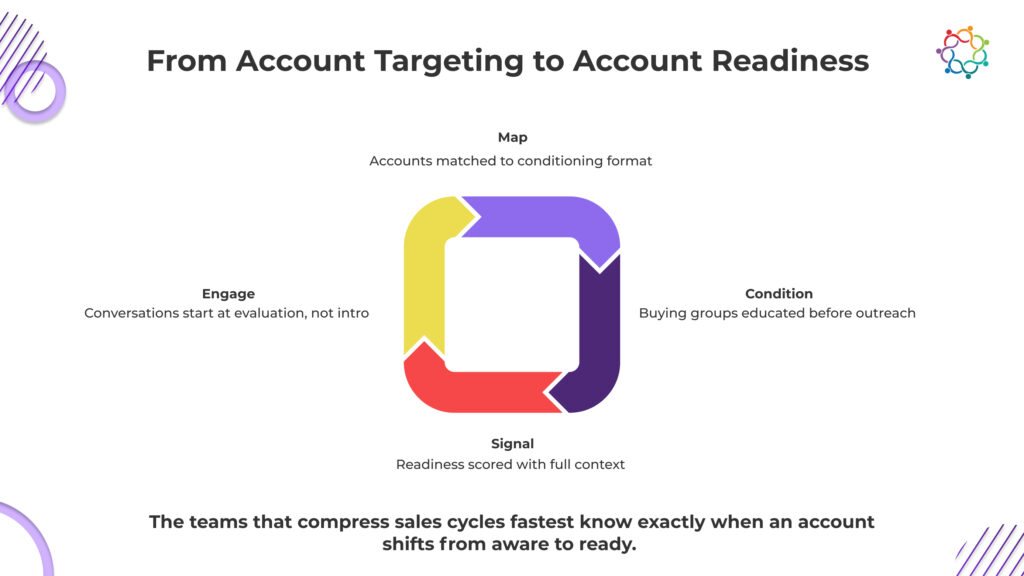
A B2B SaaS company running a serious account-based motion starts the quarter with 50 target enterprise accounts. Rather than sequencing all 50 into immediate outreach, the marketing team maps each account to an event format that matches its readiness stage.
Ten accounts showing active evaluation signals get invitations to an executive dinner: intimate, peer-led, focused on a specific strategic challenge, with no product pitch and no slides. Fifteen accounts in early exploration get routed to a half-day workshop where the problem space is defined collaboratively. The remaining 25 accounts, still in category awareness mode, get access to a conference track designed to educate without selling.
Before each event, invitations are written around the specific challenge each account is navigating. The reason to attend is grounded in the account’s context, not the host’s agenda.
During the events, engagement is tracked at the account level rather than the individual level. Which accounts sent more than one stakeholder? Which sessions triggered the most questions? Which booth conversations ran long, and what drove them? All of this becomes readiness data, not attendance data.
After the events, accounts are scored on readiness and routed to sales with full contextual briefings. The ten accounts from the executive dinner do not receive a standard discovery call. They receive an opening from a sales rep who knows exactly who attended, what concern was raised, and what the account said it was trying to solve.
The pipeline impact is direct. Sales conversations begin at evaluation depth rather than education depth. Decision cycles compress because conditioning preceded outreach. Conversion rates improve because accounts are engaging by choice after readiness has been built, not by interruption before it has.
ABM has spent a decade getting better at the targeting question. Account scoring is sharper. ICP definitions are tighter. Intent data is more granular. The “who” problem is largely solved for mature teams, and solving it produced real pipeline improvements.
But the “when” problem has been left almost entirely unaddressed.
Timing failures are invisible in most pipeline reports. A deal that took four months to close when it could have taken two does not show up as a failure. It shows up as a closed-won with a long sales cycle, and the weeks of unnecessary education at the top of the funnel disappear into the background.
Event-led ABM is not a new channel to bolt onto an existing motion. It is the structural answer to a timing question that targeting precision will never resolve on its own.
The shift it requires is not in the budget or campaign architecture. It is in how events are defined, positioned, and connected to the systems that govern account progression. When events are treated as conditioning systems rather than lead generation channels, they do something no amount of outreach precision can replicate: they move accounts from aware to ready before sales ever enter the room.
The ABM teams closing deals fastest are not running more targeted campaigns. They are building readiness before outreach begins, and events are the primary mechanism they use to do it.
Samaaro helps B2B teams capture account-level engagement signals across events, from session attendance to booth conversations, and feed them directly into CRM workflows so sales enter with context, not cold. See how it works.
For more on why events remain the highest-leverage channel for B2B tech buyers, read: Why B2B Tech Companies Still Invest in Events in a Digital-First World