Samaaro + Your CRM: Zero Integration Fee for Annual Sign-Ups Until 30 June, 2025
- 00Days
- 00Hrs
- 00Min

1
2
3
→
Bottom Line:
Event sponsorship ROI is determined before the event by how clearly outcomes, signals, and ownership are defined.
Your company spent $40,000 sponsoring a tech summit last quarter. The booth looked sharp. The team was energetic. The badge scanner worked. Three weeks later, your CEO asks about the investment’s results, and you pull up a spreadsheet showing 200 badge scans, 14 “qualified conversations,” and a note that reads, “strong brand visibility.”
The silence after you finish presenting is not an awkward pause. It is the sound of measurement failure.
This is a scene that plays out in marketing reviews across SaaS, fintech, and medtech companies every single quarter. The discomfort in that room is not about the event. The event probably went fine. The discomfort is about the fact that $40,000 was committed to an outcome nobody defined, tracked with metrics that cannot connect to the pipeline, and reported in a format designed to fill space rather than answer a question.
The problem is not that your team failed to execute. The problem is that event sponsorship ROI was never built into the structure of the investment from the start. The metrics you collected after the event are not measurements. They are retrospective justification dressed up as reporting. And until that distinction is taken seriously before the next cheque is signed, the spreadsheet moment will keep happening.

Walk through any well-run B2B event, and you will find competent execution everywhere. Booths are designed to specification. Branding is consistent. Sponsored sessions are delivered on time. The operational layer works.
The failure is not in what happens on the floor. It is what happens after the floor clears that influences.
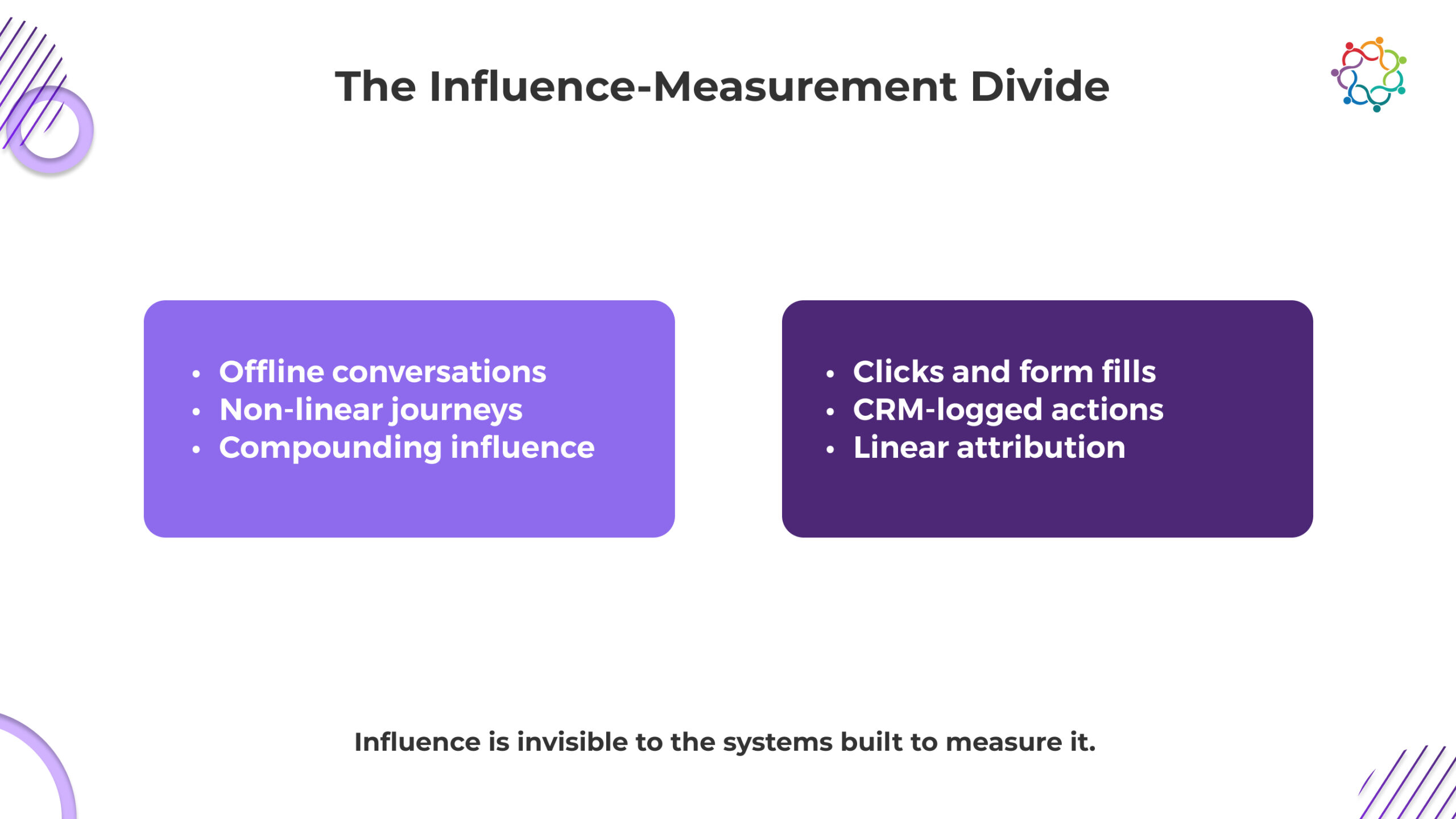
Sponsorship operates in a fundamentally hostile measurement environment. The event organiser controls most of the audience data. The highest-value interactions are offline conversations that leave no digital trace. The buyer who heard your session, spoke to your rep, and picked up a case study on Tuesday may not make a purchase decision for another four months, in a conversation you were never part of and cannot see.
This is not a gap your team created. It is a structural feature of how B2B sponsorship works.
The core tension here is simple and consistently underestimated: sponsorship generates influence, and measurement requires traceability, and those two things operate in entirely different systems. Closing the gap between them requires more than better follow-up. It requires a different approach to how the investment is scoped before the event begins.

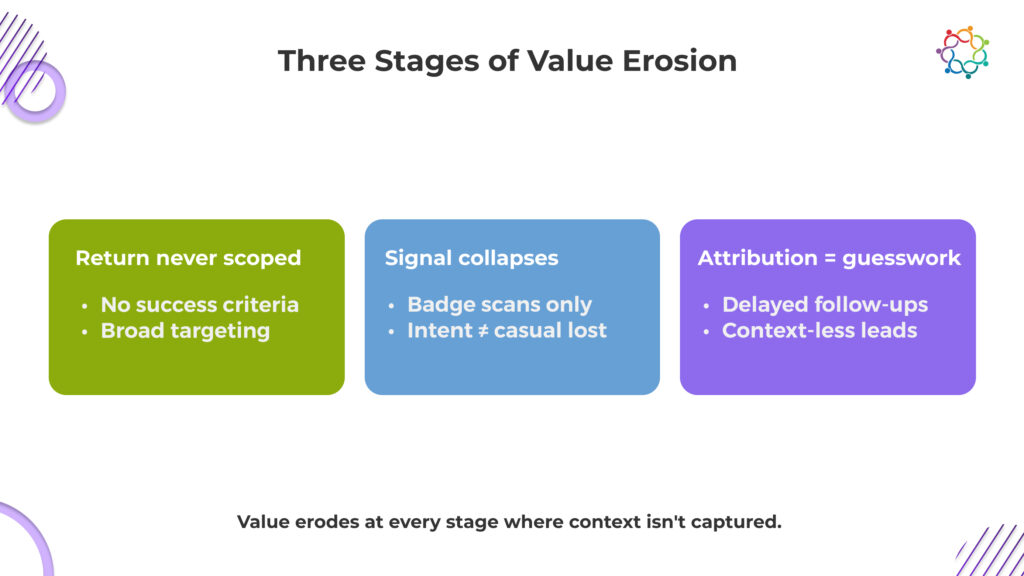
If you trace the lifecycle of a sponsorship investment, the return does not disappear in one moment. It leaks in three distinct stages, and each stage has a different mechanism of failure.
Before the Event: Return Was Never Defined
Most sponsorship commitments are made without a defined outcome. Not a vague outcome like “increase brand awareness” or “generate leads,” but a specific, measurable outcome tied to a business target: pipeline generated, opportunities influenced, accounts engaged.
When success is not scoped before the investment is made, every metric collected after the event becomes arbitrary. You can report 200 badge scans or 14 conversations, but neither number means anything without a benchmark against which to measure it. The measurement problem at the end of the quarter almost always traces back to a scoping problem at the beginning of the cycle.
During the Event: Signals Collapse in Real Time
On the event floor, activity is high, and usable intelligence is near zero. Badge scanners capture presence, not intent. The VP evaluating your product and the attendee who stopped for a free pen generate identical data points in your system.
Conversations happen, but the context of those conversations is rarely captured in any structured way. What was discussed, which product areas resonated, what objection was raised, and what the buyer said they would do next are all details that live in the heads of your booth staff and begin fading within hours of the event closing.
After the Event: Attribution Becomes Guesswork
By the time follow-up emails are sent, the connection between the original interaction and the sales motion has already broken. Leads enter the CRM without context. Sales reps open conversations cold, referencing an event the prospect may barely remember.
The pipeline influence from that $40,000 investment does not disappear because it never existed. It disappears because the links between conversation, intent, and deal movement were never captured in a form that could be used.

There is a specific reason sponsorship underperformance goes unnoticed for so long: the metrics used to justify the investment are the same metrics that prevent anyone from seeing the gap.
Consider the input-output chain as it typically runs:
Each of these produces a number that looks like a result. Booth traffic of 300 looks productive. A lead list of 150 looks healthy. An email open rate of 22 percent looks reasonable. None of these numbers tells you whether the investment moved a single deal forward.
This is where sponsorship reporting becomes self-reinforcing. The numbers are busy enough that the right question never gets asked. Volume substitutes for value, and because the dashboard looks populated, nobody pushes on whether any of it means anything. The metrics most commonly used to justify B2B event sponsorship are precisely the metrics that create false confidence about B2B event sponsorship.

At this point, a reasonable response is to conclude that better execution would fix the problem. Brief the booth staff more thoroughly. Follow up faster. Tag leads more carefully in the CRM. These are execution improvements applied to a measurement design problem. They make the current system slightly less bad. They do not fix the system.
The underlying issue is a design flaw in how sponsorship measurement is owned.
Event teams own the experience. Revenue teams own the pipeline. Neither team owns the connection between the two. The interaction that happened at the booth and the deal that eventually closes six months later are separated by a chain of handoffs, system boundaries, and ownership gaps that no amount of individual effort can bridge without structural design.
Attribution models built for digital marketing assume a traceable click path: an ad impression, a landing page visit, a form submission, a conversion. Offline influence that compounds across weeks and multiple touchpoints fits none of those models.
This is not a failure of effort or intelligence. It is a mismatch between the measurement architecture and the actual mechanism by which sponsorship generates value.
Until the connection between event experience and revenue outcome is treated as a shared system owned jointly by event, marketing, and sales, the sponsorship measurement gap will persist regardless of how good the event was or how hard the team worked.
The single most effective thing a marketing leader can do to improve event sponsorship ROI has nothing to do with what happens at the event. It has to do with what gets defined before the contract is signed.
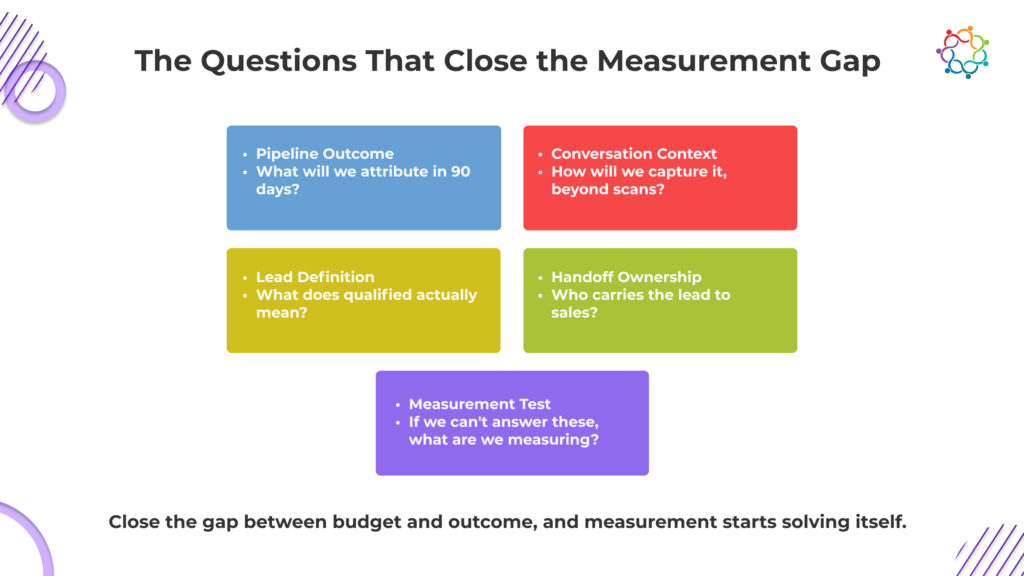
These five questions are not a checklist. They are a forcing function. If you cannot answer them before the event, you are not ready to commit the budget:
Most sponsorship ROI is not lost after the event ends. It is lost before the sponsorship is signed, in the gap between committing the budget and defining what that budget is supposed to produce. Close that gap, and the measurement problem starts solving itself.
The spreadsheet moment at the top of this blog is preventable. That is the gap Samaaro closes. Book a walkthrough.

Samaaro is an AI-powered event marketing platform that enables marketing teams to turn events into a measurable growth channel by planning, promoting, executing, and measuring their business impact.
Location


© 2026 — Samaaro. All Rights Reserved.