Samaaro + Your CRM: Zero Integration Fee for Annual Sign-Ups Until 30 June, 2025
- 00Days
- 00Hrs
- 00Min

Key Takeaways (TL;DR)
1
2
3
→
Bottom Line:
Attendance rose 15 percent, satisfaction climbed 8 percent, manual setup hit zero, same team underneath.
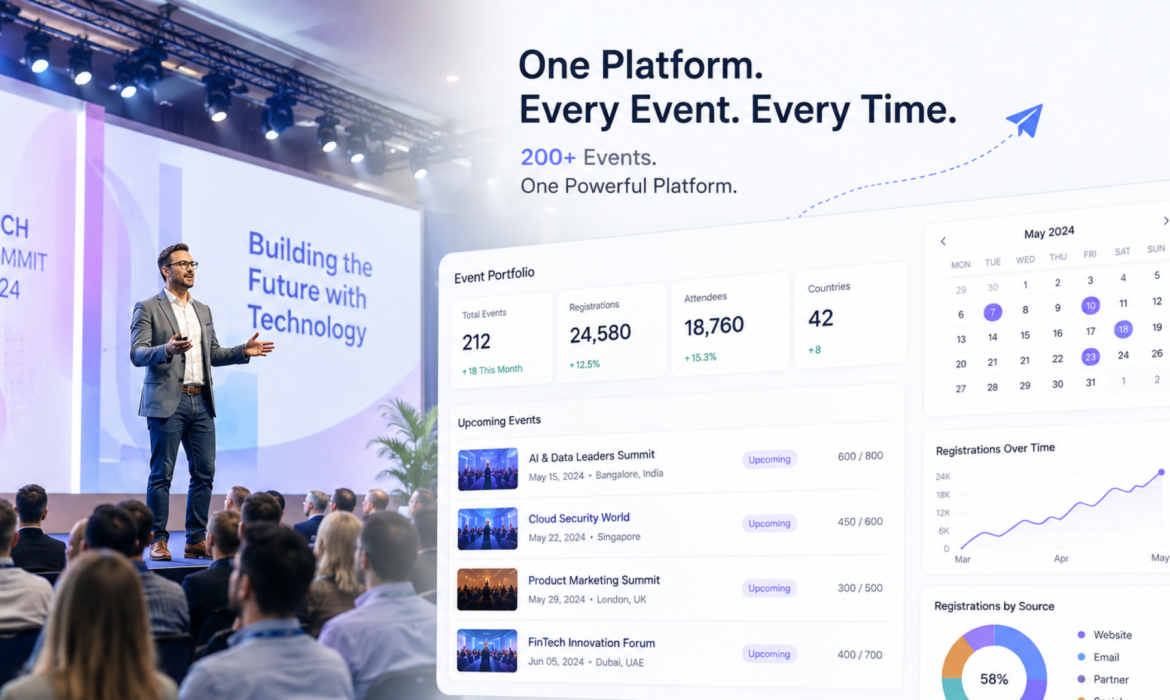
Most marketing teams consider a dozen events a year a stretch, and many feel stretched well before that. TechTalk Summits hosts over 200 events across a calendar that rarely has a quiet week, with a team of twenty. The obvious question is the only one worth asking: how does a team that size keep that many events running without falling apart?
The concise response is that TechTalk manages event management at scale by consolidating its entire portfolio onto a single platform, rather than creating a distinct tool suite for each event. Instead of re-creating each event from the ground up, they reuse the setup, conduct multiple events simultaneously from a single view, and allow the repetitive administrative tasks that typically burden a small team to complete themselves. That combination is what lets twenty people operate a calendar that would otherwise demand a far larger team, or a lot of dropped balls.
What follows is the operational version of that answer, lever by lever, drawn from TechTalk’s own story on Samaaro. These are the decisions that make the volume possible, and most of them apply to any team whose event calendar is growing faster than its headcount.
TechTalk Summits runs face-to-face networking events for IT decision-makers. Their events bring CIOs, cybersecurity leaders, and solution providers into the same room to work through mission-critical problems, with the conversation centered on data security, cloud transformation, and where enterprise IT is heading. The format is high-touch and relationship-driven, the kind of event where the experience in the room is the whole point, and they run more than two hundred of them in person every year.
That scale is exactly why their setup is worth studying. For TechTalk, events are the entire business, which makes them one of the most demanding event operators around, and a high-volume, high-frequency calendar is the hardest test an event platform can face. Software that holds up across two hundred in-person events a year, run by twenty people, has been tested far harder than software carrying a few annual conferences. So how they manage it matters well beyond their niche: it is the scaling problem most growing event teams meet, just at a smaller scale. You can read the full account in TechTalk’s case study; this piece pulls out the operational levers behind it.
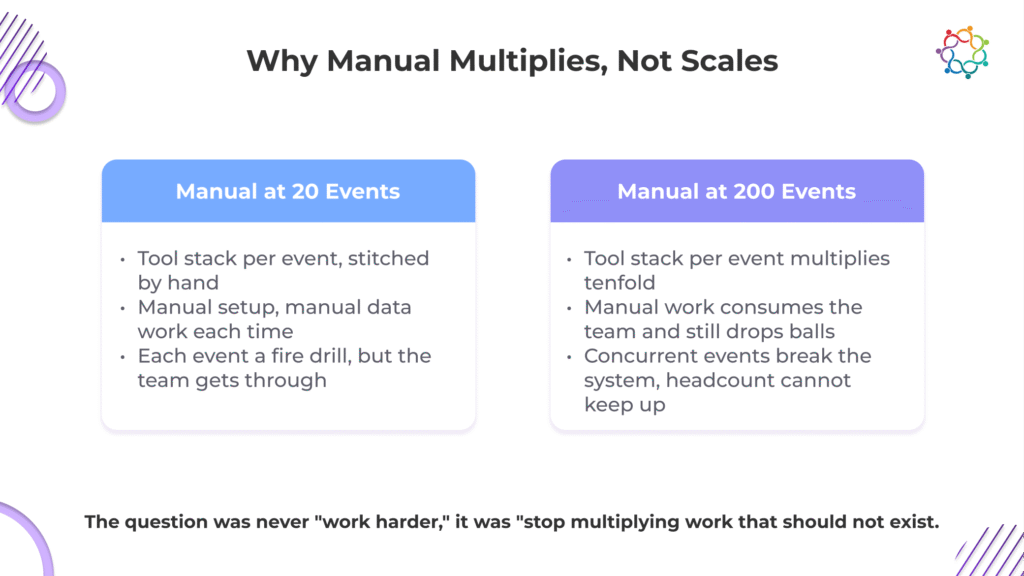
Run a few events a year and a stitched-together approach holds. A spreadsheet here, a forms tool there, an email platform for invites, a separate system for check-in. It is messy, but it works. Run two hundred, and that same approach multiplies. Every manual step you did once for a single event, you now do hundreds of times, and when a dozen events overlap in the same stretch of weeks, the cracks turn into breakages.
Before Samaaro, TechTalk felt this directly. Their stack had carried them through years of growth, ON24, Google Forms, spreadsheets, and email tools, but at their volume the manual work had become unsustainable, and the problems were the ones any high-frequency operator will recognize:
The headcount is the deeper point. Because you cannot hire quickly enough to keep up with a calendar that grows faster than you can staff it, hand stitching at this volume would devour the entire crew and yet leave balls dropped. There was no way to close that gap by working more. The objective was to run the volume without tripling the staff and without a malfunctioning system.
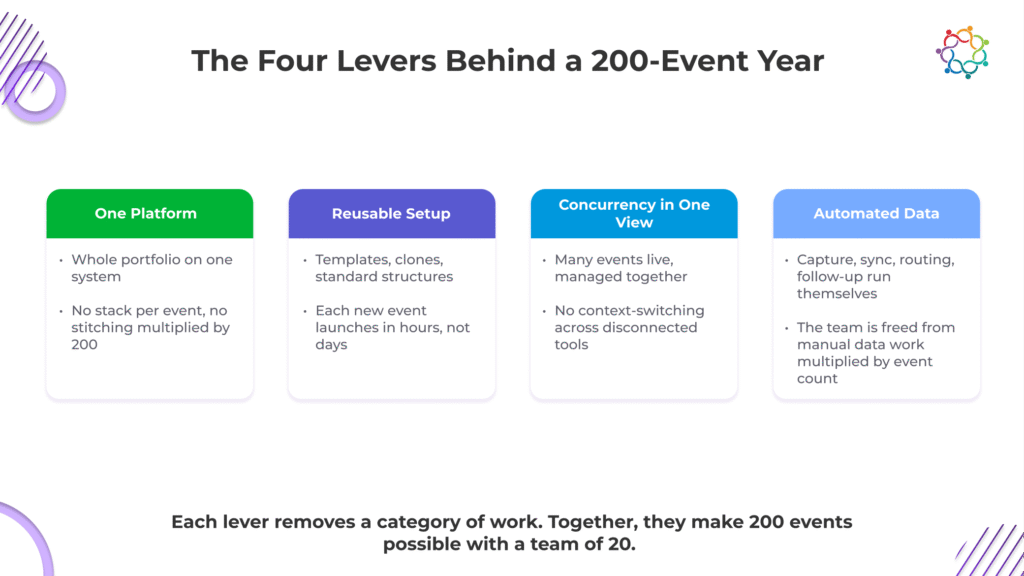
The foundation of everything else is consolidation. Instead of assembling a set of tools for each event, TechTalk now runs the whole portfolio on a single platform, one system standing behind every event on the calendar. Samaaro replaced the old stack with what the team treats as a single source of truth for operations and engagement, so work that used to be spread across four or five disconnected tools happens in one place.
For a team running at this volume, that is the difference between feasible and not. The clearest example is how their events get into the system at all. Using custom APIs, Samaaro connected TechTalk’s website directly to the platform’s backend, so more than two hundred events import in one click into a central admin dashboard, with no manual setup and nothing lost in transfer. From that one dashboard, the admin team can see every event in a single view, assign the sub-admins and hosts who run each one, push an agenda change across events in seconds, and preview the attendee experience before anyone arrives.
The contrast with the old way is stark. A team running this many events on a stitched stack would spend most of its hours moving the same data between tools that were never built to talk to each other. On one platform, that category of work mostly disappears, because the data already lives in one place.
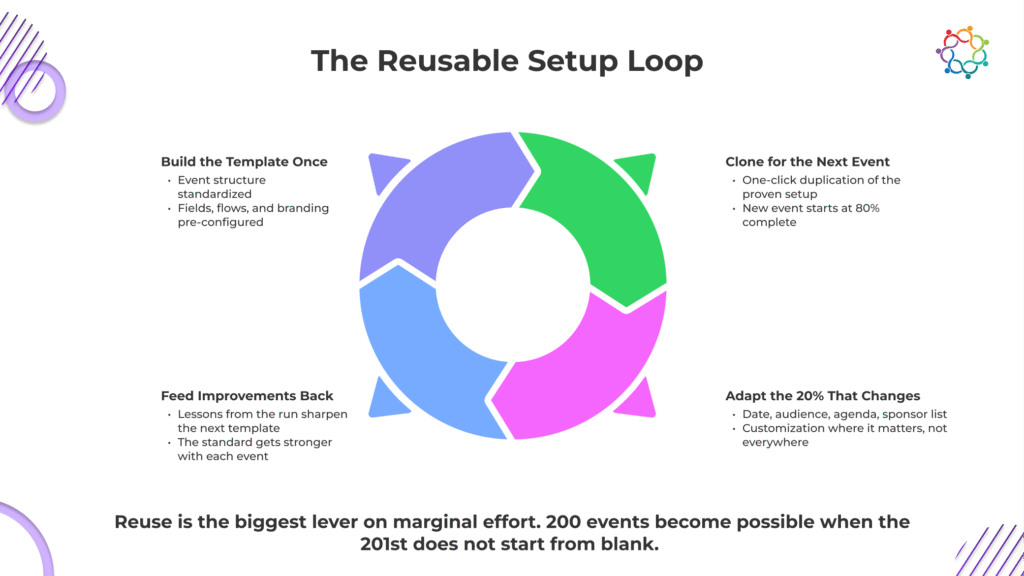
If consolidation is the foundation, reuse is the lever that does the heavy lifting. The reason twenty people can stand up event after event is that they are not building each one from scratch. Setup is reused rather than recreated, so launching the next event is a quick configuration instead of a project.
TechTalk’s sponsor booths are the clearest illustration. Creating digital booths for hundreds of sponsors used to be slow, manual work, rebuilt for every event. Samaaro replaced that with what it calls an Event Exhibitor Key. Each sponsor booth is built once in Showcase, the platform’s lead capture module, complete with branding, meeting scheduling, lead forms, and live analytics. To put that booth into any event, an admin pastes the exhibitor key into the dashboard, and the booth appears, fully configured. A per-event build becomes a single reusable asset deployed in seconds.
The same logic runs through the rest of their setup. Agenda changes sync across events in seconds instead of being re-entered one event at a time, and the engagement setups that were once duplicated for every event are configured once and reused. The marginal effort of the next event is what decides whether twenty people can run twenty events or two hundred, and reuse is the biggest single lever on that number. It is also why the team reports zero manual setup as one of its outcomes.
A packed calendar’s real difficulty is concurrency, the weeks when several events are live at once and a small team is moving between all of them. Run each event as an isolated scramble in its own set of tools, and overlapping events collide, people lose track of which event they are even in, and context-switching eats the day.
TechTalk’s team runs the portfolio in parallel from a single view instead. Samaaro’s Host Event List gives each team member one personalized screen showing every event they are assigned to, its status as upcoming, live, or completed, and a direct link into any event’s dashboard. There is no hunting across tools and no separate login per event. Underneath, a central admin dashboard holds the whole portfolio, while each event also has its own sub-admin dashboard for live attendee tracking, QR check-ins, polls and surveys, and sponsor booth controls, all managed from one screen that includes the reception desk and live Q&A.
The contrast with a stitched setup is the whole story of concurrency. Running three events in the same week can break a team working across disconnected tools, because there is no single place to see them and every switch means another login and another context. Running dozens at once is routine when they all live in one system and a single view shows what is happening across the calendar.
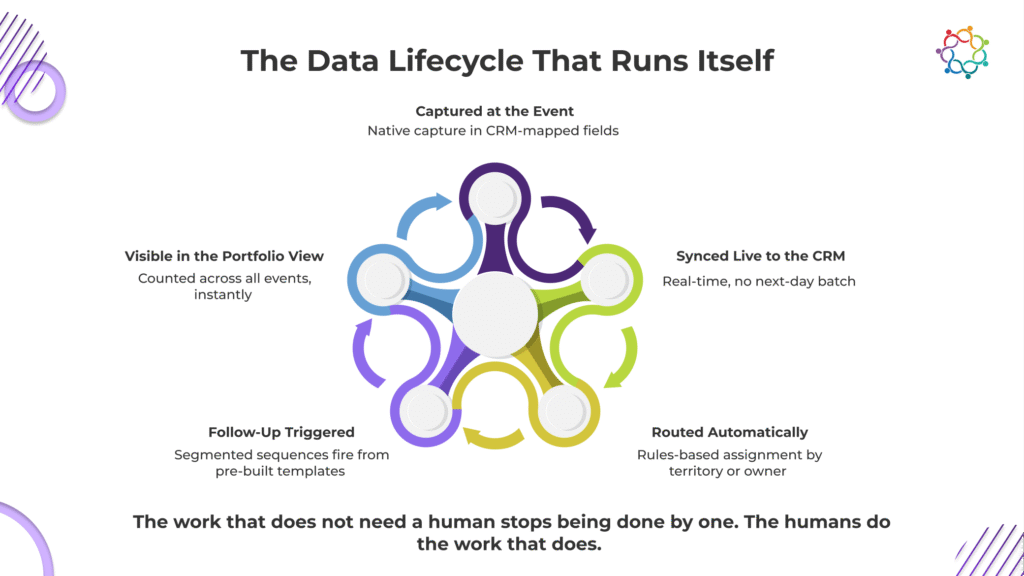
The fourth lever is what ties the headcount story together. The admin that usually grows in lockstep with event count, the sending, the chasing, the manual data entry, the report-stitching, largely runs on its own, so a team of twenty is not doing it two hundred times over.
A few examples from TechTalk’s setup show what that means in practice:
The payoff is where the headcount math closes. Because the platform handles the mechanics, the twenty people spend their time on the work that genuinely needs humans, designing the experience in the room, building sponsor and attendee relationships, and making each event feel personal instead of mass-produced. That is the real shape of scaling without headcount: it takes the grind that never needed a person off the team’s plate, which leaves the people free for the work only people can do.
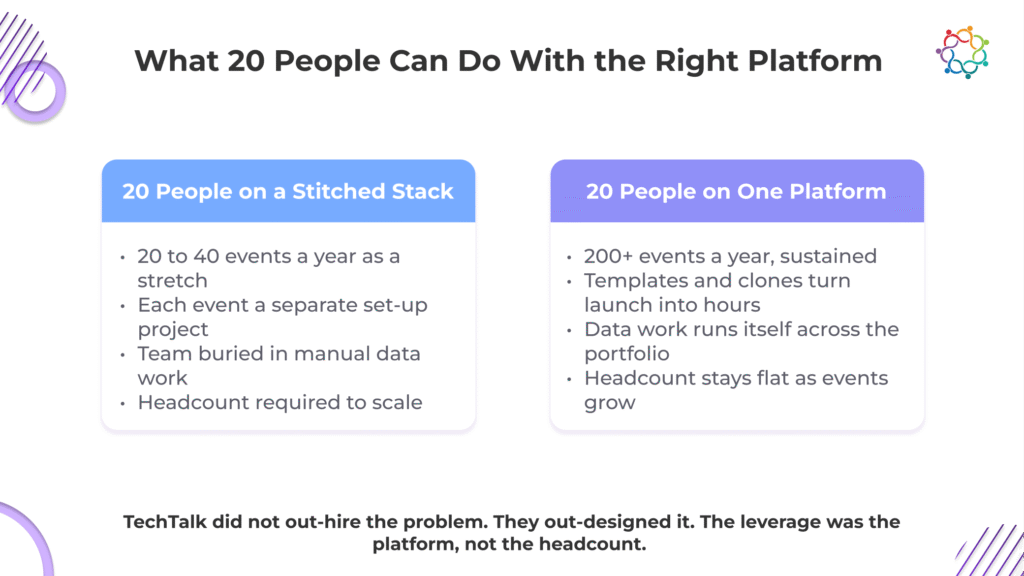
Put the four levers together, and the results show up in the numbers TechTalk reports. Attendance rose by fifteen percent, helped directly by the move to multi-channel communication, since invites and access details that once disappeared into spam now reach people by email, SMS, and WhatsApp, so more of the people who registered actually show up. Satisfaction climbed eight percent, a sign that the experience itself got better as the operational friction came out of it. And the manual setup that used to start every event dropped to zero.
It is worth being clear about what produced those numbers. They come from how the work is structured, the four levers above, rather than from a larger team. The same twenty people are running the calendar, and what changed is the system underneath them.
John Healy, Head of Operations at TechTalk Summits, put the experience this way: “Samaaro’s check-in solution is fantastic, ensuring a smooth guest experience, and their around-the-clock support means we’re never left without expert help whenever we need it.” For an operation running events almost every week, a system that holds up on the floor and support that answers when something breaks is much of what keeps the volume sustainable.
The takeaway from TechTalk is simple to state. A team of twenty runs more than two hundred events a year because the platform absorbs the work that does not scale, freeing the people for the work that needs them. Event management at scale, as their story shows, is a structural decision more than a staffing one.
The lesson for any growing event team is the same. You scale an event program by consolidating onto one platform so the effort of the next event stays small, instead of hiring in proportion to the calendar. Headcount grows in a straight line, and a platform lets the work bend.
TechTalk did not outsource the problem of running two hundred events a year. They out-designed it.
Want to see what running your whole event program on one platform looks like, at your volume? Book a walkthrough and talk to the team about your portfolio.