Samaaro + Your CRM: Zero Integration Fee for Annual Sign-Ups Until 30 June, 2025
- 00Days
- 00Hrs
- 00Min
You spent three weeks promoting it, two hours running it, and got 200 registrants. So why does your CRM show four qualified leads?
Webinars are one of the most resource-intensive formats in B2B marketing. Speaker prep, platform setup, promotion, live facilitation, and post-event follow-up. Yet most demand gen teams treat each webinar as a one-day event rather than a three-phase lead generation system, and they pay for that choice in a pipeline that never materialises.
Leads don’t disappear in one place. They leak at three points: before the session, when registration attracts volume without qualifying intent. During the session, when passive attendance produces no usable signal. And after the session, when follow-up is too slow, too generic, or sent to the wrong segment.
This is not a beginner’s guide to hosting webinars. It’s a tactical playbook for demand gen teams already running programs who want significantly more pipeline from the same effort. Twenty-nine tactics, organised by phase, including the ones most B2B teams have never tried.

The pre-webinar phase has one job: get the right people into the room, ready to engage. Every decision from topic selection to the reminder email three days out either serves that goal or wastes promotional budget on registrants who were never going to convert.
Topic and Positioning
Tactic 1: Name your webinar like a resource, not an event. “How CFOs Are Cutting SaaS Spend in 2025” outperforms “Q3 Product Webinar” in every registration metric. The title is the first conversion point, and a title that sounds like a calendar invite generates calendar invite response rates.
Tactic 2: Align the topic to a specific buyer journey stage, not a trending theme. Top-of-funnel topics drive registration volume. Mid-funnel topics drive intent. Running a top-of-funnel webinar when you need a mid-funnel pipeline is a structural mismatch that no amount of follow-up fixes.
Registration Page Optimisation
Tactic 3: Keep the form to five fields maximum. Company name, work email, job title, and company size. Every additional field beyond that measurably reduces conversion. Friction before the session means fewer people in the room, regardless of how relevant the topic is.
Tactic 4: Add one qualifying question that doubles as a segmentation signal. “What is your biggest challenge with X right now?” gives sales context before the lead is ever touched and creates the segmentation variable that drives personalised follow-up.
Tactic 5: Include social proof on the registration page. Past attendee count, speaker credentials, and one or two testimonials from previous sessions. Trust reduces registration friction in a way that a longer description never will.
Promotion Strategy
Tactic 6: Run a four-touch pre-event email sequence. Touch one is the announcement at three weeks out. Touch two is value-added content related to the topic at two weeks out. Touch three is a speaker spotlight at one week out. Touch four is a day-before reminder with logistics and what to expect. A single announcement email is not a promotional strategy.
Tactic 7: Promote inside the product if your platform allows it. In-app banners or notification prompts to existing users consistently outperform cold email outreach in registration conversion. The audience is already engaged with your platform and has context for why the topic matters.
Tactic 8: Use paid LinkedIn promotion for high-value campaigns. Targeting by exact ICP job titles and company sizes fills the room with decision-makers that organic reach will not reach, regardless of your content quality.
Pre-Event Engagement
Tactic 9: Send a pre-webinar survey 48 hours after sign-up. Two or three questions about the registrant’s current challenge. This does three things simultaneously: it increases show-up rate through micro-commitment, it gives the speaker real audience data to reference during the session, and it produces the segmentation data that drives post-event follow-up.
Tactic 10: Create a registrant-only question submission thread. A LinkedIn post or email thread where registrants can submit questions in advance. Engagement investment before the session increases engagement during it, and the questions tell you what the audience actually cares about rather than what you assumed they did.
Tactic 11: Send a “what to expect” email three days before the event. Include specific questions that will be answered, any tools to have ready, and a calendar link. No-show rates are driven by uncertainty as much as disinterest. Remove the uncertainty.
Tactic 12: Brief your sales team on the registered lead list before the event. Flag high-value accounts so sales can send a personalised pre-event note. A message from a named rep, “I noticed you are joining our webinar Thursday, happy to connect after”, converts significantly better than any automated sequence.
Tactic 13: Prepare a live-only resource handout. A one-page PDF, a template, or a checklist tied to the topic. Announce it in the reminder email as an incentive to attend live rather than watch the replay. People will show up for an exclusive resource they cannot access otherwise.

The live session is where intent signals are generated or lost permanently. Every attendee in that room is telling you something through their behaviour. Most teams capture none of it.
Format and Structure
Tactic 14: Open with a poll in the first 90 seconds. Before introductions. Before the agenda. A single provocative question that establishes interactivity as the session norm and captures an immediate segmentation data point before attention has a chance to drift.
Tactic 15: Structure content in 10 to 12-minute blocks separated by an interaction moment. A poll, a chat prompt, a Q&A pause, or a live reaction question. Attention drops sharply after ten minutes of uninterrupted presentation. Break the pattern before you lose the room, not after.
Interaction Mechanics
Tactic 16: Use the chat as a live lead scoring layer. Assign one team member to monitor and tag responses in real time: PN for pain point named, IN for product interest, QU for question worth following up on. This converts a passive chat stream into the most contextually rich data your CRM will receive all quarter.
Tactic 17: Run a mid-session poll tied to your value proposition. “How are you currently solving X?” with answer options mapped to your competitive landscape. It feels like engagement to the attendee. It’s a qualification signal for your team.
Tactic 18: Call on chat contributors by name. Social recognition increases participation measurably. When attendees know they can be acknowledged publicly, the chat becomes a competitive engagement surface rather than a place people type and forget.
Closing and CTA
Tactic 19: End with one specific CTA tied to the buyer’s next logical step. Not “reach out to learn more.” Something like: “If you want to run this framework in your own environment, we have a 30-minute working session available this week.” Specific beats generic at every stage of the funnel.
Tactic 20: Do not close the Q&A when the session ends. Tell attendees that unanswered questions will receive a personal written response within 48 hours. This creates a direct post-event touchpoint with the most engaged segment of the room, and no additional promotional effort is required.

This is where most B2B teams drop the ball. The session is over, the team is exhausted, and 200 contacts are sitting in a CRM waiting for outreach that either never arrives, shows up too late, or says the wrong thing to the wrong segment.
Speed and Segmentation
Tactic 21: Send the follow-up email within two hours of the session ending. Recall and intent peak in the immediate post-event window. A two-hour delay is acceptable. A 24-hour delay is a conversion killer, and the next morning is already too late for the highest-intent segment.
Tactic 22: Segment follow-up into at least three tracks. Live attendees, registered non-attendees, and on-demand viewers who engage with the replay later. Each group has a different relationship to the content, a different level of intent, and requires a different message and CTA. One email to all three is not a follow-up. It is noise.
Tactic 23: Personalise by referencing what the attendee actually did. “Based on your answer to our poll, it sounds like X is a priority for your team” outperforms every generic recap email in existence. The data exists. Use it.
Content and CTA Strategy
Tactic 24: Lead with the most actionable insight from the session, not the replay link. Replay-first emails signal you have nothing new to offer. The insight earns the click. The replay is the secondary resource.
Tactic 25: Include the live resource handout only in the attendee follow-up. Not the non-attendee version. The exclusivity reinforces the value of showing up live and creates a differentiated touch for each segment that costs nothing to execute.
Tactic 26: Include one conversion offer specific to the webinar topic. A free audit, a template download, a strategy call, or a product trial tied directly to what they just watched. Generic product pitches after a warm session reset the relationship to cold. Make the offer earn its place.
Sales Handoff and Nurture
Tactic 27: Equip sales with an outreach template that references the specific session. The attendees’ poll responses, any chat signals flagged during the session, and the webinar topic. A cold-feeling sales email after a warm session experience is a trust reset that your pipeline cannot afford.
Tactic 28: Add non-converting attendees to a webinar-specific nurture track. The next two to three pieces of content are mapped to the same topic. Returning them to the generic newsletter sequence breaks the topical thread the webinar started and eliminates the intent signal it created.
Tactic 29: A registrant who didn’t attend and didn’t open the follow-up email is not a lost lead yet. Send a second email seven to ten days later with a different subject line and a different format: a two-minute highlight clip instead of the full replay, or a one-page summary PDF instead of a link. This typically reactivates 10 to 15 per cent of the silent group. Given that 30 to 40 per cent of your registrant list goes silent after one touch, that’s the pipeline most teams write off without ever testing whether it was recoverable.

Webinar lead generation programs that optimise for registrant counts are measuring the wrong thing and building programs around a metric that does not connect to revenue.
The five metrics that actually reflect whether a webinar program is working:
Five metrics. One reporting slide. Reviewed in the debrief within 48 hours of each event. If your webinar report does not include a pipeline number, you are not measuring the right thing.

The answer to underperforming webinars is almost never more webinars. It is better to have systems around the ones already running. Most demand gen teams are sitting on months of registrant data, session recordings, and post-event intent signals they have never fully activated.
Pick one section from this guide. Run one tactic you have not run before on your next webinar. Measure it. Then come back for the next one.
A webinar that does not generate pipeline is not a demand gen asset. It is a very expensive piece of content. Make yours earn its place.
Samaaro connects the system between phases, registration data flowing into attendee engagement tracking, post-session lead scoring syncing directly into your CRM, so the 48-hour follow-up window doesn’t close while your team is still exporting CSVs. See how it works.
Product teams today are not short on data. Usage metrics, NPS scores, support ticket volumes, and session recordings signal that the quantitative layer is thicker than it has ever been. And yet teams continue shipping features that miss the market, roadmaps that do not reflect what buyers actually need, and product decisions made in rooms where no customer voice was present.
The missing ingredient is not more data. It is a direct, structured, and unfiltered dialogue with the customers who understand the problem at a strategic level.
Most companies that recognize this gap do one of two things. They skip CABs entirely because the effort feels disproportionate to the perceived return, or they run sessions that are effectively product demos with a Q&A at the end. The customer sits politely, nods at the roadmap, and leaves without saying a single thing that changes a product decision.
A customer advisory board event that is well-designed is not a customer appreciation dinner or a roadmap preview session. It is a structured, facilitated environment in which a carefully selected group of strategic consumers provides advice on product direction, identifies issues that the internal team is unable to see, and challenges assumptions before they become costly errors.
It is worth being clear about what a CAB is not, because the confusion is common. A QBR is transactional and account-focused. A customer conference is broadcast, not a dialogue. A user research session is tactical and feature-specific. A CAB operates at the level of product vision and market direction, and its output is decisions, not satisfaction scores.
This guide covers every element of a customer advisory board event that product marketing and customer success leaders need to run one that actually delivers.
Member selection is upstream of everything else in this process. Get the room wrong, and the quality of your agenda, facilitation, and capture systems will not save you. Wrong members produce feedback that is either too polished to be useful or too specific to generalize into product decisions.
Who belongs in the room?
The ideal CAB member is senior enough to speak to strategic challenges rather than feature preferences, engaged enough with your product to have real opinions formed through real use, and different enough from the other members to prevent the session from becoming an echo chamber. VP level or above is the right seniority bar. Diversity across industry, company size, and use case is not a nice-to-have. It is a structural requirement for producing feedback that reflects the actual market rather than one segment of it.
Who to keep out
Avoid customers who are unconditionally happy with the product. They will validate rather than challenge, and validation is not what a CAB exists to produce. Avoid customers who are so unhappy that they will use the session to relitigate support issues. And avoid participants who are too junior to influence their own organisation’s buying decisions; their feedback may be accurate, but it cannot travel up the way you need it to.
How to build the roster
For a single event, ten to sixteen members is the right size. Enough diversity to generate genuine disagreement, small enough for real conversation. A deliberate composition works: 40 percent power users who engage with the product at depth, 30 percent strategic buyers who evaluate the competitive landscape, and 30 percent growth-stage customers who represent the direction your ICP is moving.
Frame the recruitment ask as a two-way exchange. Members get early access to roadmap thinking, peer networking with counterparts facing identical problems, and direct influence on product decisions. You get unfiltered strategic input. Send a pre-read document two weeks before the event covering discussion themes, rules of engagement, and what happens to their feedback after the session.

Every agenda item should be a question, not a presentation. The moment your agenda becomes a list of slides to show, you have built a conference, not a CAB. Allocate at least 60 percent of total session time to customer voice and treat that ratio as non-negotiable.
A full-day customer advisory board event agenda that works:
The roadmap slot requires a specific rule. Present only enough to provoke a reaction, not enough to answer every question. The moment you finish the share, ask: “What is missing from this picture?” and “What would you re-prioritize, and why?” If the twenty-minute slot runs as a twenty-minute pitch with Q&A at the end, you have inverted the ratio that the entire agenda depends on.

Customers in a room with your executive team will default to diplomatic, softened feedback unless the environment is specifically designed to prevent it. This is not dishonesty. It is the entirely predictable result of putting people in a social situation where criticism feels risky.
Five techniques that change the dynamic:
Use a neutral facilitator.
When your Head of Product runs the session, customers self-censor around the hierarchy in the room. A facilitator from a different internal function or an external professional removes that dynamic entirely.
Ask provocative questions
“What should we stop doing?” lands completely differently from “What do you like most about our roadmap?” Design questions that require customers to take a position, not just affirm one.
Use anonymous polling for sensitive topics.
Tools like Slido or Mentimeter allow members to register honest opinions before group discussion shapes their answers. The data surfaces uncomfortable truths that no one would say first in a room.
Run breakout groups before plenary report-back
Small groups of three to four customers produce more candid conversation than a full table with a VP of Product present and listening. Bring the outputs back to the full group rather than starting there.
Hold a parking lot for off-topic ideas.
Members who feel heard on tangents stay more engaged on the core questions. A visible parking lot signals that nothing raised is being dismissed.
What to avoid is equally important: do not defend the product when a customer criticizes it, do not let one voice dominate the room, and do not fill the silence. Silence after a hard question usually means someone is about to say something that matters.

Capturing feedback well requires a dedicated note-taker who is separate from the facilitator. This person captures verbatim quotes, not paraphrased summaries.
When you write “customers want better integrations,” that’s a vague roadmap note. When you capture the exact words a VP used to describe a workflow failure, that’s a product brief. Verbatim quotes are the raw material. Summaries are opinions about the raw material.
Use a structured capture template for each discussion block covering: the topic, the verbatim customer quote, frequency (how many others echoed the same point), urgency signal, and potential product implication. Tag themes in a shared document visible to your internal team only as the session progresses.
Within 48 hours of the event, run an internal debrief with product, marketing, and customer success present. Cluster the raw notes into five to seven primary insight themes. Then score each theme on two axes:
Frequency, meaning how many members raised it, and strategic alignment, meaning how closely it maps to your current product direction and ICP needs. High frequency combined with high alignment means act on it and tell members you did. High frequency with low alignment means investigate further because it may signal a strategy gap. Low frequency with high alignment means flag it for individual follow-up with the member who raised it.

The session ends. The feedback exists. What happens in the next five business days determines whether your CAB program builds trust or burns it.
Send a personalised thank-you within 24 hours that references something specific the member said. Not a mass email. A note that proves you were listening. Follow it with a formal CAB summary document within five business days covering the key themes heard, the initial product team response, and committed next steps with owners and timelines attached.
Be explicit about what will not be acted on and why. Honesty about constraints builds more trust than vague promises about everything being considered.
Between events, create a quarterly cadence that shows members what has changed in the product as a direct result of CAB input. Give select members early access to features connected to their specific feedback. Invite them to 30-minute follow-up calls to pressure-test specific decisions. These are not favours. They are the mechanism by which members remain invested in the program.
To make the program repeatable, document the full event design in a CAB playbook covering member criteria, agenda template, facilitation guide, capture system, and follow-up protocol. Run the event twice per year for most SaaS companies, quarterly for enterprises with fast-moving roadmaps. Refresh membership, thoughtfully rotate out members who have disengaged, and bring in voices that reflect where your ICP is moving, not where it was.
If your CAB event ends and your product team has not changed a single priority as a result of it, you did not run a customer advisory board event. You ran a customer dinner with a nicer agenda.
Your customers are already forming opinions about your product. The only question is whether they are forming them in your room or in someone else’s.
The CAB Event Planning Template includes everything you need to run this from scratch: member selection scorecard, full-day agenda template, facilitation question bank, feedback capture sheet, and post-event follow-up email sequence.
Samaaro helps enterprise teams capture structured feedback, polling, and session-level insights at customer advisory board events, then route them into a single system, so CAB input becomes product decisions rather than debrief notes nobody revisits. Talk to our team.
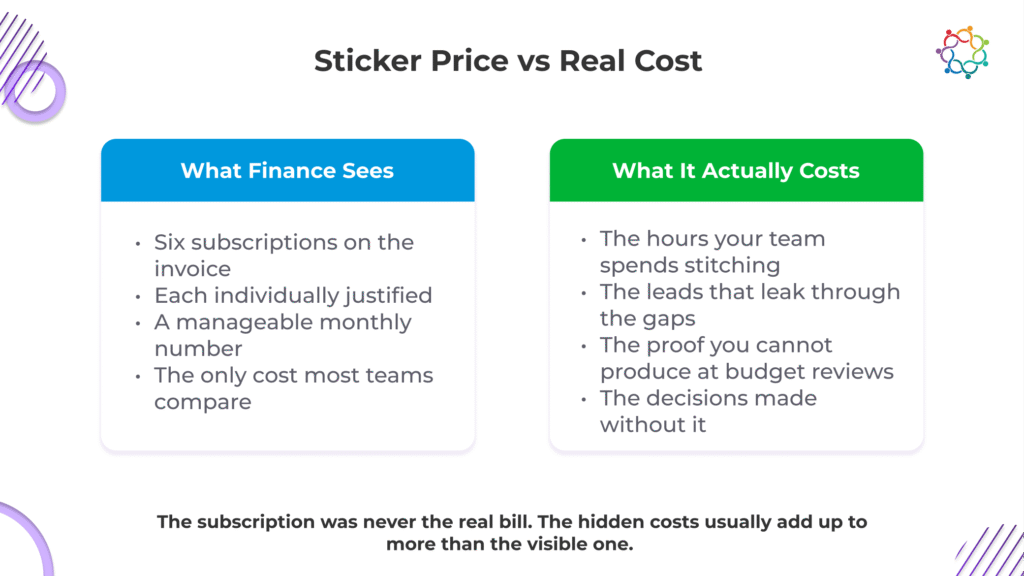
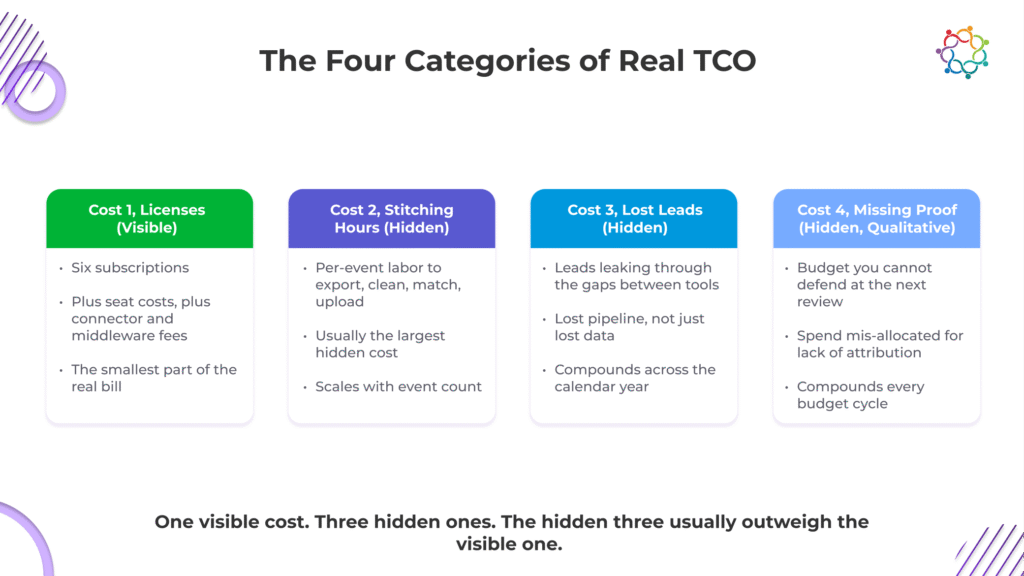
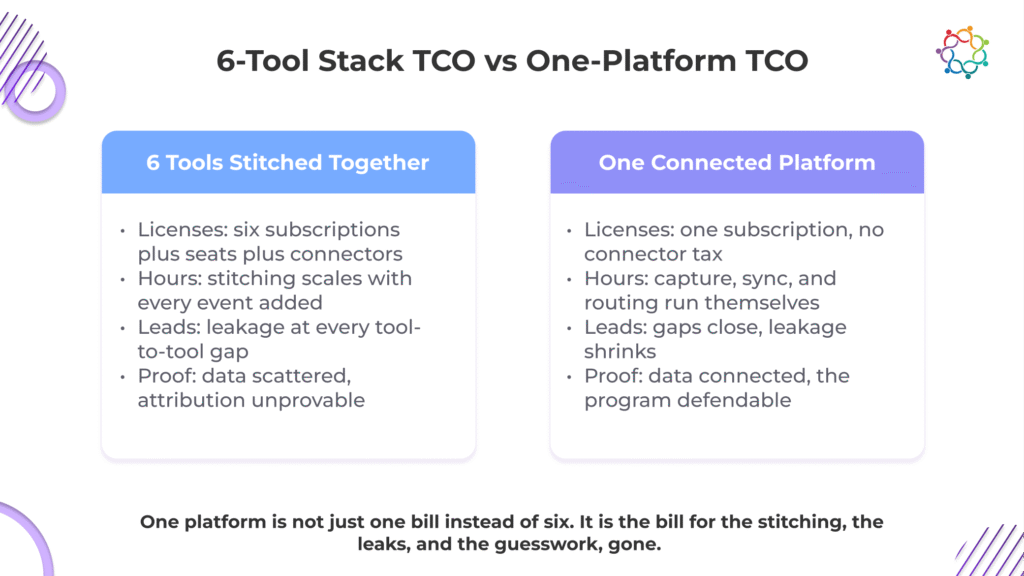
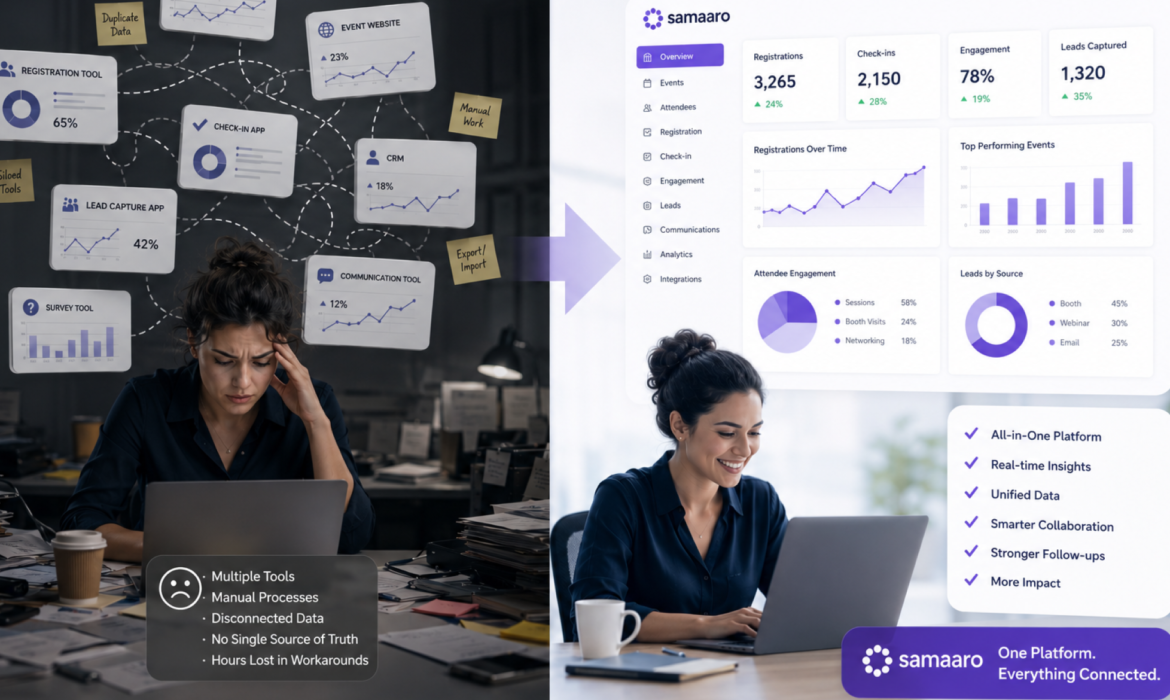
A mid-market SaaS company runs 12 events a year. Their event tech stack includes a registration platform, a check-in app, a networking tool, a survey platform, an email automation layer, and an analytics dashboard. Annual cost: roughly $80,000.
After their flagship conference last quarter, the CMO asks: “Which of the 300 attendees were from our target accounts, and how many entered the pipeline within 60 days?”
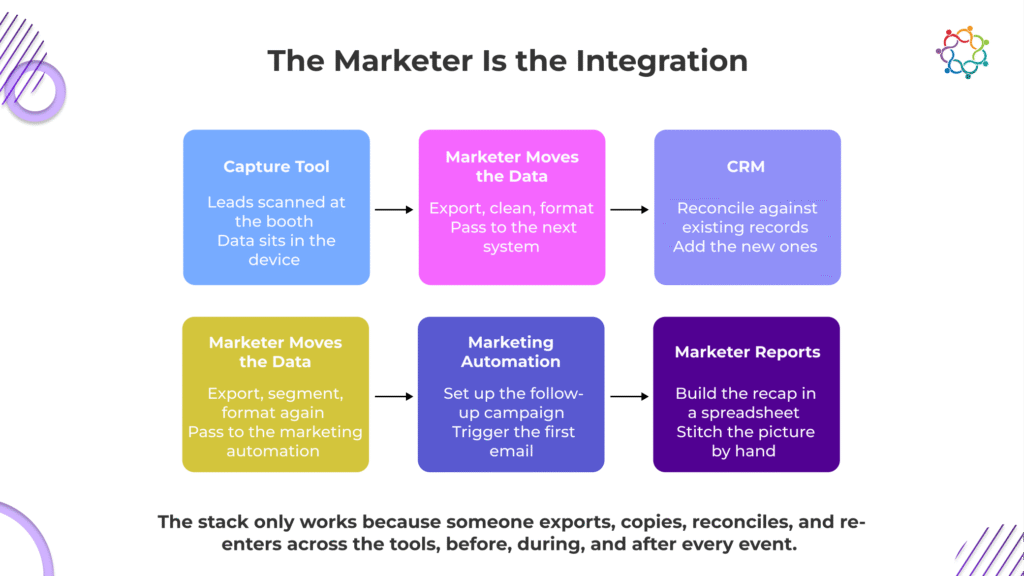
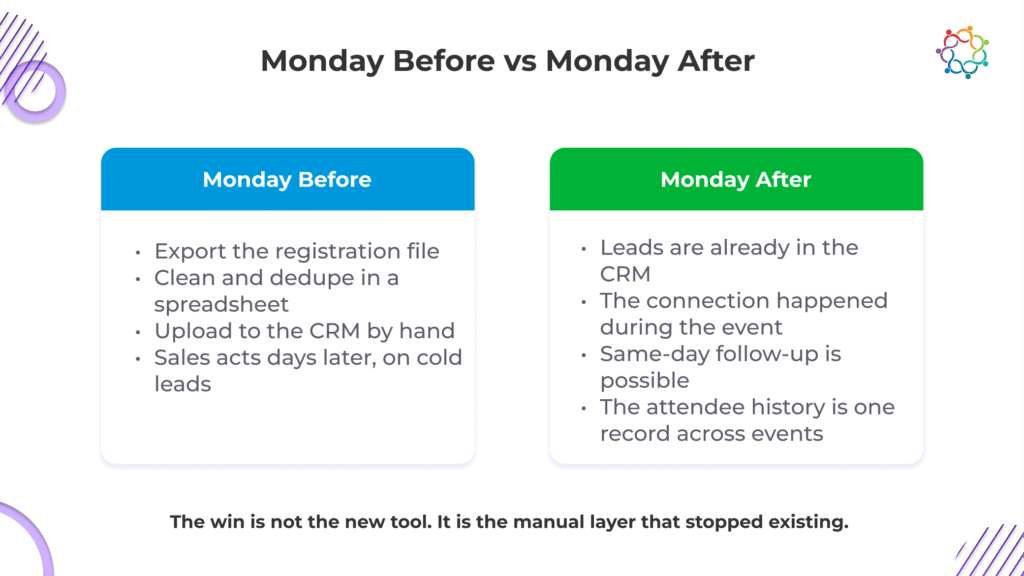
Nobody can answer. Not because the data does not exist. Because it is scattered across six tools that do not talk to each other. The registration platform has the account data. The check-in app has the attendance records. The engagement scores are in the analytics dashboard. The survey responses are in a separate tool entirely. Pulling a unified answer would take three manual exports, a spreadsheet, and two hours of someone’s time, by which point the question has already moved on.
This is the event tech paradox. Capability increases, but clarity does not. Every tool was added to solve a real gap. But the stack was never designed as a system. It was assembled as a collection. The result is high operational coverage and near-zero revenue visibility.
The issue is not that teams buy the wrong tools. It is that they evaluate tools against the wrong criteria entirely.

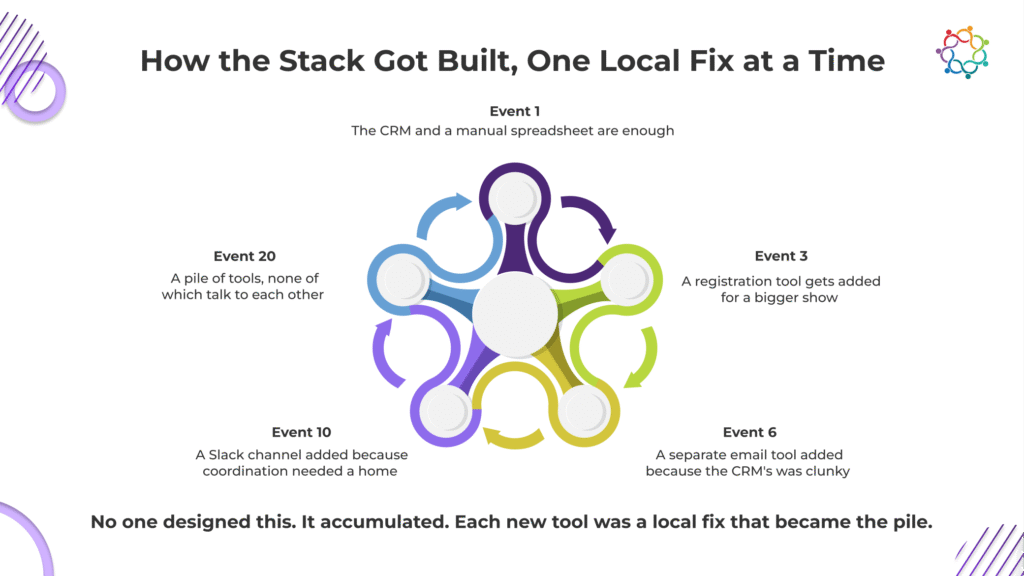
Stack bloat does not happen because marketing ops teams are careless. It happens because every tool makes sense at the moment of purchase.
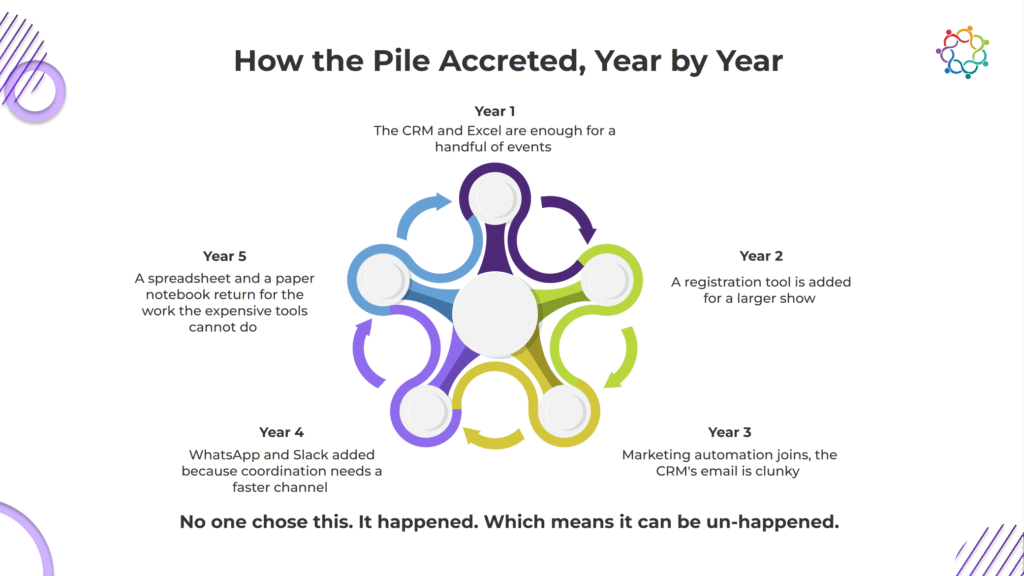
The registration tool gets bought when the team outgrows a manual process. The check-in app gets added for a large conference with complex logistics. The survey tool comes in when post-event feedback needs to scale. The analytics layer gets layered on when leadership starts asking ROI questions. Each decision is individually justified, individually approved, and individually forgotten once the event it was purchased for is over.
What nobody asks: does the fifth tool make the second one redundant? Does the analytics layer just re-visualize data that the registration platform already captures? Does the check-in app produce engagement data that overlaps with what the networking tool tracks?
The financial cost is visible on a procurement spreadsheet. The operational cost is less visible but far more damaging:
That last point is the one that matters most. The entire point of the stack is to produce a clear picture of who attended, how they engaged, and what to do with them next. When data is split across six systems, that picture never assembles cleanly enough to act on.
Stacks do not bloat because of bad decisions. They bloat because of unaudited accumulation, and most teams never stop to audit.

Even well-intentioned stacks fail in predictable ways. The breaks are not random. They happen at the same three points across almost every B2B event operation.
Most stacks record volume. A badge scan at a booth tells you someone walked past. It does not tell you they spent twelve minutes asking about your enterprise API integration. When signal capture lacks qualitative context, every attendee looks identical in the CRM. Sales receives a list where someone who attended three sessions and asked about pricing is scored the same as someone who checked in, attended one keynote, and left at lunch. The score says “medium engagement” for both. The pipeline value is not remotely the same.
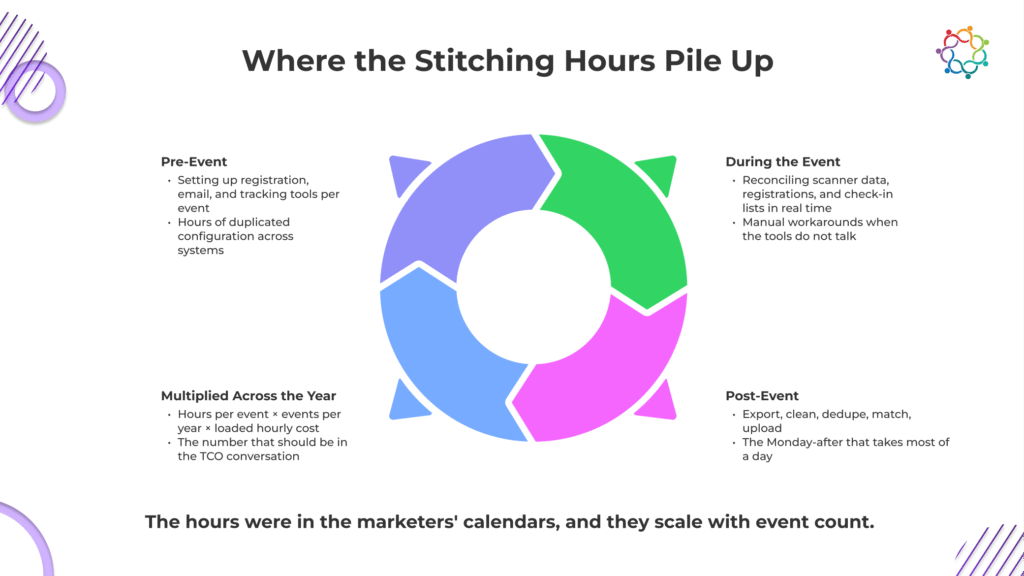
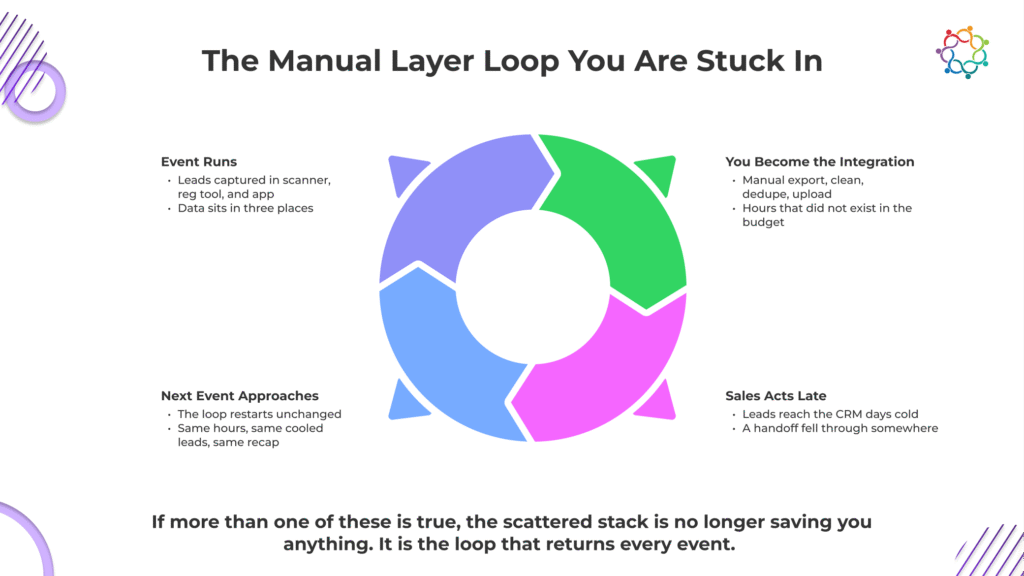
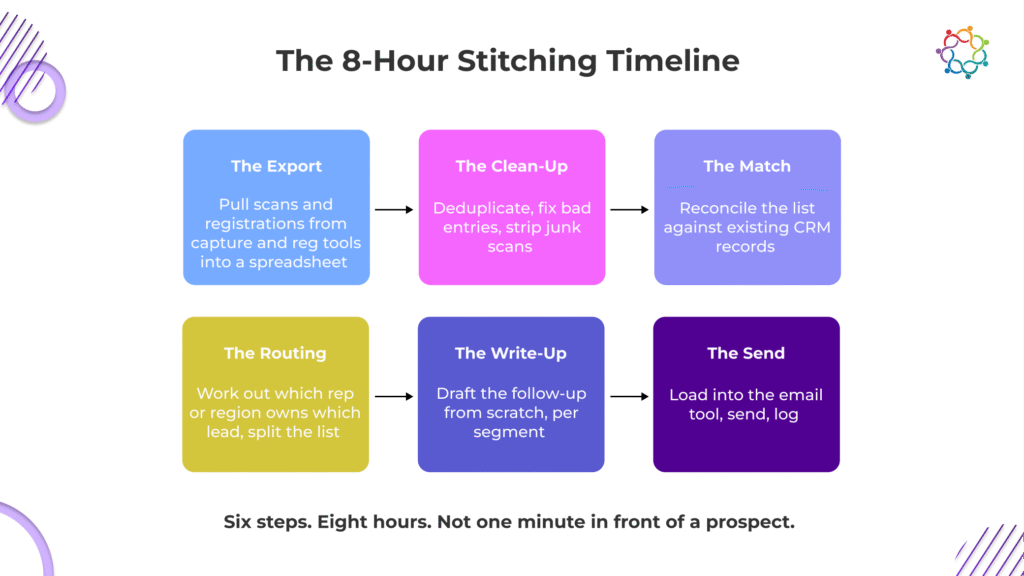
Registration data sits in one tool. Engagement data sits in another. Post-event survey responses sit in a third. Reconciling them means manual CSV exports, a spreadsheet that someone has to maintain, and a lag of two to five days before a unified view exists. The 48-hour window where event leads are warmest closes while the data is still being stitched together by hand.
Even when data is unified, most stacks lack a mechanism to translate event engagement into actionable CRM fields. A sales rep sees “attended conference” as a lead source. They do not see “attended three sessions on data security, raised compliance questions twice, and spent fifteen minutes with the solutions engineer.” Without that context, outreach is generic. Generic outreach produces generic results.
The revenue visibility gap is not a pipeline problem. It is a data architecture problem that shows up as a pipeline problem.

Before renewing a contract or adding another tool, run every layer of your current event tech stack through these questions. If fewer than five get a clear yes, the stack is optimised for execution, not revenue.
The goal is not minimalism. It is accountability. Every tool that cannot answer yes to at least one of these questions is overhead, not investment.

A right-sized event tech stack does four things and does them well. It does not need to do forty things adequately.
One system owns the attendee relationship from first invitation through post-event communication. Registration, segmentation, and pre-event nurture all live here. The requirement is not feature depth. It is this layer that produces clean, structured data that every other layer can use.
Check-in, session tracking, lead capture, networking, and feedback all belong in this layer. The non-negotiable requirement is context-rich signal capture. Volume metrics alone produce flat CRM records. This layer needs to distinguish a stakeholder in active evaluation from someone who attended because the session was on the way to lunch.
Event data flows into the CRM with full context attached. Not “attended event” but “attended these sessions, engaged at this depth, asked these specific questions, and represents this target account.” Sales receives a prioritised and contextualised handoff, not a CSV with a thousand rows and no explanation.
This layer answers whether events are moving the pipeline, not just whether people showed up. Cross-event reporting, ROI measurement, and attendee behaviour trends belong here. If this layer only produces attendance charts, it is not analytics. It is documentation.
Some teams accomplish all four layers with two tools. Others need four. The number is irrelevant. What matters is that data flows across layers without manual reconciliation and that each layer contributes to one question: what should happen next?
Every time a tool is added to the event tech stack, one question is worth asking before anything else: Does this make it easier to connect an event interaction to a revenue outcome?
If yes, it earns its place. If the honest answer is “it makes the event run more smoothly,” but it does not improve revenue visibility, it is an operational convenience. Operational conveniences are not inherently bad. But they should not be confused with strategic infrastructure, and they should not consume budget that could improve intelligence.
Your stack does not need more features. It needs fewer gaps between what happens at the event and what shows up in the pipeline.
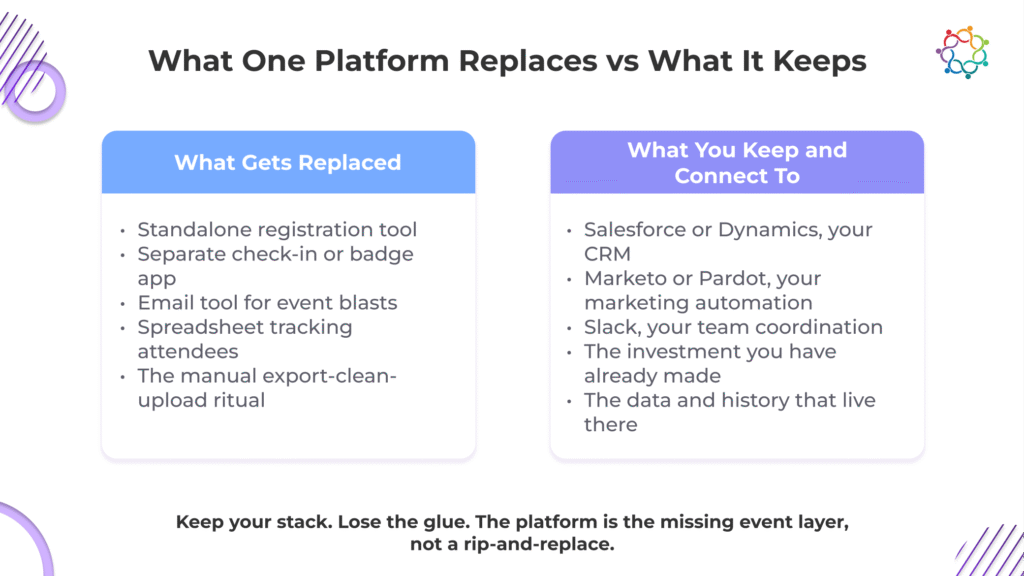
Samaaro unifies audience management, on-site signal capture, CRM integration, and post-event analytics into a single connected system, so event data flows into the pipeline without manual exports, silos, or two-hour spreadsheet reconciliations. Talk to our team.
Your ABM team identified 200 target accounts last quarter. Sales built sequences, launched outreach, and ran the plays. Response rate: 4 percent.
Of the accounts that responded, most conversations began with “tell me what you do,” not “we have been evaluating options.” After three months of targeted outreach, the first sales call is still just an introduction.
This is not a targeting failure. The accounts were right. The ICP was tight. The outreach was personalised. The failure is a timing failure, and it is one that most ABM programs never acknowledge because timing is harder to measure than coverage.
ABM is exceptional at answering who to engage. It is structurally weak at answering when an account is actually ready to engage.

The result is predictable. Sales enters account conversations before those accounts have built the internal context or alignment to evaluate a solution. The first call does work that should have happened weeks earlier, and pipeline entry gets pushed back by exactly that margin.
The gap is not between marketing and sales. It is between account identification and account readiness. ABM closes the first with data and segmentation. Almost nothing in a standard ABM program is designed to close the second.

Readiness is not awareness, and conflating the two is where most ABM pipelines stall before they start.
An account is aware when it knows your category exists. An account is ready when its buying group has built enough shared context to evaluate a vendor rather than just inquire about one. The gap between those two states is wide, and outreach alone cannot close it.
Awareness is not a buying signal.
An account that recognises your category exists has learned something. Its buying group has not necessarily built anything. Recognition lives in individual heads. Readiness lives in the shared context that a group of stakeholders has developed together, enough that they can look at a vendor and evaluate rather than inquire. That is a different state, and no amount of individual exposure produces it automatically.
Traditional ABM optimises for coverage, not readiness.
Most programs measure engagement as ad impressions, email opens, content clicks, and whitepaper downloads. These metrics are useful for tracking activity. They are useless for determining whether a buying group is prepared to evaluate a solution at the depth a sales conversation requires. Surface interactions tell you an account was touched. They say nothing about whether the people inside that account are aligned, informed, or ready to have a productive vendor conversation.
Skipping readiness transfers the burden to sales.
When ABM moves accounts from targeting straight into outreach without building readiness, the first sales call becomes a teaching session. The second call does what the first should have done. By the third, the account may have moved toward a competitor whose marketing did the conditioning work ABM skipped.
Readiness has to be built deliberately.
It does not emerge from enough ad frequency or enough follow-up emails. It requires structured, multi-stakeholder engagement that gives a buying group the context and confidence to evaluate rather than just listen.
The channel that builds readiness most efficiently is one that most ABM programs treat as an afterthought.

Events are not lead generation channels in an ABM context. They are pre-sales conditioning systems, and the distinction changes everything about how they should be planned, measured, and connected to the wider ABM motion.
Lead generation asks how many names were captured. Conditioning asks which accounts now have enough context and multi-stakeholder exposure to engage sales in a genuine evaluation conversation. These are fundamentally different questions.
What events can do that no other ABM channel replicates:
Event-led ABM positions events as the mechanism that moves accounts from aware to ready before sales enter the picture. This is not a supplementary tactic. It is the structural layer that most ABM programs are missing entirely.

The event-ABM connection breaks in practice not because events fail to generate signals, but because those signals never reach the systems that could act on them.
Events live in one team’s remit. ABM lives in another. The event team measures registrations, attendance rates, and session satisfaction scores. The ABM team measures account coverage, pipeline sourced, and outreach response rates. Neither operates with a shared definition of account readiness, and neither has a shared system for tracking it across the account lifecycle.
A shared readiness definition might be as simple as this: an account is ready when two or more stakeholders from the buying group have engaged with event content at depth and the account’s deal stage in the CRM reflects active evaluation. That is a definition both teams can track against, and almost no one has one.
What this looks like in practice: a target account sends three people to your annual conference. They attend four sessions, ask substantive questions in two, and spend fifteen minutes at your booth discussing a specific operational challenge. The event team logs three registrations and one booth visit. The ABM team never sees the session-level detail. Sales sends a standard cold sequence two weeks later with no reference to any of it.
The engagement happened. The conditioning happened. But because it was not captured with context and fed into the ABM system, it functionally did not happen from a pipeline perspective.
The root cause is not poor execution. It is the absence of a shared system for capturing and routing event signals. Events generate readiness signals continuously, but signals without structured capture do not become intelligence. They become noise. And when ABM teams cannot see what events are producing at the account level, they keep treating events as a separate channel rather than the conditioning layer that the entire motion depends on.

A B2B SaaS company running a serious account-based motion starts the quarter with 50 target enterprise accounts. Rather than sequencing all 50 into immediate outreach, the marketing team maps each account to an event format that matches its readiness stage.
Ten accounts showing active evaluation signals get invitations to an executive dinner: intimate, peer-led, focused on a specific strategic challenge, with no product pitch and no slides. Fifteen accounts in early exploration get routed to a half-day workshop where the problem space is defined collaboratively. The remaining 25 accounts, still in category awareness mode, get access to a conference track designed to educate without selling.
Before each event, invitations are written around the specific challenge each account is navigating. The reason to attend is grounded in the account’s context, not the host’s agenda.
During the events, engagement is tracked at the account level rather than the individual level. Which accounts sent more than one stakeholder? Which sessions triggered the most questions? Which booth conversations ran long, and what drove them? All of this becomes readiness data, not attendance data.
After the events, accounts are scored on readiness and routed to sales with full contextual briefings. The ten accounts from the executive dinner do not receive a standard discovery call. They receive an opening from a sales rep who knows exactly who attended, what concern was raised, and what the account said it was trying to solve.
The pipeline impact is direct. Sales conversations begin at evaluation depth rather than education depth. Decision cycles compress because conditioning preceded outreach. Conversion rates improve because accounts are engaging by choice after readiness has been built, not by interruption before it has.
ABM has spent a decade getting better at the targeting question. Account scoring is sharper. ICP definitions are tighter. Intent data is more granular. The “who” problem is largely solved for mature teams, and solving it produced real pipeline improvements.
But the “when” problem has been left almost entirely unaddressed.
Timing failures are invisible in most pipeline reports. A deal that took four months to close when it could have taken two does not show up as a failure. It shows up as a closed-won with a long sales cycle, and the weeks of unnecessary education at the top of the funnel disappear into the background.
Event-led ABM is not a new channel to bolt onto an existing motion. It is the structural answer to a timing question that targeting precision will never resolve on its own.
The shift it requires is not in the budget or campaign architecture. It is in how events are defined, positioned, and connected to the systems that govern account progression. When events are treated as conditioning systems rather than lead generation channels, they do something no amount of outreach precision can replicate: they move accounts from aware to ready before sales ever enter the room.
The ABM teams closing deals fastest are not running more targeted campaigns. They are building readiness before outreach begins, and events are the primary mechanism they use to do it.
Samaaro helps B2B teams capture account-level engagement signals across events, from session attendance to booth conversations, and feed them directly into CRM workflows so sales enter with context, not cold. See how it works.
For more on why events remain the highest-leverage channel for B2B tech buyers, read: Why B2B Tech Companies Still Invest in Events in a Digital-First World
Your company spent $40,000 sponsoring a tech summit last quarter. The booth looked sharp. The team was energetic. The badge scanner worked. Three weeks later, your CEO asks about the investment’s results, and you pull up a spreadsheet showing 200 badge scans, 14 “qualified conversations,” and a note that reads, “strong brand visibility.”
The silence after you finish presenting is not an awkward pause. It is the sound of measurement failure.
This is a scene that plays out in marketing reviews across SaaS, fintech, and medtech companies every single quarter. The discomfort in that room is not about the event. The event probably went fine. The discomfort is about the fact that $40,000 was committed to an outcome nobody defined, tracked with metrics that cannot connect to the pipeline, and reported in a format designed to fill space rather than answer a question.
The problem is not that your team failed to execute. The problem is that event sponsorship ROI was never built into the structure of the investment from the start. The metrics you collected after the event are not measurements. They are retrospective justification dressed up as reporting. And until that distinction is taken seriously before the next cheque is signed, the spreadsheet moment will keep happening.

Walk through any well-run B2B event, and you will find competent execution everywhere. Booths are designed to specification. Branding is consistent. Sponsored sessions are delivered on time. The operational layer works.
The failure is not in what happens on the floor. It is what happens after the floor clears that influences.
Sponsorship operates in a fundamentally hostile measurement environment. The event organiser controls most of the audience data. The highest-value interactions are offline conversations that leave no digital trace. The buyer who heard your session, spoke to your rep, and picked up a case study on Tuesday may not make a purchase decision for another four months, in a conversation you were never part of and cannot see.
This is not a gap your team created. It is a structural feature of how B2B sponsorship works.
The core tension here is simple and consistently underestimated: sponsorship generates influence, and measurement requires traceability, and those two things operate in entirely different systems. Closing the gap between them requires more than better follow-up. It requires a different approach to how the investment is scoped before the event begins.

If you trace the lifecycle of a sponsorship investment, the return does not disappear in one moment. It leaks in three distinct stages, and each stage has a different mechanism of failure.
Before the Event: Return Was Never Defined
Most sponsorship commitments are made without a defined outcome. Not a vague outcome like “increase brand awareness” or “generate leads,” but a specific, measurable outcome tied to a business target: pipeline generated, opportunities influenced, accounts engaged.
When success is not scoped before the investment is made, every metric collected after the event becomes arbitrary. You can report 200 badge scans or 14 conversations, but neither number means anything without a benchmark against which to measure it. The measurement problem at the end of the quarter almost always traces back to a scoping problem at the beginning of the cycle.
During the Event: Signals Collapse in Real Time
On the event floor, activity is high, and usable intelligence is near zero. Badge scanners capture presence, not intent. The VP evaluating your product and the attendee who stopped for a free pen generate identical data points in your system.
Conversations happen, but the context of those conversations is rarely captured in any structured way. What was discussed, which product areas resonated, what objection was raised, and what the buyer said they would do next are all details that live in the heads of your booth staff and begin fading within hours of the event closing.
After the Event: Attribution Becomes Guesswork
By the time follow-up emails are sent, the connection between the original interaction and the sales motion has already broken. Leads enter the CRM without context. Sales reps open conversations cold, referencing an event the prospect may barely remember.
The pipeline influence from that $40,000 investment does not disappear because it never existed. It disappears because the links between conversation, intent, and deal movement were never captured in a form that could be used.

There is a specific reason sponsorship underperformance goes unnoticed for so long: the metrics used to justify the investment are the same metrics that prevent anyone from seeing the gap.
Consider the input-output chain as it typically runs:
Each of these produces a number that looks like a result. Booth traffic of 300 looks productive. A lead list of 150 looks healthy. An email open rate of 22 percent looks reasonable. None of these numbers tells you whether the investment moved a single deal forward.
This is where sponsorship reporting becomes self-reinforcing. The numbers are busy enough that the right question never gets asked. Volume substitutes for value, and because the dashboard looks populated, nobody pushes on whether any of it means anything. The metrics most commonly used to justify B2B event sponsorship are precisely the metrics that create false confidence about B2B event sponsorship.

At this point, a reasonable response is to conclude that better execution would fix the problem. Brief the booth staff more thoroughly. Follow up faster. Tag leads more carefully in the CRM. These are execution improvements applied to a measurement design problem. They make the current system slightly less bad. They do not fix the system.
The underlying issue is a design flaw in how sponsorship measurement is owned.
Event teams own the experience. Revenue teams own the pipeline. Neither team owns the connection between the two. The interaction that happened at the booth and the deal that eventually closes six months later are separated by a chain of handoffs, system boundaries, and ownership gaps that no amount of individual effort can bridge without structural design.
Attribution models built for digital marketing assume a traceable click path: an ad impression, a landing page visit, a form submission, a conversion. Offline influence that compounds across weeks and multiple touchpoints fits none of those models.
This is not a failure of effort or intelligence. It is a mismatch between the measurement architecture and the actual mechanism by which sponsorship generates value.
Until the connection between event experience and revenue outcome is treated as a shared system owned jointly by event, marketing, and sales, the sponsorship measurement gap will persist regardless of how good the event was or how hard the team worked.
The single most effective thing a marketing leader can do to improve event sponsorship ROI has nothing to do with what happens at the event. It has to do with what gets defined before the contract is signed.
These five questions are not a checklist. They are a forcing function. If you cannot answer them before the event, you are not ready to commit the budget:
Most sponsorship ROI is not lost after the event ends. It is lost before the sponsorship is signed, in the gap between committing the budget and defining what that budget is supposed to produce. Close that gap, and the measurement problem starts solving itself.
The spreadsheet moment at the top of this blog is preventable. That is the gap Samaaro closes. Book a walkthrough.
Event teams rarely struggle to prove activity. Lead counts are high, badge scans are logged, and post-event reports suggest strong performance. On paper, the numbers validate the investment.
But this surface-level success often hides a deeper issue. Sales teams frequently report that little of this data is usable. Contacts exist, but context is missing. Follow-up becomes guesswork rather than progression.
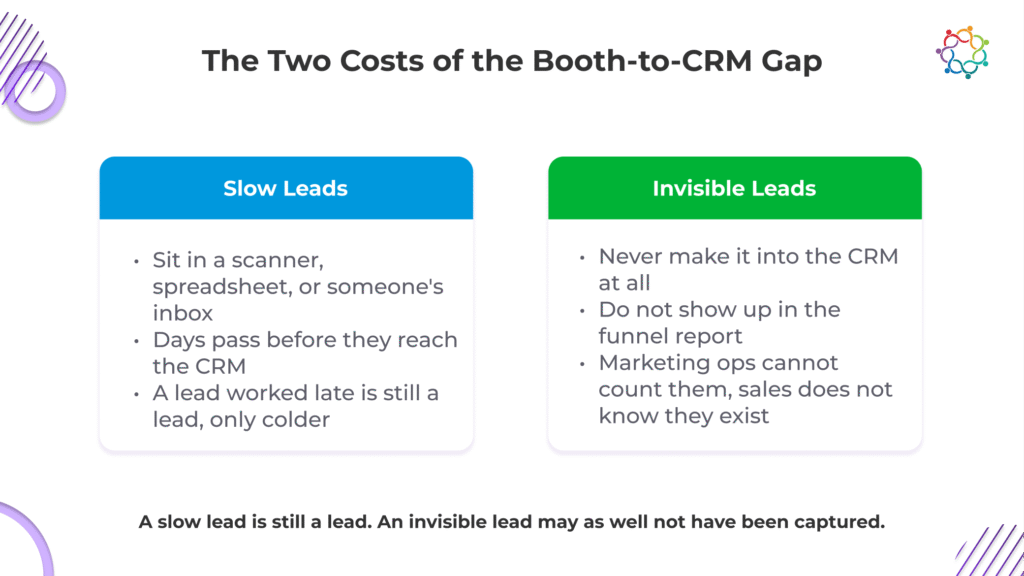
Event lead capture fails before reaching sales because the captured data often lacks structure, context, and clear workflows for qualification, routing, and activation. The breakdown does not happen at collection. It happens in every step that follows.
The most common misdiagnosis in event lead capture is assuming the problem starts on the floor. In most cases, the booth execution functions as expected. Conversations happen, interest is generated, and contacts are captured in real time. The breakdown begins only after the interaction ends, when that information is expected to move through systems and become usable.
What appears to be a lead quality issue is almost always a workflow issue that emerges post-event. The captured data enters a process that lacks continuity, structure, and clarity. Lead capture is not a moment at the event. It is a sequence that extends well beyond it.
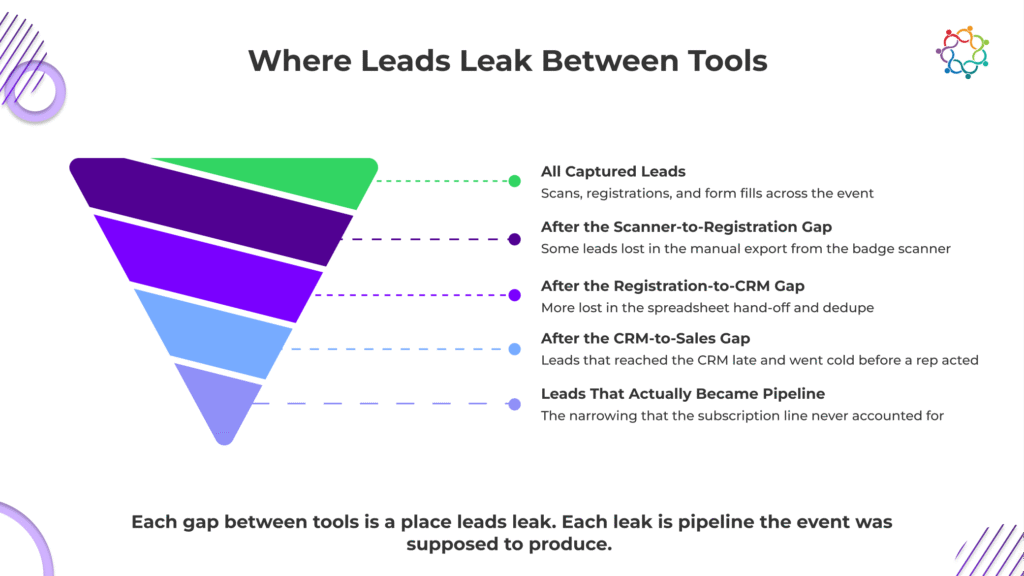
The first systemic failure appears in how data moves after collection. Most teams still rely on batch-based processes. A rep has a strong conversation on Tuesday at the booth. The CSV export happens on Friday. The CRM upload happens the following Wednesday. By the time the rep receives a notification to follow up, the prospect has already taken two other vendor demos and gone cold.
This latency creates a gap between interaction and action. At the same time, data rarely moves as a unified dataset. It fragments across spreadsheets, scanning tools, handwritten notes, and CRM imports. Each system holds a partial view, not a complete record. Duplicates emerge naturally from this fragmentation, where the same contact appears multiple times across different tools with inconsistent fields, making the dataset unreliable before sales ever open it.
By the time the data is available, much of its context and urgency are already gone.
Even when data arrives on time, it rarely contains the depth required to act on it. Most captured records include only basic identifiers: name, email, and company. Sales opens the CRM record and sees: Name, Title, Company, Email, Source: Trade Show. Nothing about the fifteen-minute conversation where the prospect described their exact pain point, explained they are currently managing the process through spreadsheets, and asked specifically about integration with Salesforce.
What is missing is the substance of the interaction: what problem was discussed, what solution was relevant, and how serious the interest actually was. Without this, the record becomes detached from the original conversation. Sales teams cannot reconstruct intent from static fields.
A contact without context is not a lead. It is an incomplete record.
Captured interactions are rarely interpreted before entering the pipeline. Everything collected is treated as a lead, without differentiation. Curiosity, casual interest, and active evaluation all look identical in the dataset.
Sales teams receive volume, not prioritization. There is no signal indicating urgency. There is no indication of fit. The burden of interpretation shifts entirely to sales, which increases friction and reduces follow-up efficiency. Reps either spend time manually sorting through unqualified records or default to ignoring the list altogether.
Without a qualification layer, sales teams cannot prioritize or act effectively on event data.
Even when data is captured and partially qualified, it still fails if there is no clear path forward. Many event workflows stop at data collection without defining what happens next. Leads enter systems, but no ownership is assigned, and no follow-up expectations are set.
This creates a structural gap between marketing and sales. Marketing assumes the handoff is complete. Sales sees no clear responsibility. Without defined ownership, leads remain untouched regardless of their potential value.
There is also typically no routing logic based on geography, account ownership, or deal stage. Every lead enters the same undefined pool, waiting for action that rarely comes. A lead without a defined next step and an assigned owner does not exist in the pipeline in any meaningful sense.
As event data moves across tools and systems through all four of the broken steps above, the cumulative result is a dataset that cannot be trusted at the record level. The same contact appears multiple times, captured through different interactions, devices, or export formats. These duplicates are rarely merged correctly, leaving fragmented visibility across the account.
Field-level inconsistencies compound the problem. Some records are partially filled. Others use different naming conventions or are missing key details entirely. The result is a dataset that requires manual cleanup before it can be used, adding delay and reducing the likelihood that any follow-up happens at all.
When data cannot be trusted, it cannot be acted upon. At this stage, the pipeline does not just stall. It actively misleads the teams relying on it.
Event lead capture rarely collapses at a single visible point. It breaks across a chain of disconnected steps, where data loses structure, meaning, and momentum. What begins as a valid interaction is gradually reduced to a record that cannot support sales action.
The failure follows a consistent pattern: data moves too slowly and fragments in transit, arrives without engagement context, enters the pipeline without qualification, sits without ownership or routing, and accumulates into a dataset too inconsistent to trust. Most organizations have gaps in at least three of these five stages, and each gap compounds the next.
Capturing leads is only the starting point. Without continuity, structure, and defined flow across all five stages, the data never matures into a pipeline. In B2B marketing, event lead capture does not fail because leads are not collected. It fails because the system designed to carry them forward is incomplete. Understanding where each breakdown occurs is the foundation for fixing it, and connects directly to how event programs should be designed, measured, and evaluated for real pipeline contribution.
Event teams often assume that once a lead is captured, it is ready for sales. CRM systems are expected to receive leads directly from events, reinforcing the belief that scanning or recording a contact is equivalent to creating a usable sales record. This creates the illusion that capture and creation are the same step.
Pressure to demonstrate output quickly further compresses these stages into a single motion. But capturing a lead and creating a lead are not the same action, even if they happen close together. One reflects a moment of interaction. The other determines whether that interaction can be acted on inside a pipeline.
Event lead capture produces raw, high-context interaction data generated in real time. It reflects what happened between a buyer and a brand, not whether that interaction qualifies for sales engagement. The output is observational, not operational.
Typical outputs include:
Captured leads are records of interaction, not yet decisions about sales readiness. They provide context, but not direction. At this stage, the data is still incomplete, often inconsistent, and lacks the structure required for routing or prioritization within a CRM environment.
CRM lead creation takes raw interaction data and transforms it into something routable, standardized, and structured. It introduces interpretation, classification, and completeness, turning scattered information into records that sales teams can act upon.
A CRM-ready lead includes:
These elements ensure the record can move within a pipeline rather than remain static. A CRM lead is not just captured data. It is data that has been interpreted and made actionable. Without this transformation, data remains disconnected from revenue processes, regardless of how many interactions were initially recorded.
The transition between captured interaction data and CRM-ready records is not automatic. It is a structural gap where most event data loses usability. Captured data is often incomplete, inconsistently formatted, and lacking clear intent categorization. CRM systems, however, require standardization, clarity, and defined inputs.
This gap is created by:
Most event leads are lost not at capture, but in the failure to translate them into usable form. The issue is not that interactions do not happen. The issue is that those interactions are not structured in a way that systems and teams can interpret consistently. Without transformation, captured data remains disconnected from execution.
When leads are pushed into CRM systems without sufficient context, they fail at the point of use. Sales teams receive records that lack clarity on intent, relevance, and prior interaction, making it difficult to prioritize or personalize follow-up.
The problem is not always lead quality. It is the absence of usable information. Common outcomes include:
Leads do not fail because they were captured incorrectly. They fail because they were never made actionable. The CRM becomes a storage system rather than a decision-making system. Without context and structure, even high-intent interactions degrade into low-value records that do not progress into the pipeline.
The translation layer sits between capture and CRM entry. It is where raw interaction data gets interpreted, structured, and matched to the fields and criteria sales teams actually need. Without it, there is no link between what happened at the event and what should happen next.
The difference between captured data and a translated CRM record is significant. A captured lead might read: “Visited booth, discussed product, seemed interested.” A translated CRM record reads: “Evaluated lead capture module for trade show use case. Currently using a manual spreadsheet process. Asked about CRM sync with Salesforce. Timeline: evaluating tools this quarter. Intent: High. Requested follow-up demo.”
That transformation is not cosmetic. It is operational. The first record sits in a database. The second drives a sales action.
Translation converts raw signals into defined intent categories, structures engagement data into standardized fields, and maps buyer context to the relevance criteria sales teams use to prioritize their time. Each of these actions moves data from descriptive to operational, ensuring that what was captured at the event can actually move forward within a system built for execution and revenue generation.
Despite the distinction, many teams continue to treat capture and creation as one step. The reasons are structural, not just behavioral.
Marketing teams are frequently incentivized to report lead volume quickly after events. Showing 400 leads in the CRM within 24 hours of an event looks like success, even if none of those records contain the context that sales needs to act. The metric being tracked is the speed of entry, not the usability of data.
CRM systems compound the problem. They accept any record regardless of completeness. There is no friction that stops unready data from entering. A contact with a name and email clears the same technical bar as a fully qualified lead with intent signals and next steps attached. The system does not distinguish between them.
Most event technology makes this worse by design. Badge scanners and registration exports push contact fields directly into CRM without a qualification or translation step in between. The pipeline fills up, the dashboard shows activity, and the underlying data problem remains invisible until sales teams begin reporting that the leads are not converting.
The industry merges these stages because it measures movement, not meaning. What gets tracked is whether leads are in the system, not whether they can be acted on. Fixing this requires changing both the metrics used to evaluate event success and the process that sits between capture and CRM entry.
Event lead capture and CRM lead creation serve different purposes within the B2B lead lifecycle. One records interaction. The other enables action. Treating them as the same step breaks the link between marketing activity and sales execution.
Without a translation layer, captured leads stall. Without structure, CRM records lose meaning. The movement from interaction to pipeline depends entirely on how well the data is transformed between these stages.
Understanding this distinction is foundational to how event programs should be designed and evaluated. It connects directly to how lead capture feeds into pipeline attribution, how sales handoff quality is measured, and how event ROI is assessed beyond contact volume. Capture is where the data begins. Translation is where its value is determined.
Lead capture at events is still seen as a logistical task. Teams scan badges, collect cards, and export lists. The result is a database often cited as event proof.
This approach persists because it is easy to execute and easy to report. A scan confirms presence. A form confirms identity. Metrics like total leads captured provide a clean, quantifiable narrative.
The issue isn’t the activity. It’s assuming these actions yield meaningful marketing. Capturing contact info shows presence, not intent. When lead capture is just scanning, it becomes a mechanical step, not a strategic function for sales and pipeline.
Contact data answers a narrow question: it identifies who engaged. It does not explain what that engagement meant.
The buyer’s priorities cannot be inferred from their name, firm, or email address. They don’t show the person’s position in the purchasing process, urgency, or importance. Sales teams who get this data are compelled to interpret intent without supporting proof, which results in low conversion rates, missed opportunities, and generic marketing.
Contact data identifies the person. It does not define the problem they are trying to solve, and it does not signal decision readiness. A name and email address do not explain why a conversation happened or whether it mattered.
Event lead capture is the structured collection of interaction data that reflects both identity and intent. It answers three critical dimensions: who the buyer is, what they engaged with, and what signals they expressed during that engagement.
The contrast between a traditional capture and a structured one is significant. A badge scan produces:
A structured lead capture produces all of the above, plus:
That second record is a data-rich representation of buyer intent. The first is an attendance log. This reframing shifts the role of lead capture from an administrative task to a core input for marketing intelligence and sales prioritization.
Events operate as concentrated environments of buyer activity. Unlike digital channels, where engagement is fragmented, events bring together individuals actively researching solutions.
Every interaction generates a signal. Conversations reveal priorities. Product demos indicate evaluation stages. Sessions attended reflect specific areas of interest. Questions asked expose the challenges a buyer is actively trying to solve.
The key is ensuring these signals are recorded, not just experienced. When a prospect asks a specific question at a booth, say, “Can your platform integrate with Salesforce within 30 days?” That question needs to become a tagged data point, not a memory. When an attendee visits three sessions on pipeline attribution, that pattern should be logged and linked to their lead record, signaling a defined area of investigation.
Even two or three sentences of structured post-conversation notes, entered into a standardized capture format, transform an ephemeral interaction into a traceable buyer signal. Events do not just generate leads. They generate insight into how buyers think and evaluate, but only if the mechanism for capturing that insight is in place.
Information is static. It includes fields like name, job title, company, and contact details. This data provides identification but no direction.
Intent signals are dynamic. They reflect behavior, engagement, and evaluation. They indicate interest level, urgency, and relevance.
The value of lead capture lies in the quality of the signal, not the volume of data. Without intent signals, event lead data cannot guide prioritization, personalize follow-up, or support meaningful sales conversations. One fills a database. The other enables action.
High-volume lead capture remains the dominant model, but the reasons are structural, not strategic.
First, there is an incentive misalignment. Marketing teams are frequently measured on lead count, not lead quality. Capturing 500 contacts at an event is a reportable success. Capturing 47 high-intent leads with a structured conversation context is harder to explain in a post-event summary, even if it drives three times the pipeline.
Second, tooling defaults reinforce the problem. Most badge scanning tools are built to capture contact fields and nothing else. They are optimized for speed, not depth. The infrastructure does not prompt for problem statements, engagement depth, or decision timelines, so those details go unrecorded.
Third, reporting simplicity wins in the short term. “500 leads captured” is a clean metric. It requires no interpretation. But a large database of contacts is not the same as a pipeline of opportunities. The volume metric creates the appearance of success without evidence of impact.
Addressing this requires changing both what is measured and what tools teams use to capture data at events.
The difference between usable and unusable lead data is the structure.
Unstructured notes vary by individual. They are inconsistent, incomplete, and difficult to interpret at scale. One sales rep writes a paragraph. Another writes three words. Neither format supports downstream analysis or reliable follow-up prioritization.
Structured data introduces consistency through defined fields:
With this structure, lead records become comparable. Teams can segment by intent level, prioritize by decision timeline, and route leads to the right sales motion based on what was actually discussed, not just who showed up.
Structured event lead capture transforms scattered interactions into a coherent dataset. It enables teams to move from isolated conversations to a unified view of buyer behavior, improving both targeting and conversion.
Event lead capture does not operate in isolation. It directly influences how the pipeline is understood and managed.
Structured data collected at events provides context for sales engagement. It helps teams prioritize accounts, tailor conversations, and track buyer progression over time. This data feeds into CRM workflows and connects to broader pipeline attribution models, helping teams understand which event interactions actually influenced deals and at what stage.
It also shapes how event ROI is evaluated. When lead records contain intent signals and engagement depth, teams can move beyond “leads captured” as the primary metric and begin measuring pipeline contribution, sales handoff quality, and deal acceleration tied to specific event interactions.
Lead capture is not an isolated activity. It is the starting point of pipeline intelligence. When executed correctly, it provides the clarity required to connect event engagement with measurable revenue outcomes and to build the case for events as a strategic channel, not just a presence play.
Contact collection without context is a surface-level activity. It captures who was present but ignores what they were trying to solve, evaluate, or move forward.
The true value of event lead capture lies in transforming interactions into structured intent data that sales and marketing teams can act on with clarity. The difference between a badge scan and a structured lead record is the difference between an attendance log and a buying signal.
In B2B marketing, event lead capture is not defined by how many contacts are collected. It is defined by how precisely buyer intent is captured, structured, and converted into pipeline insight. That precision is what connects events to revenue and what determines whether lead capture functions as a strategic asset or an administrative habit.
Most organizations still evaluate success through what is easiest to capture. Registration numbers, attendance rates, and cost per event dominate reporting dashboards because they are immediate and clean. These indicators create a sense of control, but not necessarily understanding.
The real issue is that teams confuse activity with impact. Engagement at events is treated as success, even when it does not move opportunities forward. This creates a structural blind spot. What looks productive on reports often has a limited connection to deal progression, leaving leadership with incomplete signals about actual performance.
Activity metrics create confidence without clarity. High attendance numbers may look impressive, but they do not confirm that buyers are advancing in their journey. Registrations reflect curiosity, not intent. Cost efficiency highlights spend discipline, not effectiveness.
The gap appears because these metrics capture participation, not influence. A room full of attendees does not guarantee that any meaningful buying conversations are happening. Activity metrics are designed to answer “what happened,” not “what changed.” That distinction matters in complex B2B environments where decisions involve multiple stakeholders and long evaluation cycles.
What gets counted is not always what counts.
Field marketing’s value does not appear at the top of the funnel. It appears in the middle and at the bottom, where it is most needed and most measurable.
Top-of-funnel metrics such as registrations, attendance, and impressions tell you whether people showed up. Mid-funnel metrics such as influenced pipeline and multi-stakeholder engagement tell you whether showing up changed anything. Late-funnel metrics such as deal acceleration and win rate impact tell you whether that change produced revenue.
Field marketing should be measured primarily on the middle and bottom rows, not the top. This is where buying committees validate solutions, compare vendors, and negotiate internal consensus. This is where field marketing operates most effectively, not by generating early attention but by reinforcing momentum inside existing opportunities. When measurement is anchored at the top of the funnel instead, teams optimize for the wrong outcomes and events appear successful in isolation while failing to shift deal dynamics where it matters most.
The transition from activity reporting to pipeline measurement is not a reporting upgrade. It is a structural redefinition of what success means.
The sections that follow cover three metrics that make this shift operational: influenced pipeline, deal acceleration, and account penetration. Together, they answer whether field marketing is shaping revenue outcomes, not just generating engagement. Field marketing is not successful because events happen. It is successful when the pipeline moves.
Before introducing new metrics, it is worth addressing what to deprioritize, because field marketing leaders often face internal resistance when moving away from attendance-based reporting.
Attendance does not need to be eliminated from reporting entirely. It becomes a diagnostic input rather than a success metric. It tells you whether your targeting and event promotion worked. It does not tell you whether the event created business value. Report it as context, not as a KPI.
The same applies to event counts and cost-per-lead figures. These are operational inputs that explain resource usage. They do not explain revenue contribution. Framing them that way internally gives leadership the visibility they expect while making room for pipeline metrics to carry the performance narrative.
Influenced pipeline measures how field marketing engagement connects to active opportunities. It tracks accounts that interacted with field initiatives and later progressed within the sales cycle.
To operationalize this, tag every event attendee in your CRM with the event as a campaign touchpoint. Then run a report showing which open opportunities had at least one contact who attended a field marketing event in the last 90 days. That report is your influenced pipeline view. It creates a direct link between marketing activity and sales outcomes without requiring perfect attribution.
Influence is measurable when engagement is tied to opportunities. If engagement consistently appears in progressing deals, it signals that field activity is shaping buyer behavior in meaningful ways. Without this metric, organizations remain blind to whether engagement is driving business impact or simply generating isolated interactions with no downstream effect.
Deal acceleration measures whether opportunities move faster after field marketing engagement. It focuses on whether the sales cycle shortens when targeted, trust-building interactions occur.
The method is a direct comparison: calculate average days-in-stage for opportunities where at least one contact attended a field event, then compare that figure against opportunities with no field marketing touchpoint. If field-touched deals move from evaluation to decision 18 days faster on average, that is your acceleration metric. The comparison makes the impact visible and defensible.
Field marketing contributes to acceleration by reinforcing confidence, surfacing and addressing objections earlier, and aligning multiple stakeholders around a shared narrative before the formal evaluation stage ends.
In complex enterprise environments, even moderate reductions in cycle time have significant revenue implications.
Enterprise deals rarely close on the strength of a single relationship. They depend on coordinated alignment across decision-makers, influencers, evaluators, and champions within the same account.
Account penetration measures how deeply engagement spreads across these stakeholder groups over time. Track the number of unique contacts engaged per account, how many roles within the buying committee have been reached, and whether engagement is repeating across those roles or remaining at the surface level.
What “good” looks like depends on deal size and complexity. A two-person buying committee engaged at 100 percent is very different from reaching two out of twelve stakeholders in an enterprise account. The benchmark question to frame internally is: are we engaging enough of the right people within this account to build consensus, or are we relying on a single champion to carry the deal?
Deals close when accounts are engaged, not just individuals. This metric shifts focus from reach to depth.
Surface metrics create reporting comfort but strategic blindness. Attendance and registrations show activity, not outcome. They cannot explain whether engagement changed buyer behavior or influenced decisions.
Field marketing’s impact becomes visible when you can answer three questions with data: which pipeline did our engagement influence, did deals move faster because of it, and how deeply did we penetrate the accounts that matter most. Everything else is context.
A modern measurement approach evaluates how interactions shape pipeline progression, accelerate deals, and deepen account relationships. Field marketing is not a volume-based activity engine. It is a system that shapes revenue movement through structured engagement, and it should be measured accordingly.
Enterprise deals rarely move fast. Most B2B sales cycles stretch across 6 to 12 months, involving multiple conversations, stakeholders, and evaluation stages. The challenge is not starting these conversations. It is keeping them alive.
Engagement spikes at the beginning and resurfaces near decision points, but the middle is where most deals quietly lose momentum. Most enterprise deals do not fail at the initial engagement stage but during periods of low interaction in the middle of the cycle.
But here is the distinction that matters and that most marketing conversations miss entirely: field marketing is not primarily a pipeline creation tool. It is a pipeline progression tool. Creating a deal is only the starting point. The real work is advancing it, and that is where field marketing operates. Every mechanism covered in this blog, from building trust through proximity to engaging multiple stakeholders simultaneously, serves that single purpose: keeping qualified opportunities moving forward until they close.
Enterprise sales are not linear. Stakeholders with varying interests, risks, and expectations engage in multi-layered discussions. Decision-makers, influencers, financial approvers, and internal advocates may all be involved in a single contract, and each will assess the same solution from a different angle.
Buying committees with numerous stakeholders and conflicting interests increase decision friction significantly. Alignment is not automatic. It has to be built over time through repeated interaction and shared understanding. The more stakeholders involved, the more likely a deal is to drift off course.
Stakeholders come and go from discussions at different times. Long evaluation periods cause internal priorities to change. Consensus is delayed by divergent viewpoints. Interest wanes in the absence of constant involvement from the full buying committee, not because buyers are uninterested but rather because the sale loses priority in the face of conflicting internal agendas. Field marketing is intended to disrupt this actual delay mechanism.
Digital channels are effective at initiating interest. Email campaigns, paid ads, and content distribution create early visibility and generate initial engagement. But as deals progress, their effectiveness declines, and in enterprise deals specifically, the reason goes deeper than “digital is passive.”
In a nine-month deal involving six stakeholders, an email nurture sequence cannot differentiate between the CFO’s concerns about total cost of ownership and the VP of Marketing’s concerns about integration complexity. Digital treats the account as a single entity. It delivers the same content to everyone and waits for someone to respond. It cannot resolve a procurement objection in real time, or reassure a skeptical executive, or rebuild urgency after a quarter-end freeze.
As a result, a plateau forms. Engagement exists on paper opens, clicks, and content downloads, but it does not progress. Deals stay technically active while quietly losing internal momentum. Visibility does not equal influence, and in long cycles, influence is what drives decisions.
The introduction of field marketing changes the structure of engagement across the sales cycle. Instead of isolated touchpoints, it creates a continuous flow of interactions designed to maintain attention and drive progression. This is not about adding more activity. It is about increasing engagement density in response to long cycle duration and stakeholder complexity.
Field marketing fills the gaps where digital channels lose impact. It introduces structured, context-rich interactions tied directly to deal progression rather than general awareness. It turns a nine-month timeline from a sequence of passive touchpoints into a series of deliberate, high-intent engagements that keep accounts active, informed, and aligned throughout.
Purchasing decisions made by enterprises are risky. Stakeholders are doing more than just assessing a solution. They are assessing long-term impact, reliability, and credibility. This is when results are altered by proximity.
Digital interactions just cannot match the nuance, instantaneous response, and real-time clarification that face-to-face encounters provide. Interaction, not exposure, is how trust is developed. Buyer’s conviction grows when they transition from passively reading content to actively participating in dialogue. Stakeholders go from weighing options to verifying their decision.
That change cannot occur through sporadic digital touchpoints over long cycles. It requires meaningful, repeated engagement. Proximity accelerates trust-building, reducing hesitation and strengthening alignment across the buying group.
If proximity accelerates trust with individual stakeholders, multi-threading is what aligns the entire buying committee. This is where field marketing’s value in complex deals becomes most visible.
Consider an enterprise account in active evaluation. The buying committee includes a CMO, a VP of Demand Generation, a Head of Events, and a procurement lead. Each holds a distinct role, set of concerns, and definition of value.
Field marketing targets them with a context-specific approach. The CMO attends an executive luncheon with non-competing companies to discuss strategy and market direction, not product specifications. The VP of Demand Generation attends a pipeline attribution discussion related to their results. Product-focused operational sessions are attended by the Head of Events. Structured follow-up with ROI documentation and implementation benchmarks addresses risk and expense issues for procurement.
These interactions do not occur in isolation. They are coordinated within a single account and evaluation window, building a shared understanding of value from multiple directions. By the time sales ask for a decision, stakeholders are not just informed. They are aligned.
Without multi-threading, alignment depends on internal communication within the account, which is inconsistent. With it, alignment is built deliberately through role-specific engagement across the buying committee.
Most marketing is measured by lead generation. But in long sales cycles, creating a pipeline is only the beginning. The real challenge is advancing it, and field marketing operates inside the pipeline, not just at the top of it.
It re-engages opportunities that have gone quiet. It strengthens active deals through deeper, higher-context interaction. It moves accounts from extended consideration to actual decision. This is where deal velocity improves, not through more leads, but through sustained engagement that keeps existing opportunities moving forward.
In enterprise sales, progression is the metric that matters. A pipeline full of stalled opportunities does not translate into revenue. Field marketing is what keeps those opportunities from stalling in the first place.
Long B2B sales cycles demand more than awareness. They require sustained, high-quality engagement across multiple stakeholders over extended timelines. Digital channels start the journey effectively, but they cannot carry it through. They lose differentiation, depth, and influence precisely when deals need it most.
Field marketing provides the structure that fills that gap. Through in-person proximity, coordinated multi-stakeholder engagement, and continuous interaction across the full sales cycle, it keeps accounts active, aligned, and progressing.
In complex B2B sales, the pipeline is not won through isolated interactions. It is won through deliberate, high-intent engagement over time, and field marketing is what makes that engagement possible.

Samaaro is an AI-powered event marketing platform that enables marketing teams to turn events into a measurable growth channel by planning, promoting, executing, and measuring their business impact.
Location


© 2026 — Samaaro. All Rights Reserved.