Samaaro + Your CRM: Zero Integration Fee for Annual Sign-Ups Until 30 June, 2025
- 00Days
- 00Hrs
- 00Min

Key Takeaways (TL;DR)
1
2
3
→
Bottom Line:
Start with automation. Add agents later, if the work they can do reaches beyond what workflows cover.
Event marketing automation and AI agents are neighbors, and they get confused constantly because both sit in the category of things that move work off your team’s plate.
Both handle repetitive work. Both run on rules. Both promise efficiency and consistency. Both require setup and maintenance.
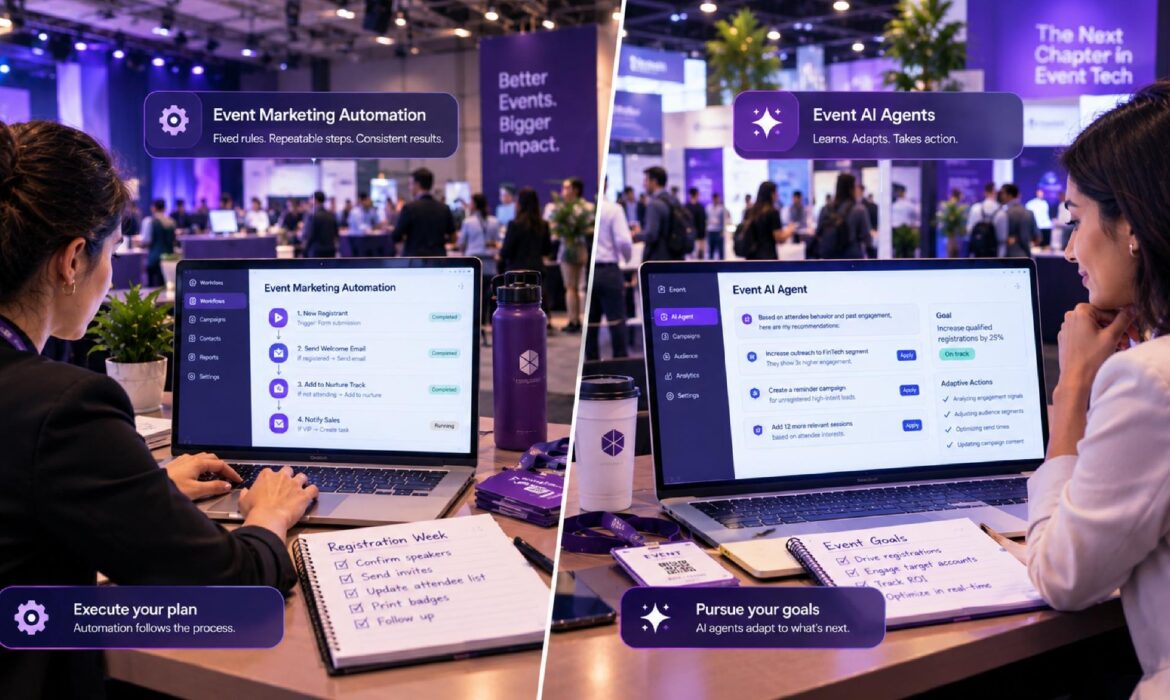
But they answer different questions. Automation asks: how do I repeat this exactly every time? Agents ask: how do I pursue this goal in changing conditions?
The difference decides which tool you need first, which one scales with your team, and which one makes sense at your current stage. This piece compares them on what they require to work, what they can do, and when each one earns its place.
Event marketing automation is foundational. Agents are enhancement. Neither is better in general; the work decides which one fits your current stage.
Automation is an if-this-then-that system. You design the rule once: if someone registers, then send confirmation, create record, schedule reminders. The rule runs every time the trigger fires.
An operations director at a SaaS company runs automation workflows and they work the same way every event because they don’t adapt or learn. They repeat exactly.
What automation requires is one person to design the workflow: map the steps, build the rules, test on a small event. Then the system runs it at any volume, identically, without getting tired or forgetting a step.
Why it works for registration, reminders, follow-up routing: these are rule-shaped processes. Every event, the same steps. Every registration, the same workflow fires. Every attendee who doesn’t confirm, the same nudge goes out. Repetition with perfect consistency is automation’s entire job.
What it cannot do is decide whether a rule still makes sense. It cannot adapt to a new situation the rule didn’t account for. It cannot choose between multiple goals. It only executes the workflow you built.
Automation is simple to design once. It is cheap to run always. It does exactly one thing forever until you change the rule.
Agents pursue goals, not workflows. You tell an agent the outcome you want (qualify leads and route them to the right owner), and the agent plans its own steps and acts under permissions you define.
What agents can do that workflows cannot: adapt to new information. If a registrant’s company changed after they filled in the form, an agent recognizes the change and adjusts routing. If an attendee asks a question indicating a different need, an agent can flag it or route it differently. If a lead matches multiple territories, an agent can propose a resolution instead of just applying the rule.
What agents require is a clear goal, permissions frameworks (what is the agent allowed to decide autonomously versus what needs human review), data to work with, and feedback to learn from.
Why agents are more complex: they propose, adapt, and learn. That power is valuable when conditions change, but it also means more setup, more oversight, and more careful permission design so they don’t make bad autonomous decisions.
The permission question that matters is critical. If an agent can route a lead without review, what happens if it routes it wrong? Automation never has this problem because the rules are fixed and tested. Agents adapt constantly, which means they can surprise you.
Agents shine when the right answer changes based on new information: scoring a lead as high or low when new account data arrives, routing contacts to different campaigns based on browsing behavior during the event, proposing when two departments should co-own an account.
Automation is an if-this-then-that verb. Agents are intelligence pursuing a goal. The table below is not a feature list. It is a comparison of how each one approaches the same kinds of work.
| Dimension | Automation | AI Agent |
| What it does | Runs the workflow you designed | Pursues the goal you set and plans its own steps |
| When it works | When the right answer never changes | When the right answer changes based on new information |
| How it decides | By fixed rules and triggers | By goals, data, and permissions frameworks |
| Can it adapt? | No, it repeats the same workflow | Yes, it adjusts steps based on new conditions |
| Main value | Speed, consistency, no surprises | Flexibility, learning, autonomous decisions |
| Main cost | Cannot handle exceptions or changes | Requires oversight, permission design, feedback |
| Best for | Registration, reminders, lead routing by rules | Scoring, qualification, dynamic recommendations |
Automation is a verb: execute this workflow. Agents are intelligence: pursue this goal. Pick the right tool for the work.
Automation is foundational. Most teams need dependable workflows long before they need an agent.
Registration, reminders, follow-up routing are rule-shaped and repeatable. Build these workflows first and get them working flawlessly. That is weeks of value with no complexity.
Once your automated workflows are running cleanly and you encounter work where the rule keeps changing (a lead’s fit changed, an attendee’s needs shifted, a priority account requires special handling), that is when agents start earning their place.
Automate the repeatable work first. Once it is working, agents can enhance it. Trying to start with agents is like writing the advanced outline before writing the foundation.
Agents are not magic and not a replacement for good data and process. A poorly designed automation repeats a bad process. A poorly designed agent is bad process with more complexity.
Both tools move work off your team’s plate, but they do it differently. Event marketing automation repeats perfectly. Agents adapt intelligently. Both have their place.
Start with workflows that are fixed and repeatable. Add agents later, when the work you are trying to do requires adaptation.
Build your event marketing automation foundation first. Add intelligence with agents later. To understand how automation fits into the broader event marketing strategy , talk with Samaaro.
What is the difference between automation and agents in simple terms?
Automation runs the exact same steps every time. Agents pursue goals and change their steps based on new information. Automation is repetitive. Agents are adaptive.
Do I need both automation and agents?
Most teams need automation first. Agents add value later when you encounter work where the rule keeps changing. Start with automation, add agents when the work demands it.
Can agents replace automation?
No. Agents work best where clean automated plumbing already exists. Build automation for your repeatable work, then agents can enhance the higher-judgment decisions on top of it.
What kind of work should I automate versus what should I use an agent for?
Automate registration, reminders, follow-up routing, and lead dedup. Use agents for qualification, dynamic routing based on new information, and proposing when conditions change.
When should a team start thinking about agents?
When your automation workflows are running smoothly and you notice yourself asking “why don’t I have a tool that adapts to this?” That is when agents earn their place.