Samaaro + Your CRM: Zero Integration Fee for Annual Sign-Ups Until 30 June, 2025
- 00Days
- 00Hrs
- 00Min

Key Takeaways (TL;DR)
1
2
3
→
Bottom Line:
Treat all three phases as paid work or accept that only one of three is doing the job.
The Show Floor Doesn’t Decide Trade Show ROI
You walk into the trade show on Day 1 already knowing whether it’s going to work. The booth could be the most beautiful in the hall, the demo flawless, the team rehearsed. None of it matters if the wrong people are walking past. Trade show ROI isn’t decided on the show floor. It’s decided four weeks before the show opens, and it’s converted six weeks after the show closes.
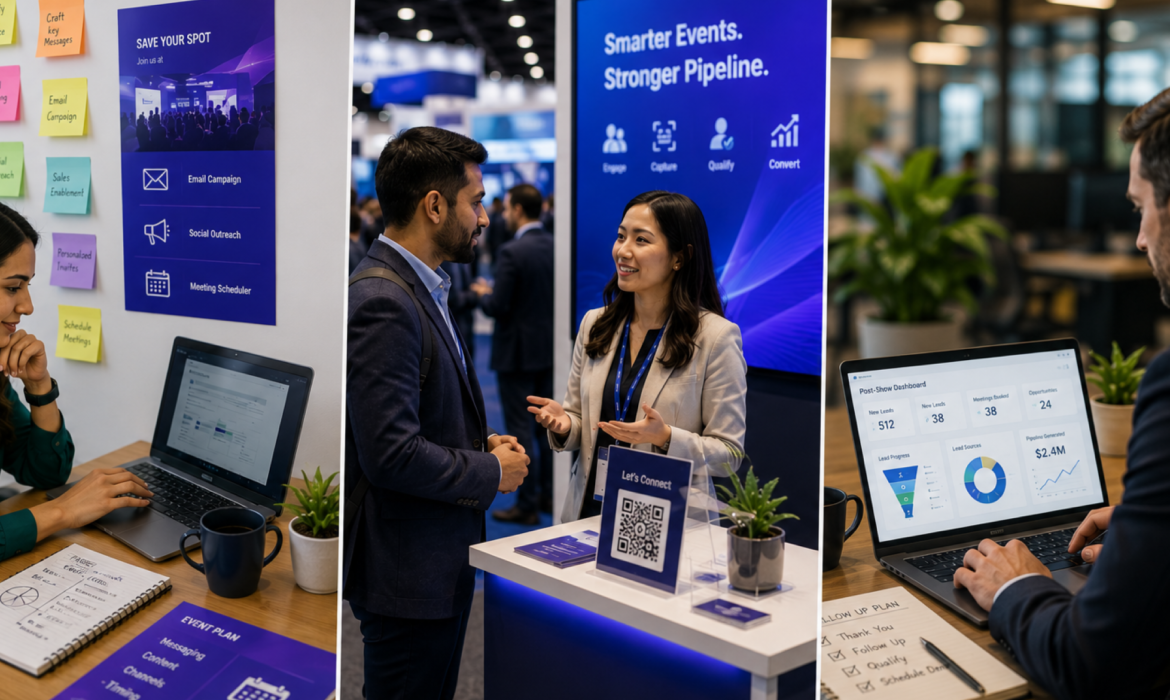
Trade show marketing phases break into three: pre-show, at-show, and post-show. The trap is treating them as equally weighted. The pre-show phase decides who shows up at your booth. The at-show phase decides whether those conversations are worth following up. The post-show phase converts intent into pipeline. Each phase has a different goal, a different operational owner, and a different ROI lever. The show floor is the middle act.
This guide walks through each phase as an architectural unit, with the strategic decisions that define it, plus the integration view of how all three compound.
Most trade show budgets concentrate spending on the show floor: booth, AV, freight, on-site staffing, and swag. Pre-show and post-show run on smaller, residual budgets, when they have budgets at all. The pipeline math runs the opposite way. Pre-show and post-show carry the heavier ROI weight, while show-floor execution carries the lighter one. Marketing leaders end up spending the most money on the phase that contributes the least, and the least on the phases that contribute the most.
This isn’t accidental. The show floor looks like the program. Three days of intense activity, photos, energy, and things to point at when the CMO asks how it’s going. Pre-show and post-show are quiet desk work that produces no visible output, which is precisely why they get under-resourced.
There’s a structural reason too. The show floor is the only phase that sits inside external vendor commercial interest. Booth designers, AV vendors, freight handlers, and event production companies aggressively sell into the at-show budget. Pre-show and post-show involve no external vendors and produce no photo opportunities. They are invisible to the parts of the org that approve the budget, which means they lose the budget conversation by default.
Common trap: reviewing trade show spend with the agency that built the booth. The agency’s incentive is to optimize the spending it controls. The marketing leader’s incentive is to optimize the spend that produces ROI. These rarely overlap.
The pre-show phase builds a tiered shortlist of attending accounts and a calendar of pre-booked meetings. Everything else is in service of that single output. Without it, the team is showing up to a show, not running a campaign.
The output. A tiered list of attending accounts cross-referenced against the CRM, segmented into A-list (book a meeting), B-list (drive a booth visit), and C-list (capture if they walk by). A calendar of confirmed meetings with the A-list. A primed audience that walks into the show knowing your booth exists, where it is, and why they should visit. (For the operational sequence behind this output, see our cluster blog Why Trade Show Marketing Investments Rarely Convert to Pipeline.)
The ownership. Demand gen owns the phase, with AE-led outreach on the A-list. Brand and product marketing are consulted on messaging and content drops; they don’t hold decision authority. The political mistake most companies make is letting the events team or the brand team run pre-show. Both will produce activity. Neither will produce a meeting calendar.
The budget share. Pre-show is structurally underfunded because it has no vendor invoices attached. It doesn’t show up on the budget review with the same weight as booth fabrication. A program that wants to win at trade shows funds pre-show as a part of the at-show, not as residual budget left over after the booth invoices clear.
The decision rights. Who’s on the A-list? When outreach starts. What meeting commitments are predefined per account? Which accounts get personal AE outreach versus marketing-led email? These decisions belong inside the pre-show team.
The phase success metric. Pre-booked meeting count walking into Day 1, expressed as a share of high-value time slots filled. Not what the booth visitors expected. Not impressions targeted. Pre-booked meetings, confirmed in the calendar, distributed to the booth team in the morning briefing. The phase either produced that number, or it didn’t.
The at-show phase exists to convert booth traffic into qualified conversations with full context. The booth isn’t the showcase. It’s a qualification factory operating for three days under fluorescent lights.
The output. A roster of qualified conversations tiered Hot, Warm, and Cold, each with a conversation summary, a next-step commitment, and an account reference attached. Pre-booked meetings from Phase 1 executed against per-account conversation goals. Spontaneous walk-ups qualified at the same standard. (For on-floor execution detail behind this output, see the Trade Show Booth Strategy Toolkit.)
The ownership. Sales leads on the floor. AEs and technical sales engineers run qualifying conversations; senior leadership shows up for priority-account meetings. Marketing supports rather than leads, owning capture infrastructure, content distribution, qualification triage, and daily-huddle facilitation. The at-show phase is the only one of the three where sales has the higher operational stake.
The budget share. At-show deserves the largest single allocation of the three because it carries the most concentrated operational cost: booth fabrication, freight, on-site staffing, and AV. But it should still leave meaningful room for pre-show and post-show. A program where the at-show absorbs the entire budget has confused activity for outcome.
The decision rights. The qualification rubric. The escalation paths. The capture infrastructure. The daily-huddle structure. These get set 72 hours before doors open, not improvised during the show. A real-time event marketing platform like Samaaro makes the qualification and capture decisions enforceable rather than aspirational, by syncing every conversation to the CRM the moment it’s logged.
The phase success metric. Qualified conversation count, with each conversation carrying tier, summary, and next step. Not badge scans. Not booth visitors. Conversations the post-show team can actually work.
Phase 3 is where the previous two phases pay off or evaporate. The post-show phase converts captured intent into pipeline before that intent decays. Buyer intent decays fast post-show: the buyer is back to a 400-email inbox, the conversation context is overwritten by the next event and the next internal meeting, and the urgency drops the moment they’re home. Post-show routing speed is the lever that determines whether intent converts before it evaporates.
The output. Hot leads converted to scheduled meetings with the account-owning AE within hours of capture. Warm leads in a tiered nurture sequence themed to the show. Pipeline created within 30 days, with show attribution, ready for forecast inclusion. Pipeline influenced beyond 90 days as captured leads progress through the funnel. (For the operational mechanics behind this output, see the Marketing-to-Sales Lead Handoff guide.)
The ownership. Post-show is the only phase that’s genuinely shared. Marketing builds the routing logic, manages the CRM import, and runs the nurture tracks for Warm and Cold tiers. Sales commits to the speed and cadence on the Hot tier. Both teams sign a written SLA before the show opens. Treat post-show as marketing’s responsibility alone, and the handoff fails by default.
The budget share. Post-show is the phase most often funded as residual. The booth invoices are clear, the team flies home, and the post-show line item is whatever’s left. This is the structural mistake that breaks more programs than any other budget decision. Post-show deserves a peer allocation to pre-show, because the post-show phase converts what the pre-show created.
The decision rights. The routing tiers and thresholds. The follow-up SLA per tier (response time, channel, cadence). The nurture sequence content. The disposition rules: when a lead is declared dead, when it returns to marketing, and when it gets re-engaged at the next show.
The phase success metric. Pipeline created within 30 days with show attribution, and percentage of Hot leads contacted within the SLA. No leads delivered. Not emails sent. Pipeline created and SLA adherence are the only two numbers that matter.
Phase quality multiplies downstream. It doesn’t add.
A pre-show that produces a thin pre-booked meeting calendar doesn’t get fixed by a stellar booth. The booth team converts whatever shows up, which is mostly whoever happens to walk past. An at-show that captures 800 ungraded scans doesn’t get rescued by a perfect post-show routing engine; the routing engine has nothing usable to route. A post-show that delays Hot-lead contact by ten days doesn’t get saved by the quality of the conversations that fed it; the conversations have decayed by the time anyone calls.
A simpler way to see it: imagine each phase as a letter grade. A program with a B+ pre-show, an A at-show, and a C- post-show isn’t a B program. It’s a D program, because the C- collapses everything upstream. The weakest phase sets the ceiling for the entire show, regardless of how strong the other two are.
This is why reallocating budget from the at-show to the other two phases produces such disproportionate returns. The marginal dollar in at-show buys a marginally better booth experience. The marginal dollar in pre-show or post-show buys a step-change in the weakest phase, which raises the ceiling of the whole program.
Common trap: optimizing the strongest phase. Marketing teams instinctively double down on what’s already working, which means at-show gets year-on-year improvement while pre-show and post-show stay flat. Find the failing phase. Fund it. Then check whether the ceiling has moved.
Trade show ROI isn’t decided in the three days under the lights. It’s decided by what happens in the four weeks before and the six weeks after. Pre-show builds the shortlist. At-show captures the intent. Post-show converts it to pipeline. Each phase compounds the next, and the weakest phase sets the ceiling for the whole program.
Pre-show. At-show. Post-show. Treat all three as paid work, or accept that only one of the three is actually doing the job.
If only one phase in your program is getting funded like real work, the fastest ROI move isn’t a better booth. It’s redirecting budget into the phase that’s currently running on residuals.