Samaaro + Your CRM: Zero Integration Fee for Annual Sign-Ups Until 30 June, 2025
- 00Days
- 00Hrs
- 00Min

Key Takeaways (TL;DR)
1
2
3
→
Bottom Line:
Senior pipeline lives in small rooms with the right guest list, customer host, peer conversation, and AE-led follow-up.
Your team is debating the budget for the next quarter. Field marketing wants $50,000 for an enterprise summit: 500 attendees, two days, big stage, big logo. ABM wants the same $50,000 for 10 dinners: 12 seats each, no stage, no agenda. The CMO usually chooses the summit because it’s visible and explainable. The CRO usually wants the dinners. Because at year-end, that’s where 60 percent of the new enterprise pipeline came from.
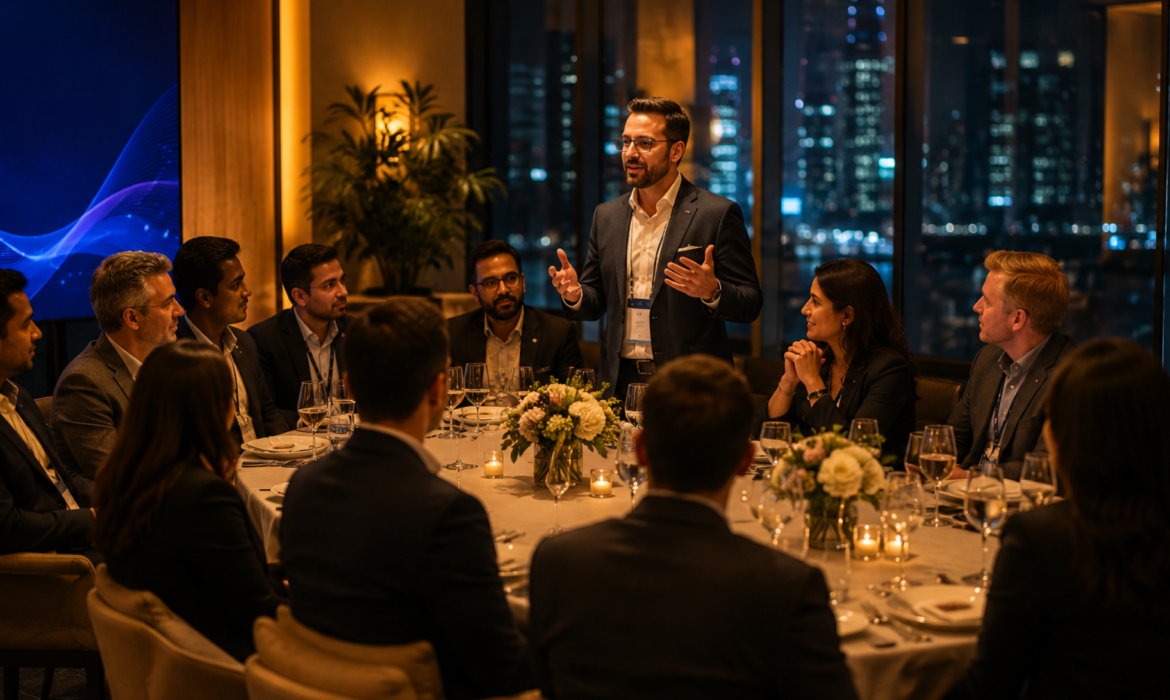
Executive dinner events are the highest-yield channel in B2B for senior pipeline. A ten-person dinner with the right guests, the right host, and the right conversation outperforms a 500-person summit on every metric that matters at the enterprise tier. This guide covers the five decisions that turn a dinner from an expensive networking evening into the highest-converting channel in your ABM stack: guest list, host, venue and conversation, follow-up, and attribution.
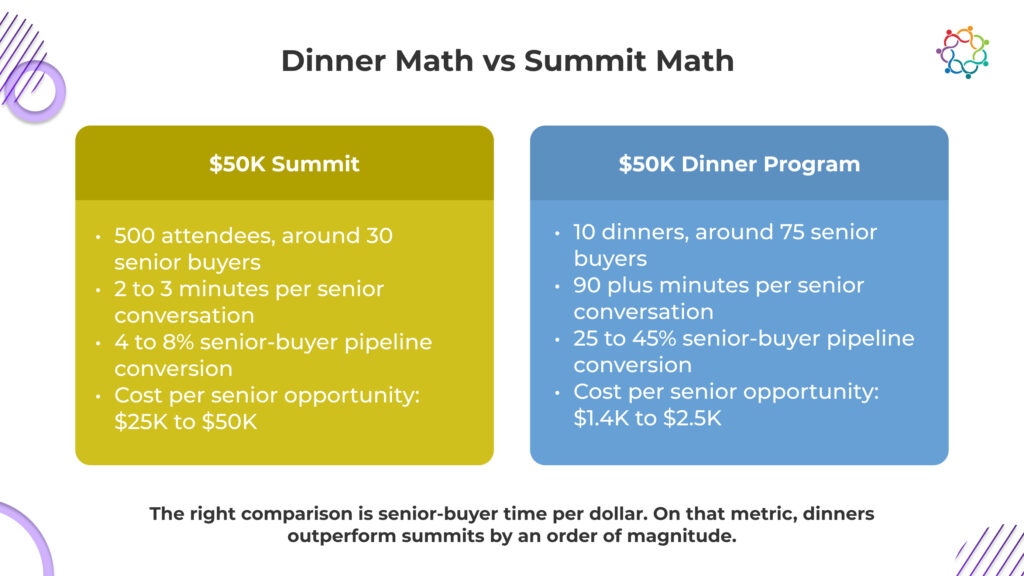
Most marketing leaders intuit that dinners outperform summits at the senior tier. The math is more lopsided than the intuition.
The 500-person summit.
A $50,000 budget produces 500 attendees, of which roughly 30 are senior buyers from priority accounts. The average meaningful conversation per senior attendee runs 2 to 3 minutes across the entire event. In our experience, senior-buyer pipeline conversion at large summits sits at 4 to 8 percent of the priority-account attendees.
The 10-person dinner program.
The same $50,000 budget across 10 dinners at $5,000 each produces roughly 75 senior buyers from priority accounts. Average meaningful conversation per senior attendee is 90+ minutes, because the dinner itself is the conversation. In our experience, senior-buyer pipeline conversion at well-run dinners sits at 25 to 45 percent.
The conversion gap.
The summit produces 1 to 2 senior opportunities. The dinner program produces 20 to 35. Cost per senior opportunity sits around $25,000 to $50,000 at the summit and $1,400 to $2,500 through dinners. The order of magnitude is real.
Why does the math hold?
A senior buyer at a 500-person summit is one of 500 distractions. A senior buyer at a dinner is one of 12 conversations. Time-on-conversation per attendee is roughly 30 to 45 times higher at a dinner. The buying committee proxy is better represented because dinners pull peer buyers from the same target accounts.
Common trap: comparing dinners and summits on raw attendance metrics.
The right comparison is senior-buyer time per dollar spent. On that metric, dinners outperform large summits by an order of magnitude.
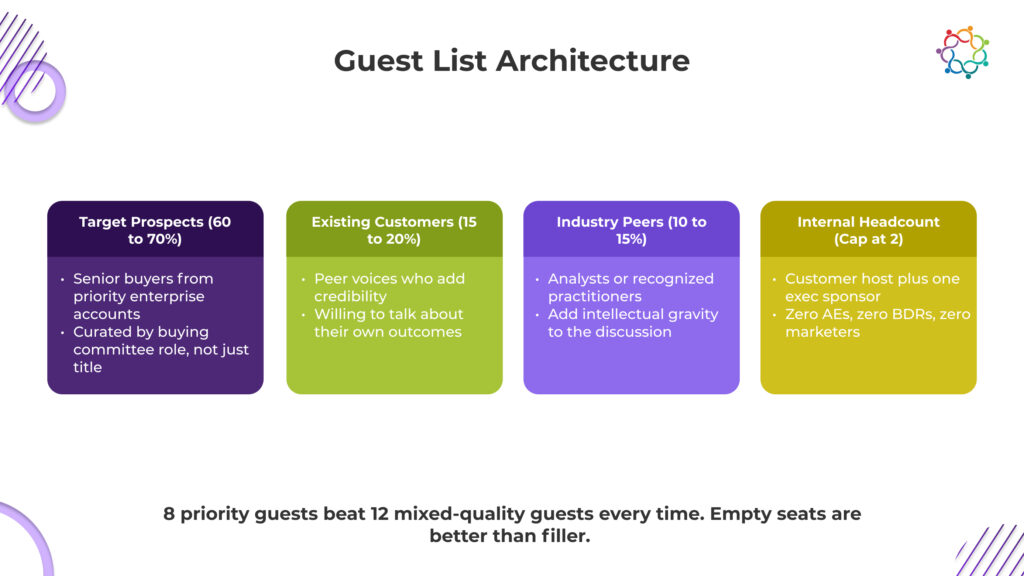
The guest list is the single most consequential decision in the program. Get it wrong and every other decision compounds the loss.
The guest list architecture.
In a typical 12-seat dinner, 2 seats go to internal (host plus exec sponsor), and the remaining 10 seats are split across three tiers. Roughly 6 to 7 seats: target prospects from priority enterprise accounts in the region. Roughly 2 seats: existing customers acting as peer voices, the credibility anchor of the evening. Roughly 1 to 2 seats: industry peers or analysts adding intellectual gravity. AEs, BDRs, and marketing managers do not get seats.
The peer-density principle.
The right room has buyers who recognize each other as peers: same seniority, similar problem space, comparable company stage. A CIO sitting next to a VP of IT Operations is a peer-density failure. They will not engage as equals. Curate by buying committee role and seniority, not just title.
The acceptance-rate math.
Senior buyers accept 15 to 25 percent of dinner invitations. A 12-seat dinner needs 50 to 80 invitations in the funnel. AE-led personal email, customer-host personal note, LinkedIn message, calendar follow-through. The customer host’s personal note converts at a meaningfully higher rate than the AE-led email.
The must-attend account list.
Define the 8 to 10 accounts you most need at the dinner before opening the invite funnel. The customer host calls each personally, peer-to-peer. The dinner does not run if 5 or more must-attend accounts decline. Reschedule rather than fill with weaker accounts.
Common trap: filling the guest list with anyone who says yes.
A dinner with 8 priority guests beats a dinner with 12 mixed-quality guests on every measurable outcome. Empty seats are better than filler. The team feels pressure to fill all 12 seats. Discipline against that pressure is the highest-leverage decision in dinner program execution.
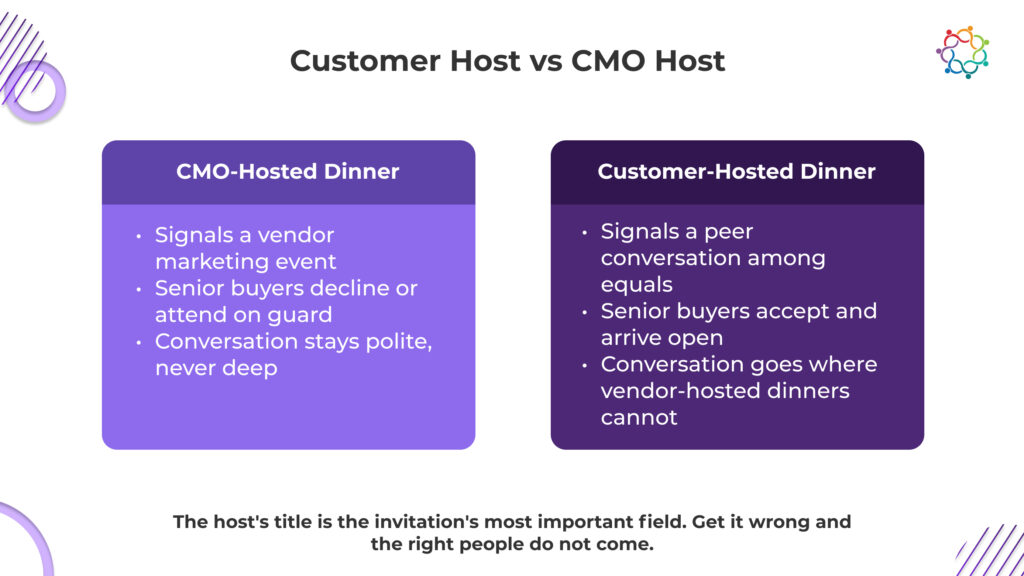
The host’s title is the dinner’s first credibility signal, and the most consistent failure point for B2B teams running dinner programs. Senior buyers read the host’s title before they read anything else.
Who the host should be.
The strongest hosts are senior customers (CIO, CMO, COO, CISO) with topical credibility on the dinner’s theme. The second-strongest are industry peers or advisors with a track record in the buyer’s domain. The technical co-founder or CEO of the hosting company can host only if they are known in the industry independently. The CMO of the hosting company should never host. The signal is wrong.
The host’s role during the evening.
Welcome the room and frame the conversation theme in five minutes or less. Keep the conversation moving without dominating it. Ensure every guest gets airtime; intervene gently if one voice takes over. Close the evening with one observation that ties the conversation together.
The host’s role before the evening.
Personally invite the must-attend accounts: peer-to-peer messaging, not marketing templates. Review the guest list and conversation theme 48 hours before, so the host walks in with context rather than catching up at the table. Receive a one-page brief on each attending account.
The host honorarium.
A modest honorarium is appropriate for non-customer hosts ($2,500 to $10,000). Customer hosts usually do not take honoraria but receive equivalent value through speaking opportunities, advisory positions, or peer recognition.
Common trap: the CMO hosts because they’re available and senior.
The CMO’s title signals “this is a marketing event,” and senior buyers either decline or attend with their guard up. The host’s title is the invitation’s most important signal. If it reads as vendor marketing, the right people do not come.
Venue and conversation design together determine whether buyers open up or stay polite. The room makes the evening either feel like a dinner among peers or a marketing event with white tablecloths.
Venue selection.
The right venue is a private room in a well-regarded restaurant, not a hotel ballroom, and not a Michelin-starred stage. The food matters, but is not the point: quality should be high enough to complement and not extravagant enough to distract. A round table beats a rectangular one, because every guest is in the conversation rather than just the people seated next to the host. Round-table seating for 8 to 14 works; beyond 14, the conversation fragments. The room should be quiet enough that voices carry across the table.
Seating logic.
Prepare the seating chart in advance, not first-come, first-served. Customer host at one end, exec sponsor at the other, which splits the room’s gravity. Priority prospects sit positioned to interact with multiple peers, not isolated next to the host. The AE sits near priority accounts but not directly adjacent: a witness, not a participant in the peer conversation.
Conversation design.
The host frames a single discussion theme: broad enough to invite multiple perspectives, specific enough to produce real insight. Three to four trigger questions are held in reserve, deployed when the conversation flags. No PowerPoint, no formal agenda, no vendor pitch, even subtly. The product can be referenced when a guest asks, never volunteered. The aim is one or two memorable observations attendees will quote later. That is how dinners propagate.
Common trap: booking a Michelin-starred venue because the budget allows it.
The signal of an over-extravagant venue, “they’re trying to impress us,” undermines the peer-conversation premise. Senior buyers attend dinners because of the room, not the menu. The venue should be excellent and forgettable, not memorable and showy.
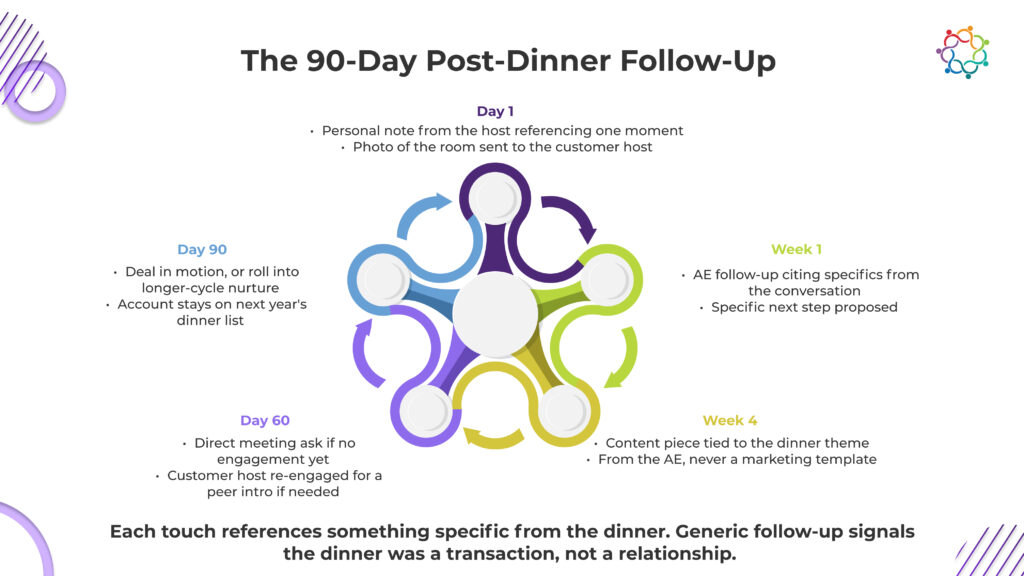
Most dinner programs unravel in the follow-up phase. The wrong cadence undoes the trust the dinner built.
Day 1 (the morning after).
A personal note from the host, not the AE, referencing one specific moment from the conversation. A photo of the room is sent to the customer host, who will often share it on LinkedIn.
Week 1.
Personal follow-up from the AE referencing what the prospect specifically said at dinner. Never a generic “great to meet you.” A specific next step: a meeting, a content share, or an introduction to a peer customer.
Week 4.
A content piece tied to the conversation theme: analyst report, customer case study, peer-validated benchmark. From the AE, not a marketing template, and tied to something the prospect raised at the table.
Day 60.
A direct meeting asks if no engagement has resulted yet. The customer host can be re-engaged for a peer introduction if the prospect has gone cold.
Day 90.
Either the deal is in motion, or the prospect rolls into a longer-cycle nurture. The account stays on the dinner-program list for the following year. The right account on the wrong week is still the right account.
The cadence rule.
AE-led, low-volume, high-relevance. Never marketing-led automation. Each touch references something specific from the dinner. Generic follow-up signals the dinner was a transaction, not a relationship. Maximum five outreach touches in 90 days. Beyond that, you are chasing, not nurturing.
Common trap: routing dinner attendees into the standard nurture sequence.
Senior buyers immediately recognize templated follow-up and read it as “the dinner was vendor marketing after all.” The follow-up has to feel like a continuation of the conversation, not a campaign.
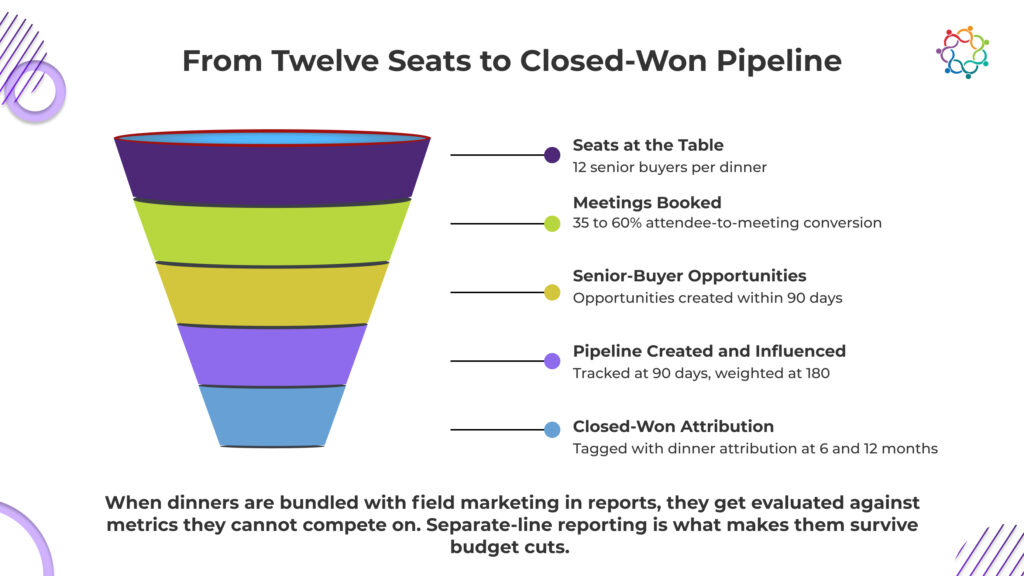
Without attribution, dinners look like a cost center and get cut from the next budget cycle.
The attribution infrastructure.
A custom CRM field, “executive dinner attended,” with date, host, theme, and conversation summary. Pipeline created within 90 days gets full source attribution to the program. Pipeline influenced beyond 90 days gets weighted touch attribution shared with other channels. Closed-won revenue gets tagged at six and twelve months.
The metrics that defend the program.
Senior-buyer opportunities created per dinner. Cost per senior opportunity is the metric that beats summits by an order of magnitude. Pipeline created and influenced by each dinner cohort. Attendee-to-meeting conversion rate, which typically sits at 35 to 60 percent for well-executed dinners, is the most reliable leading indicator of pipeline outcome.
The reporting cadence.
30 days post-dinner: attendance summary, meetings booked, opportunities created. 90 days: pipeline created and influenced. 180 days: closed-won attribution. Year-end: program-level ROI rolled up across all dinners.
The dinner vs. summit comparison slide.
A single slide for the next budget conversation: senior opportunities per dollar across the channel mix. Trend line of dinner program performance year over year. Customer host roster, which is proof that the program built reusable peer credibility that compounds across years.
When dinners are bundled with all field marketing in reports, they get evaluated against summit attendance metrics that they cannot compete with. Separate-line-item reporting is what makes dinners survive budget cuts. Bundling is how good programs lose budget defenses they should have won, and it’s a reporting decision the marketing leader controls, not the CFO.
Senior pipeline doesn’t come from large rooms. It comes from small rooms with the right people, the right host, and a real conversation. Defend the guest list. Host with a customer, not the CMO. Choose the venue and design the conversation to produce insight. Follow up like a peer. Report the dinner pipeline as a separate line item.
Most marketing leaders are debating whether to spend $50,000 on a summit or 10 dinners. The teams that won the year already chose.
If your team is running dinner programs and the senior-opportunity attribution column on the post-event report is still empty, the gap usually sits in the CRM and reporting layer. Samaaro is built for the reporting layer that closes it.