Samaaro + Your CRM: Zero Integration Fee for Annual Sign-Ups Until 30 June, 2025
- 00Days
- 00Hrs
- 00Min


Key Takeaways (TL;DR)
1
2
3
→
Bottom Line:
Brands that win their category are not the ones nominated, but the ones who decided what counts as a category.
Your competitor just hosted the inaugural CX Innovator Awards. Twelve categories. A judging panel of two Forrester analysts and three industry CMOs. 400 enterprise nominations. The winners got picked up by Forbes, AdWeek, and four trade publications.
Six months later, every B2B media outlet covering CX uses their category names. Your competitor didn’t win an award. They became the authority that defines what awards exist.
Hosting an industry awards event isn’t a vanity project. It’s a category strategy. The company that gets to define the categories gets to define the market.
This guide covers the five decisions that turn an awards event from a black-tie photo opportunity into a year-round category authority, including the ROI math that explains why hosting beats sponsoring for any company trying to own a market.
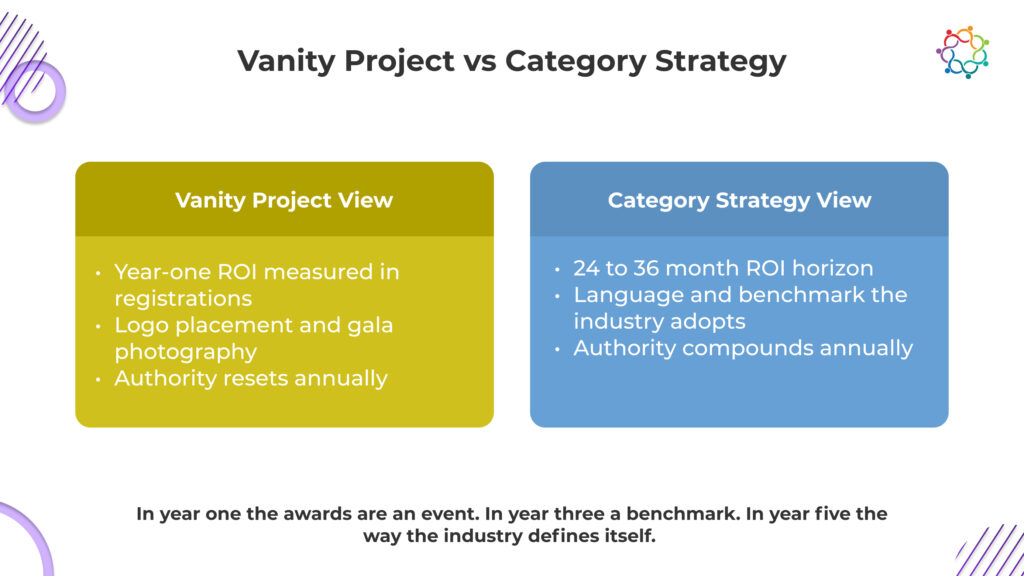
Most marketing leaders see awards as event programs. The reframe is that awards are a category mechanism that compounds in ways event programs do not.
The category-naming principle.
Every industry awards program is implicitly a category taxonomy. The host decides what counts as a category, what counts as a sub-category, and what counts as a discipline within the field. Whoever defines the taxonomy controls how the industry talks about itself.
The authority transfer.
When an analyst, customer, or journalist later references “Best Customer Journey Orchestration,” the host who created that category accumulates authority every time the term is used. The transfer is silent and continuous.
The compounding effect.
In year one, the awards are an event. In year three, they are a benchmark. In year five, they are how the industry itself is defined. The cost structure is roughly flat. The authority earned compounds.
The implication.
Hosting an awards program is a long-horizon investment in category ownership, not a short-horizon investment in brand visibility.
Common trap: evaluating awards against single-event ROI metrics.
Registrations, social impressions, attendees. The ROI of awards compounds across years. Measuring it in event-level metrics is like measuring the ROI of a podcast after one episode. The right horizon is 24 to 36 months, with leading indicators tracked across the first year.
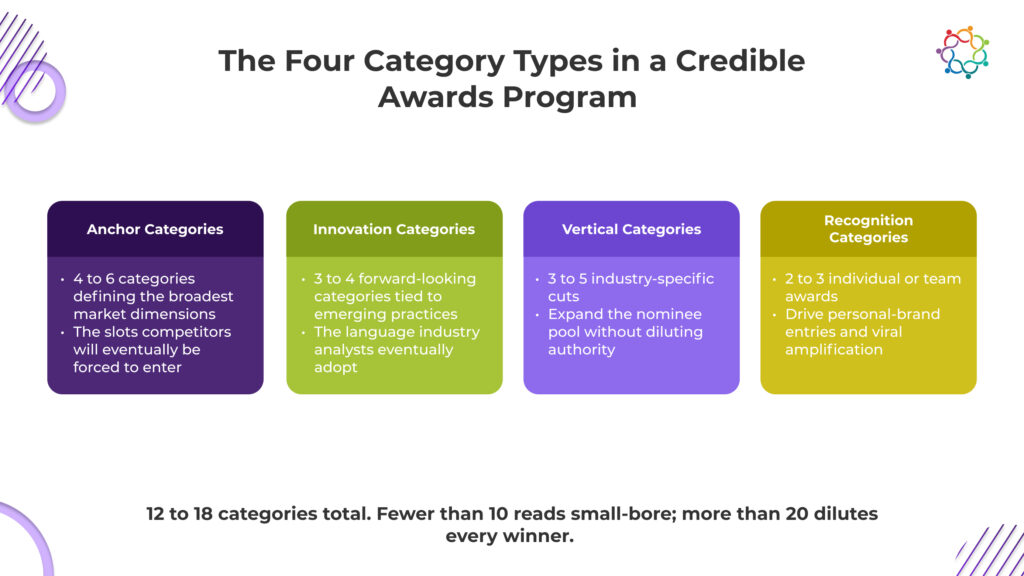
Category design is the leverage decision in any awards program. It determines whether the awards become an industry standard or a forgettable annual gala.
The category design framework.
A well-structured B2B awards program runs four category types in parallel:
The naming logic.
Categories should be named with specific functional language, not generic adjectives. “Best Customer Data Platform Implementation” beats “Best CDP Award” by a wide margin. Names that imply a discipline, not just a product type, hold up over time: “Excellence in Customer Journey Orchestration” implies orchestration is a discipline, which is exactly the authority transfer the program is trying to engineer. Avoid names that lock to your product vocabulary. Categories must feel industry-owned, not vendor-owned, and the industry reads vendor vocabulary from a long distance.
The category quantity rule.
12 to 18 categories is the sweet spot for a major B2B awards program. Fewer than 10 reads as small-bore and signals the program isn’t a serious benchmark. More than 20 produces dilution, where every winner means less, and the program loses its tier-of-recognition status. The sweet spot lets you cover the market without diluting the price.
Common trap: designing categories around your product taxonomy.
If your CDP product has three editions, naming “Best CDP Edition,” “Best Mid-Market CDP,” and “Best Enterprise CDP” telegraphs that the program is vendor marketing, not industry recognition. Categories must read as industry-defined even when they are vendor-hosted.
The judging panel is what separates a respected industry awards program from vendor self-congratulation. The composition is what the industry reads first when assessing credibility.
The panel composition.
The recommended target composition for a major B2B awards program runs roughly 35 percent industry analysts (Forrester, Gartner, IDC, or boutique analysts), roughly 35 percent customer practitioners (senior CMOs or category leaders from companies not using your product), about 18 percent journalists or trade press editors, and about 12 percent from your own company. The internal seats go to senior leadership only, never PMM or content marketers. Outside-company members must always exceed inside-company members by at least a 4 to 1 ratio. That ratio is the credibility floor of the program.
The recruitment logic.
Treat judges like board members: a 12-month commitment, light obligations, premium positioning. Honoraria are appropriate but modest. Judging is a credibility transaction, not a paid engagement, and high honoraria signal the program is buying participation rather than earning it. The first wave of recruited judges is the hardest; subsequent recruitment becomes easier as the panel becomes prestigious.
The conflict-of-interest discipline.
Judges cannot evaluate categories where they have direct business interests. Judges cannot evaluate companies they consult for or hold equity in. Disclosure is published alongside winner announcements. Without this discipline, a single perceived conflict becomes the story instead of the winners.
Common trap: stacking the panel with internal employees and friendly customers.
The shortcut destroys the credibility premise of the program. A panel that is 60 percent internal employees plus three friendly customers is read by the industry as a vendor-controlled award. Once that perception forms, the program never recovers it.
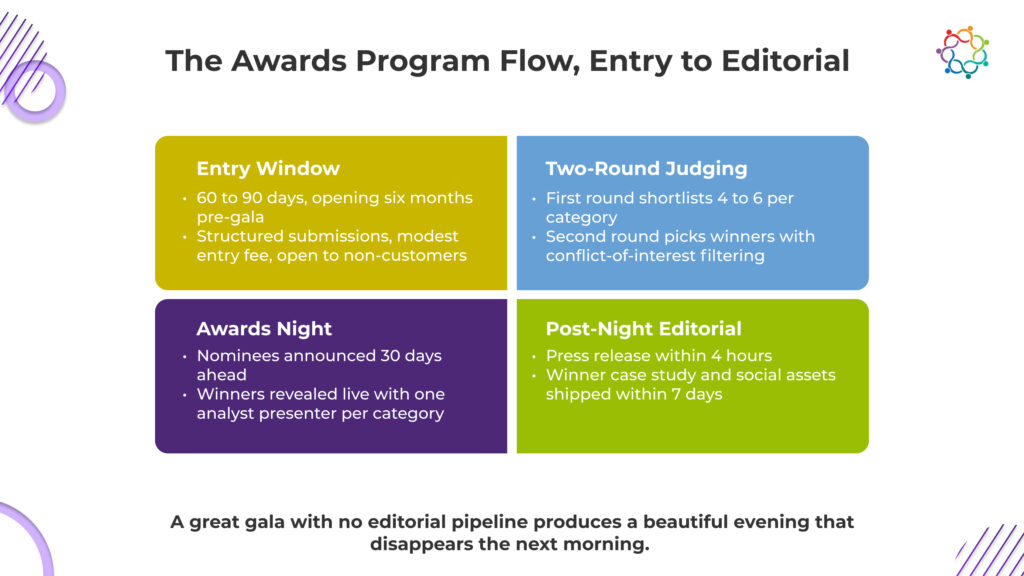
The awards night is the visible moment, but the program runs continuously from the entry window to the post-night editorial.
Entry mechanics.
Open the entry window 6 months before the awards night and keep it open for 60 to 90 days. Submissions should be structured around case-specific evidence: outcome metrics, customer references, methodology, not just narrative. A modest entry fee ($100 to $500) signals seriousness and reduces low-quality entries. The program must be open to non-customers; this is non-negotiable. A program that excludes non-customers is a customer marketing event, not industry awards. Self-nominate, peer-nominate, and analyst-nominate paths broaden the entry pool.
The judging workflow.
Run two-round judging. The first round narrows entries by category to a shortlist of 4 to 6. The second round selects winners. Each entry is reviewed by at least three judges, with conflicts of interest filtered automatically by the entry platform. Publish the scoring rubric in advance; transparency is part of credibility. Capture judges’ deliberation for use in winner-announcement editorial content.
The awards night design.
Three format options. A standalone awards gala is the highest-positioning play but the most expensive ($300K to $1M+ for a major B2B program). An awards night embedded inside a larger industry conference (the Cannes Lions model) is higher-leverage for category strategy but requires an existing conference to host it. A partnered awards night within another organization’s event limits hosting cost while preserving category authority. Announce nominees 30 days pre-event to drive pre-show coverage. Announce winners live, with one industry analyst presenting per category, so analyst presence carries the authority signal into the room.
The post-night-of discipline.
The first 72 hours determine how much trade-press coverage the program earns, and the editorial pipeline that gets readied during them is what converts the gala into a year-round authority engine.
Common trap: treating the awards night as the deliverable.
The gala is the visible moment. The entry pipeline, judging credibility, and post-event editorial pipeline are what make it a category program. A great gala with no editorial pipeline produces a beautiful evening that disappears the next morning.
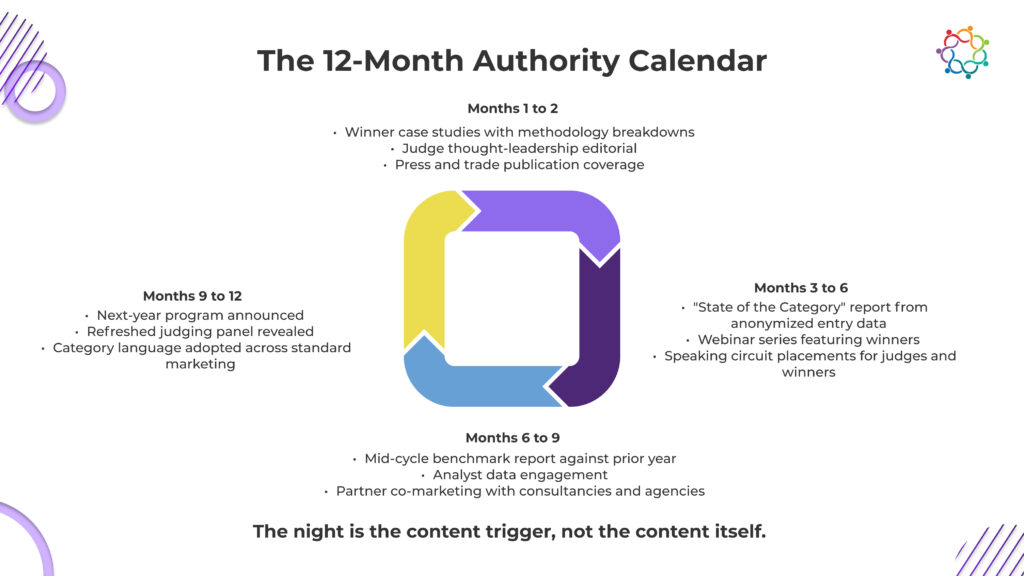
The single largest gap in most awards programs is the absence of a 12-month editorial calendar that monetizes the authority earned at the gala. The night is the content trigger, not the content itself. The 12 months that follow are where the program either becomes a category benchmark or becomes a forgotten gala.
Months 1 to 2 (post-gala).
Winner case studies get published with deep methodology breakdowns. Judge perspectives get published as thought-leadership editorial. The press cycle and trade-publication coverage get seeded continuously across the first 60 days, while the news value is still fresh and trade outlets are actively assigning coverage.
Months 3 to 6.
Publish a “State of the [Category]” report drawing on the anonymized entry data. The report establishes the program’s data position as authoritative, which is the same play that analyst firms run with their own surveys. Run a webinar series with winners walking through their approach. Place judges and winners on the speaking circuit as “featured in [Award Name]” voices.
Months 6 to 9.
Publish a mid-cycle benchmark report comparing entries from this year to last (only applicable from year two onward). Engage analyst firms by delivering the entry data as input for their own published reports. Activate partner co-marketing with agencies and consultancies whose clients won, who lean into the authority by association. This phase is where the program’s data positioning starts compounding into outside-authored coverage.
Months 9 to 12.
Announce next year’s program. Open the entry window. Reveal the judging panel for the next cycle with new prestige adds, since each year’s panel should add to the previous year’s, not just replace it. The category language created during this cycle becomes the language used in your standard marketing: landing pages, sales decks, and blog posts.
Common trap: no editorial calendar after the gala.
Companies that invest $500K+ in an awards program and don’t allocate budget to a 12-month content calendar leave roughly 70 percent of the program’s value unrealized.
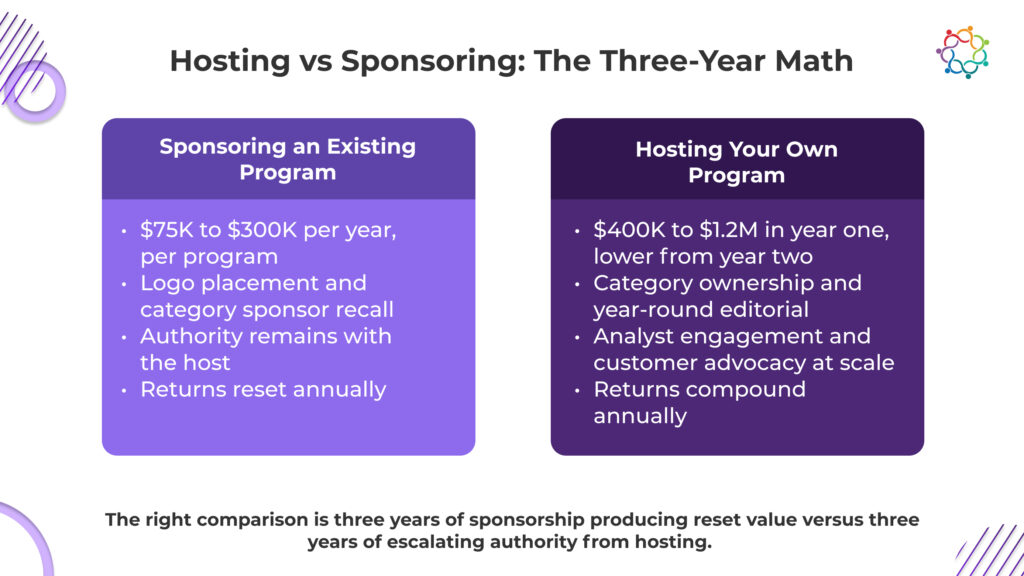
Most B2B marketing leaders default to sponsoring industry awards because hosting feels expensive. The math typically inverts once the time horizon is honest.
The cost comparison.
Sponsoring an existing industry award typically costs $75K to $300K, depending on the program. The outcome is logo placement, occasional category sponsorship, and modest brand recall. Authority gain is minimal because the host retains the category authority.
Hosting your own awards program typically costs $400K to $1.2M in year one (program design, judging panel, entry platform, gala, content) and $300K to $800K in year two and beyond. The outcome is category ownership, year-round content, analyst engagement, and customer advocacy at scale. Authority gain is substantial, and it compounds.
The breakeven framing.
Hosting your own awards costs roughly three to five times what sponsoring an industry award costs. The brand-equity return on hosting compounds annually. Sponsorship returns reset annually. Three-year cumulative ROI typically inverts in favor of hosting by the end of year two, which is the time horizon any honest evaluation has to cover.
When sponsoring is the right call.
Three conditions justify defaulting to sponsorship. The market category is already defined, and another well-respected program owns it (the Webby Awards in digital experience, for example). The company is too early-stage to support the operating commitment of hosting. The strategic priority is brand visibility within an existing category, not category ownership of a new one.
Common trap: defaulting to sponsorship because the per-year cost is lower.
The right comparison isn’t $200K sponsorship vs. $800K host. It’s three years of $200K sponsorship producing reset value versus three years of escalating authority from hosting.
An awards program is a category mechanism. Its compounding value lives in the language it creates and the authority that language transfers back to the host. Design categories that define a discipline. Recruit a judging panel that exceeds inside-company voices 4 to 1. Run with editorial rigor. Monetize the authority across 12 months. Choose hosting over sponsorship when category ownership is the strategy.
The brands that win their categories aren’t the ones that get nominated. They’re the ones who decided what counts as a category in the first place.
If your team is evaluating whether an industry awards program belongs in the marketing portfolio, the answer usually turns on whether the company is trying to own a category. Samaaro is built for the reporting layer that ties multi-year event programs back to the pipeline.