Samaaro + Your CRM: Zero Integration Fee for Annual Sign-Ups Until 30 June, 2025
- 00Days
- 00Hrs
- 00Min


Key Takeaways (TL;DR)
Bottom Line:
Customer education events determine retention because confidence, not satisfaction, is what protects renewals and prevents silent churn.
Churn is usually explained with easy answers: pricing, feature gaps, competition. These explanations protect internal narratives. But most customers leave not because something fails, but because they never achieve confident, independent usage.
A product can work perfectly and still feel uncertain. When customers do not understand how to extract value, hesitation replaces conviction. Confusion lowers perceived impact before dissatisfaction is voiced. Usage becomes shallow. Advocacy never forms. Renewal becomes risky.
Customers rarely churn in a dramatic moment. They drift when nothing fully clicks.
Retention is not first a product problem. It is a learning problem. If customers never achieve usage maturity, they cannot justify value internally. And if they cannot defend the investment, they will not renew it.
This blog covers why education, not support, determines long-term retention and how structured learning directly influences confidence, trust, and loyalty.
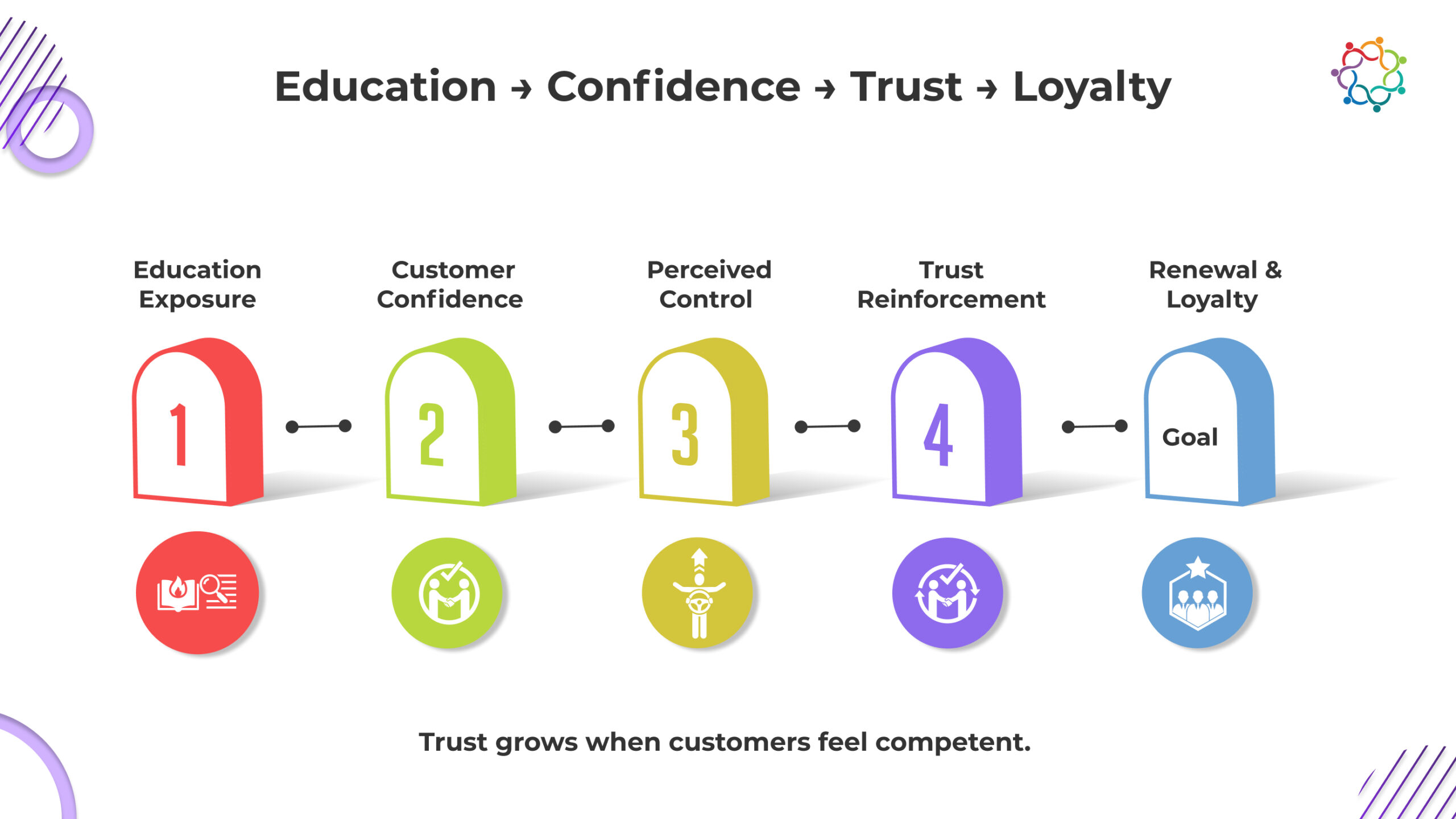
Education is not a content function. It is a confidence engine. Customers do not renew because they were helped quickly. They renew because they feel capable of winning consistently. Confidence lowers perceived risk. Lower risk strengthens trust. Trust stabilizes retention.
When customers understand not just how a feature works but why it matters, value realization accelerates. They shift from dependency to control. Control changes behavior. It increases experimentation, deepens adoption, and strengthens internal alignment. That alignment protects renewals long before procurement discussions begin.
If customers constantly need reassurance, loyalty is fragile. If they understand how to create results independently, loyalty becomes durable. Retention strengthens when customers feel in control, not when they feel supported.
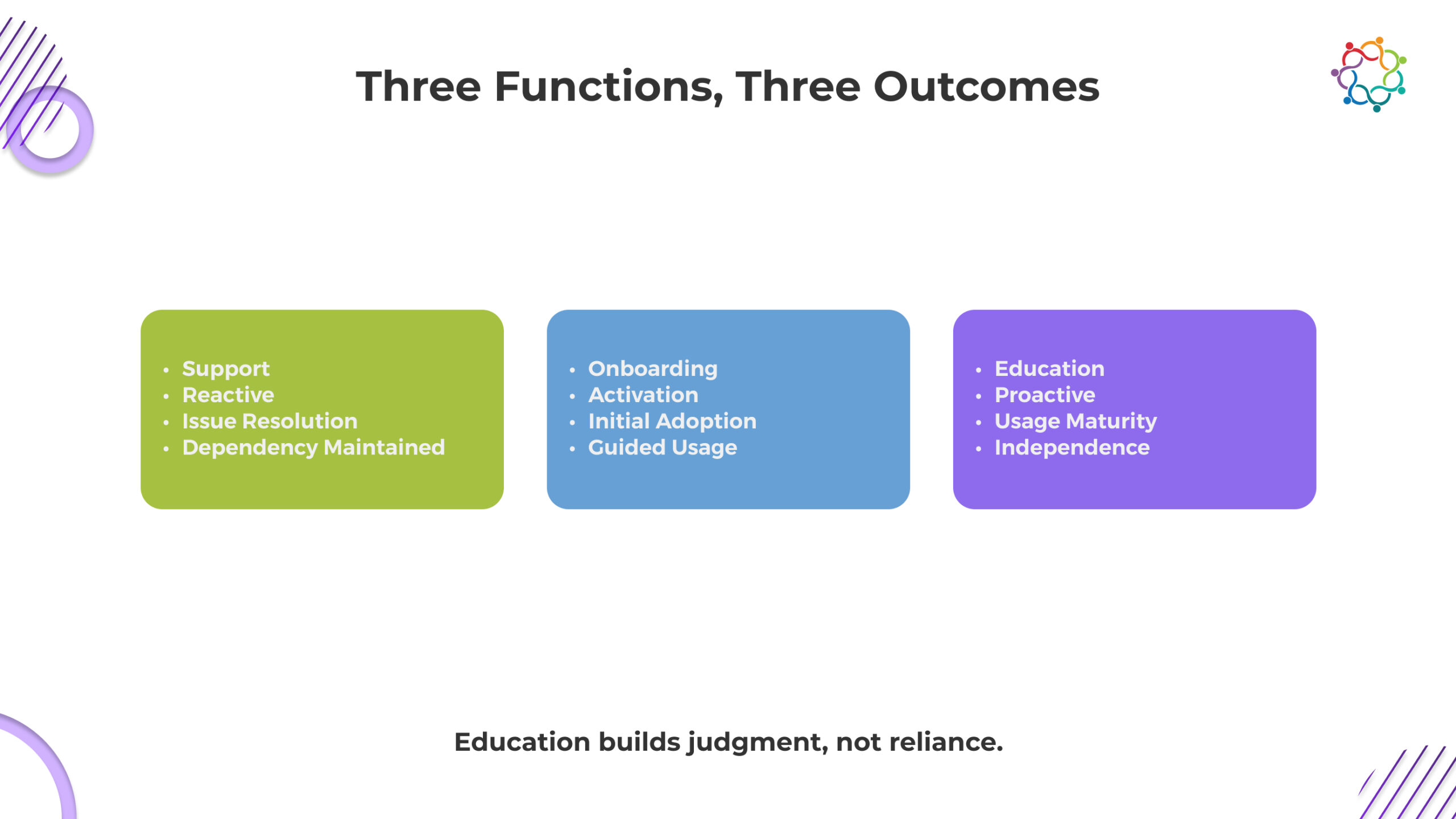
If you blur the line between support, onboarding, and education, you are mismanaging retention. These functions are not interchangeable. Treating them as one bucket guarantees shallow adoption and fragile renewals.
Support is reactive. It activates after friction appears. A ticket is raised. A response is given. The issue is resolved. Resolution restores functionality, not mastery.
Education anticipates confusion before it compounds. It addresses recurring gaps collectively. It upgrades baseline understanding across accounts. If your customers only learn when something breaks, you are training dependency, not confidence. Dependency increases churn sensitivity. Prevention reduces it.
Onboarding moves customers from purchase to first value. It proves the product works. Then it ends.
Education begins where onboarding stops. It deepens usage maturity. It connects features to evolving business scenarios. Without structured reinforcement, adoption plateaus at “good enough.” Good enough does not survive competitive pressure. If learning stops after activation, renewal risk starts increasing.
Support answers how. Education clarifies why and when. That difference defines retention strength.
Customers who understand context make independent decisions. Independent users explore more. Exploration drives deeper value realization. If your customers cannot articulate strategic application, they are not loyal. They are temporary.
Education events exist to create autonomy. If your programs do not build judgment, they are not protecting retention.
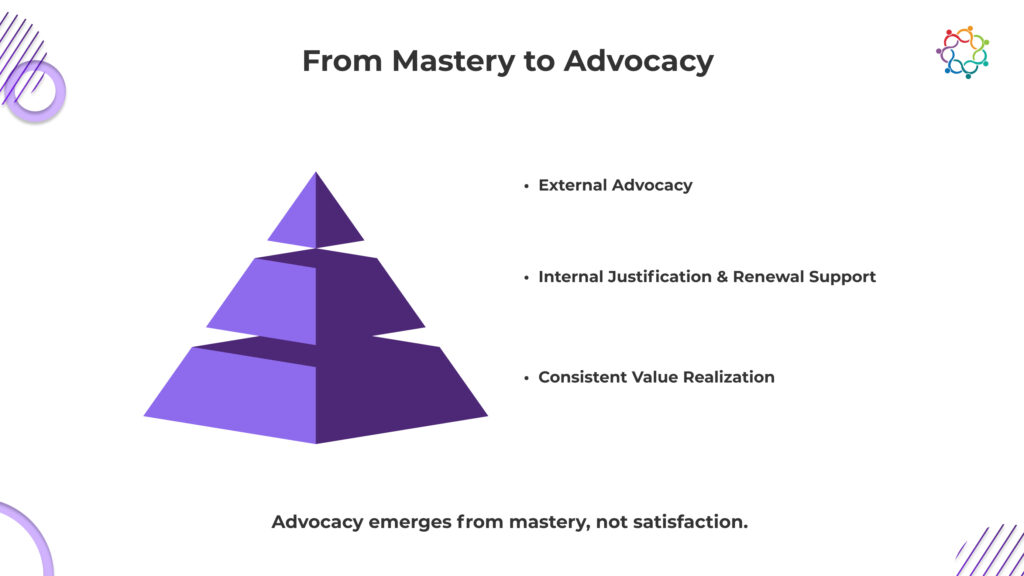
Retention is not just about contract continuity. It is about durable alignment between product value and customer belief. Education shapes that alignment.
Educated customers extract value faster. They expand usage across teams. They connect capabilities to measurable outcomes. This accelerates value realization and reinforces retention economics.
Mastery changes internal conversations. When customers understand a product deeply, they can justify investment decisions. They defend budget allocations. They articulate ROI in their own language.
Education influences advocacy in subtle ways:
Satisfaction is emotional. Mastery is structural.
Advocacy often emerges from competence, not delight. A satisfied customer may still consider alternatives. A master user understands trade-offs. They recognize opportunity cost. They know what would be lost in migration.
This is where customer education events compound impact. They create shared learning communities. They normalize advanced practices. They reinforce trust through transparency and expertise.
Over time, educated customers become internal experts. Internal experts anchor renewal conversations. They reduce procurement friction. They provide social proof inside their organizations.
Retention is reinforced when value is clearly articulated, and education makes that articulation possible.
Without ongoing product education programs, usage stagnates. Stagnation lowers perceived growth potential. When growth potential declines, renewal risk rises.
Retention is sustained by continuous learning, not periodic persuasion.
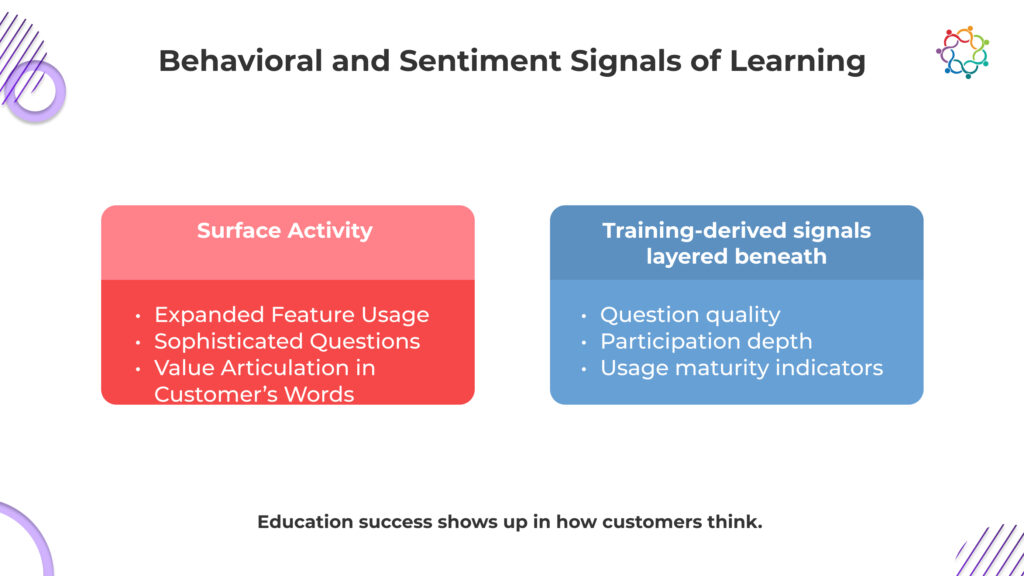
Attendance metrics are visible. Retention signals are deeper.
Measuring customer education impact requires behavioral and linguistic analysis. Surface engagement does not prove confidence. Leaders must look for evolution.
Behavior reveals maturity. As customers learn, patterns shift.
These indicators reflect usage maturity and value realization. They signal that learning reinforcement is occurring. Customers are not just consuming content. They are applying it.
Advanced questions demonstrate cognitive progress. When customers challenge assumptions or explore integration depth, they display confidence. Confidence reduces churn risk because it strengthens internal ownership.
Signal quality improves when behavior changes. Retention becomes predictable when adoption depth expands consistently.
Language shifts precede renewal strength. Customers who understand value articulate it clearly.
Listen for evidence:
These signals indicate trust reinforcement and advocacy formation. Education is working when customers teach others. Peer teaching reflects mastery.
Measuring impact requires qualitative attention. Surveys alone are insufficient. Observe how customers think. Observe how they speak. Observe whether they connect the product to business outcomes without prompting.
Education success appears in dialogue quality, confident framing, and proactive engagement. Retention improves when customers internalize value narratives. Education shapes those narratives.
Most teams claim retention is a priority. Few allocate resources to the one lever that systematically protects it. Education is deprioritized not because it lacks impact, but because its impact is misunderstood. If you treat learning as optional, you are choosing preventable churn. The bias is structural, and it is expensive.
Education rarely delivers dramatic quarterly lifts. It compounds quietly through confidence-building and usage maturity. If you prioritize only visible short-term wins, you will consistently underinvest in long-term retention economics. In reactive organizations, short-term spikes often win budget over long-term compounding effects.
Education influences customer success, product adoption, marketing advocacy, and expansion revenue. Because the outcomes are distributed, accountability becomes blurred. When no single team “owns” the upside, no single team fights for the budget. Avoiding ownership does not reduce risk. It increases it.
Measuring customer education impact requires behavioral analysis, not vanity metrics. Reduced churn volatility and stronger renewal confidence appear over time. If your measurement model only rewards immediate attribution, you will miss the structural drivers of loyalty.
Education prevents confusion, stagnation, and silent disengagement. Prevention rarely looks urgent until renewals decline. By then, rebuilding trust is slower and more expensive than sustaining it.
If you are underfunding education events, you are not being efficient. You are deferring risk.
s
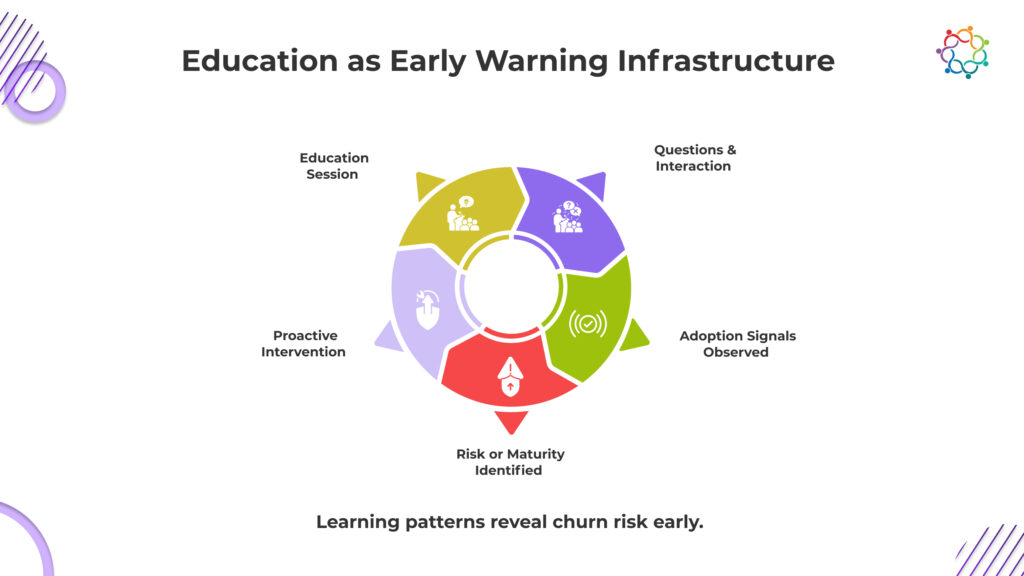
Education is not only about delivery. It is diagnostics.
Every question asked during a session reveals adoption maturity. Basic clarifications signal early-stage understanding. Advanced integration inquiries signal confidence and exploration.
Attendance patterns also reveal risk. Declining participation can indicate disengagement. Sudden inactivity may reflect internal disruption. Consistent engagement suggests embedded value.
Feedback collected during sessions often exposes strategic gaps. Customers articulate friction points candidly in educational settings. This transparency provides early warning long before formal churn signals appear.
Signal quality from engagement is stronger in educational environments because participation is voluntary and intent-driven. Customers who attend want to improve outcomes. Their questions are forward-looking. Their concerns are predictive.
Retention intelligence derived from education is proactive. It enables targeted intervention before risk materializes. It allows customer success leaders to prioritize accounts based on learning velocity rather than only revenue size.
Usage maturity is observable in real time through dialogue depth. Leaders who treat education as insight infrastructure gain clarity that others miss.
Retention is easier to protect when warning signals are visible. Education events make those signals visible.
Retention is not protected by reminders, discounts, or last-minute persuasion. It is protected by understanding. Customers renew when they are confident, capable, and clear about the value they create with your product. That clarity does not happen accidentally. It is built through deliberate education.
If learning slows, usage plateaus. If usage plateaus, renewal weakens. The pattern is predictable.
Customer education events are not optional programming. They are a retention infrastructure. Underinvest here, and churn becomes a matter of time, not surprise, especially for teams that delay formalizing how they approach education strategy.