Samaaro + Your CRM: Zero Integration Fee for Annual Sign-Ups Until 30 June, 2025
- 00Days
- 00Hrs
- 00Min


Key Takeaways (TL;DR)
Bottom Line:
Product launch events succeed when they convert attention into structured early usage. Adoption must be designed into the launch, not assumed after it.
Product launch events are often treated like the ultimate proof of a product’s promise. They are visually stunning, strategically timed, and built to generate applause, social shares, and registration numbers. The room buzzes. The chat fills with excitement. Marketing celebrates. Leaders nod approvingly.
The structural problem is simple: attention alone does not create adoption.
For product marketers and growth leaders, this is frustrating. Launch-day applause rarely leads to lasting engagement. Usage often drops sharply once the excitement fades. The problem is not that users fail the product, but that the launch fails the users.
The issue is not user apathy. It is launch design. Attention, messaging, and onboarding are misaligned with real behavior change. Launch events must function as the starting point for learning and action, not the peak of success.
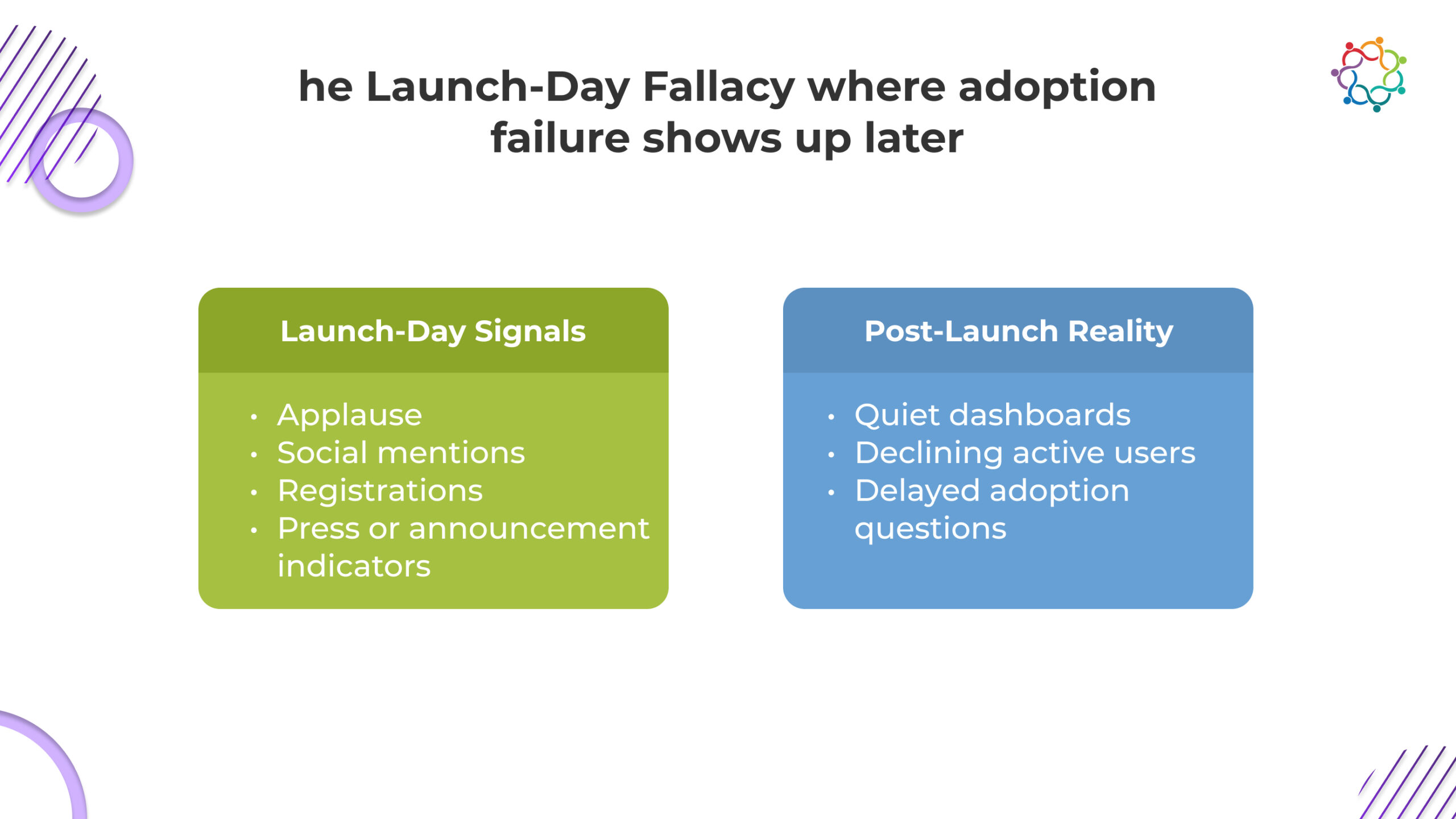
Creating enthusiasm on launch day is surprisingly simple. Any product can appear revolutionary for a few hours with a well-executed presentation, striking graphics, and well-publicised announcements. The number of registrations soars. Buzz on social media gets more intense. The perceived level of success is increased by media publicity. However, none of these measures assess how likely users are to interact with the product.
The fundamental flaw is the assumption that visibility equals adoption. Teams often equate applause with understanding and awareness with action. Launch events reward immediate attention rather than sustained engagement. Users may leave the event inspired, but inspiration without guidance rarely translates into behaviour change.
Why adoption suffers:
Most launches succeed as events and fail as adoption systems. The audience leaves with enthusiasm but not clarity on the next steps, setting up adoption decay from the outset.
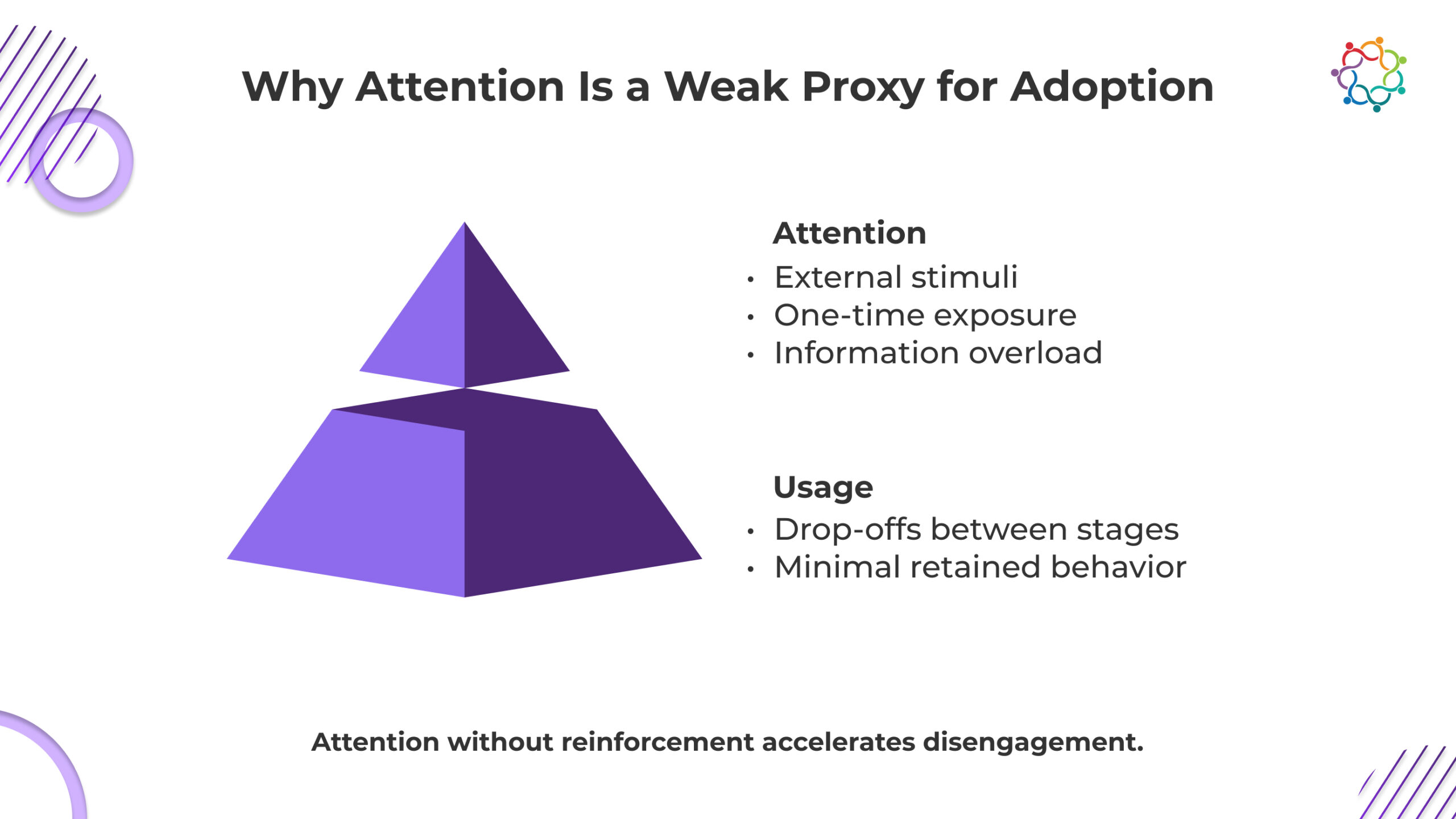
Engagement during a launch is not evidence of sustained usage. Even though an eye-catching presentation or an engaging demonstration may get people to look, listen, and cheer, it doesn’t guarantee that they will utilise your product.
Adoption is essentially distinct. Repeated encounters, intrinsic motivation, and a firm grasp of value extraction are necessary.
Users are forced to assimilate too much information too soon because most launch events jam months’ worth of content into a few hours. Awareness does not equate to action. Although users may leave feeling amazed, they do not leave feeling knowledgeable. Their excitement fades the moment they return to their daily routines, and without structured reinforcement, drop-off becomes inevitable.
Attention cannot carry adoption without reinforcement. Real adoption is earned through guidance, reinforcement, and clarity.
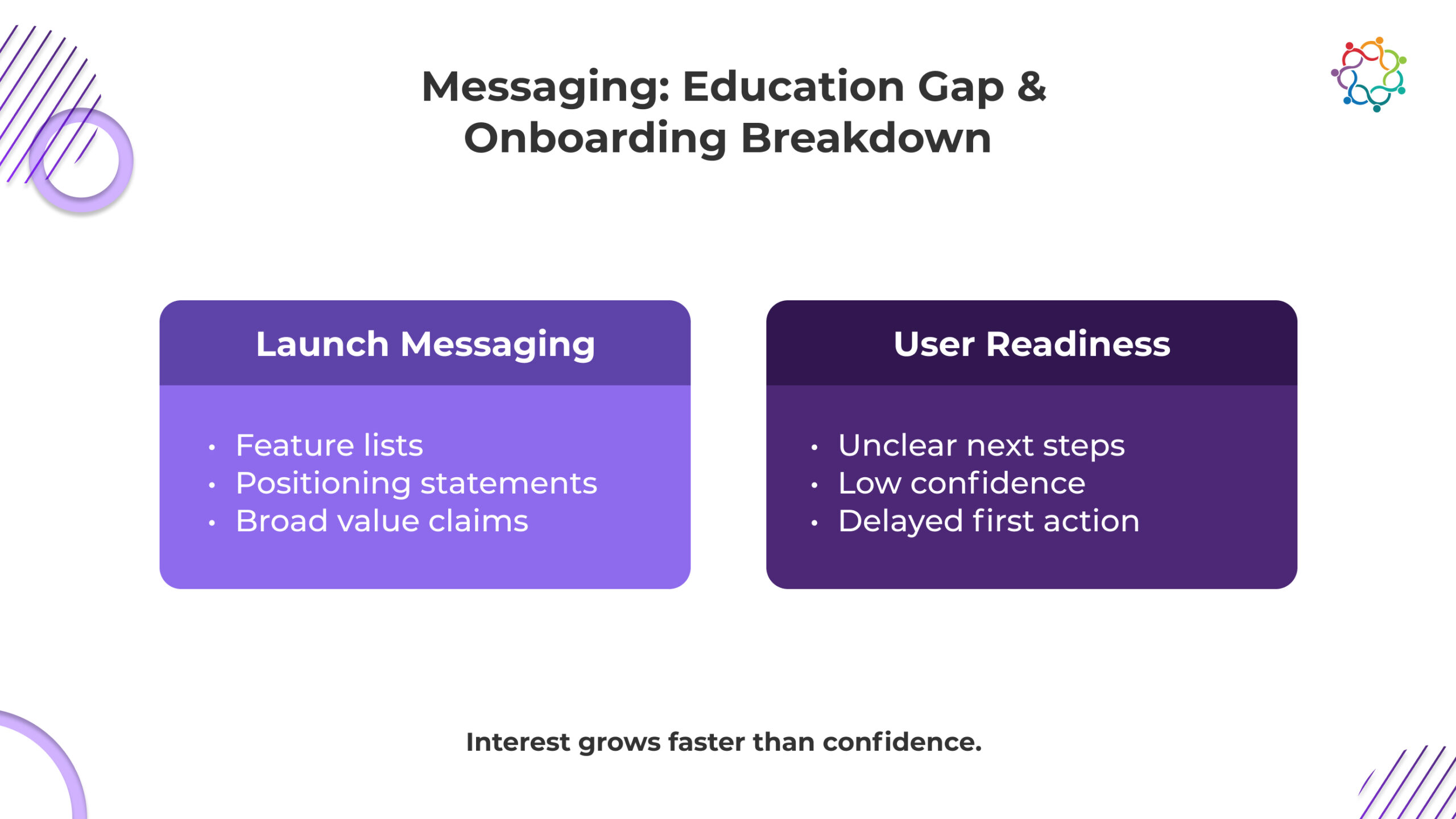
Even well-positioned products struggle after launch because messaging and education are treated as the same thing. They are not. Messaging creates interest. Education creates usability. When that distinction is ignored, adoption slows before it properly begins.
Launch presentations often highlight multiple features in rapid succession. Users see capability, but they do not see sequence. Without context on when and why to use each feature, complexity increases and confidence drops.
Strong positioning clarifies who the product is for and why it matters. It rarely explains how to start. Users understand the promise but remain unsure about the first practical step toward value.
Events compress large amounts of information into a short time frame. Cognitive overload reduces retention, which increases activation lag once users attempt to engage independently.
Curiosity drives sign-ups. Confidence drives continued use. Without guided education that builds familiarity and competence, early enthusiasm fades into hesitation, and hesitation turns into abandonment.
Adoption improves only when education is embedded directly into the launch experience rather than postponed until later.
Most launch events prioritize spectacle over readiness. Users frequently depart feeling excited but unsure of their next course of action. The experience is fragmented since onboarding is handled as a distinct operation, frequently months after the launch. Adoption is intrinsically brittle when launch and onboarding are separated.
Launch events frequently put the reveal ahead of preparation, emphasising statements over concrete actions, which leaves people without obvious ways to get value right away. Adoption stalls before it even starts because onboarding is viewed as reactive rather than proactive, leaving early users unsupported.
This assumption ignores activation lag and compounds cognitive overload. Adoption is not accidental. It must be deliberately designed. Launch events that ignore onboarding unintentionally guarantee a post-event drop-off.
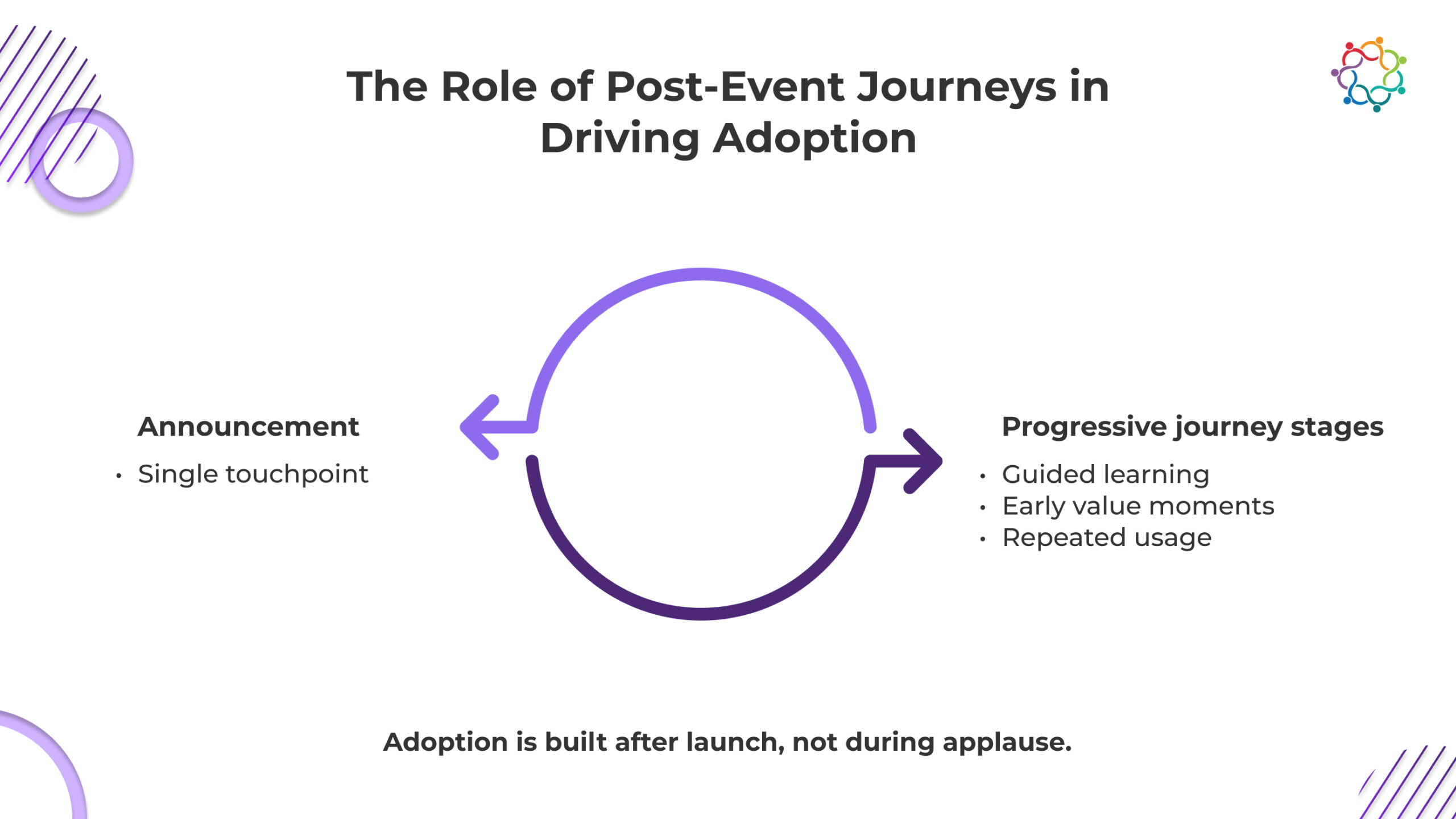
Adoption is not a moment of excitement. It is a behavioral transition. And behavioral transitions don’t happen on stage; they happen through repetition under reduced uncertainty.
A launch event creates awareness and emotional energy. What it does not create is confidence. After the spotlight fades, users are left with questions: Will this fit into my workflow? Will it slow me down? What happens if I get stuck? That uncertainty is the real barrier to adoption.
Post-event journeys exist to systematically remove that uncertainty.
Spaced reinforcement, through follow-up emails, contextual nudges, short webinars, or guided in-app prompts, keeps the product cognitively active without overwhelming the user. Each interaction reduces ambiguity. Reduced ambiguity increases willingness to try. Trying creates small repetitions. Repetitions, when paired with visible progress, begin forming habit.
This is the cause chain:
Early value moments accelerate this loop. When users experience a quick, tangible win soon after the event, perceived risk drops. The product stops feeling theoretical and starts feeling useful. Momentum replaces hesitation.
Engagement signals complete the feedback system. When teams track who activates, who stalls, and where friction occurs, they can intervene before confusion turns into abandonment. Without this, usage decay is inevitable.
The uncomfortable truth is that even a high-energy, well-attended launch cannot guarantee adoption. Energy fades. Memory decays. Attention shifts. Only structured, pre-planned post-event journeys convert awareness into behavior.
Events ignite interest. Journeys convert it into habit.
And without engineered habit, usage always drifts back to baseline.
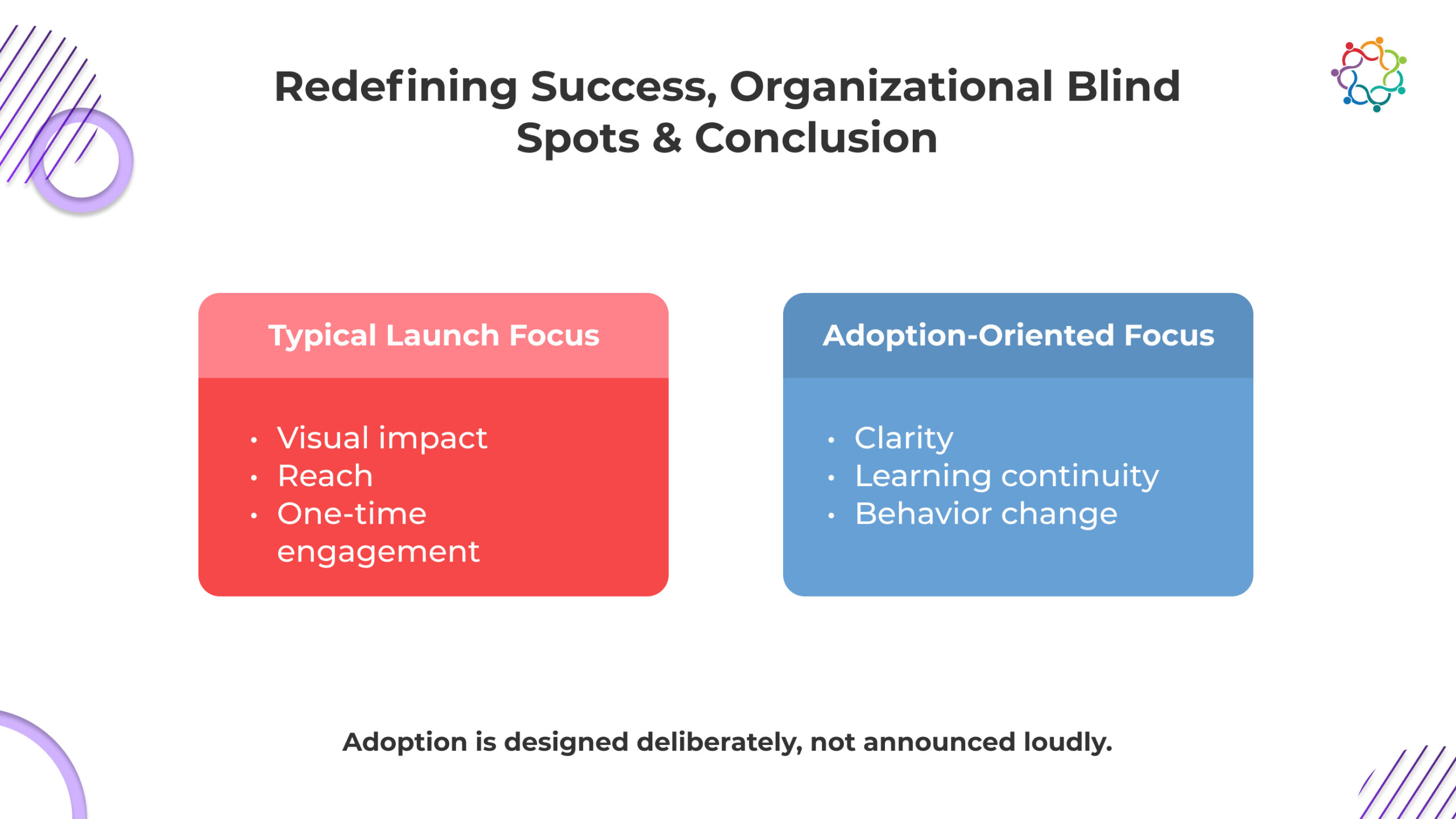
Conventional product introductions frequently emphasise spectacle. Teams spend a lot of money on announcements, visual impact, and one-time interaction, producing impressive moments that are rarely used again. The issue is that these measures prioritise attention over behaviour and praise over adoption.
Successful launches adopt a distinct strategy. Instead of viewing the incident as a climax, they view it as the beginning of a process of learning and behaviour modification. Reducing cognitive friction, defining future actions, and fostering confidence in early use are the goals of every choice, from agenda design to demos. The objective is to empower consumers to take action, not to impress.
| Typical launches optimize for: | Adoption-focused launches optimize for: |
| Visual impact | Usage clarity |
| Announcement reach | Defined first action |
| One-time engagement | Reinforced early value |
Effective launches translate attention into first use. Announcements reaffirm early value, engagement tactics extend beyond the event to direct uptake, and visuals aid in understanding. The most successful events resemble the initial chapter of onboarding rather than the conclusion. They are intended to pique interest, provide clarification on usage, and sustain momentum long after the cheering has stopped.
Teams that focus on adoption-first design avoid the common trap of high visibility with low retention.
Marketing is rewarded immediately. Product is judged months later. No one is accountable for the gap. Marketing teams cheer when the event goes viral, counting registrations, social mentions, and applause as proof of achievement. Product teams wait months to judge whether users actually engaged, often realising too late that the product hasn’t been adopted.
Nobody assumes accountability for the path that unites these two realities in the meantime. Most teams act as though they can optimise for both adoption and spectacle without altering accountability or incentives.
The disconnect is not a minor oversight; it’s a structural flaw. By celebrating attention without owning post-launch behaviour, teams create the perfect conditions for disengagement. Users leave the launch excited, but with no guidance, no support, and no reinforcement, they quietly abandon the product. When no team owns adoption continuity, disengagement is predictable.
Launch-day applause is fleeting. Buzz does not equate to usage, and registration numbers do not translate into engagement. Product launch events can generate excitement and social proof, but without deliberate design for behaviour change, adoption will inevitably lag.
Adoption requires continuity. It demands that learning extend beyond the event, that onboarding is integrated with launch messaging, and that post-event journeys reinforce confidence and momentum. Events must initiate behaviour change, not conclude messaging.
A launch merely increases the drop-off if it does not make the product easier to use. If a launch does not make first usage easier within 24 hours, it has failed adoption.