Samaaro + Your CRM: Zero Integration Fee for Annual Sign-Ups Until 30 June, 2025
- 00Days
- 00Hrs
- 00Min

Key Takeaways (TL;DR)
Bottom Line: WhatsApp is effective when used selectively as a high-trust and high-attention channel; it turns intent into action and improves event ROI clarity without relying on volume.
Event marketing rarely fails because of weak programming or poor promotion. It fails because attention is scarce. B2B teams continue to celebrate registrations and eventually see attendance fall sharply as the event approaches. Reminders are sent, posts are published, and calendars are blocked, but follow-through still remains unreliable.
The issue is not awareness. It is timing and proximity. Inbox fatigue means event emails are buried under internal threads and automation noise. A further degree of unpredictability is introduced by social platforms, where algorithms determine whether an event message is ever viewed. The choice moment has frequently passed by the time an attendee notices an update.
In 2026, event attendance is increasingly shaped by channels that operate closer to real behavior. People show up when communication feels direct, relevant, and human. This shift is why WhatsApp event marketing is gaining strategic importance. It aligns with how professionals coordinate important commitments, turning intent into action rather than letting attention slip away.
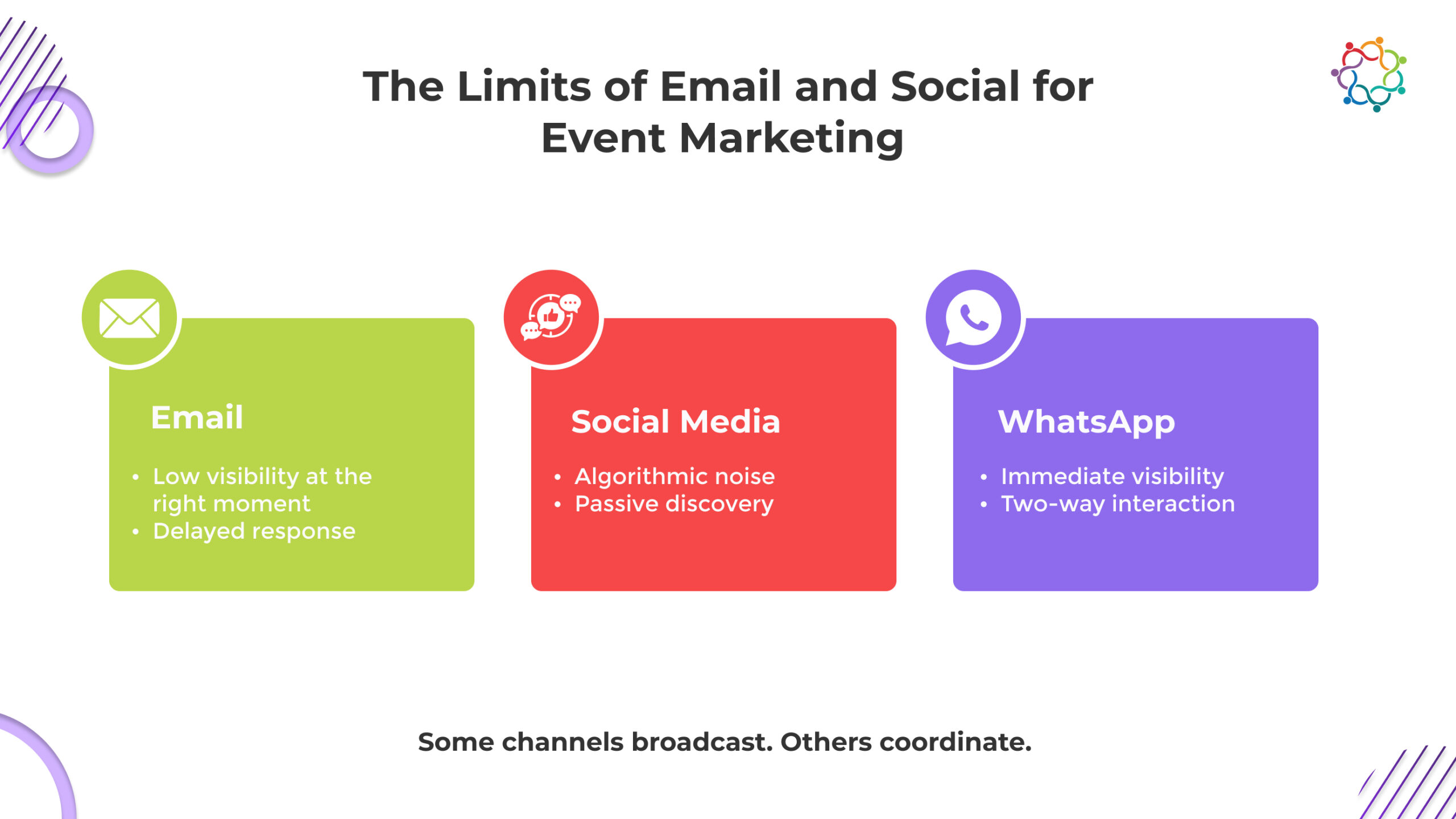
Email and social media remain foundational channels, but their structural limitations are increasingly visible in event contexts. Email is asynchronous by design. Messages arrive alongside dozens of others, are opened hours later, or never at all. Even when opened, they rarely invite immediate action. Social platforms amplify reach but dilute intent. Posts are public, fleeting, and rarely tied to a specific moment of decision.
Several structural constraints explain why these channels underperform for events:
When attendance drops, teams often respond by increasing frequency. This approach treats the problem as executional when it is behavioral. People skip events because the event never crossed their attention at the right moment or felt personally relevant.
These limitations are simply not designed for high-touch, time-sensitive coordination. In long-cycle B2B environments, this gap becomes expensive. Event marketing on WhatsApp begins to surface as a response to this structural mismatch rather than a tactical experiment.
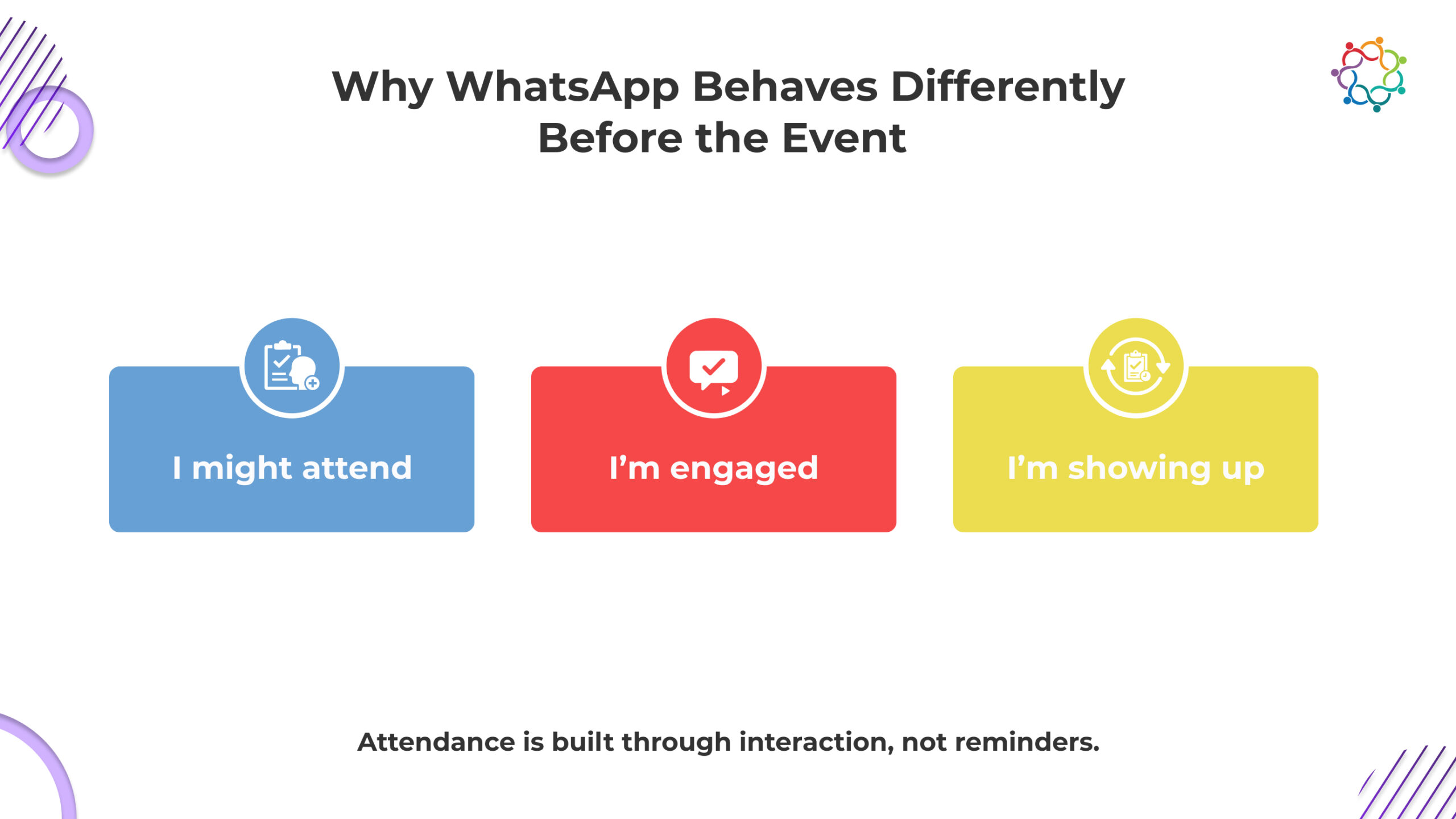
WhatsApp operates in a setting that people already identify with urgency, trust, and genuine conversation, which sets it apart from conventional event marketing methods. Passive consumption and broadcasting are not intended uses for WhatsApp. It is built for response. This difference in behavior explains why WhatsApp performs so differently for event marketing in 2026.
WhatsApp communication begins with explicit consent. When someone opts in, they mentally categorize messages as relevant and personal rather than promotional. This opt-in intimacy changes how messages are received. Event updates feel like coordination, not marketing. This trust-based communication increases read rates and reduces resistance, especially in high-touch B2B environments where relevance matters more than volume.
WhatsApp messages are typically read within minutes, not hours or days. This response velocity matters most close to the event date, when decisions to attend are made. Quick replies allow teams to confirm attendance, resolve doubts, and adjust communication in real time. Email and social media lack this urgency, making them unreliable at decision moments.
WhatsApp keeps all event-related communication in a single, continuous thread. Context is never lost. Logistics, value reminders, and questions build on each other instead of resetting with every message. This conversation continuity reduces confusion and effort for attendees, making follow-through easier and more natural.
Because WhatsApp lives in a high-attention space, messages are rarely ignored. People either respond, ask questions, or act. This makes WhatsApp an attention channel rather than a promotion tool. For event teams, this behavioral pattern is what makes WhatsApp event marketing structurally different from email and social, and increasingly more effective.
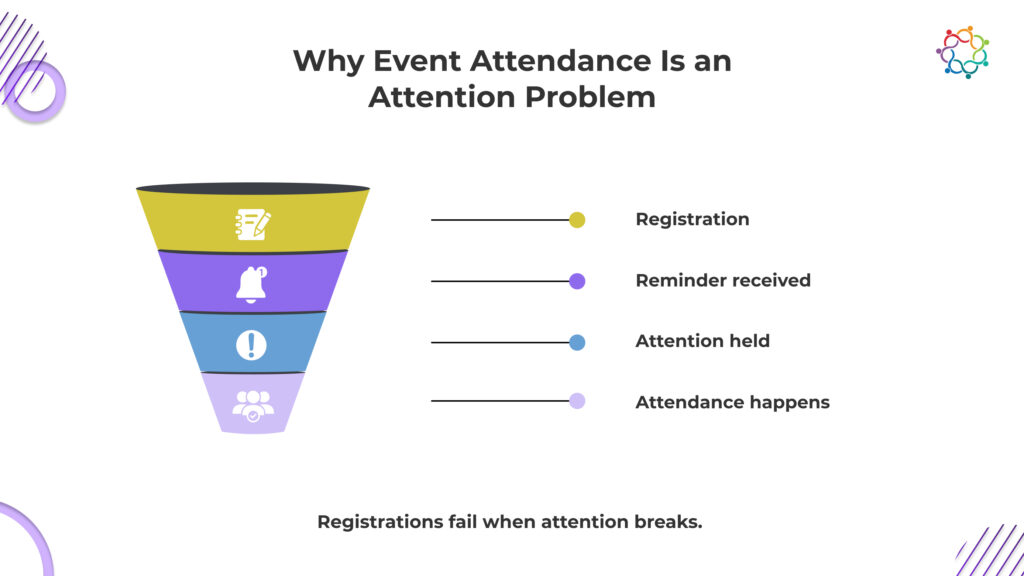
Before an event, the most important objective is not promotion but commitment. Registration is a signal of interest, not a guarantee of attendance. WhatsApp allows teams to bridge this gap by shifting communication from reminders to alignment.
Instead of sending passive messages, teams can use two-way confirmation to clarify expectations, answer questions, and reinforce value. This interaction reduces uncertainty, which is a major cause of drop-offs. When attendees can quickly confirm logistics or relevance, their likelihood of showing up increases.
WhatsApp also supports contextual messaging. Rather than generic countdown emails, messages can reference specific sessions, speakers, or outcomes relevant to the attendee.
Key ways WhatsApp supports pre-event follow-through include:
This approach reframes attendance as behavioral alignment rather than marketing pressure. By the time the event begins, attendees who remain engaged are mentally committed, not just registered. This is where WhatsApp event marketing begins to outperform traditional event communication strategies.
(Also Read: How to Maximize Event Registrations with WhatsApp Groups: Tips and Tricks)
Once an event begins, attention becomes even more fragile. Attendees are moving between sessions, conversations, and competing priorities. At this stage, communication must be relevant and smooth. WhatsApp changes live event engagement because it functions as a real-time coordination layer rather than a broadcast channel. This help team supports attendees without pulling them away from the experience.
Teams can use WhatsApp to deliver accurate and timely updates, including reminders for sessions, room changes, or schedule modifications. These gentle reminders cut down on misunderstandings and lost opportunities without overwhelming participants. Messages are viewed and responded to promptly because they arrive in a trusted setting, which increases their involvement without making noise.
Questions and concerns are sometimes left unanswered during events because participants are reluctant to speak in public or are unable to locate the appropriate contact. WhatsApp makes it simpler to exchange comments, highlight problems, and ask questions by facilitating private or small-group communication. Teams are able to resolve conflict before it affects the experience and deepen engagement through this real-time conversation.
WhatsApp gathers feedback during the event, as opposed to after it has already happened. Real-time responses to sessions, presenters, or logistics are available to attendees. Instead of assessing problems after the event, this real-time information enables teams to make changes quickly, increasing engagement and happiness.
WhatsApp works best when it supports the event instead of competing with it. By focusing only on essential communication, it keeps attendees informed without distracting them from sessions or conversations. This balance is what makes WhatsApp effective as a live engagement layer rather than a content feed.
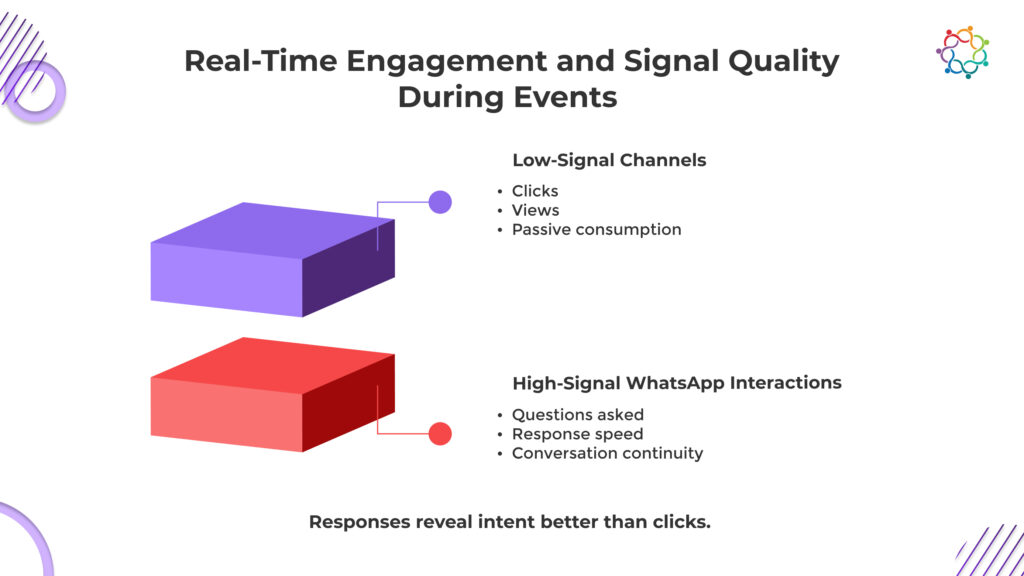
Event marketers often struggle with weak engagement data. Clicks and opens provide limited insight into intent. WhatsApp interactions, however, generate richer behavioral signals that are easier to interpret directionally.
Who responds, how quickly they reply, and what they ask reveal more than passive metrics. Response timing acts as a proxy for urgency or interest. Questions indicate relevance. Silence signals disengagement. These patterns emerge naturally within conversations.
WhatsApp also highlights differences between group and one-to-one engagement. Group interactions reveal collective interests, while private messages surface individual concerns or buying signals. This distinction helps teams prioritize follow-up without relying on complex attribution models.
Important signal types include:
These insights matter because they connect engagement to behavior, not vanity metrics. While WhatsApp does not solve attribution, it provides clarity that email and social media cannot. This signal richness is a core reason why WhatsApp event marketing is gaining strategic relevance in 2026.
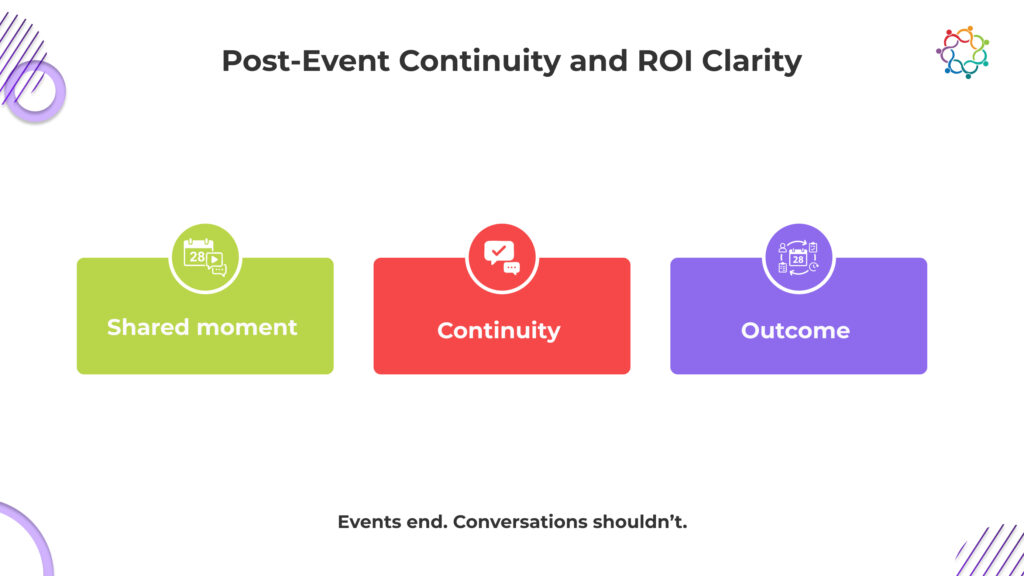
Most event communication collapses after the event ends. Attendees receive generic recap emails that summarize sessions but fail to continue the conversation. Social posts highlight photos rather than outcomes. Momentum fades quickly.
WhatsApp supports post-event continuity because the conversation never resets. Follow-ups feel natural rather than intrusive. Teams can reinforce key moments, share relevant resources, and transition into sales or relationship conversations without switching channels.
This continuity reduces friction. Attendees do not need to reorient themselves or search for context. The thread already contains the event journey. This makes follow-up messaging more relevant and timely.
Effective post-event WhatsApp communication focuses on:
By acting as a bridge rather than a blast tool, WhatsApp extends the event’s value beyond the live moment. This sustained engagement is difficult to achieve through traditional event follow-up messaging channels.
Event ROI has always been challenging to prove because outcomes are indirect and delayed. WhatsApp does not magically solve attribution, but it improves clarity by reducing drop-offs between stages.
When engagement happens in a conversational environment, it is easier to observe how attention turns into action. Fewer steps are lost between registration, attendance, and follow-up. This simplifies analysis even if it remains imperfect.
WhatsApp also lowers the cost per meaningful interaction. Instead of spending on repeated broadcast messages, teams invest in fewer, more relevant touchpoints. This efficiency matters in high-touch, long-cycle markets where quality outweighs volume.
ROI becomes clearer through:
This practical clarity strengthens the case for WhatsApp as a primary event engagement channel rather than a supporting tactic.
WhatsApp is not universally effective. Its strength depends on context, audience expectations, and discipline. A realistic assessment builds credibility with senior stakeholders.
WhatsApp excels in events that are high-touch, time-sensitive, and relationship-driven. It underperforms in large, anonymous events where opt-in intimacy is unrealistic. Overuse or aggressive messaging quickly erodes trust.
Key considerations include:
Opt-in discipline is critical. WhatsApp should never feel compulsory or excessive. When used with restraint, it strengthens trust-based communication. When abused, it damages it.
Understanding these boundaries ensures WhatsApp remains effective rather than intrusive.
In 2026, strong event marketing is not about expanding the channel mix. It is about using fewer channels with clearer intent. Audience attention has consolidated around spaces built for response, not broadcast. Channel strategy must reflect how people actually act, not how teams are used to communicating.
Channel choices should be driven by behavior, not habit. Messaging channels outperform broadcast channels when the goal is coordination, commitment, and follow-through.
Communication should align with decision moments. High-attention channels should be reserved for points where attendees choose to register, engage, or show up. Overusing them dilutes impact.
WhatsApp works best with boundaries. Email remains the system of record. Social channels maintain visibility. WhatsApp should be used selectively to drive confirmation, urgency, and real-time engagement, not as a replacement for everything else.
Reducing channels increases trust. When each channel has a defined role, messages feel intentional, are acted on faster, and create less friction for attendees.
Event success follows attention, not exposure. In 2026, attention lives in conversations that feel relevant. Messaging platforms have become central to how people coordinate important activities.
WhatsApp event marketing wins because it aligns with real behavior. It supports attendance follow-through, real-time engagement, and post-event continuity without relying on hype or volume. When used with consent and restraint, it strengthens trust and clarity.
The strategic takeaway is simple. Choose channels where people respond. Design events around attention, not assumptions. Conversations determine outcomes.
(If you’re thinking about how these ideas translate into real-world events, you can explore how teams use Samaaro to plan and run data-driven events.)