Samaaro + Your CRM: Zero Integration Fee for Annual Sign-Ups Until 30 June, 2025
- 00Days
- 00Hrs
- 00Min

Picking an event format used to be an afterthought, whatever fit the budget and the calendar. That’s changed. With marketing teams running everything from 5,000-person conferences to 20-person executive roundtables in the same quarter, the format itself now shapes the outcome as much as the content does. Get the format right and the tech, KPIs, and ROI story all line up naturally. Get it wrong, and even a well-executed event ends up measured against the wrong goals entirely.
Events still earn their place in the marketing budget. Not just for awareness, for pipeline, for partnerships, for the kind of loyalty a display ad can’t build. But the format is the decision that quietly shapes everything downstream of it, planning timeline, tech stack, how attendees actually engage, whether ROI is even measurable at the end.
A 5,000-person conference and a twenty-person roundtable are not smaller and bigger versions of the same event. They run on entirely different logic, different KPIs, different tech. This piece walks through the formats trending in 2026 and the tech stack needed to run each one properly, from registration through to CRM connectivity.

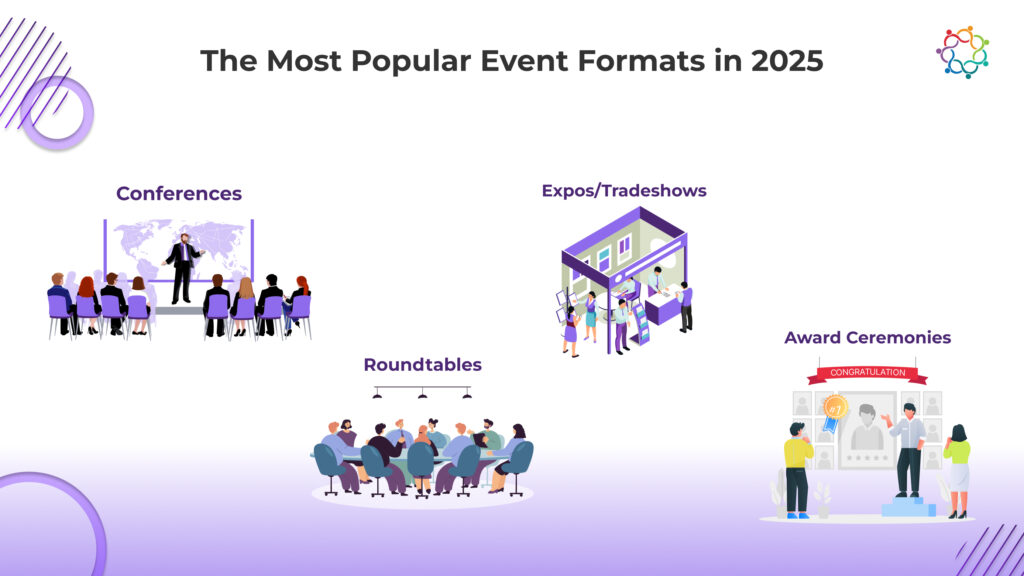
Conferences are still the format enterprise brands default to when the goal is visibility. A tech summit or an annual customer forum pulls attention into one place, positions the brand as a category leader, and generates leads through content and real interaction. These run big, from a few hundred people to several thousand, built for awareness and lead generation more than anything else.
Roundtables sit at the opposite end, and they’ve gotten more popular as marketing teams stopped chasing headcount and started chasing the right twenty people in a room. An invite-only session with ten to fifty senior attendees does something a conference structurally can’t: real one-to-one attention. That’s what makes them useful for account-based campaigns and relationship-building with accounts already deep in a sales cycle.
Expos and trade shows remain the backbone of industries like real estate, manufacturing, and retail, where a product genuinely benefits from being seen or demoed in person. These pull in anywhere from a thousand to twenty thousand attendees, built around footfall: booths, walkthroughs, demo zones, a lot of badge scans. The goal is demand generation and vendor alignment at volume.
Award ceremonies run smaller, usually a hundred to a thousand people, but do something the other three don’t: they’re built on emotion first, storytelling, entertainment, recognition. Whether it’s an internal team celebration or an industry-wide award night, the payoff is loyalty and PR buzz more than direct pipeline.
Here’s where a lot of event programs quietly go wrong: measuring every format against the same handful of metrics. A conference and a roundtable were never trying to do the same job, so judging them on the same scorecard hides what each one actually accomplished.
For a conference, registrations and session attendance are the obvious numbers, but content downloads, NPS, and demos booked tell you more about whether the content landed. The planning detail skipped most often: segmenting the audience by persona and funnel stage before building the agenda, not after.
A roundtable succeeds or fails on a different scale entirely. RSVP rate and no-show ratio matter, but so does something harder to quantify, whether a CRM note actually got logged and a follow-up meeting got booked. Every invitee needs a specific reason for being in the room, a renewal at risk, an upsell worth pursuing, and the tech needs to support 1:1 scheduling and closed-loop CRM updates, not just a headcount.
Expos live and die on lead quality more than volume. Booth visits and badge scans are the vanity numbers; engagement score and lead qualification tags are what actually matter once sales starts working the list. Real-time lead capture beats a CSV export two weeks later, every time.
Award ceremonies get judged on softer signals that still matter commercially: RSVP conversion, social shares, how many people watch the highlight reel afterward. Getting the guest list and seating right does more for the PR outcome than almost anything else on the checklist.
This is the part most teams get wrong: buying one tool and forcing every format through it. Each format needs a different combination of core platform, on-site tech, CRM connection, and engagement layer.
| Format | Core Platform | On-Site Tech | CRM & Analytics | Engagement Tools |
| Conferences | End-to-end event platform | QR check-in, session tracking | CRM sync, pipeline tracking | Polls, live Q&A, push notifications |
| Roundtables | RSVP and calendar integration | Branded check-in, concierge tools | Lead scoring, notes sync | 1:1 feedback forms, follow-up workflows |
| Expos | Exhibitor suite, floorplan tools | Badge printing, lead scanners | Booth analytics, source tagging | Gamification, lead scoring |
| Award Ceremonies | Guest list manager, seating tool | QR check-in, assigned seating | RSVP analytics, report exports | Highlight reel automation, post-event NPS |
None of this works without integration underneath it. Whatever tools end up in the stack, they need pre-built connectors to the CRM, the marketing automation platform, and wherever feedback actually gets collected, or the data just sits in silos nobody reconciles.

A conference on Samaaro typically runs QR-based kiosk check-in, a Salesforce sync, and live polls through a branded mobile app.
A roundtable looks nothing like that. Calendar sync replaces the kiosk, HubSpot handles the CRM side, and WhatsApp and email campaigns managed through the platform do the outreach. Networking tools built for one-to-one scheduling matter more here than any check-in flow, since the entire value of the event is in who talks to whom.
An expo leans hard into badge printing and lead scanners, a Zoho integration on the CRM side, and booth-specific gamification with a leaderboard.
An awards night runs QR check-in with a smart seating planner, a dashboard or custom CRM connection, and a social wall plus live media relay.
Each setup is built to take as little manual coordination as possible, which matters most for a team running four or five different formats across a year.
A marketing calendar with a product launch this month and a CXO roundtable next month doesn’t have room for onboarding a new platform every time the format shifts. What it needs is one system flexible enough to handle both without anyone relearning how to use it.
Samaaro runs a closed-door discussion, a mid-sized launch, and a multi-day expo on the same underlying system. RSVP workflows, calendar sync, QR check-in, booth-level lead capture, custom seating, the platform adjusts to what’s needed and stays out of the way for what isn’t.
The bigger payoff shows up in the data. Attendee details, engagement touchpoints, feedback, and CRM syncs all live in one place instead of four separate exports reconciled by hand. Who attended three sessions, who asked a question, who filled out the post-event survey, all of it is visible from a single dashboard, which is what makes personalization for the next event possible instead of theoretical.
That combination is why marketing teams across real estate, IT, consulting, and healthcare run their whole event calendar through one platform instead of switching tools every time the format changes.
The format decision carries as much strategic weight as the campaign theme wrapped around it. It shapes the team’s workload, the KPIs that actually apply, and whether ROI is measurable at all by the time the event wraps.
Get the format-to-tech match right, and an event marketing calendar that mixes conferences, roundtables, and expos across a year stops feeling like four separate jobs. Automated event communications tying registration, reminders, and follow-up together are what keep that calendar running without a manual process rebuilt for every single format.
Ready to map out your 2026 event calendar with the right format-tech fit? Contact Samaaro and find a platform that grows with your events instead of working against them.
1. What are the top event formats trending in 2026, and what business goals does each one best serve?
Large conferences suit brand awareness and category leadership. Executive roundtables suit ABM and senior pipeline. Expos suit lead volume and product launches. Pick the format based on the goal, not on what’s trending.
2. How do the KPIs and success metrics differ across conferences, roundtables, expos, and award ceremonies?
Conferences track attendance and pipeline influenced. Roundtables track account quality and deal acceleration. Expos track lead volume and cost per lead. Award ceremonies track PR coverage and sponsor satisfaction. One dashboard for all formats hides what each does well.
3. Why are invite-only executive roundtables gaining popularity over large-scale conferences for B2B marketing teams?
A 20-person roundtable with the right CMOs often builds more pipeline than a 2,000-person conference where the right people get lost in the crowd. Roundtables are cheaper, faster to organize, and easier to repeat across regions.
4. What tech stack components are essential for successfully executing each event format?
Flexible registration, QR check-in, an event app, automated multi-channel communication, lead capture and qualification, native CRM integration, and real-time analytics. Depth varies by format, but this core stack applies across all of them.
5. Can one platform like Samaaro manage multiple event formats without switching tools?
Yes. Samaaro manages conferences, roundtables, expos, and award ceremonies on one platform, covering registration, check-in, engagement, and analytics without switching tools between formats.