Samaaro + Your CRM: Zero Integration Fee for Annual Sign-Ups Until 30 June, 2025
- 00Days
- 00Hrs
- 00Min

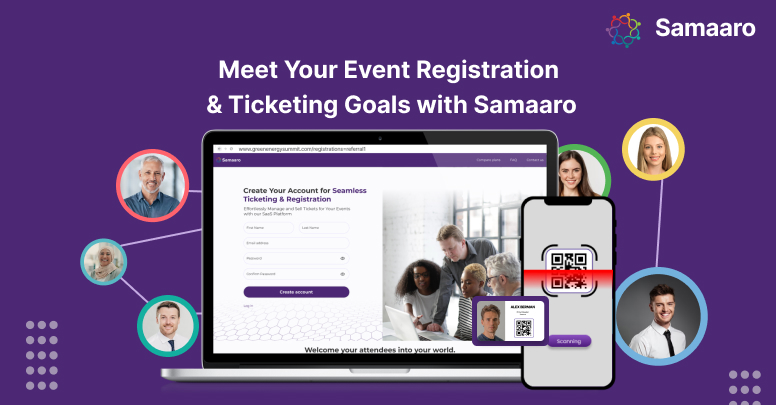
Events exist for the networking, the ideas exchanged, the memories that stick around after everyone’s gone home. None of that happens if the registration process turns people away before the event even starts. It sounds like a small piece of the puzzle. It usually decides whether the puzzle comes together at all.
Registration is the first real interaction an attendee has with an event. A clean, simple process leaves a good impression before anyone’s even walked through the door. A confusing one does the opposite, and some people just give up and close the tab. That drop-off happens more often than most organizers realize, and it’s rarely captured anywhere because the person never became a lead in the first place. Ticketing carries its own weight too, shaping revenue and how manageable the whole event turns out to be.
Samaaro’s features are built to smooth out that entire process, start to finish. Whether the event is a small workshop or a large-scale conference, the platform scales to fit. This piece walks through what those features actually do, what real organizers have gotten out of them, and where the value shows up for both the organizer and the attendee.
A wide feature set makes registration and ticketing genuinely easier to run.
Landing Page
First impressions happen here. A custom event landing page, built around your branding, gives an event a real online presence instead of a generic form buried in an email that gets forwarded three times before anyone actually reads it.
Date, venue, schedule, speaker bios, sponsors, links to supporting materials, all of it belongs on one well-organized page. Attendees find what they need fast, and that clarity builds anticipation before the event even starts.
Customized Ticketing Options
Ticketing that flexes to the event, not the other way around, opens the door to more kinds of attendees. Different categories, pricing tiers, and packages mean a student rate and a VIP pass can both exist without either one feeling like an afterthought bolted onto a single fixed price.
That range widens who an event can reasonably reach, and a wider reach usually shows up directly in ticket sales.
Payment Options
Multiple payment gateways mean attendees pay the way they already prefer, card, PayPal, or something else entirely. That flexibility alone tends to reduce drop-off at the final step of checkout, the step where a lot of otherwise interested people quietly abandon a purchase.
Support for multiple currencies extends that same convenience internationally. An event drawing attendees from different countries doesn’t have to force everyone through a single payment method that only works well for one region, which usually means losing a chunk of international interest before it ever converts.
Registration Confirmation and RSVP
Confirmation goes out through email, SMS, and WhatsApp, whichever channel an attendee is actually going to see. Organizers can also upload an expected attendee list and prompt RSVPs ahead of time, which sharpens planning well before the event date arrives.
Check-in itself stays simple. An intuitive process at the door keeps lines short and turns a registered name into a confirmed guest without the usual bottleneck that forms the moment doors open.
Badge Printing
Badge printing adds polish on top of a fast check-in. Personalized badges, some with QR codes for quick scanning, carry a name, affiliation, and whatever else matters for that event.
Automating badge creation removes a source of manual error, and it saves real time that used to go into printing and sorting badges by hand the morning of the event, usually right when there’s the least time to spare.
Real-Time Analytics
Event management software that surfaces analytics as the event unfolds gives organizers something to act on immediately, not just review afterward. Attendee engagement, behavior, session popularity, all visible in real time, updating as the day actually progresses rather than compiled into a report a week later.
That visibility matters most when something unexpected happens. A session drawing a bigger crowd than planned can move to a larger room, or get repeated later in the day. One that’s underperforming might get folded into another session or pushed harder on promotion mid-event. Neither adjustment is possible without the data showing up while there’s still time to act, and by the time a post-event report flags the same issue, the moment to fix it has already passed.
A. Increased Attendance and Revenue
A smoother registration process paired with flexible payment and ticket options tends to show up directly in the numbers. More people complete registration when the process doesn’t get in their way, and that shows up on the revenue side too, since every abandoned checkout is a ticket that never got sold.
B. Enhanced Attendee Experience
The benefits reach past the organizer’s side of things. A simple registration flow, badge printing on-site, and real-time updates all shape how an attendee feels about the event, and that impression carries into how they talk about the organization afterward, whether that’s a glowing recommendation to a colleague or a quiet decision not to come back next year.
C. Streamlined Event Management
Event logistics can turn into a maze fast. Real-time analytics and the ability to adjust on the fly cut through a lot of that complexity, and organizers end up with a day that runs on decisions backed by actual data rather than a hopeful guess made under pressure with half the information they’d actually want.
TEDx Hyderabad
TEDx Hyderabad ran into two specific problems: managing attendee numbers and paying more than it should have on payment gateway fees. There was also no clean way to track which coupon codes were actually driving registrations, which made it hard to judge whether marketing spend was working, or just quietly draining budget with nothing to show for it.
Samaaro brought in Indian payment options to cut those transaction costs and consolidated the whole ticketing process into one system. Flexible discount codes and vouchers encouraged group sign-ups. Email and WhatsApp outreach through the platform pushed registration and engagement higher than expected.
The results: over 1,250 people registered, 136 distinct coupon types got used, check-in took just 75 minutes total, and the platform handled more than 40,000 messages across the campaign, a scale of communication that would have been nearly impossible to coordinate manually.
Major Agricultural Exhibition in Brazil
An 80,000-person farming event came with a language problem most platforms aren’t built to handle. Samaaro’s registration forms supported English, Portuguese, and Spanish, which meant attendees from different linguistic backgrounds could register without a translation headache slowing them down, or worse, giving up on registering entirely.
Twelve check-in counters ran on tablets with Samaaro’s system, staffed by volunteers who needed minimal training to use it. Farmers moved through registration without friction, regardless of their comfort with technology, which mattered at an event where not every attendee was equally at ease with a digital check-in process.
The result: roughly 800 people registered per kiosk, averaging about 45 seconds each. That kind of throughput at that scale isn’t accidental, it comes from planning the check-in flow around the actual constraints of the event ahead of time, not adjusting on the fly once a line has already formed.
Unlimited Events and Unlimited Tickets
Samaaro’s free ticketing option supports an unlimited number of events, workshops, concerts, whatever the format, with no cap on how many you can run. Paid ticket sales aren’t capped either, which sets it apart from platforms that quietly limit event or ticket counts once you’re on a free tier, usually the moment you’d actually notice the limitation.
Unlimited Tickets and Coupon Codes
Ticket types and coupon codes have no ceiling either. Promotions can run as often and in as many variations as an event actually needs, without hitting an artificial limit partway through a campaign that was working.
Transparent Pricing
Samaaro’s pricing is built around clarity rather than surprise fees added after the fact. Current pricing details are laid out plainly, so organizers know exactly what a plan costs before committing, not after checkout when a fee suddenly appears that nobody mentioned earlier.
Custom Registration Forms
A registration form shapes the first real impression of an event. Custom fields let organizers collect exactly the attendee data that matters, preferences, demographics, anything specific to that event, which turns out to be useful well beyond the current event when planning the next one, rather than starting from a blank slate every time.
Personalized Registration Emails
A tailored registration email, rather than a generic template, signals that an event was actually built with its attendees in mind. That small touch tends to build the kind of loyalty that brings people back for future events, the sort of thing a generic confirmation email never manages to do on its own.
Samaaro adapts to a wide range of event types rather than forcing every organizer into the same mold. From stronger attendance numbers to a smoother attendee experience and a genuinely more manageable event day, the platform covers the full registration and ticketing cycle in one place, from the first landing page visit to the badge scanned at the door.
Curious what this looks like for your next event? Book a demo with Samaaro today.