Samaaro + Your CRM: Zero Integration Fee for Annual Sign-Ups Until 30 June, 2025
- 00Days
- 00Hrs
- 00Min


1
2
3
→
Bottom Line:
The data is already there. Capturing it deliberately, so the next touch is informed, is the whole game.
The strongest first-party data you have, you already collected.
Every badge scanned and session joined is information you own outright. Most teams let it evaporate the moment the event ends.
A single event already generates registration detail, session attendance, engagement signals, and direct feedback. All of it is first-party, all of it collected with consent, and none of it borrowed from a browser or a third party that could change the rules tomorrow. You didn’t rent this data. You were handed it.
The shift worth noticing is quiet. As third-party signals get harder to rely on, the data a brand already owns from its own events gets more valuable, not because it changed, but because it was never at risk in the first place.
What follows is the specific data your events already produce, why capturing it deliberately matters more now, and where most of it quietly disappears.
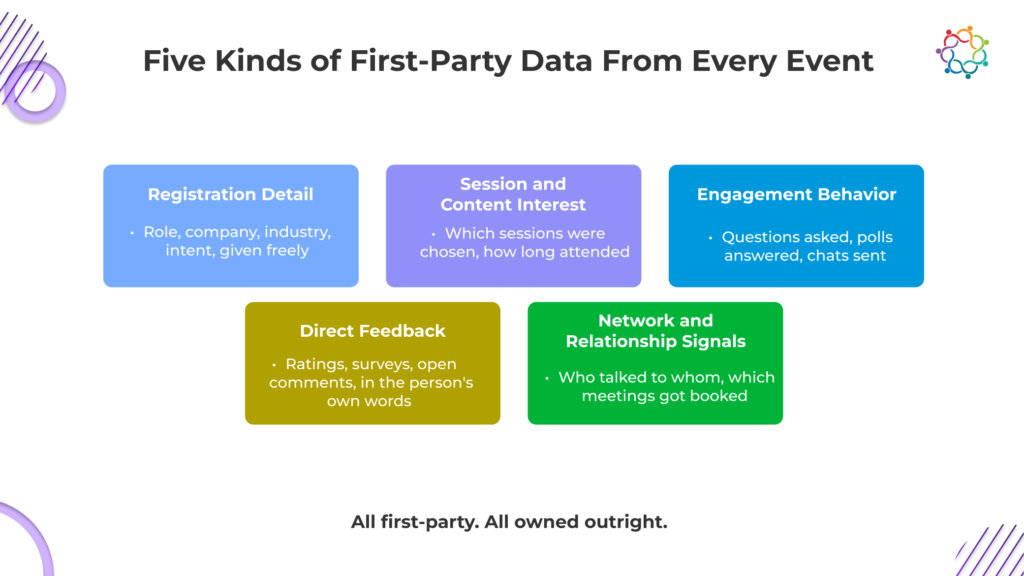
Walk back through your last event and count what it produced. Most of it, you already have, and most of it, you own outright. None of it needed a tracking cookie, a data broker, or a guess.
Role, company, industry, and often intent, captured the moment someone signs up. Freely given, because the person wants to attend, not scraped from a browsing session they never agreed to. You know before the doors open that a third of the room is heads of security at mid-market software firms, because they told you.
Which sessions someone chose, how long they stayed, and what they skipped, a direct signal of what a person cares about. Someone who sat through all three compliance sessions is telling you something a retargeting pixel never could, and how long people linger in each session is data you captured cleanly.
Questions asked, polls answered, chats sent, connections made. Small actions that together describe how involved someone was, and with what. The attendee who asked two questions and booked three meetings is a different lead from the one who logged in once and left. Adding them up shows who to call first, based on what they actually did.
Ratings, survey answers, and open comments, the person’s own words about what worked, offered voluntarily right after the experience. “The pricing session ran long” is a product signal as much as an event rating, if the feedback is read that way rather than filed after one glance.
Who talked to whom, which meetings got booked, which connections formed. Data about how people relate to each other, not just how they relate to your brand. A prospect who met your solutions lead on-site is warmer than the org chart alone would suggest, and those relationship signals are almost impossible to buy and easy to capture if you’re looking.
Common trap: treating all of this as operational exhaust instead of an asset. Registration lists get archived, feedback forms get read once and filed, and none of it gets pulled forward into how the next event or campaign gets built, so the same insight gets rediscovered or missed every single time. The irony is that the data most teams pay agencies to approximate is the data their own events hand them for free.
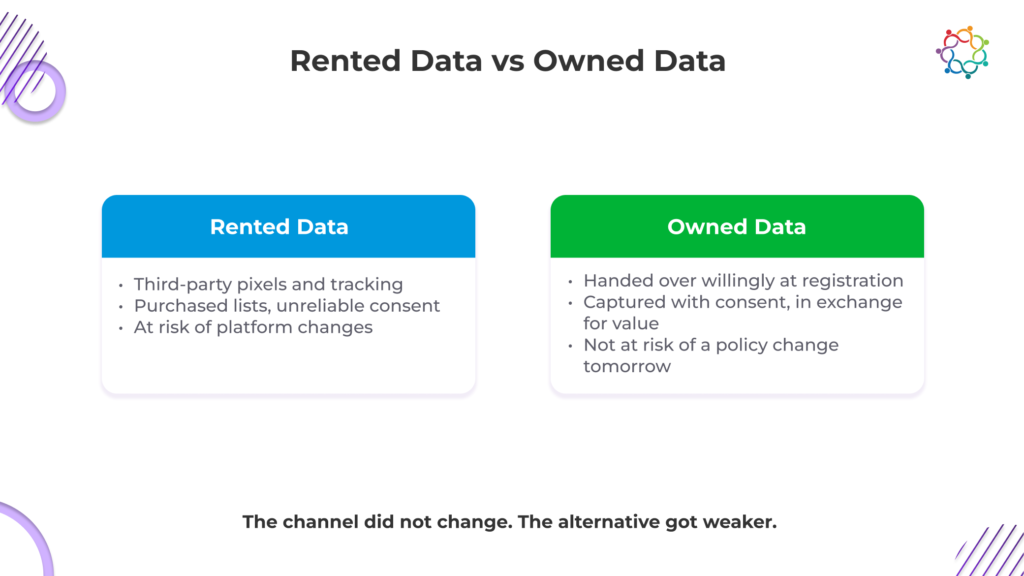
For years, a lot of B2B marketing leaned on third-party signals: ad-platform data, tracking pixels, purchased lists. Information rented rather than owned, and increasingly restricted.
That ground has shifted, though not the way the headlines predicted. Google walked back its plan to remove third-party cookies from Chrome in 2025, so the cookie didn’t die on cue. But Safari and Firefox have blocked third-party cookies by default for years, privacy laws keep expanding, and consent rules keep tightening, so the data a brand rents from the open web keeps getting patchier and harder to trust. The direction of travel hasn’t changed: less cross-site tracking, more consent, and a bigger premium on data you own. For a channel that produces owned data by default, that’s a tailwind rather than a threat.
When borrowed signals get weaker, the channels that already produce owned, consented data become relatively more valuable. Events qualify plainly: an event is one of the few marketing motions where a person hands over real information willingly, in exchange for something they want, attendance, content, or a connection. That’s a different footing from data collected passively in the background.
The move here is simple: keep the data from the events you already run, instead of letting it wash out after each one.
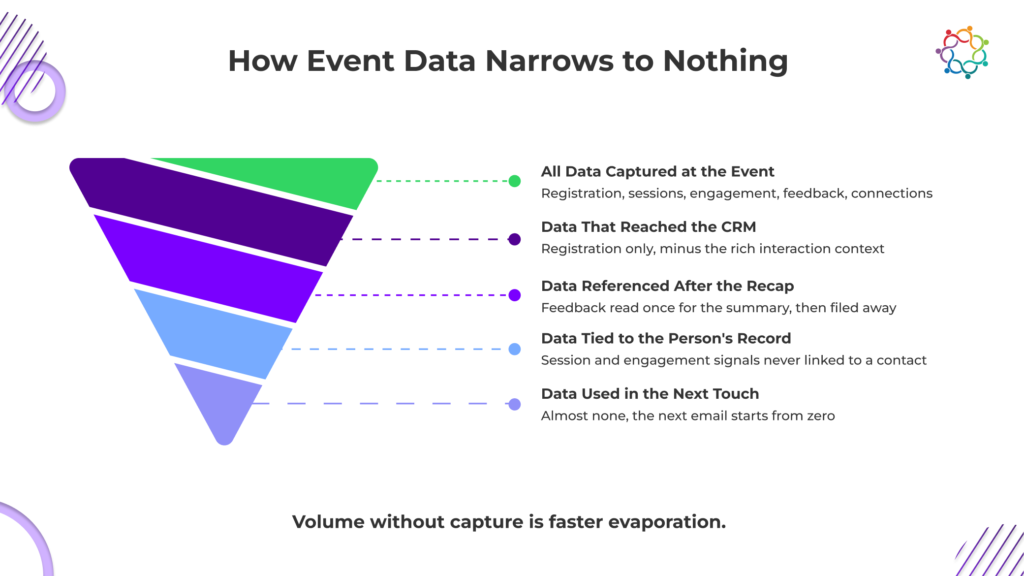
None of this data is hard to produce. It’s just easy to lose, and it tends to disappear in the same three places.
Registration data sits in the event platform and never makes it into a CRM or a segmentation list beyond that one event, so the person who raised their hand is invisible by the next campaign. Feedback gets read for a single post-event summary and then never referenced again, even though it often repeats across events in ways worth noticing. And engagement signals, which sessions someone attended, which connections they made, never get tied back to that person’s record, so the next touch with them starts from zero. By the time anyone wants to use it, the person has been re-marketed to as if the event never happened.
The common thread is that none of this needs new technology to fix. It needs a decision, made before the event, that the data will land somewhere it can be used again, which usually means tying event data to the CRM. For most teams, that’s a matter of the integrations they already have, not a new system. The fix costs a decision, not a purchase. Assuming more events will fix it is the trap; volume without capture just means more data evaporating faster.
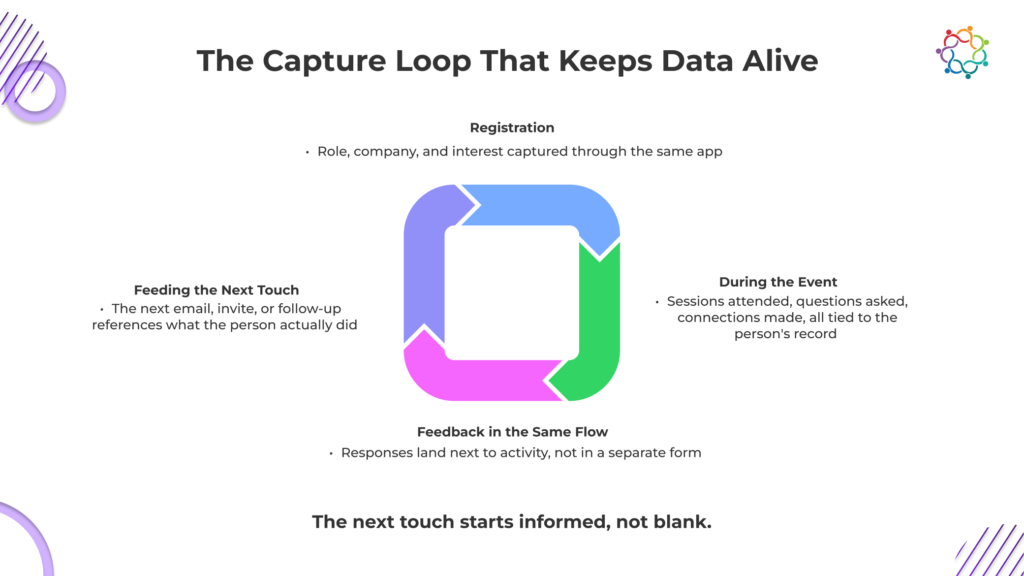
Capturing this well isn’t a technology project. It’s a set of small defaults, decided up front. Get them right and capture stops being a post-event chore and starts being automatic.
The event attendee app is usually where this comes together, because it’s the one touchpoint present at registration, during every session, and through the interactions in between, which is the broader case for treating the event app as the hub rather than one more tool. The difference shows up months later, when a sales conversation opens with “you were at our security roundtable and asked about SOC 2” instead of a cold reintroduction. That line lands because the data behind it was captured the day it was created, not pieced together from memory a quarter later.
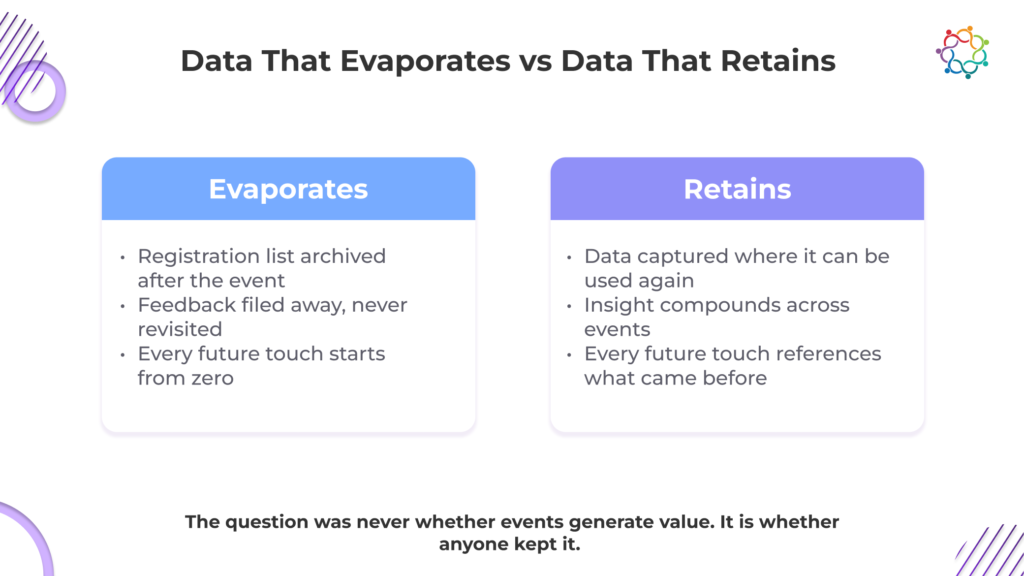
An event already produces registration detail, interest signals, engagement, feedback, and relationship data. All of it first-party, all of it owned outright, all of it sitting there, whether or not anyone does something with it.
So the real work happens before the next event: decide that this data gets captured somewhere it can be used again, and the person who spent a day with your brand stays known long after they log off. Most of what you’d want to know about them, they already showed you at the event, so capturing it is what lets the next conversation pick up where that one left off. The event already did the expensive part; keeping the data is the cheap step.
If you’re weighing where that capture should happen in practice, it’s worth a short walkthrough.