Samaaro + Your CRM: Zero Integration Fee for Annual Sign-Ups Until 30 June, 2025
- 00Days
- 00Hrs
- 00Min

Key Takeaways (TL;DR)
1
2
3
→
Bottom Line:
Most event teams lose the same 1 to 2 weeks every quarter to work that follows identical steps every single time.
Ask an event marketer how long it takes to run an event, and you get the hours for planning the agenda, drafting the invitation, managing promotion. Ask how much of that work repeats exactly the same way every single event, and nobody has an estimate. Event automation candidates are everywhere. It is the work that nobody writes down, the hours that disappear into Tuesday and Wednesday afternoons.
Event teams lose hours every event to work that follows the same steps every event. Not to bad planning, but to work that should move itself. That time compounds. Six months of events means six sets of the same weeks consumed by identical tasks.
Event marketing automation makes invisible work visible. This piece walks through three time blocks where most teams lose days: registration weeks, follow-up nights, and scattered reminders.
An event marketing manager at a SaaS company hosted a flagship event with 400 registrations. Two team members spent two full days on work that should have been automatic.
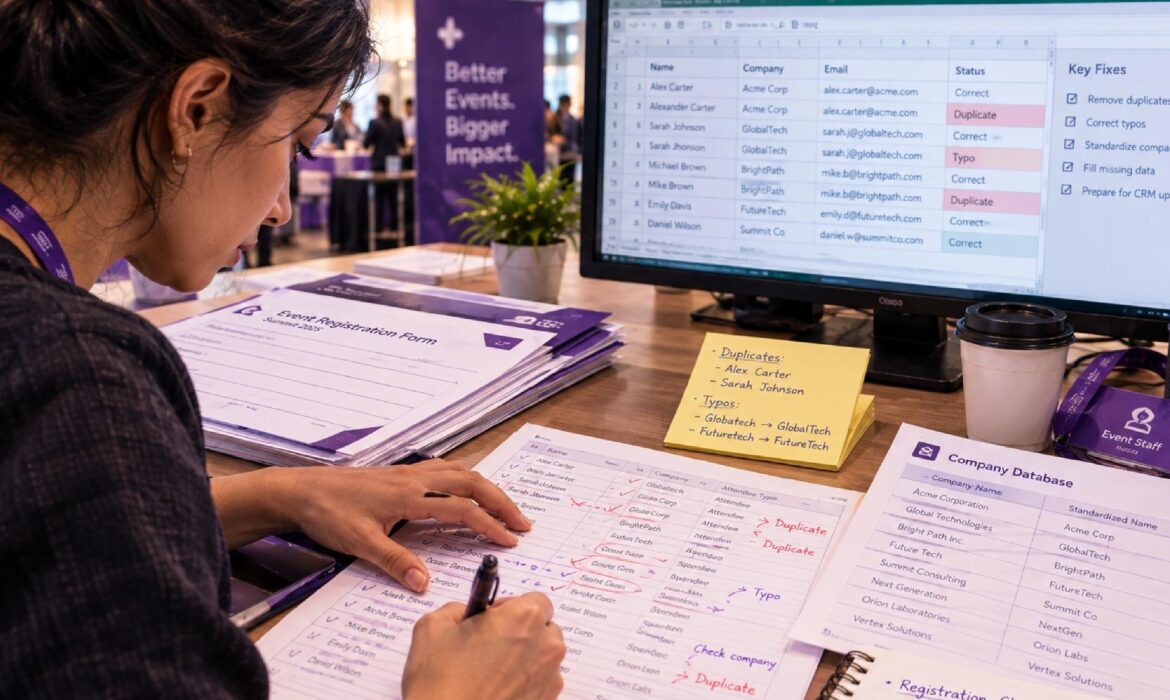
What those two days contained: sending confirmations manually, building the attendee list in a spreadsheet, cross-checking names against the CRM, correcting signup typos, deduplicating where people registered twice, pulling missing company data by hand, preparing the CRM sync list manually, scheduling the reminder sequence.
Every event brings new names and the same steps. The process is not written down as a workflow, so every team member does it their own way. A new coordinator learns by watching, not from a document.
A 50-person event feels manageable: one coordinator, a few hours. A 500-person event breaks someone’s week: two coordinators, two full days, still something gets missed. The steps are so clear and repetitive that they should move automatically. Every step is a rule: if someone registers, send them this. If they pay, create this record. If they confirm, mark them here.
Managing that flow in one system turns two days into a few hours.
The event ends Wednesday afternoon. The team wants to follow up Thursday. But exporting, routing and preparing the list takes Thursday night and Friday. By Friday afternoon the follow-up goes out when the conversation is already cooling.
What the steps look like: exporting the attendee list from the event platform, deduplicating it, sorting by territory or account, assigning each name to the right owner, filling in missing account data by hand, writing segment-specific follow-ups, scheduling sends or attaching to Salesforce.
A demand generation coordinator’s weeks were defined by Thursday and Friday as lead processing. Happened every event without fail. Never written into the job description. Started happening because nobody else was doing it.
No system is running the transforms, so they happen by hand the same way every time with the same errors: typos in company names, wrong owners assigned, people marked as hot who were just polite. If export happens Friday afternoon, routing finishes Saturday evening, and follow-up goes out Monday. Four days after the event.
Reminders do not move automatically. Someone writes them, someone schedules them, someone tracks opens if at all, someone chases people who registered but never confirmed.
Cadence gets improvised: three days out for the first reminder, one day out for the second, day-of notification. But timing is never the same twice because nothing was written down as a standard.
Some reminders sent manually the evening before from an inbox. Some set up in the email tool with uncertain send times. Some via text if the data sync worked that day. Inconsistency compounds the work.
The cost is scattered: two hours Tuesday preparing copy, one hour Thursday scheduling, 30 minutes before go-time fixing what did not send. Hours do not add up in a standup. Scattered time is invisible to anyone outside the event team, so it never gets prioritized for fixing.
Every event follows the same shape: registration, reminders, check-in, follow-up. The steps inside each phase are rule-shaped: if someone registers, send them this. If they don’t confirm, nudge them. If they attended, send the recap.
Doing these steps by hand means doing them the same way every event. The difference between manual repetition and automation is not a tool. It is documentation. Write the steps down, and a system can run them. Leave them undocumented, and a person runs them every time.
Why teams do not document is because the process is so obvious it does not feel like it needs writing down. Everyone knows what to do. Except everyone does it slightly differently, and new people learn by watching, not from a guide.
Not that your team is slow, but that your team is doing work a system was built to do. The events themselves have a documented operational framework that sits above all of this.
The weeks that disappear are not mysterious. They are registration processing (1 to 2 days), follow-up routing (1 to 3 days), and reminder sends (scattered). Happening the same way every event. Everyone is an event automation opportunity.
Write down the work, and the work becomes visible. Visible work gets prioritized and becomes automatable.
Which of these three weeks does your team want to get back first?
To see how automated event communications runs those weeks on one attendee record, book a demo with Samaaro.
What counts as repetitive event work?
Any step that follows the same rule every event: send confirmations when people register, nudge if they don’t confirm, export the list, assign leads to owners, send post-event recaps.
How much time does registration processing really take?
A 50-person event takes a few hours. A 300-person event, 1 to 2 days. A 500-person event, often two full days plus errors that compound.
Why is follow-up routing always the Friday night task?
Events end midweek and sales wants to chase hot leads immediately, but the list is not ready. Export, dedup, segment and assign all happen by hand, taking 6 to 8 hours.
What makes reminders scattered and invisible?
No standard timing, no documentation, no single system. Some sent manually, some scheduled in email, some via text. Coordination happens in Slack with no single view.
Can you automate the judgment calls in events?
No. Automation runs rule-shaped work: if this, then that. Choosing the audience, writing the core message, deciding what to do with a lead, those stay with people.