Samaaro + Your CRM: Zero Integration Fee for Annual Sign-Ups Until 30 June, 2025
- 00Days
- 00Hrs
- 00Min

1
2
3
→
Bottom Line:
Programs compound, events do not; the CAB earns its weight from persistence.
The CAB Is Not a Quarterly Dinner
Most companies that claim to run a customer advisory board are running a customer dinner with a recurring date on the calendar. The invite list shifts each quarter. The agenda is decided three weeks out. By the third session, the strongest customers stop replying. The marketing leader concludes the format does not work. The format is fine. What failed is that it was never a program.
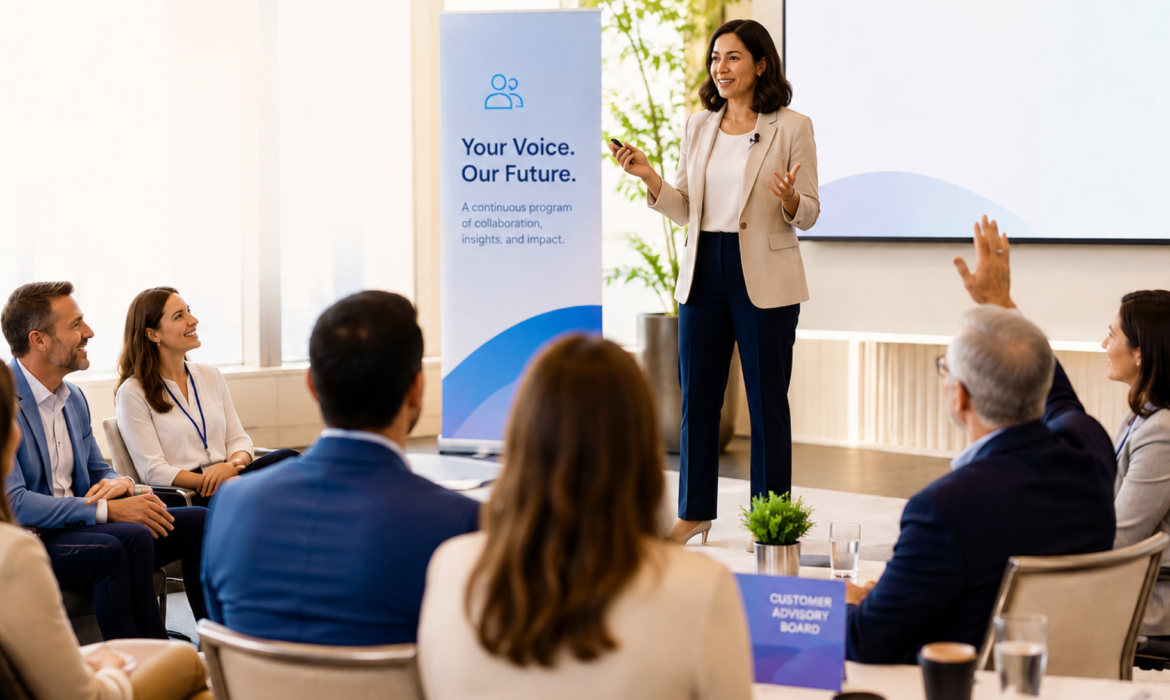
A customer advisory board is a closed-door program of 8 to 15 strategic customers who meet 2 to 4 times a year under a written charter, with the purpose of shaping the host company’s product roadmap and go-to-market decisions. The format is not a recurring event. Sessions are checkpoints in a longer arc.
This article covers what makes a CAB a program, where it sits next to lookalike formats, and what the charter, cadence, and membership decisions produce.
Three structural elements separate a CAB from every other closed-door format. None of them shows up in a single session. All three are what make the CAB a program.
Persistent membership. The same customers attend every session for the duration of their term. A 12-month or 24-month commitment is standard. Membership is invitation-based and named in advance. The roster is the program, and rotating it casually breaks what the CAB is supposed to produce. Each new member starts at session zero on context; each departing member takes institutional memory with them.
A written charter. The CAB operates against a document that names the program’s purpose, the topics members weigh in on, the decisions the host commits to consult the CAB on before making, and the boundaries of confidentiality. Without a charter, the program drifts toward whatever the next session’s agenda owner finds interesting. A charter is what lets a senior customer take the program seriously enough to clear their calendar twice a year.
Continuity between sessions. Each meeting builds on the last. A decision discussed in Q1 is revisited in Q2 with the data. A roadmap item raised in Q2 is reviewed in Q4 with the build progress. Members experience the program as a continuous influence loop, not three disconnected dinners with the same logo.
The CAB earns its strategic weight from the persistence of all three elements together. A program with members but no charter becomes a customer dinner club. A charter without continuity produces good intentions and no influence. Continuity without persistent membership becomes a rolling focus group.
Three lookalike formats get confused with the CAB in practice. Each confusion creates a distinct failure mode.
Not a customer panel. A panel is a one-time, single-session gathering convened to react to a specific question. It has no membership, no charter, and no continuity. A panel is useful for episodic insight. A CAB is the instrument for ongoing strategic input. Confusing the two leads to over-investing in panels and under-investing in the program that compounds.
Not a focus group. A focus group exists to test a hypothesis that the host already has. The host runs the conversation. The participants are paid or incentivized. The output is a research finding. A CAB inverts every part of this. The members set part of the agenda, the host is in service of their input, and the output is a strategic decision that the host commits to weighing.
Not a user group or community. A user group is an open or semi-open membership organized around a product. Its purpose is community among users. A CAB is small, closed, and organized around strategic decisions the host has not yet made. The two formats can coexist, but they do not substitute for one another. A user group cannot give the host roadmap conviction. A CAB cannot scale to a community.
Common trap: calling a program a CAB to make it sound more important to internal stakeholders. When the structure underneath is a panel or a focus group, members notice within two sessions and disengage. The most damaging form is when product and GTM leaders inside the host begin to treat the program as a real CAB and act on its input, while members treat it as casual conversation and offer surface-level reactions.
Two design decisions carry the heaviest leverage in a CAB program: how often the group meets, and who is in the room.
Cadence: 2 to 4 sessions per year. Each cadence has a different commercial signature.
Two sessions a year is the minimum viable rhythm. Works only when the host is unusually disciplined about pre-session prep and the charter is unambiguous. Below this, continuity collapses, and the influence loop never closes.
Three sessions a year is the standard stable cadence. The shape mirrors most companies’ annual planning cycles. One session shapes annual priorities, the next reviews execution, the third sets up the following year’s questions.
Four sessions a year is the upper limit before extraction sets in. Works only when each session is short (90 minutes max), and the host genuinely uses the input between sessions. Above this, the program turns into work, and the highest-value members are the first to disengage.
Composition: 8 to 15 members from strategic accounts only. Strategic means the customer’s input materially affects product or GTM decisions, not the customer’s revenue. A mid-sized customer with the right buyer persona and deep adoption contributes more than a large customer with shallow usage.
Seniority is set to the decision the CAB advises on. Product roadmap input requires VPs of the buying function. GTM input requires CMOs, CROs, or equivalent. Mixing the two breaks every session.
Member terms run 12 to 24 months with staggered rotation. One-third of the membership turning over each year keeps the program fresh without losing institutional memory.
A CAB does not appear in pipeline reports, and it should not be defended on pipeline grounds. The program earns its line item against two internal decisions a marketing leader could not make as well without it.
Decision 1: Product roadmap conviction. The CAB is the highest-signal forum a product organization has access to. Survey data tells the host what customers say they want. Usage data tells the host what they do. The CAB tells the host why, and which of the two signals to weigh more heavily in any given quarter. A roadmap decision made with CAB input carries the internal conviction that no other input method produces.
Decision 2: GTM positioning and category direction. Where the market is heading is a question no internal team can answer alone. The CAB compresses that answer from a dozen senior buyers into a single afternoon. Positioning shifts, category bets, and messaging direction all benefit. A category move made with CAB validation moves faster internally than the same move made on instinct.
The defensible scorecard. Count the product and GTM decisions in the past 12 months that referenced CAB input. That is the program’s commercial output. A CAB that cannot answer that question in concrete terms is not yet a real program. A modern event marketing platform like Samaaro keeps session content, member contributions, and decision references on the same program record, so the scorecard exists by default rather than as a retrospective scramble.
Persistent membership. A written charter. Continuity between sessions. Three elements that turn a recurring dinner into a program that compounds. Run all three for a year, and the CAB starts producing the kind of strategic input no other forum gives a company. Skip any one, and the program reverts to a customer dinner with a more impressive name.
The CAB is the one closed-door format that runs as a program rather than an event. Roundtables and dinners are single sessions optimized for that night’s outcome. The CAB is a 12-month arc optimized for influence that compounds. Two different operating models, two different budget defenses, two different scorecards.

Samaaro is an AI-powered event marketing platform that enables marketing teams to turn events into a measurable growth channel by planning, promoting, executing, and measuring their business impact.
Location


© 2026 — Samaaro. All Rights Reserved.