Samaaro + Your CRM: Zero Integration Fee for Annual Sign-Ups Until 30 June, 2025
- 00Days
- 00Hrs
- 00Min

Key Takeaways (TL;DR)
1
2
3
→
Bottom Line:
Choose based on whether you need reach now or audience building over time.
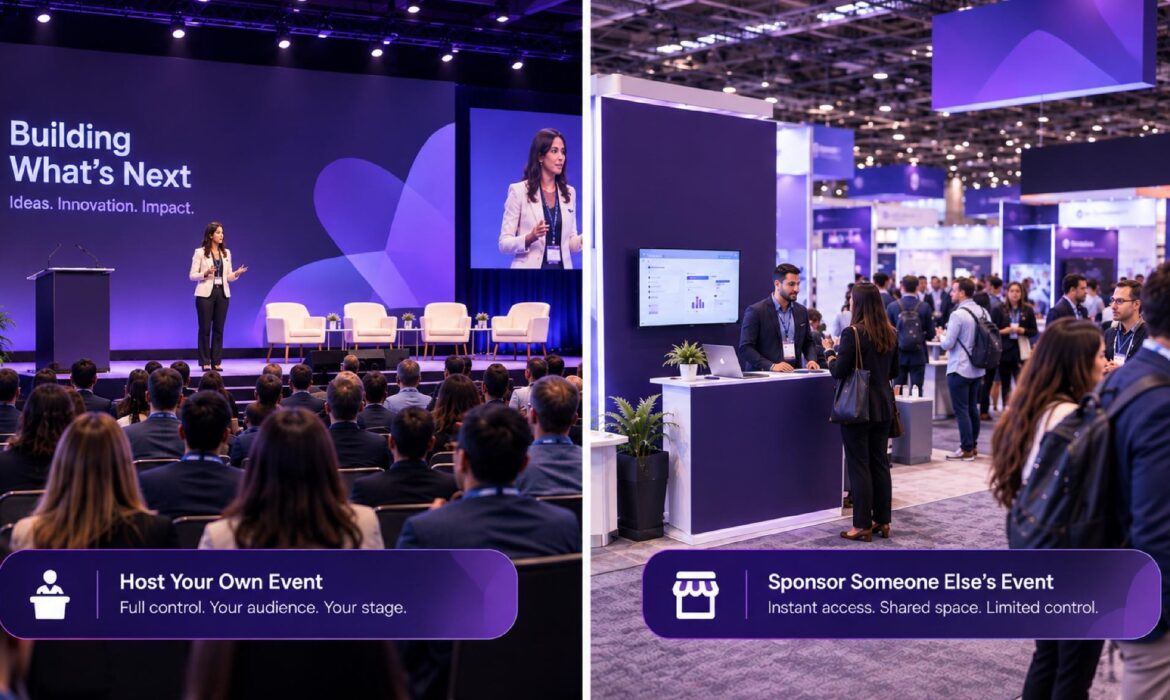
Event hosting strategy determines what every event dollar buys: your own audience or access to someone else’s. Hosting builds your audience over time. Sponsoring borrows theirs immediately. Both have their place, and the choice does not end the question. It shapes how you run the program.
This is a mid-year, mid-funnel question. Companies planning their annual event strategy need to know which approach fits their current GTM motion, because switching from one to the other in the middle of the year is expensive and disruptive.
What sponsorship packages actually buy is one half of the decision. What hosting buys is the other half. The choice depends on whether you prioritize control or reach, ownership or speed.
A VP Marketing at a mid-market company spent two years hosting an annual conference. Year one: six months of planning, significant upfront investment, 300 attendees, and early-stage ROI. Year two: similar effort, 350 attendees, starting to see repeat attendance and attendee-to-customer conversions. By year three, the event was producing pipeline, but required ongoing marketing leadership time to run well. That operational cost is rarely budgeted upfront.
What ownership means is control over the agenda, the speakers, the messaging and the attendee experience. You own the attendee list and the relationships. You decide what happens next year.
The timeline runs six to twelve months from decision to first event. The first event almost always loses money or breaks even. Year two shows early ROI. Year three or four, a well-run owned event becomes a brand and pipeline asset. Companies that host once and abandon it usually attribute the loss to poor execution rather than the natural investment curve.
Direct cost includes venue, catering, promotion and speaker travel. Indirect cost includes marketing staff time, event production, sponsorship and partnership negotiation, and follow-up logistics. Most companies budget the first and not the second, which is where they lose visibility on why the event costs so much.
What you get back is your own audience over time. Data you control. Attendee relationships that persist beyond the event. A platform for thought leadership. The ability to test new programs on your audience without paying an organizer a fee.
A director at an early-stage company started sponsoring events to get in front of customers. Built relationships and pipeline from year one, and now is considering whether to host a niche summit because sponsorships are not reaching early-stage prospects deeply enough. The sponsorship strategy worked for reach. It did not work for audience building.
What borrowing means is immediate access to an existing audience. No audience build time. No long waiting period for ROI. The organizer handles all logistics, promotion and attendee management. That convenience has a price: you have limited control over who shows up and what happens.
The timeline is 3 to 6 months before the event for the sponsorship decision. Execution starts 3 months out. By event day you are in front of the right people. That same calendar, for sponsorship tier selection, is what decides what you actually get from the room. That same calendar for your event hosting strategy is still in the planning phase.
Upfront cost is lower (the sponsorship fee), but less control over outcome. You get what you negotiated and nothing more. If hosted meetings do not happen or the audience is not quite right, you have limited recourse. The organizer takes the risk of audience quality. You take the risk of whether your message resonates.
What you get back is immediate pipeline. Data if included in the tier. Relationships if you make them. But no owned audience, no attendee list you can use next year, and no building of your brand through the event itself.
A common approach for mid-market companies is to balance sponsorships for reach with owned events for audience building. This mix gives them immediate pipeline from sponsorships plus long-term asset building from owned events. The ratio varies by company stage and growth targets.
The portfolio math reads like this: five to eight sponsorships per year produces quick wins and continuous pipeline. One or two owned events per year produces audience and brand building. The sponsorships fund themselves from the pipeline they produce. The owned events are investments that pay off in year two or three.
Sizing the portfolio depends on company stage. Companies just starting might do eight sponsorships and zero owned events to get reach immediately. Mature companies might do two sponsorships and two owned events so audiences and pipeline both grow. Company size and growth stage decide the mix.
The decision criteria is straightforward. If you need pipeline now, sponsor. If you need audience over time, host. If you need to know which sponsorship is the right fit for your current audience, that decision is upstream of whether you should be sponsoring at all. If you need both reach and audience, do both but sequence them. Sponsorships this quarter, owned events next quarter, staggered through the year so the team is not overloaded and so you can learn from early sponsorships before investing in hosting.
Not either-or, but both-and, depending on your timeline and budget. Early-stage companies often have to choose sponsorship first. Mature companies often can afford both.
Ask three questions before deciding which path fits your situation.
Do you need pipeline reach in the next six months? If yes, lean sponsorship. If no or not urgent, hosting is possible.
Do you have a defined audience, or the data to build one? If yes, hosting is possible. If no, sponsorship is easier because you are borrowing someone else’s.
What is your team capacity? Hosting requires ongoing attention for 6 to 12 months before the event, then continuous management year over year. Sponsorship is 3 to 6 months of attention per event.
Early-stage companies at Series A to B should sponsor. You need pipeline now, you do not have owned audience assets yet, and you cannot afford the time cost of hosting. Sponsorship gets you in the door.
Growth-stage companies at Series C and beyond, $50M to $500M ARR, can do both. You have the budget and capacity to run sponsorships for reach and one owned event per year for brand.
Enterprise companies above $500M should lean owned events. You have a large audience to market to, and you can afford to build your own platform instead of paying to borrow someone else’s.
Hosting builds audience over time. Sponsoring borrows reach immediately. Both are legitimate strategies, and which sponsorship to choose is a different decision than whether to sponsor at all.
Choose based on your current need. Do you need to reach people now or build an audience you can reach continuously?
To talk through which approach fits your GTM motion and how to structure a portfolio that includes both, reach out to Samaaro.
What is the cost difference between hosting and sponsoring?
Sponsorship costs 10K to 150K depending on tier. Hosting costs 100K to 500K for year one including staff time, with ROI typically appearing in year two or three. Sponsorship costs less upfront but less control. Hosting costs more upfront but builds an asset you own.
How long does it take to plan a hosted event?
Six to twelve months from decision to execution for a first event. Subsequent years get faster because venue, logistics and team processes are established. Most companies plan their annual event starting six months before.
When should a company start sponsoring versus hosting?
Early-stage and growth-stage companies should sponsor first. Sponsorship gives immediate pipeline and requires less team capacity. Hosting is a mature-stage move when you have audience size and team capacity to support both the planning cycle and the ongoing relationships.
Can you do both sponsorships and hosted events in the same year?
Yes. The pattern is to stagger them. Run sponsorships in Q1 and Q3 for pipeline, host an owned event in Q2 and Q4 for audience building. This spreads the team workload and creates a continuous event motion instead of bunched effort.
How do you measure ROI on a hosted event?
Pipeline sourced, attendee retention year over year, customer acquisition cost from attendees, and brand lift in the market. Year one usually breaks even or loses money. Year two and three, well-run events produce measurable ROI. The measurement is the full three-year view, not the first event.