Samaaro + Your CRM: Zero Integration Fee for Annual Sign-Ups Until 30 June, 2025
- 00Days
- 00Hrs
- 00Min

Key Takeaways (TL;DR)
1
2
3
→
Bottom Line:
Media event monetization comes down to turning a trusted audience and a hard-won contact database into delegate and sponsor revenue, which is exactly the work the manual era makes hardest to scale.
Event sponsorship is a package of access sold by an organizer: presence, a speaking platform, arranged meetings, positioning, data and content rights. Trade show exhibiting is the purchase of floor space to display and demo. Event sponsorship often includes exhibiting. Exhibiting almost never includes anything beyond the booth.
Two companies pay to be present at the same trade show. One signed a sponsorship agreement, the other an exhibitor contract. A week later both ask whether it was worth the money, and the answer sits in the contract.
The terms blur because trade shows put sponsors and exhibitors on the same floor. They are two different purchases, and the difference matters before the budget is committed. [What a sponsorship agreement actually covers → /what-is-event-sponsorship/] is where that difference starts.
A sponsorship contract buys six things at once. A marketing director at a B2B software company negotiated a summit package: booth space, a speaking slot on day two, eight hosted meetings the organizer scheduled, website branding, the permitted attendee list with badge scans, and the right to reuse her session recording.
Almost everything in a sponsorship package falls into six buckets.
Content. Session recordings and photos that keep working after the event ends.
Tiers are different mixes of the same six. Gold adds the keynote slot, premium placement and a VIP dinner. Silver adds a panel seat and fewer meetings. Bronze is a booth and basic scanning. The same structure turns up wherever events are used as a marketing channel, not only on a trade show floor.
The contract decides it. If hosted meetings are not written in, the sponsorship does not include them, whatever the brochure says.
Exhibiting is the purchase of a booth on a trade show floor. You get the space, the power and the aisle traffic. People walk past, some stop, and your team demos what you sell. That is the whole agreement.
What an exhibitor contract leaves out is longer than what it includes: no speaking slot, no meetings arranged by the organizer, no pre-event branding, no attendee list beyond what you scan yourself, and no rights to session recordings.
A trade show manager at a logistics event describes the pattern. Exhibitor-only companies come to her after the show asking why they had no qualified meetings. The answer is in what they signed: meeting facilitation and attendee data sat in the sponsorship packages, not the booth rental.
Price follows the same line. Booth rental commonly runs from $5,000 for a small stand to $50,000 for a large custom build. A sponsorship including the same booth often runs from $25,000 to $150,000, because stage time, meetings and data are added on top. Those ranges are market estimates rather than published rates, and they move with region, venue and build. The gap between them is the point.
Exhibiting is reactive by design. You staff the booth, you scan the badges of people who stop, and you hope the right ones walk past.
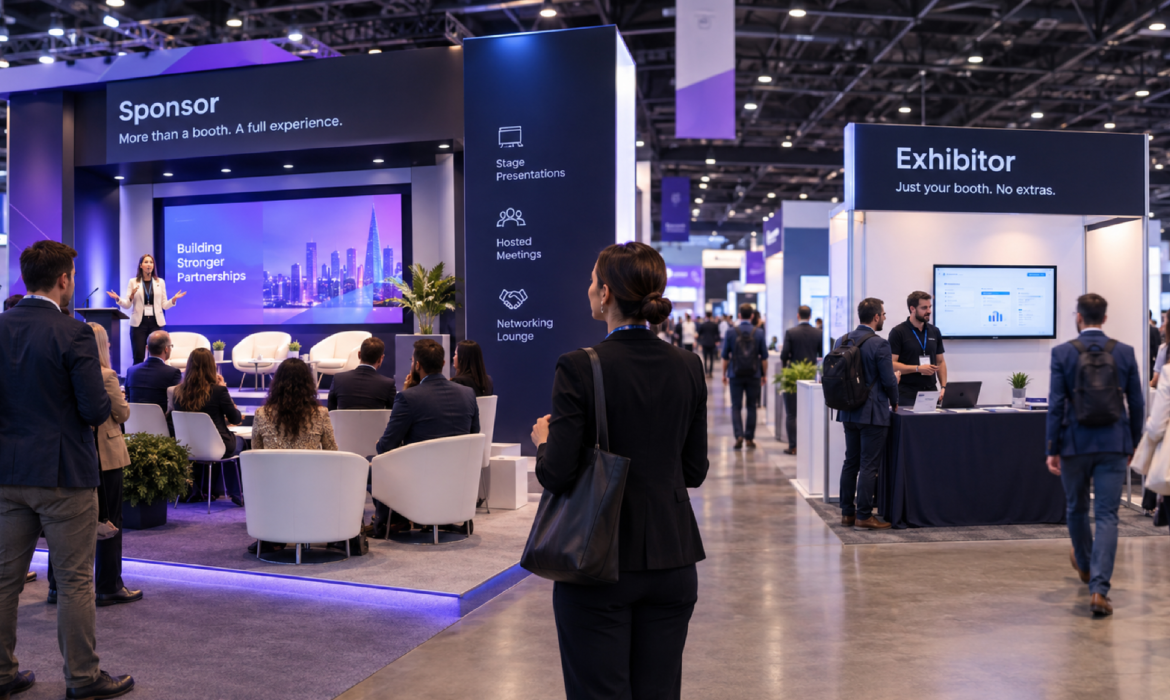
Trade shows sell both, side by side. A sponsor may hold a premium booth location with signage identifying them as a sponsor. An exhibitor holds a standard booth. To an attendee walking the aisle they look similar, which is most of the reason the terms blur.
The prospectus separates them clearly. Organizers list sponsorship packages at one price, described as a booth plus a set of benefits, and exhibitor packages at another, described as booth rental with a size attached. The sponsorship line adds the six elements. The exhibitor line adds none.
Most sponsors also exhibit, because the booth is already in the package. A company paying for stage time and hosted meetings has no reason to leave the floor space unstaffed.
They come apart everywhere else. Conferences, summits, awards nights and community events often run sponsorships with no exhibitor floor at all. There, sponsorship is the only way to buy a presence.
Booth strategy, stand design and floor traffic are their own discipline, and [how a trade show program is actually run → /what-is-trade-show-marketing/] sits outside this comparison.
The brochure is marketing and the contract is the agreement. Read the second one.
Work through the six elements and check which appear in writing. If hosted meetings are listed, you are getting them. If not, the organizer has not promised them, and a sales conversation is not a deliverable. The same test applies to speaking slots, branding, attendee data and content rights.
Check what the word booth means in each document. A sponsorship contract may specify a premium 20×20 with a named location, while an exhibitor contract specifies a standard 10×10 assigned by the organizer. That difference is priced accordingly.
Data terms deserve the closest read. Does the contract grant an attendee list, and how far ahead? Does it permit badge scanning at your booth? Do you hold usage rights to your own session recording? Data access is often the most valuable line in the agreement and the one nobody checks until renewal.
Neither option is better in general. Which one is better for you depends on what the contract includes, not on how the event looks or what a competitor booked last year.
Sponsorship buys a package of access. Exhibiting buys floor space. At trade shows the two sit side by side and often overlap in one deal. Everywhere else, sponsorship stands alone.
When you are weighing the two, lay the contracts next to each other. The line items that appear in one and not the other are the real difference. Understanding what your event sponsorship agreement actually includes is what prevents overpaying for benefits you will not use. Lead capture and follow-up are where sponsorships prove their worth. Talk to Samaaro about how to track lead quality from sponsorships across your program.
Can you sponsor an event without exhibiting?
Yes. Conferences, summits and community events often sell sponsorships with no exhibitor floor at all. The package covers branding, speaking, meetings and data, with no booth because there is no floor.
Is a booth included in a trade show sponsorship?
Usually yes, and often at a better size or location than a standard exhibitor booth. Some tiers cover branding and stage time only, so check.
Why does sponsorship cost more than exhibiting?
Sponsorship sells access rather than space: stage time, hosted meetings, branding and data on top of the booth. Exhibiting prices the space alone.
What is an exhibitor contract?
An exhibitor contract is the agreement to rent floor space at a trade show. It specifies booth size, location, build rules and power, then stops.