Samaaro + Your CRM: Zero Integration Fee for Annual Sign-Ups Until 30 June, 2025
- 00Days
- 00Hrs
- 00Min

Key Takeaways (TL;DR)
1
2
3
→
Bottom Line:
Treated as a revenue and go-to-market engine, a media company’s event is often one of the clearest places the brand gets paid for what it already does well.
Your event is your reputation, standing in a room.
When you publish for a living, your event is your reputation standing in a room. It can also be one of the strongest ways you grow.
A media company’s event does more than sit off to the side of the business as a marketing line item. It works as a revenue line through sponsorship and ticketing, as a go-to-market motion through the access it grants advertisers and partners, and as a credibility signal that reinforces everything the publication already stands for. Treated as a revenue and go-to-market engine, it stops looking like a cost and starts looking like the business.
Framing the event as a side activity that merely supports the publication undersells it. More often, the event is one of the clearest, most direct ways the brand itself gets monetized.
What follows is how a media brand’s event functions as its product in its own right.

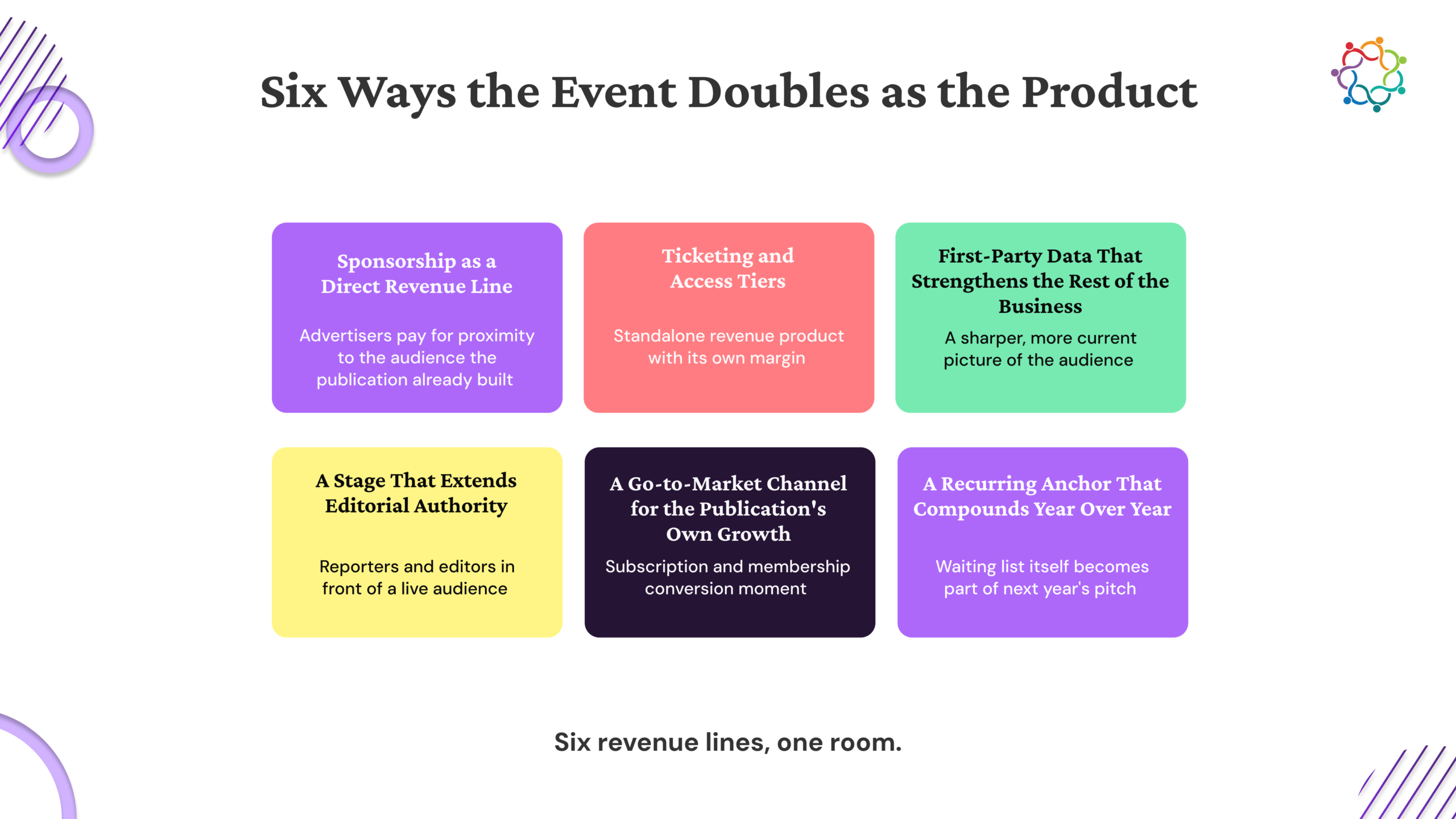
Each of these is a concrete revenue or growth mechanism that lives in the event itself.
Common trap: filing the event under marketing and judging it against a marketing budget. A media brand’s event usually earns its keep far more directly than that framing allows, and evaluating it only as promotion undercounts what it returns as a revenue and growth line in its own right.

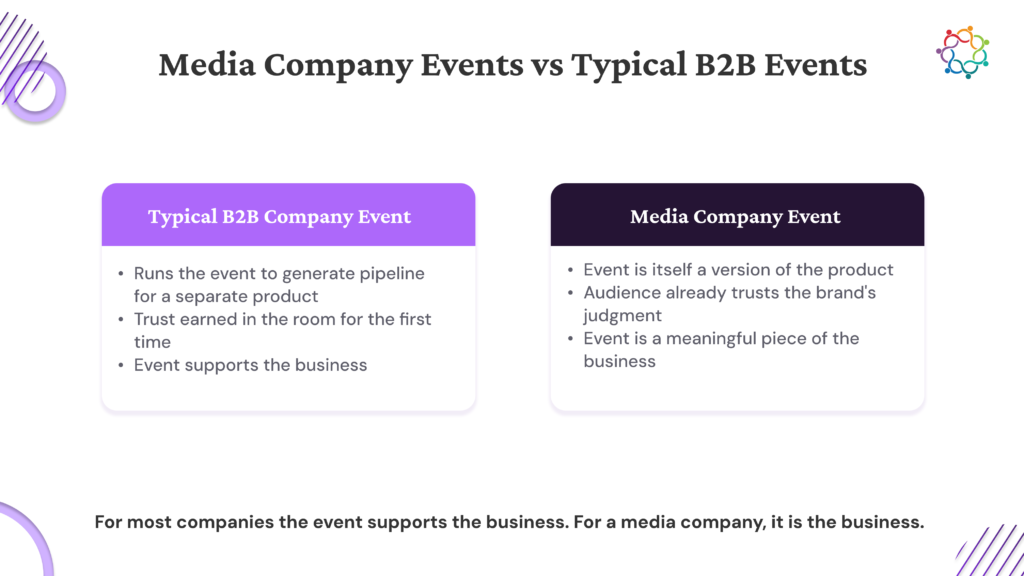
Most B2B companies run events to generate pipeline for a separate product. A media company’s event often is a version of the product itself, built from the same audience relationship and the same editorial credibility the business already runs on. That’s a different starting point, and it changes the economics.
The audience already trusts the brand’s judgment before the event begins. A vendor walks into the room trying to earn that trust for the first time; a publication walks in having earned it over years of coverage. That standing trust is what makes sponsorship and ticketing viable as direct revenue instead of mere cost recovery, because sponsors are buying access to an audience that already takes the brand seriously. A vendor has to prove it belongs in the conversation; a publication convened the conversation, and that difference is worth real money to a sponsor deciding where to spend.
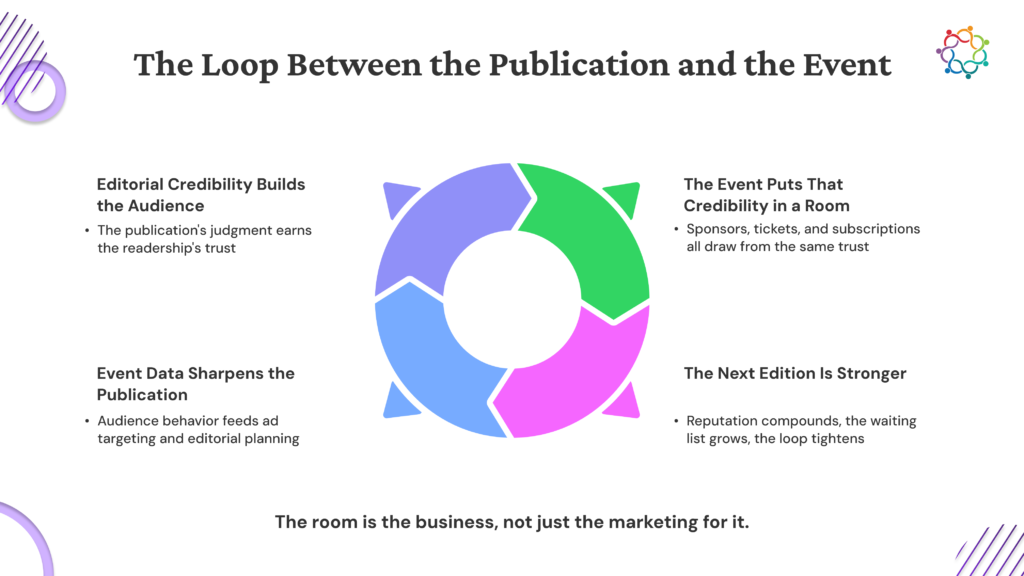
The two sides also feed each other. Event data sharpens editorial and ad targeting, and editorial credibility is what makes the event worth attending or sponsoring in the first place. It’s a loop most B2B companies don’t have, and it’s part of why events keep climbing as a channel in the latest B2B event marketing benchmarks. For most companies, the event supports the business. For a media company, the event often is a meaningful piece of the business.

Picture a publication known for covering one industry, running its annual summit.
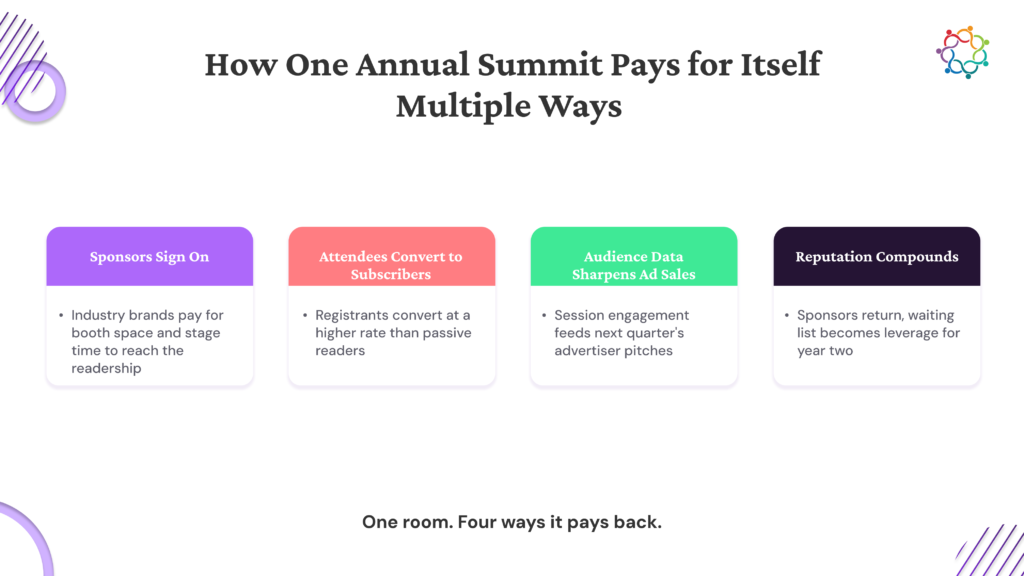
Sponsors from that industry pay for booth space and stage time, because the audience in the room is the exact readership their ad dollars already chase. There’s no audience to convince; it’s the same one the publication has been building for years, now gathered in a single place for two days. For the sales team, that room is the easiest pitch of the year: the reach is standing right in front of the sponsor, badge on and asking questions, instead of estimated on a media kit.
Attendees who register convert to paid subscribers at a noticeably higher rate than readers who only meet the brand through articles, because a live session with an editor carries more weight than a byline. Then the data does double duty: who registered, which sessions they attended, and what they engaged with feeds the sales team’s advertiser conversations the following quarter, sharpening the pitch with real audience behavior instead of estimated reach.
And it compounds. Sponsors return because last year’s room delivered, and the waiting list itself becomes part of what makes this year’s sponsorship pitch stronger than it was twelve months ago. None of it took a bigger event than the brand could already run. What it took was treating that event as a place where the business gets paid, and building it to do exactly that.
The same logic runs across more than one format, and most media brands eventually run a few, layering them across the year so the audience always has a next reason to gather.
Different formats, the same underlying asset: an audience that trusts the brand enough to show up, and sponsors who will pay to reach it.

Sponsorship revenue, ticketing as its own product, data that sharpens the rest of the business, editorial authority extended live, a growth channel for subscriptions, and a recurring asset that compounds: put together, they describe a business in their own right.
For a media company, the event is often one of the clearest places the publication gets paid for what it already does well. Running it that way, so sponsorship revenue, ticketing, and audience data all come out of the same room, is what an event marketing platform is built to hold together in one place.
So look at your flagship event and ask what it would take to run it as a product. If that’s the direction you’re heading, Samaaro can run the revenue, ticketing, and data side from one place.
1. How does event manager software help media companies turn events into revenue?
Event manager software keeps sponsorship, ticketing, and registration running in one place, so the revenue side of the event isn’t spread across spreadsheets. Sponsor packages, paid tiers, and sign-ups are managed together, which is what lets a small team run a flagship as a real revenue line rather than a marketing cost.
2. What’s the benefit of using an event management app for event ticketing?
An event management app makes paid attendance and VIP tiers their own product line, sold and managed alongside the rest of the event. Running tickets this way shows which topics an audience will actually pay to attend, and that signal is far stronger than a free registration when the sales team plans next year’s program.
3. Can an event planning tool help run a recurring flagship event?
Yes. An event planning tool lets you set the annual summit up once and reuse the format each year, so it compounds instead of resetting. The waiting list, the sponsor roster, and the agenda carry forward, which is what turns a one-off summit into a recurring event the whole business can plan around.
4. How does event coordinator software manage sponsorship fulfillment?
Event coordinator software keeps every sponsor’s deliverables in one place: booth space, stage time, VIP access, and what each package promised. The coordinator can see commitments well before the deadline instead of reconstructing them from email threads, which is what makes sponsors feel looked after and come back for the next edition.
5. How does conference management software handle multiple sponsor tiers?
Conference management software lets you define tiers once, gold, silver, bronze, each with its own booth placement, stage slots, and access. The system keeps those benefits straight across dozens of sponsors, so nothing gets managed on a spreadsheet and every sponsor receives exactly what their package included.
6. How does event organizer software turn a one-time summit into a recurring revenue event?
Event organizer software lets you build the first summit, save the setup, and reuse it the next year instead of starting over. Sponsors return because the last room delivered, the waiting list grows, and registration flows and sponsor packages carry forward, so each edition takes less to run and earns more than the one before.

Samaaro is an AI-powered event marketing platform that enables marketing teams to turn events into a measurable growth channel by planning, promoting, executing, and measuring their business impact.
Location


© 2026 — Samaaro. All Rights Reserved.