Samaaro + Your CRM: Zero Integration Fee for Annual Sign-Ups Until 30 June, 2025
- 00Days
- 00Hrs
- 00Min

Key Takeaways (TL;DR)
1
2
3
→
Bottom Line:
Run one more event the old way with someone counting; that baseline stops being available the moment anything switches on.
Built From Zero, Every Time
Some event work is hard. Different work is simply done again. The attendee list assembled from nothing for the ninth year running. The payment status checked name by name against a bank statement. The badge list retyped because last year’s file had a different shape. None of it is difficult, and all of it will happen again in exactly the same form the next time, which is the only quality that matters when deciding what to hand to software.
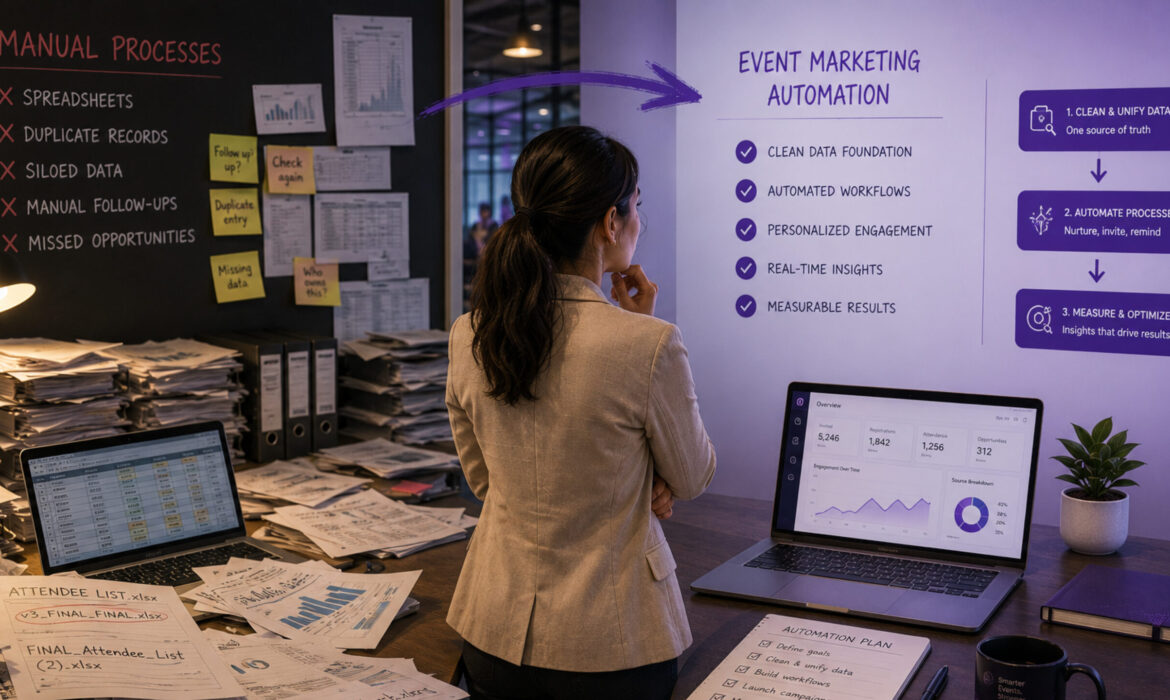
Where to start with event marketing automation is a question about dependencies rather than about impact. Routing, sending, and reporting all read from the record, so each one inherits whatever is wrong with it. Clean and automated record upkeep makes the next three worth doing. Automating sends before cleaning the records is how teams end up automating their mistakes.
This is written for teams automating events for the first time, where nothing is connected because nothing has been bought yet. If your tools already exist but don’t talk to each other, that’s a different starting position, and it changes what the first move should be.
The test for what to automate first is repetition rather than effort. Work that gets rebuilt from zero every cycle is the target, whether or not it feels demanding.
A demand generation team at a B2B software company had been running the same annual summit for years. Registration was a manual list, payment status was checked by hand against bank statements outside any system, and the badge file got retyped every year because the previous year’s version had a different column order. None of that felt hard at the time. All of it would happen identically next year, which is why it qualified as the thing to address first, not because it was the thing that felt worst.
That team did not have a sophistication problem. They had a repetition problem, and the two need different advice. Repetitive work is what automation reaches for first, which is also why the event work nobody should be doing twice is usually not the work anyone complains about. The dramatic pain points are judgment work, and judgment is the last thing to hand over.
So the test stays simple. Does this task get rebuilt from nothing next cycle, in the same shape? If yes, it qualifies. If not, it stays with people, at least for now.
What to automate first in event marketing is decided by a dependency chain. Four links sit in sequence, and each one reads from the one before it.
Everything downstream reads the attendee record: name, company, role, what they registered for and whether they showed up. Nothing reads from anywhere else. Automating record upkeep first means deduplication, filling gaps and one version of each person.
A lead assigned by territory or account is assigned based on what the record says. A stale job title routes to the wrong owner. The routing worked correctly the whole time. Event data cleanup is therefore the first move, because it is the one thing every downstream process will inherit.
Who receives what depends on the record and on routing. A duplicate contact receives the message twice. A mismatched account receives it at the wrong person. The first automation error most teams meet is a record error wearing a sending error’s clothes.
Numbers assembled from records, routing, and sends inherit every error in the chain and present them with more confidence than a manual count would. So the sequence is not opinion. It is a dependency. Fix the base and the next three become worth automating, each easier than it would have been alone.
Lead assignment becomes possible only after records are clean, which is the proof that this sequence is not a preference but a necessity. Automating event communications depends on clean data flowing through lead assignment and routing before any send goes out.
A first-time buyer has no baseline, which means no way to show the change worked. Every team that already had tools has a baseline to compare. A team replacing event spreadsheets has only a feeling that it used to be worse.
Why that matters more than it sounds is because the first automation is rarely the last. The second one needs funding. Without a measured baseline, the case for phase two is testimonial, and testimonials lose budget arguments to numbers.
So run one more cycle exactly as it runs now, and record four things. How many hours went into assembling and cleaning the list? How many people touched it? How many corrections were made after the fact? How long from event close to the follow-up going out? Nothing else, and nothing changed during the cycle.
Why are those four? Each one has a direct after-state. Measure them both and the comparison writes itself later and cannot be argued with.
A first-time buyer who had to make the internal case for an event platform had nothing to hold a proposal against, so the conversation became a debate about price rather than the work being replaced. Knowing how to build a business case for event automation means starting with the baseline, not with the tool, which is the honest answer to how to measure event work before automating it.
The first step in automating anything is a cycle where nothing gets automated, and skipping it costs more later than it saves now.
These are sequencing calls, not permanent rules. Each one has a condition that changes the answer.
Anything sent to your most senior invitees or named accounts. Defer until the record for those contacts has been cleaned through one full cycle and the template has been sent manually enough times that its wording is settled. The unlock is a quarter with no corrections needed on that list.
Anything that touches money or access. Payment status, complimentary entitlements, and who may enter a paid session. Defer while verification still happens outside the system, because automating a check whose source of truth is a person’s judgment automates the timing and not the check. The unlock is the verification itself, living in one place.
Reporting. Defer until records, routing, and sending have each run reliably for a cycle. The unlock is being able to answer where a number came from without opening three files.
None of those is off limits. Each one is waiting for a condition rather than a rule.
Event marketing automation for the first time is a sequencing problem, and the first move is counting rather than switching anything on. The work worth removing is the work that arrives identically every cycle, and it is usually not the work that anyone complains about.
So before changing anything, run one more event exactly the way it runs now, with someone counting hours, hands, corrections, and days. That cycle is the only chance to record the past, and it stops being available the moment the first thing gets switched on. See how the dependency chain works inside an event management platform. To see records, routing, sending, and reporting working in sequence, book a platform walkthrough.
1. How does event manager software show you the dependency chain for automation?
Event manager software displays the sequence: records first, then routing, then sending, then reporting. Each reads from the one before it. Fix records and the next three become worth automating. Automate sending on messy records and you’re delivering errors faster to more people.
2. Why should I use event management app to clean records before automating anything?
Everything downstream reads the attendee record: name, company, role, what they registered for. A duplicate contact gets routed twice. A stale title routes to the wrong owner. Clean records before you automate. It’s the move that makes every other automation worth doing.
3. What does event coordinator software do when you establish your baseline?
Run one more cycle the old way and count hours spent, hands involved, corrections made, days to follow-up. That’s your baseline. Nothing else changes. You can’t show automation worked without knowing what the before looked like. This cycle is your only chance to capture it.
4. How does event planning tool help you identify what qualifies for automation?
Test repetition, not effort. Does this task get rebuilt from nothing next cycle, in the same shape? If yes, automate it. If no, keep it with people for now. The work nobody should do twice is usually not the work anyone complains about most.
5. When should I use conference management software to decide what to defer?
Defer sending to senior contacts until general-list sending runs clean for a cycle. Defer anything touching money until verification lives in one place. Defer reporting until records, routing, and sending are reliable. Each deferral has an unlock condition, and patience costs less than a mistake.
6. How does event organizer software show the dependency chain in action?
Records feed routing. Routing feeds sending. Sending feeds reporting. Each inherits what came before. A stale record breaks routing. Broken routing breaks sending. Broken sending breaks reporting. Automate in sequence, not the other way around. The chain holds regardless of the system.