Samaaro + Your CRM: Zero Integration Fee for Annual Sign-Ups Until 30 June, 2025
- 00Days
- 00Hrs
- 00Min


Key Takeaways (TL;DR)
1
2
3
→
Bottom Line:
One annual plan, every event tied to revenue, and a calendar built strategically instead of one event at a time.
The whole year, mapped in one sitting.
Planning next year’s events one calendar invite at a time is how things slip through the cracks. Map the whole year first.
Before a single event goes on the calendar, five things need mapping across the year: the revenue goal each event serves, the format, the owner, the budget, and how they sit relative to each other across the year, not just one at a time. Get those on one page and next year stops being a scramble.
The failure mode is familiar. A team running ten or more events a year, planning each as it comes, ends up duplicating effort, clashing dates, and spreading budget unevenly, because no one ever looked at the whole year at once.
Below: the checklist of what to map, how to lay it into a calendar, and a fillable annual planning template so the mapping doesn’t start from a blank spreadsheet.
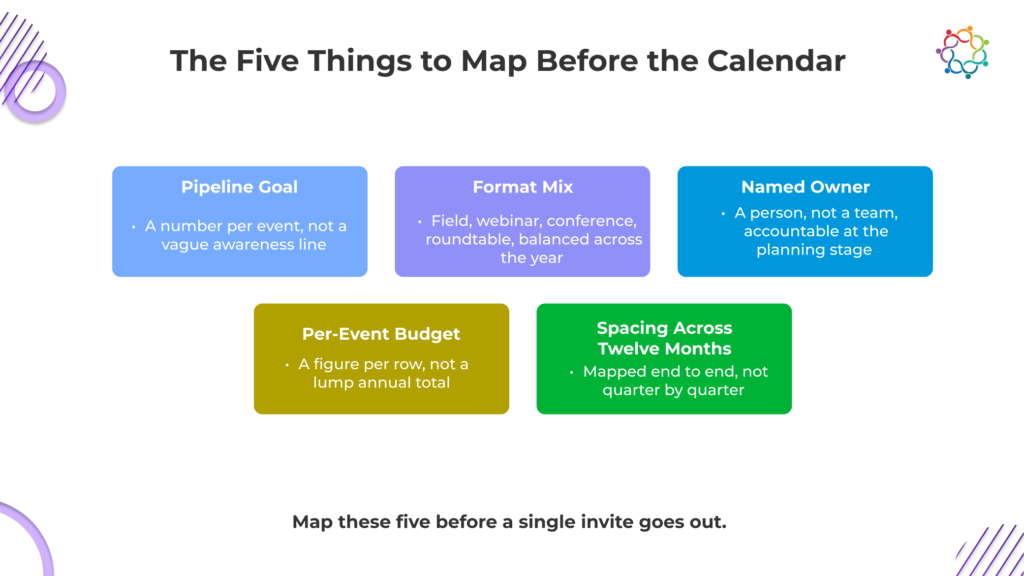
Five things need to exist on paper before a date gets booked. Each one is concrete enough to act on today, and skipping any one of them tends to come back as a problem later in the year.
Not a vague brand-awareness line, a number: new revenue, account engagement, or renewal support, stated per event before it’s scheduled. “Book 30 sales meetings” or “source 500,000 dollars in new deals” both work, framed as SMART targets, the way a strategic event calendar is built. “Raise awareness” doesn’t, because you can’t plan a calendar around it.
Field events, webinars, flagship conferences, and executive roundtables each pull different effort and return different outcomes. Mapping the mix stops a year drifting toward whatever format spins up fastest. A year that’s accidentally 80% webinars is a default nobody actually chose.
Not a team, a person accountable for that event’s outcome, assigned when you set the owner at the planning stage, rather than after the date is locked. “TBD” now becomes a scramble later; a name now means someone owns the result from day one.
A single annual total hides which events are overfunded and which are starved. Breaking it out per event, the way an event budget planner forces you to, surfaces the tradeoff conversation early, while there’s still room to move money. A number per event also keeps the annual total honest, because it’s built from real commitments rather than a round figure someone hoped would cover the year.
Mapped across the year, not quarter by quarter, so two major events don’t land three weeks apart competing for the same sales team’s attention and the same prospect’s calendar. Read the year top to bottom and the clusters jump out before they become a conflict, so nobody has to choose, three weeks out, between two events that both deserved a clear run.
Common trap: approving an annual budget total without breaking it into a per-event figure. A lump sum feels like planning; it’s really just permission to plan later, event by event, under pressure, which is exactly the pattern this exercise is meant to break.
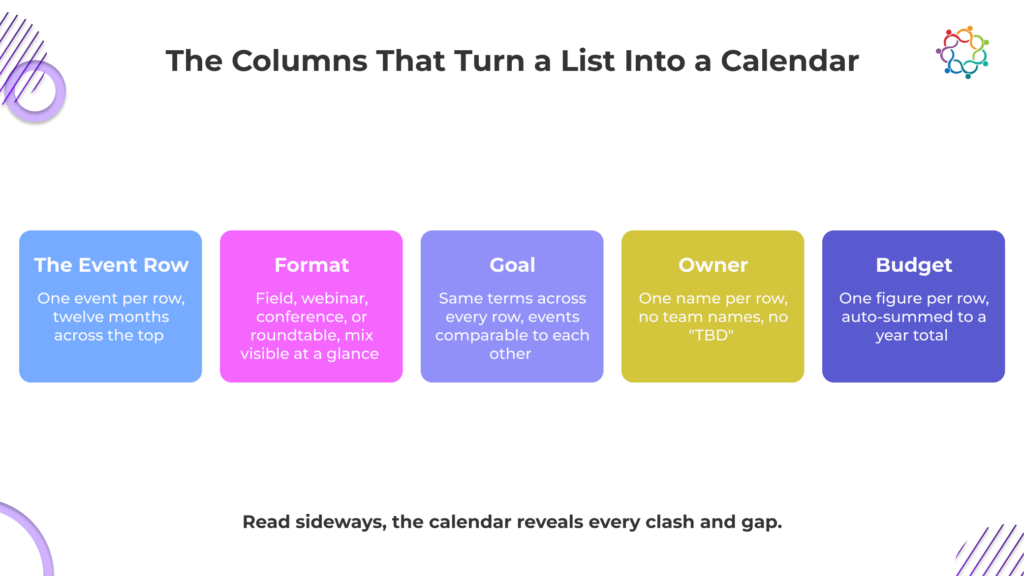
The mapping becomes a document the moment it has a shape. Use one row per event, with the twelve months running across the top, so every event has a fixed place on the timeline instead of living in a separate file per quarter.
Each row carries the same handful of columns.
A finished row reads in a single line: Q2 customer roundtable, roundtable format, goal of 15 open opportunities engaged, owned by Priya, budget of 8,000 dollars. Fifteen rows like that, and the year is a plan you can defend rather than a hope you’re carrying in your head.
Then read the calendar sideways. Once every row is filled, the spacing problem becomes visible immediately: clusters and gaps show up on the page instead of surfacing as a scheduling conflict three weeks out. A gap in Q3 is as useful to see as a cluster in Q2, because an empty stretch is either a deliberate breather or a missed quarter, and the page tells you which.
So why do so many teams skip it? The honest reason is time. Mapping a full year up front takes a real block of focused attention, and the next event is always more urgent than the year as a whole, so the whole-year exercise keeps losing to the next deadline. The urgency is real, and it almost always favors the fire in front of you over the year as a whole.
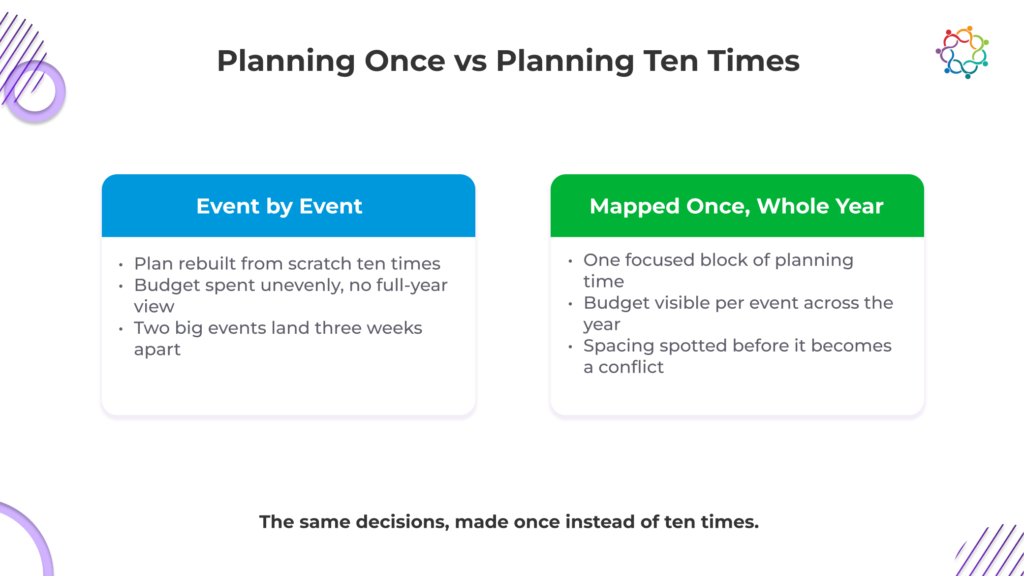
The cost of planning event by event is easy to underrate. Effort gets duplicated as each plan is rebuilt from scratch. Budget gets spent unevenly because no one can see the full year’s allocation at once, which is exactly the gap the CFO’s event budget questions are designed to expose. And events land too close together because nobody checked the calendar against anything but itself.
Here’s the reframe. The annual map replaces ten scattered planning moments with one. You make the same decisions, goal, format, owner, and budget, once and in a single sitting, instead of ten separate times at ten separate moments of higher pressure. What makes it doable is having the columns already built, so you’re filling in a template rather than inventing a system from a blank sheet.
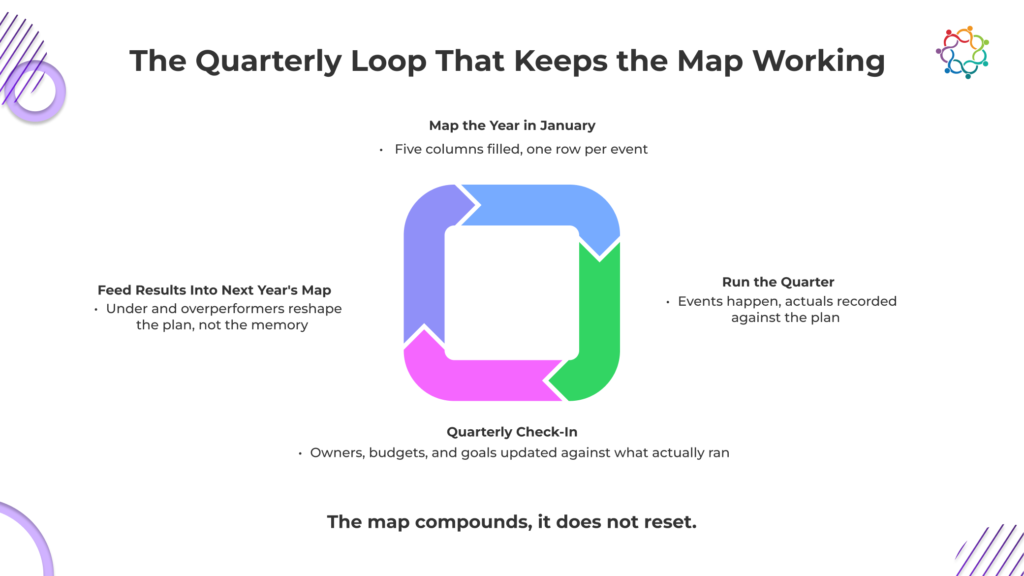
A map built once in January and never reopened fails the same way ad hoc planning does, and as a program scales, that gap is part of why teams outgrow execution-only tools. Four habits keep the calendar alive.
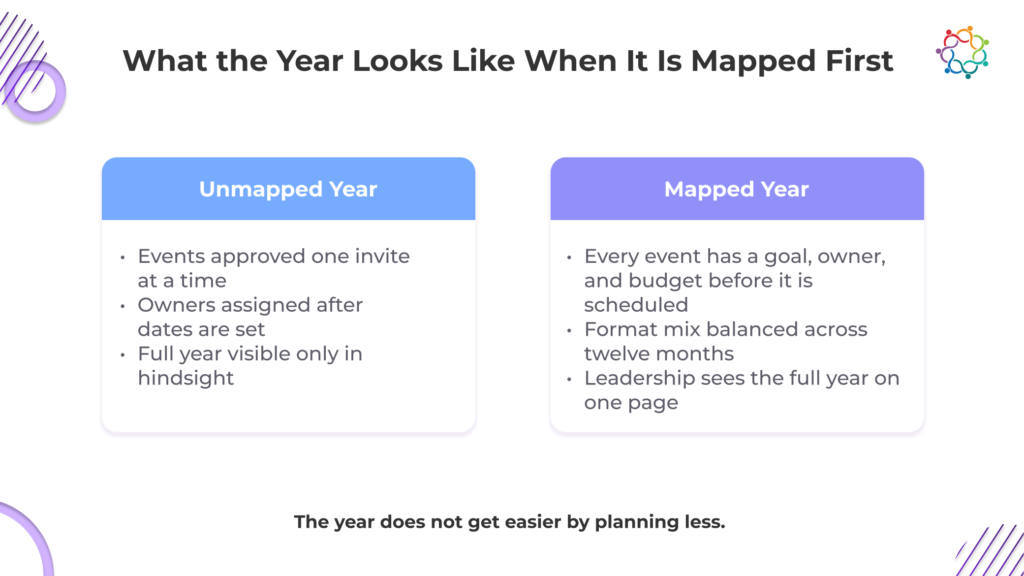
Five things to map, one row per event, and a goal, a format, an owner, and a budget for each. That’s the whole exercise, and it turns twelve months of reactive scheduling into one plan you can defend. The map earns its keep in three ways: a year planned in one sitting spends its budget where it counts, spaces its events so they don’t cannibalize each other, and gives every event an owner before the date is set.
Do it once, up front, all the way across the year, and every event after that starts from a plan instead of a blank calendar invite.
Everything above comes pre-built in an editable Annual Event Planning template: a twelve-month calendar with a row per event and columns for format, goal, owner, and budget, plus a one-page visual version for sharing with leadership. Download it below. It takes your first name, work email, company size, and role.
If keeping that calendar current each quarter should be a pull instead of a rebuild, book a walkthrough.