Samaaro + Your CRM: Zero Integration Fee for Annual Sign-Ups Until 30 June, 2025
- 00Days
- 00Hrs
- 00Min

1
2
3
→
Bottom Line:
Use the three that work, skip the keynote magic, and fix the data foundation first.
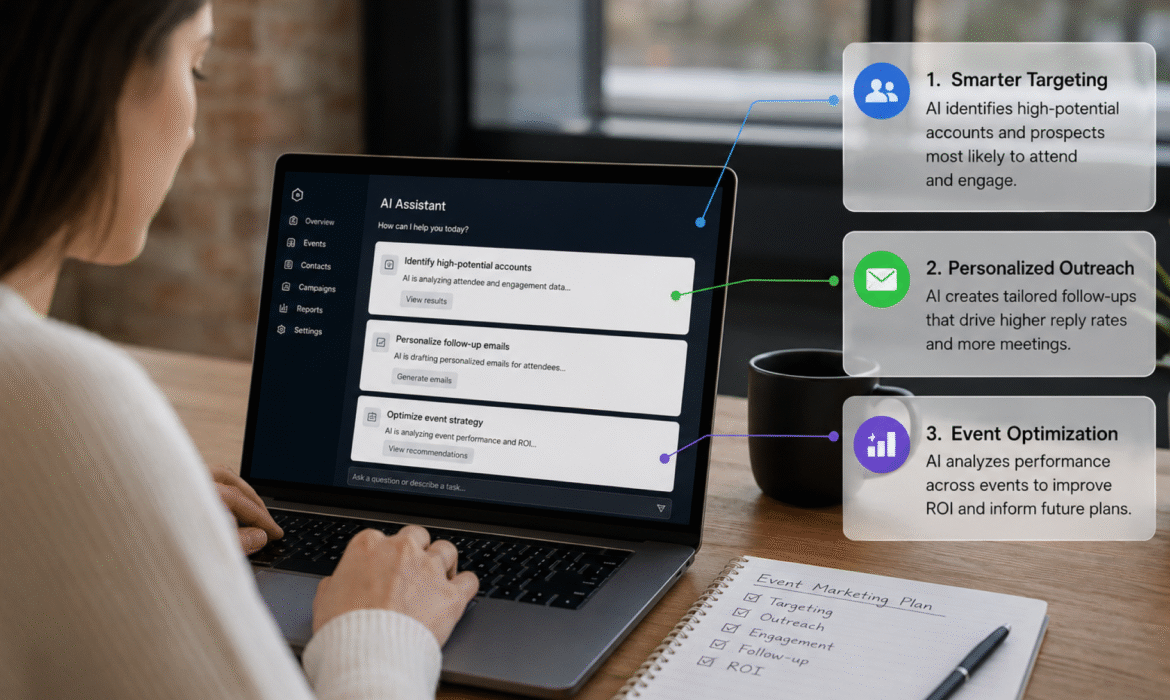
Almost every B2B events team now uses AI in some form. Far fewer agree on what it is actually good for. For every workflow where AI quietly saves a team hours a week, there is a demo promising an autonomous event planner that never survives contact with a real event. So the useful question for AI event marketing in 2026 has moved past whether to use it. The question now is which uses have made it into production, and which are still slideware.
Asked plainly, how are B2B teams using AI for event marketing in 2026? In three places that consistently work: drafting the words an event runs on, personalizing the attendee experience, and processing what an event leaves behind. Adoption is close to universal. Event Tech Live reports that 91% of business events professionals now use AI in some form. Most of that use, though, sits in basic content production, while the flashier promises, the ones that fill keynote slides, have mostly not been delivered. Near-universal adoption and a much shorter list of things AI reliably does well are two different facts, and the gap between them is where most of the confusion lives.
This piece names the three use cases that genuinely work in 2026 and the ones that are still hype, a map of where the technology earns its keep today and where it falls short.

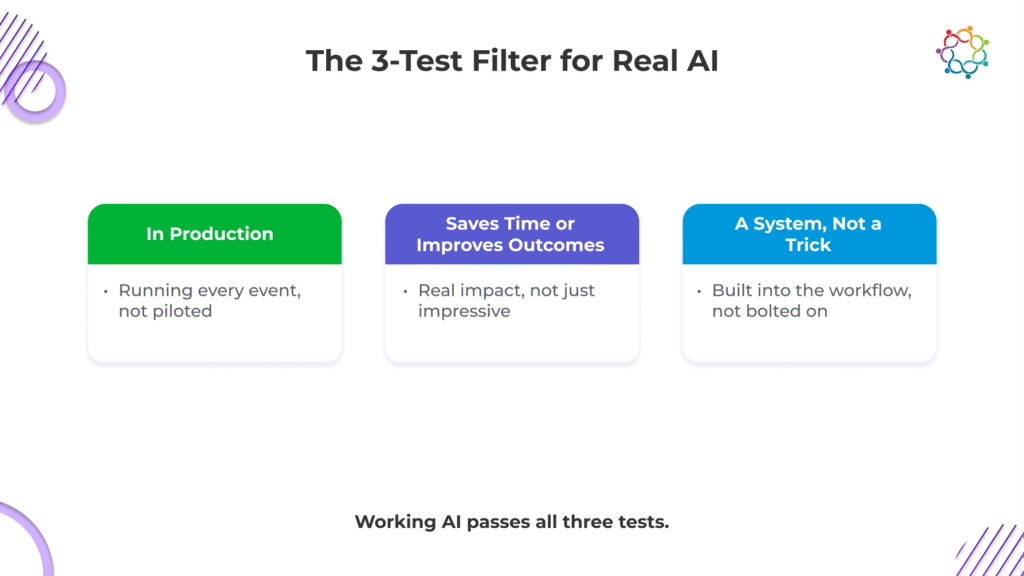
Not all AI use is equal, so before naming the use cases that work, it helps to have a test. The line that matters runs between AI that is in production, running every event in real teams, and AI that is demo-ware, impressive on a stage and absent in practice. Three quick criteria separate them.
All three criteria point the same way, toward whether the AI shows up in the actual work rather than the demo. By this test, most AI-for-events talk is still hype, and a smaller set genuinely works. The rest of this piece is about that smaller set, and it names the hype plainly.

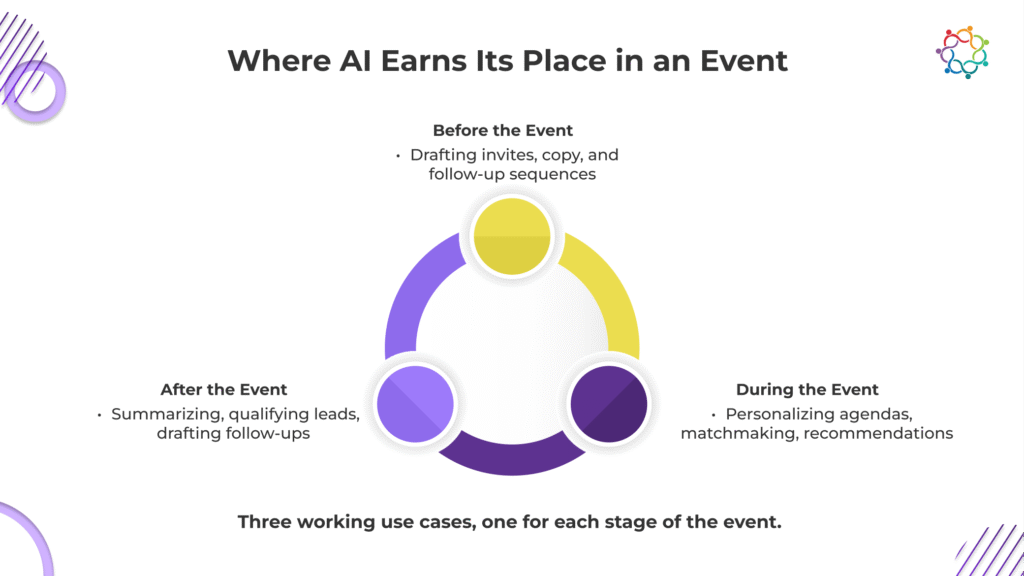
The most adopted, most real use of AI in events is the words. Every event runs on a lot of copy: invite emails, registration page text, session and agenda descriptions, social posts, reminder sequences, and the follow-up messages that go out afterward. AI drafts all of it.
This is where adoption is deepest. HubSpot reports that more than 80% of marketers now use AI for content creation, including email copy, a shift from producing the words by hand to drafting them with AI at scale. Events generate more copy than almost any other channel, and AI compresses days of drafting into hours by taking on the slowest part of the job, the blank page. Teams use it in production for the communications layer of every event, well past the experiment stage.
There is a real limit, and this is where it bites hardest. As AI-generated content spreads, audiences are getting better at sensing what a human wrote and what a machine did. Event Tech Live, citing WordStream analysis, notes that around half of consumers can now identify AI-generated content, and a majority report lower engagement when they suspect a machine wrote it with no human behind it. Careless use risks exactly the backlash it was meant to avoid. It works when AI drafts and a human edits. It fails when AI replaces the writer altogether.
This is the promotional work, the production of the content that an event runs on. Filling the room is a separate problem, and AI does not solve that one here.
The second use case lives inside the event: tailoring the experience to the individual attendee. AI recommends sessions, matches attendees and sponsors, builds personalized agendas, and suggests who is worth meeting.
Why it works comes down to scale. Past a certain event size, no human can hand-tailor each attendee’s path through a multi-track conference, and AI now makes data-driven personalization possible at that scale. It is one of the few high-impact workflows the most effective teams concentrate on, exactly the kind of repeatable, system-level use that the real-versus-hype test rewards. Done well, it changes what an attendee actually does: which sessions they attend, who they meet, and how much of the event lands for them.
Where it is real: larger conferences and multi-track events, where personalization moves the needle on attendee behavior. At a small event, a human can still do this by hand. Past a few hundred people, a model is the only thing that can.
The limit is the data. Personalization is only as good as what sits behind it. Thin or fragmented attendee data produces generic suggestions that fool no one, the same recommended session for everybody. Real personalization needs real, connected, first-party data, which means the event has to capture that data somewhere usable to begin with. The model can only tailor what it can see. Give it a connected record of who someone is, what they registered for, and what they did at the last event, and the recommendations get genuinely useful. Give it a name and an email, and it hands everyone the same agenda.
The third use case starts when the event ends. An event produces a pile of material, session recordings, captured leads, and engagement signals, and AI processes it far faster than a person can. It summarizes sessions, cleans and qualifies the leads, drafts personalized follow-ups, and surfaces those who actually engaged rather than those who simply registered. The work that once meant a person reading every transcript and hand-sorting a spreadsheet of scans now happens in a fraction of the time.
Why it works: the post-event pile is large and time-sensitive, and speed is the whole game. Amex GBT’s 2026 Global Meetings and Events Forecast found AI being used clearly across the event lifecycle, from planning and attendee communications through to engagement tracking and post-event evaluation. That last stage matters most for follow-up, because the speed of follow-up decides whether a warm lead stays warm. The faster the pile gets processed, the more of it converts, and the operational mechanics of getting follow-up out fast are a discipline in their own right.
Where it is real: teams use it in production to compress post-event processing that used to swallow days into something that takes hours.
The limit is the same one personalization runs into, sharpened. AI can only process the data it is handed. Feed it the fragmented, messy output of an export-and-stitch workflow, the spreadsheets pulled from five tools, and it produces faster mess, not insight. Clean, connected data in, useful output out. The quality of what comes back is set by the quality of what goes in.

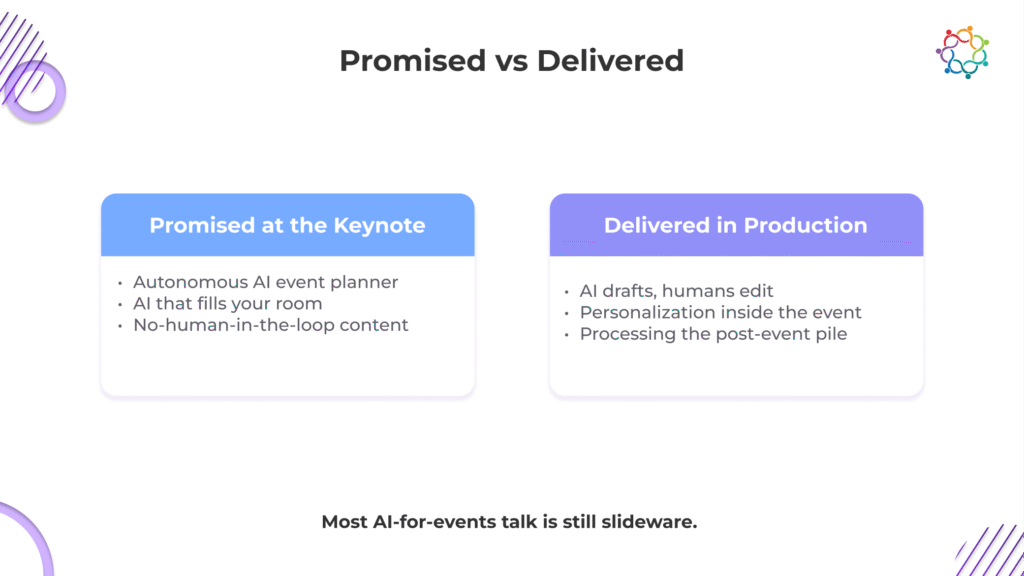
Now the other side, named plainly. Four AI promises are constantly demoed and delivered almost nowhere.
This is not the same as saying AI is overrated. The point is narrower. These specific promises have not been delivered, while the three use cases above have, in every event, in real teams. The pattern is worth noticing: the promises that fail ask AI to replace a human or manufacture demand; the ones that work give AI a defined, repeatable job. Saying so plainly is what makes the rest of this credible. A piece that pretended all of it worked would be the least trustworthy thing you read about AI this quarter.

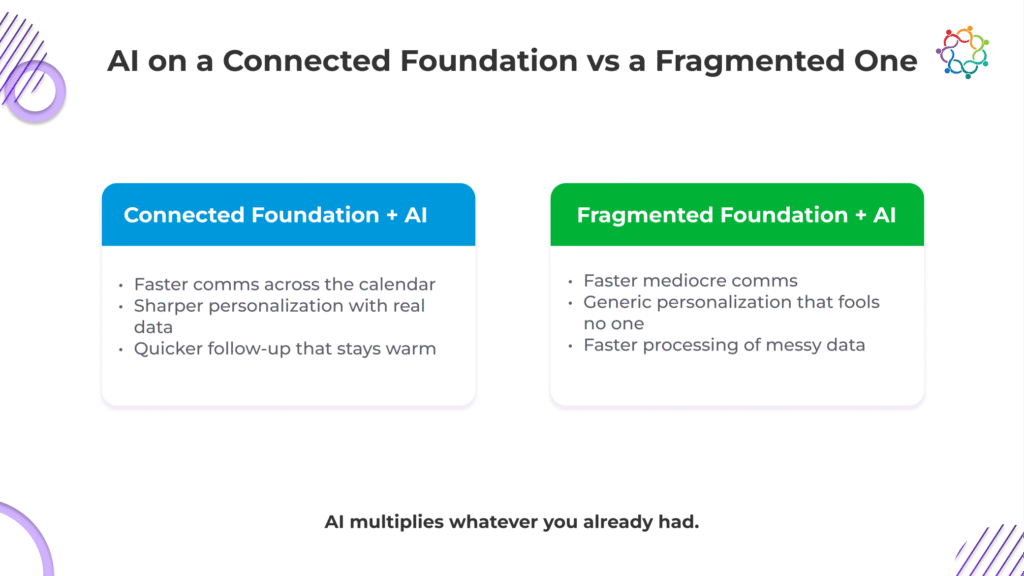
Step back from the three use cases and the same pattern runs through all of them. AI amplifies whatever foundation you already have rather than building one for you. Feed it clean, connected event data and it compounds: faster communications, sharper personalization, quicker follow-up. Feed it fragmented data and it produces fragmentation faster.
That reframes who wins with AI in events. The teams getting real value are the ones whose event data is connected enough for AI to work on, rather than the ones who have bought the most AI. A multiplier needs something solid to multiply, and a model pointed at scattered, half-stitched data just multiplies the mess.
This is the same problem that sits under the manual export-and-stitch reality of most event programs, and under the disconnected stack of tools that creates it. When AI underdelivers for a team, the cause usually sits in the fragmented data underneath rather than in the model, the exact gap that keeps events from being automated in the first place.
So the prerequisite for getting value from AI in events is a connected data foundation rather than a bigger AI budget. The clearest priority for event marketers right now is to get event data connected to the CRM and the rest of the marketing stack, so it becomes usable first-party data instead of a pile of exports. The broader view of how that connected foundation reshapes field marketing sits in the B2B Field Marketing Playbook. Fix the foundation, and AI finally has something worth amplifying.
In 2026, AI genuinely works in event marketing for three things: drafting the words, personalizing the experience, and processing what an event leaves behind. Most of the rest is still hype, and the teams winning with the three that work share one trait: a connected data foundation for the AI to act on. Start with the three, ignore the keynote magic, and fix the foundation first.
AI is not going to plan your event, fill your room, or replace your judgment in 2026. It will draft faster, personalize more widely, and process quicker, as long as the data underneath it is in order.
That connected foundation is what one event platform is built to give you. See what it looks like for your own events. Contact us.

Samaaro is an AI-powered event marketing platform that enables marketing teams to turn events into a measurable growth channel by planning, promoting, executing, and measuring their business impact.
Location


© 2026 — Samaaro. All Rights Reserved.