Samaaro + Your CRM: Zero Integration Fee for Annual Sign-Ups Until 30 June, 2025
- 00Days
- 00Hrs
- 00Min

1
2
3
→
Bottom Line:
The upload disappears when the event runs on the same system the data lands in.
It is 9 a.m. on Monday. The event wrapped on Thursday. Somewhere on a laptop is a spreadsheet, exported from the registration tool, or the badge scanner, or three different places at once, and someone is about to spend the morning cleaning it, deduping it, and uploading it to the CRM by hand. It is 2026, and this is still how the leads from a live event reach the systems that act on them.
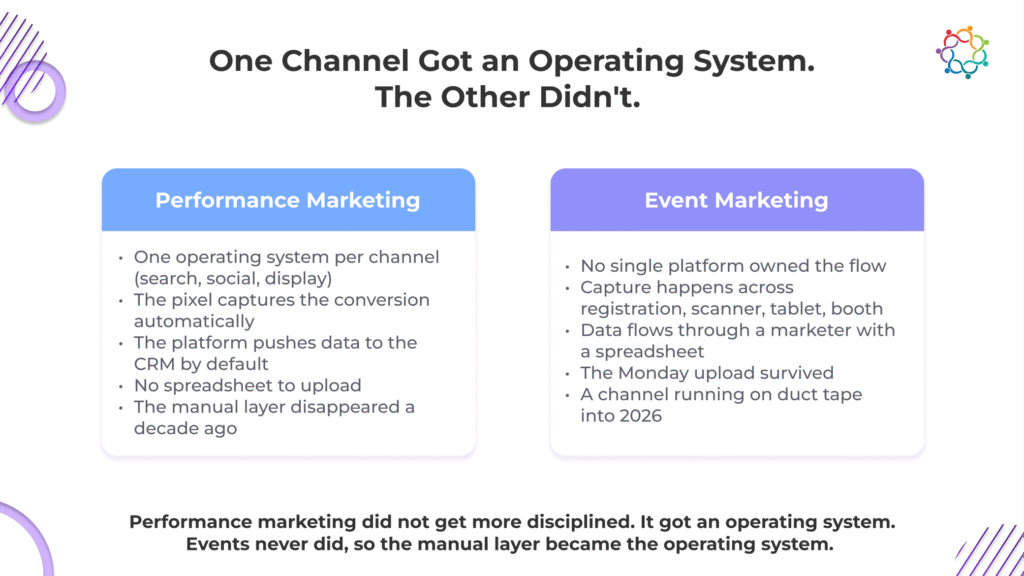
Event marketing automation has lagged about a decade behind the rest of marketing, and there is one structural reason. Events never got the operating system performance marketing got years ago. Paid search and paid social run on platforms that capture, track, and route their data without anyone touching it, so their version of the Monday upload disappeared a long time ago. Events never had a single platform that owned the whole flow from registration to CRM, so a person and a spreadsheet filled the gap, and they have been filling it ever since.
That makes the Monday upload more than a quirky habit. It is the clearest evidence that one channel was left out of the automation that every other channel now takes for granted. This piece is about why it still exists and how it ends.

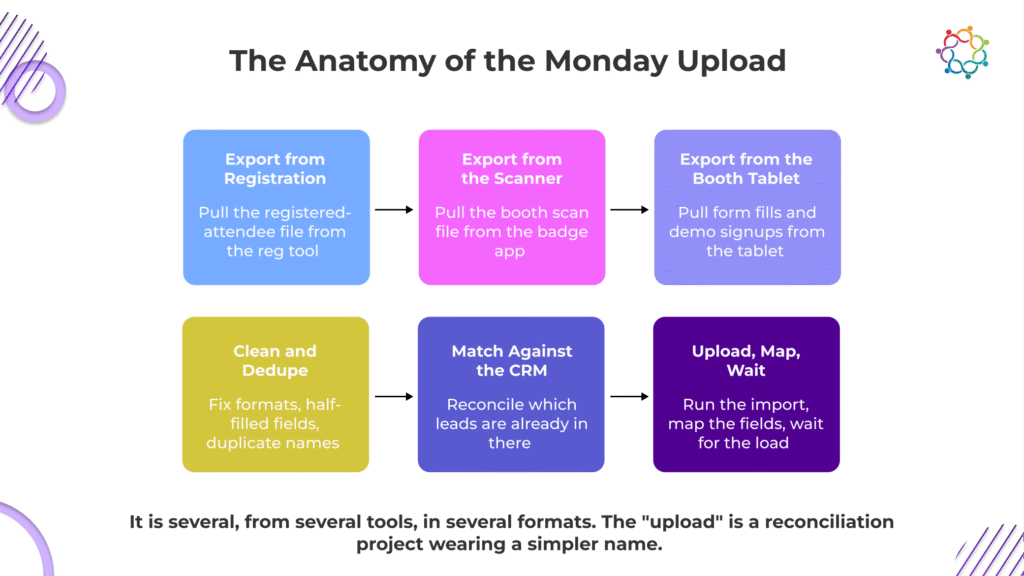
Watch the ritual closely and it has a shape. It runs in the same order every time, and only at the end of it can anyone in sales do something useful with a single lead.
The part that hides in plain sight is the number of files. The data comes out of several tools at once, in several formats, which makes the upload a reconciliation project wearing a simpler name. It eats a Monday morning, sometimes most of a day, sometimes a whole week as the last files trickle in. This is the manual layer, the human glue between the event and the systems, and it runs on a spreadsheet. So the question worth sitting with is why this still exists when almost nothing else does.

Performance marketing used to have its own version of this. A decade ago, the people running paid search and paid social moved a lot of data by hand too. They pulled reports, copied numbers between tools, and reconciled spend against results in spreadsheets of their own. The manual layer was everywhere.
Then the channel got an operating system. The ad platforms across search, social, and display became the thing that captured the click, tracked the conversion, and pushed the result into the CRM and the dashboard on their own. The pixel, the tag, the native integration: these did the carrying. The data moved because the platform owned the movement.
The performance marketer’s Monday upload simply vanished. No one exports a spreadsheet of clicks to key in by hand, because there is nothing left to export. The platform absorbed the work, and then the work was gone, a consequence of the new plumbing rather than a goal anyone chased. Speed and discipline had little to do with it.
That distinction matters for what follows. Performance marketing closed its manual layer in a structural way. The channel got a system that made the work pointless, and the hours came back as a side effect. The marketers were no more careful than they had been. The platform was simply doing the part a person used to do by hand.
So the real question is why does the same thing never happen to events?

The answer is structural, and it comes down to how event data is born.
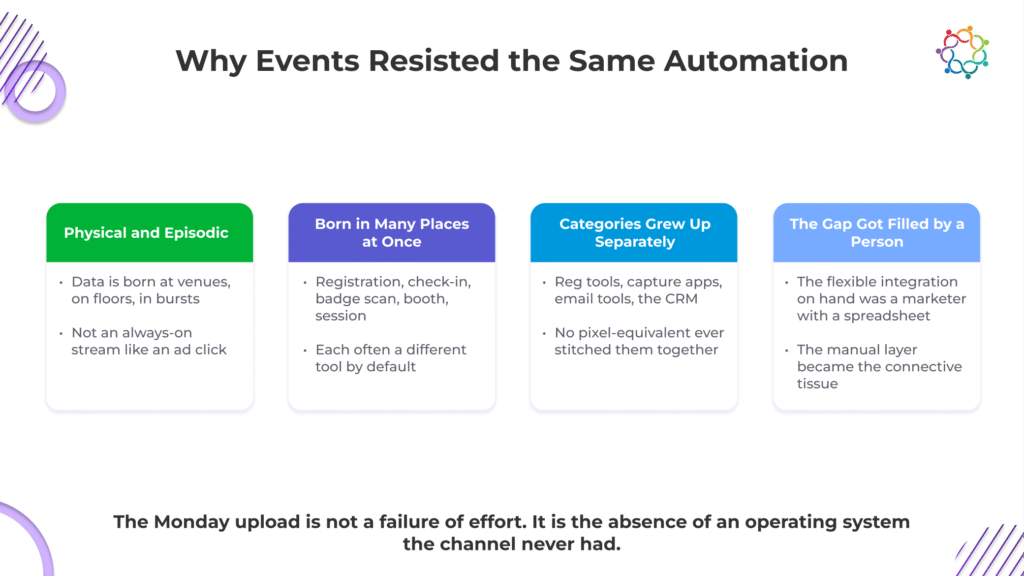
Ad data is an always-on stream. A click happens in a browser, inside a system that is already watching, so capturing it is the same motion as creating it. Event data behaves nothing like that. It is physical and episodic. It is born in bursts, at a venue, on a show floor, at a booth, in a room, and then the burst is over until the next event. There is no browser quietly recording the whole time.
It is also born in many places at once. Registration happens in one tool, check-in in another, badge scans in a third, booth capture in a fourth and session attendance somewhere else again. Each of those moments often lives in a different system, bought at a different time for a different reason. The data arrives scattered by default.
And no single platform ever grew up owning that whole flow. Registration tools, capture apps, email tools, and the CRM each evolved on their own track, so there was never a pixel-equivalent stitching them together. The connective tissue that performance marketing got for free from its platforms had to come from somewhere, and the only flexible integration on hand was a person with a spreadsheet.
That is the real diagnosis. The Monday upload is what the absence of an operating system looks like, the same absence performance marketing closed a decade ago. Effort was never the missing piece. Events are simply the last major channel where the marketer is still the integration, because nothing was ever built to be it.

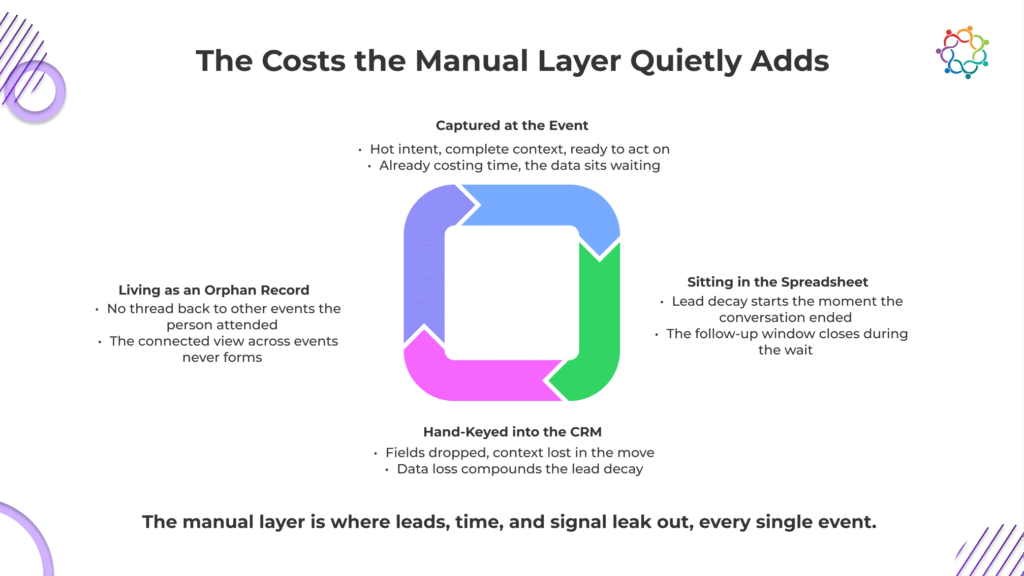
None of this would matter much if the manual layer were free. It is not. The cost shows up in four places, every event, whether or not anyone is counting.
Add it up and the manual layer is far more than a chore on the side. It is the seam where leads, time, and signal quietly leak out of the program, event after event. The full math of what that adds up to, the licenses, the lost hours, the leads that never get worked, lives in a dedicated cost breakdown worth reading on its own.

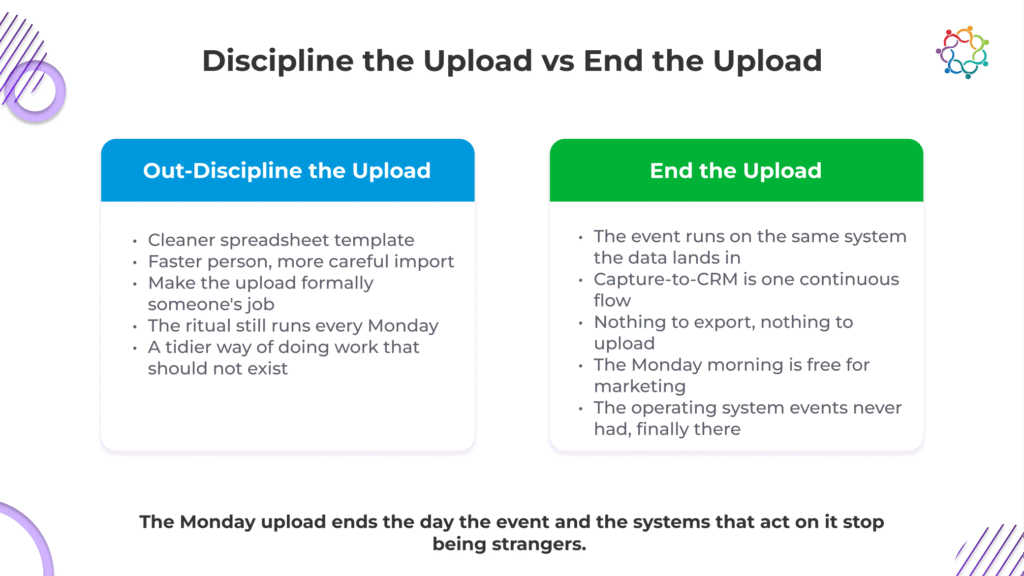
When the Monday upload hurts enough, the instinct is to get better at it. Build a cleaner spreadsheet template. Standardize the export formats. Assign it formally so it stops landing on whoever has a free morning. Run it faster next time.
Every one of those moves helps a little, and none of them touches the actual problem. The upload is a structural artifact of fragmentation. It exists because the data is born in five places and lands in a sixth with no system connecting them, and a tidier template does nothing about that. A faster, more careful person still does the work by hand, every event, because the operating system that would erase the work is still missing.
This is the trap. You cannot out-discipline a missing operating system. Every process fix is a neater way of performing work that should not have to exist, and the better you get at it, the more permanent it becomes, because now it runs smoothly enough to ignore.
Which points to a different question. The question worth asking is how to make the upload unnecessary, rather than how to run it better, and that is a matter of systems instead of effort. It is the line that separates a tidier Monday from a Monday with no upload in it at all.
The way out is simpler to describe than to build, and it starts from one idea: the upload disappears when there is nothing to upload.
That happens when the event runs on the same system the data needs to land in. When registration, check-in, on-site capture, and the connection into the CRM are one platform instead of five separate ones, the data never has to be moved on Monday because it is already where it needs to be the moment it is captured. The lead scanned at the booth on Thursday is in the system on Thursday, routed and ready, with no spreadsheet in between. That is the operating system events never had, and it is what event marketing automation actually requires: one connected flow rather than a faster way to move files between disconnected tools.
This is exactly the move performance marketing made. It removed the need for the manual work rather than getting better at performing it, and the Monday upload disappeared on its own. Events can take the same path. The capability has existed for a while. What has been missing is the decision to run the whole event on one system instead of assembling it from five.
The way out, then, is an operating system for event marketing, the connective tissue the channel skipped, and the broader picture of how field marketing runs once that tissue is in place sits in the B2B Field Marketing Playbook. The fix is structural, and the structure is finally within reach.
Strip away the detail and the picture is plain. The Monday upload survives because event marketing is the last major channel still running without an operating system, and the way to end it is to give events the connected flow performance marketing got a decade ago. The data stops needing a human courier the moment the event and the systems that act on it stop being strangers.
Every other channel stopped exporting spreadsheets years ago. Event marketing kept the ritual, and it kept it for a long time, because nothing was ever built to make it unnecessary. The Monday upload was never the sign of an undisciplined team. It was the last sign of a channel still waiting to be automated.
The platform that ends the Monday upload already exists. See what that looks like for your own events, at your volume.

Samaaro is an AI-powered event marketing platform that enables marketing teams to turn events into a measurable growth channel by planning, promoting, executing, and measuring their business impact.
Location


© 2026 — Samaaro. All Rights Reserved.