Samaaro + Your CRM: Zero Integration Fee for Annual Sign-Ups Until 30 June, 2025
- 00Days
- 00Hrs
- 00Min

Key Takeaways (TL;DR)
1
2
3
→
Bottom Line:
Buyers leave with something they wrote themselves and reference it later in an internal meeting.
A Discussion with Whiteboards Is Not a Workshop
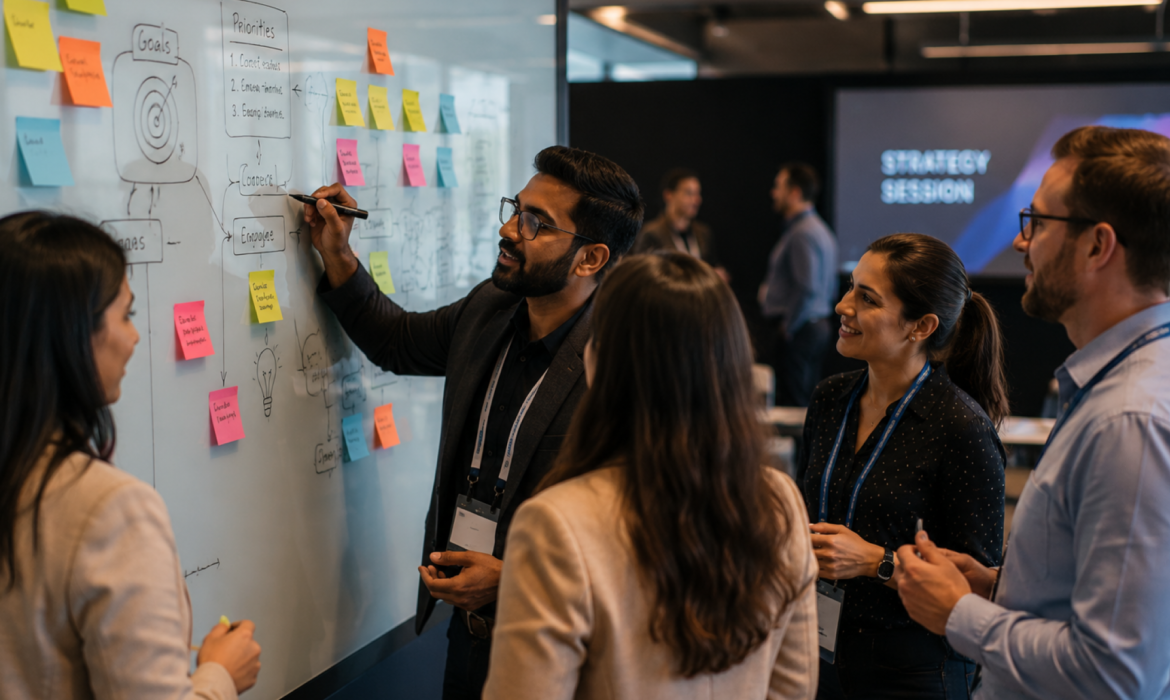
An account team books a strategy workshop with a target buyer. The deck has 24 slides. Two say “Discussion.” One has a whiteboard photo as the background. The buyer arrives expecting to work on something specific to their business. The session opens with a 40-minute company overview. By the time the first exercise lands, the buyer has stopped engaging. The host team logs the session as a workshop. What actually ran was a meeting with sticky notes nearby.
A closed-door workshop is a working session in which the host and a small group of buyers jointly produce an output relevant to the buyer’s business, within a fixed time block. The format is defined by what the room makes together, not by what the host presents.
This article covers what working-not-talking means, the agenda that makes a workshop work, when it beats a roundtable for account depth, and how the host has to behave.
The workshop differs from every other closed-door format on three operating principles. Hold them, and the format produces account intelligence that no conversation-led session can reach. Drop them, and the session reverts to a customer meeting with a longer calendar block.
The buyer is a contributor, not an audience. In every other closed-door format, the buyer’s job is to participate in conversation. In a workshop, the buyer’s job is to produce something. The buyer is drafting, mapping, prioritizing, sketching, or scoring. The posture is active. The output belongs to them and goes home with them, which is why their attention holds in a way it does not hold in a discussion-led format.
The host is an exercise designer, not an expert. The expert posture is the default failure mode of B2B workshops. The host who arrives with the answer produces no signal. The host who arrives with a structured question and helps the buyer answer it produces account intelligence that no other format generates. The host’s expertise lies in the design of the exercise, not the content of the answer.
The output is the agenda, not a follow-up. The session is built backward from a specific artifact that the buyer will walk out with. A prioritized list. A drafted plan. A scored matrix. A mapped flow. The artifact is the reason the format is justified, and the reason the buyer will reference the session in their next internal meeting. Without a named output, the format collapses into discussion regardless of how the room is staged.
A workshop is structured as three movements, not a long meeting agenda. Each has a specific job, and skipping any one breaks the format.
Movement 1: Problem framing (30 to 45 minutes). The opening establishes the specific problem the room will work on. Framing is not a company introduction or a market overview. It is a focused articulation of the question the buyer faces, validated by the buyer in the room before the work begins.
The framing must end with the buyer agreeing on the question. If the room cannot agree on the question, the work in the next movement is wasted. The host’s job is to ask, not to assert. The framing artifact is a single statement that the buyer signs off on.
Movement 2: Group work (60 to 90 minutes). The longest movement. The buyers do the work, in pairs or small clusters if more than four are in the room. The host moves between groups as a facilitator, not a participant.
The exercise is structured tightly. Open-ended exercises produce vague output and lose the room. Constrained exercises with clear instructions and a fixed time produce output that the buyer can defend back to their organization. The constraint is what makes the artifact useful.
This is also where the host learns the most about the account. How the buyers prioritize, what they argue about, where they hesitate, and which language they reach for are commercial signals the host cannot get from any conversation-led format.
Movement 3: Output and commitment (20 to 30 minutes). The closing consolidates the work into the named artifact and locks specific next steps. The buyer commits to what they will do with the output. The host commits to what they will return with.
A workshop that ends with thanks and a photo is a workshop that produced no commercial momentum. The closing commitment is the link between the session and the pipeline movement that justifies the format.
Three account scenarios justify the workshop’s higher design cost and on-day risk. Each is a case where account depth is the goal that no other closed-door format reaches.
A single account that needs to be understood, not engaged. The buyer is committed to a conversation, but the host does not yet understand the account well enough to position effectively. A roundtable produces relational warmth and surface insight. A workshop forces the buyer to articulate their priorities in their own language. The host walks out with a documented view of the buyer’s actual decision logic, which no amount of roundtable conversation produces.
A buying committee that needs to align internally. Multiple stakeholders inside one account hold different views, and the deal is blocked by their misalignment. A roundtable cannot resolve this because it is built on parallel peer conversations across companies. A workshop is exactly the format that can. The host facilitates the committee’s own internal alignment, with the deal as the indirect beneficiary. The artifact the committee produces is what they carry into their next internal meeting.
A strategic customer the host wants to convert into a co-creation partner. An existing customer with strong adoption is a candidate for expansion or for product collaboration. A roundtable treats them as a peer voice among others. A workshop treats them as a working partner on a question that matters to them. The shared output names a future joint initiative, which converts the customer relationship from transactional to programmatic.
Common trap: choosing the workshop because it sounds more substantial than a roundtable. The workshop costs more in design time and risks more on the day. The format is justified only when account depth is what the strategy actually needs.
Three facilitation disciplines determine whether the workshop produces. None can be improvised on the day. All three have to be in place before the calendar invite goes out.
Exercise design happens before the invite. The single most diagnostic question a workshop host can be asked is: What is the buyer going to produce in the second movement, and what does the template look like? A host who cannot answer this in one sentence and one printed page has not yet designed a workshop. They have booked a meeting.
The senior host is in the room and quiet. The buyer reads the host’s seniority as a signal that the session matters. The senior host’s silence during the working movement is what tells the buyer the session is for them. A senior host who narrates or jumps in to demonstrate expertise has converted the workshop back into a meeting. Presence is the contribution. Performance is the failure mode.
The output template is the host’s most important artifact. The blank template the buyers fill in carries more of the workshop’s design intelligence than the slides, the venue, or the catering. A poorly designed template produces vague output regardless of how senior the room is. A well-designed template produces commercially useful artifacts even when the day runs imperfectly. The template is where the format actually lives. A modern event marketing platform like Samaaro keeps the exercise template, the buyer-signed framing statement, and the closing commitments on the same account record, so the artifact survives the post-workshop handoff intact.
Frame the question. Work the question. Lock the output. The buyer leaves with something they wrote themselves, and three weeks later, refers to it in a meeting the host was never invited to. That’s the workshop. Everything shorter than that is a meeting with sticky notes nearby.
For the broader format category, see the What Are Closed-Door Events anchor page. For the comparison with conversation-led formats, see the Executive Roundtables and Customer Advisory Boards pieces in the cluster.