Samaaro + Your CRM: Zero Integration Fee for Annual Sign-Ups Until 30 June, 2025
- 00Days
- 00Hrs
- 00Min


Key Takeaways (TL;DR)
1
2
3
→
Bottom Line:
Without measuring NRR lift against a non-attending control cohort, a $1.5M conference is a beautiful expense, not an investment.
Your annual user conference cost $1.5M, took eight months to plan, and 2,400 customers and prospects flew in for two days. Three months later, your CRO asks what the conference achieved in terms of net revenue retention. The marketing team has session attendance data, NPS scores, and a beautiful post-event photo deck. Nobody can answer the question.
This is the position most B2B SaaS marketing leaders end up in by their second or third annual conference. The customers loved it. The product team got their launch moment. But the line connecting $1.5M to NRR, expansion, and renewal was never established, and the next budget review won’t go well.
User conference marketing is the largest customer marketing investment most B2B SaaS companies make in a year. It is also the most commonly mismeasured. This playbook covers the five marketing decisions that determine whether the conference moves renewal, expansion, and advocacy, or just produces good photos.
This article is the framework, end-to-end, plus a 16-week pre-conference marketing calendar your team can deploy for the next annual cycle.
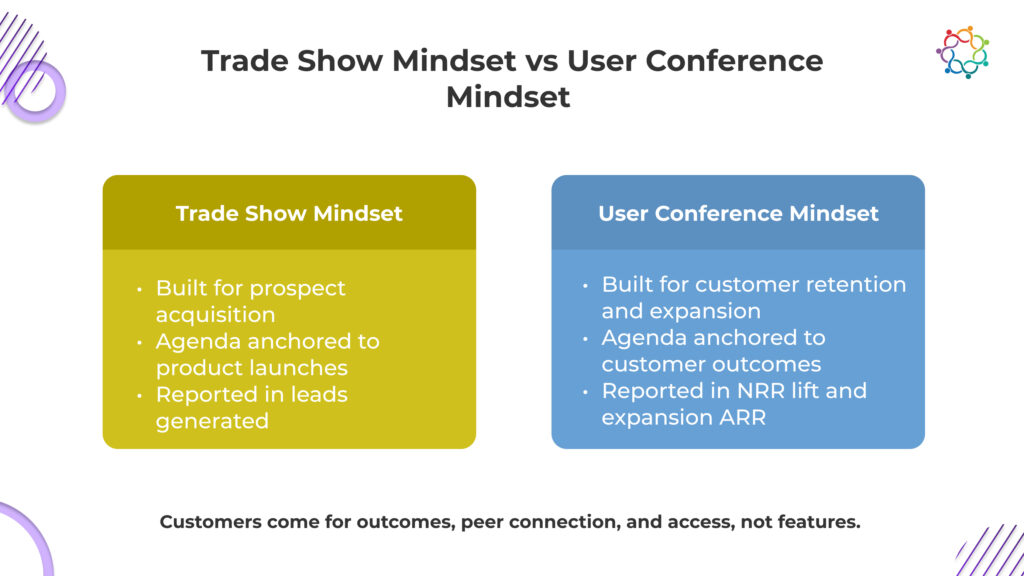
User conferences are not trade shows in larger ballrooms. The audience is different, the goals are different, and the post-event metrics that matter are different.
The audience reality.
In our experience, the large majority of attendees at a healthy B2B SaaS user conference are existing customers, typically in the 70 to 80 percent range, though the exact mix depends on the company’s stage and customer base. The remaining slots belong to high-fit prospects, partners, and advocates. The conference is a customer marketing event with a prospect overlay, not the other way around.
The success metrics that match that audience.
Net revenue retention lift on attending customers. Expansion pipeline opened during the conference. Advocacy program enrollments. Multi-product adoption inside the customer base. Net-new pipeline is a secondary metric, useful, but not the headline number.
The cross-functional truth.
Marketing leads. Customer success manages attendee health and outreach. Product owns the on-stage roadmap. Sales drives expansion conversations.
Common trap: running it like demand gen.
Marketing teams default to demand gen tactics because that is the muscle they know. The result is a prospect-heavy registration push, an agenda built around product launches, and post-conference reporting that talks about leads instead of renewals. The conference produces logos and lanyards, but does not move the customer base.
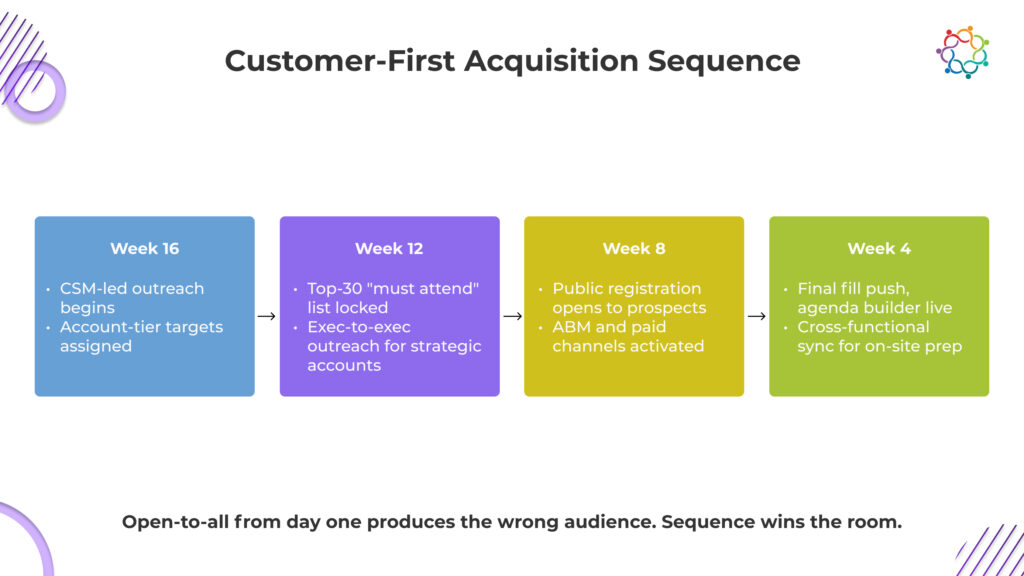
Acquisition order determines audience composition. Get the order wrong, and the conference fills with the wrong mix, regardless of marketing budget.
The customer-first acquisition stack.
Customer Success Managers drive registrations for their accounts, not marketing email blasts. Each CSM has a target attendance number for their book of business, tied to the account tier and renewal date. CS-led outreach starts 16 weeks out, before public registration opens.
Marketing equips CSMs with tools for effective outreach: personalized emails, account talking points, exec sponsor invites for strategic accounts, and real-time registration tracking. The conversation stays CSM-to-customer, not a marketing campaign.
Prospect acquisition runs in parallel.
Open registration to prospects 8 weeks out, after customer registration is established. Cap prospect attendance at a level that protects the customer experience. In our experience, somewhere in the 20 to 30 percent range works for most B2B SaaS conferences, though the right ceiling depends on how customer-marketing-led the conference intends to be.
Prospect acquisition channels: paid social against ICP-defined audiences, partner co-marketing, and direct sales invitations to ABM target accounts. Inbound paid traffic is the lowest priority.
The “must attend” list.
A pre-defined list of accounts that marketing and CS jointly commit to landing in the room. The list includes top 20 strategic accounts, expansion-ready accounts, at-risk renewals, and advocate champions. Personal exec-to-exec outreach goes to this list, not generic invites. The “must attend” list is the conference’s renewal-and-expansion engine.
Common trap: opening registration to everyone at the same time.
Open-to-all sequencing produces the wrong audience mix: heavy on prospects who paid for tickets, light on the strategic customer accounts who need a personal ask. A user conference filled mostly with prospects is a trade show with a customer logo on the badge. Customer-first sequencing is the only way to get the right room.
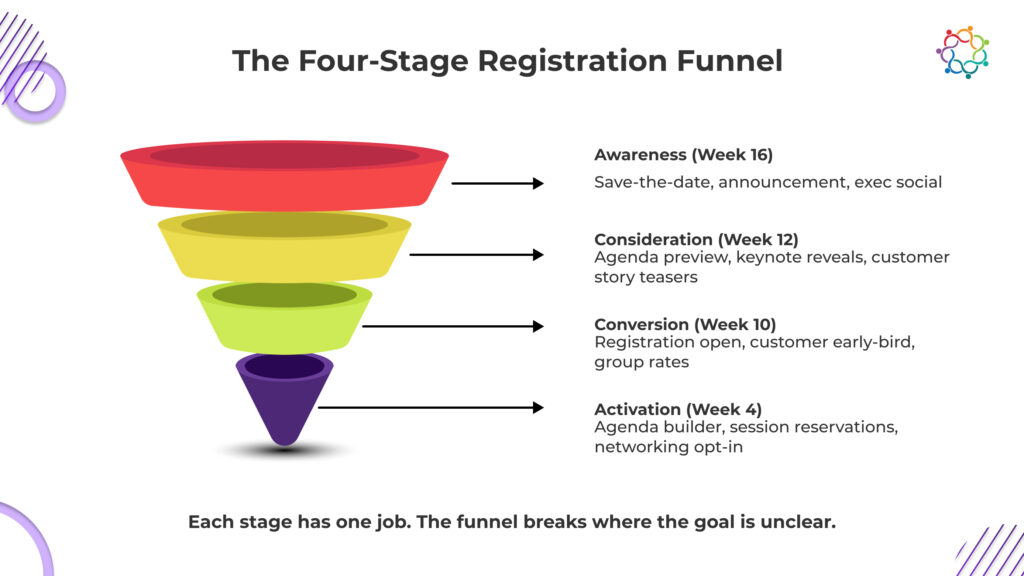
The registration funnel is where high-intent traffic either becomes high-attendance registration or drops out at a clunky form. Most teams under-engineer this stage and lose meaningful intent at the conversion step.
The funnel stages.
Form design that converts.
Two-step registration: minimum fields first (name, email, company), profile-deepening fields after confirmation. Customer accounts auto-detected by email domain, never asked: “Are you a customer?” Session pre-selection inside the registration flow tends to drive materially higher day-one attendance, in our experience.
The marketing calendar logic.
16 weeks of pre-conference marketing, not a 4-week sprint. Each touchpoint has one goal: register, build an agenda, confirm travel, and prep ahead. The marketing calendar syncs with CSM outreach windows so customers do not get the same message from two senders in the same week.
This is the operational layer Samaaro is built for: tiered registration workflows, two-step forms, native CRM sync for auto-detected customer accounts, and a marketing calendar that runs without the team manually reconciling sends across CS, marketing, and sales.
Common trap: building the form for marketing’s data needs.
A 14-field registration form noticeably depresses completion and produces a database your CRM team will spend a week cleaning. Capture the minimum at registration. Deepen the profile post-confirmation. The form’s job is enrollment, not data warehousing.
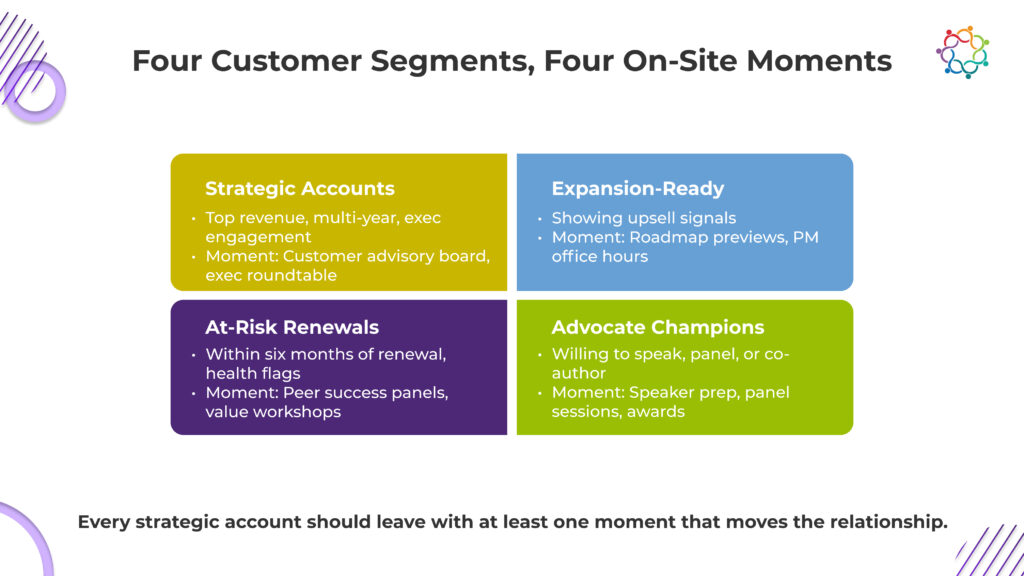
Segmentation determines the relevance of every email, every track, every on-site experience. A single “all customers” email path fails the strategic account attending with three team members and the at-risk renewal attending alone, simultaneously.
The four customer segments.
The two prospect segments.
What changes per segment?
Pre-conference emails. Messaging, exec sender, and agenda recommendations are all tailored to the segment. The strategic account gets a personal note from the AE’s executive sponsor. The inbound prospect gets the marketing nurture cadence.
On-site assignments. Dedicated CSM time for strategic accounts, exec dinners for top-20, executive briefings for ABM targets, peer cohort sessions for at-risk renewals.
Session paths. Roadmap deep-dives for expansion-ready, peer success panels for at-risk renewals, vision keynotes for strategic accounts, product overview tracks for ABM prospects.
Follow-up sequences. Each is tied to the conversation that should have happened at the conference. Strategic accounts get an exec recap. Expansion-ready accounts get a roadmap follow-up. At-risk renewals get a CS-led check-in. Advocates get a thank-you and an advocacy ask.
Common trap: customer and prospect as the only two segments.
A single “all customers” email track treats a $5M strategic account the same as a $40K at-risk renewal. Both attend the same conference. Neither needs the same email. Segmentation depth determines on-site impact, and on-site impact determines NRR lift.
On-site is where the conference produces revenue impact or does not. The decisions made in the four months before doors open determine what every attendee actually experiences, segment by segment.
The agenda-by-segment principle.
The same general session opens the conference. The afternoon tracks are where the segmentation actually lands.
The “moments that move accounts” framework.
Every strategic account should leave with at least one specific moment that moves the relationship forward. A meeting with the CEO. A roadmap commitment from the product. An advocacy invitation. A specific problem solved by the CS team. These moments are pre-engineered for the top 30 accounts, not left to chance, and the engineering work happens in the last 48 hours before doors open.
CSMs and AEs receive a per-account briefing 2 days out: who is attending, what conversation needs to happen, who from the executive bench needs to be in that conversation, and what the next-step commitment should look like.
The on-site capture infrastructure.
Session attendance is tracked at the door scan and tied directly to the attendee’s CRM record. One-to-one meetings logged in the CRM with a conversation summary and next step. Real-time alerts to CSMs when a flagged account does or does not attend their assigned session.
Common trap: product marketing dominates the agenda.
A user conference agenda built around the product team’s release schedule produces a great launch moment but a forgettable customer experience. Customers come for outcomes, peer connection, and access to the people who build the product. Features are the means. Outcomes are the message.
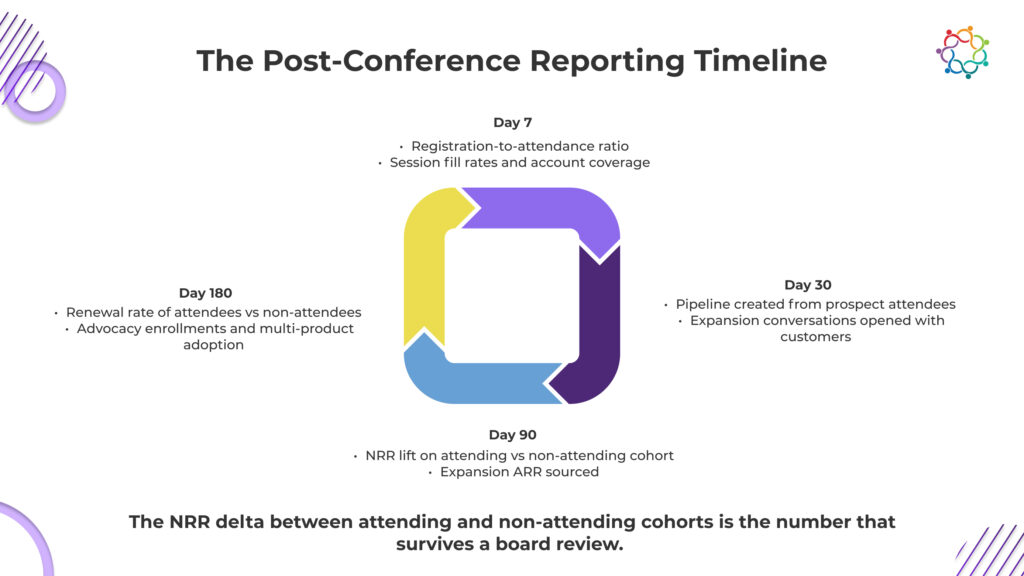
Post-conference reporting is where the $1.5M either becomes a defensible investment or stays a beautiful expense. The reporting framework runs across four cadences, each with a specific question to answer.
The reporting framework.
The cohort comparison.
Compare conference attendees to a control cohort of similar customers who did not attend. The NRR delta between cohorts is the cleanest defensible metric for conference impact and the single number that survives a board-level budget review.
The CMO-to-board summary.
One slide. Four numbers: attendance, NRR lift, expansion ARR, and advocacy program enrollments. A year-over-year trend if it is a recurring conference. A verdict line at the bottom: did the conference produce a return that justifies running it again or restructuring it?
Common trap: NPS and satisfaction as the headline metrics.
NPS, session ratings, and satisfaction scores are diagnostic. Useful for next year’s planning. Irrelevant for budget defense. The metrics that defend the conference are renewal rate, expansion ARR, and advocacy enrollments, measured against a control cohort of non-attendees. Diagnostic metrics belong in the appendix, not in the headline.
User conference marketing is a system. Customer-first acquisition. A segmented registration funnel. Segmented on-site experience. Reporting tied to renewal, expansion, and advocacy. The user conference is the one moment in the year when your customers gather under your roof. Do not waste it as a trade show in disguise.
Everything above, expanded into the full 12-page User Conference Marketing Playbook, including the 16-week pre-conference marketing calendar your team can deploy for the next annual conference.