Samaaro + Your CRM: Zero Integration Fee for Annual Sign-Ups Until 30 June, 2025
- 00Days
- 00Hrs
- 00Min


Key Takeaways (TL;DR)
1
2
3
→
Bottom Line:
A DevCon planned with user-conference muscle produces a vendor expo that developers walk out of and write Hacker News posts about.
Your CMO just approved $1.4M for the company’s first developer conference. The events team is briefing the agency: 1,500 attendees, two-day program, opening keynote, customer success panel, exec fireside, partner booths, closing networking gala. The plan looks like every B2B user conference you’ve ever attended, and it is the plan that will produce a half-empty room of polite developers writing one-star Hacker News posts about why your DevCon felt like a vendor pitch.
Developer conference planning looks superficially similar to user conference planning and operates on entirely different rules. Audience expectations, stage rules, sponsorship mechanics, and success metrics each diverge. This guide walks every decision side-by-side, what works at a business conference, what works at a DevCon, and why the two playbooks do not translate.
The framework runs across six decisions: audience expectations, stage time, content depth, sponsorship mechanics, content team, and metrics.
Most DevCons fail because the planning team applies user-conference muscle to a developer audience. The structural shift has to come first.
The mental-model shift.
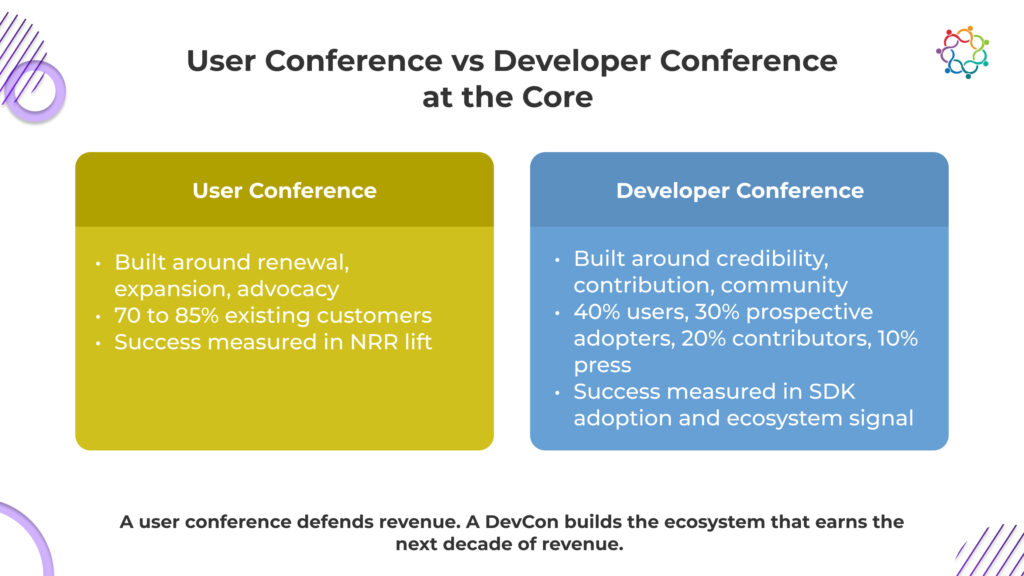
A user conference is a customer marketing event built around renewal, expansion, and advocacy. A developer conference is a trust-and-adoption event built around credibility, contribution, and community. These are not the same business problem.
The audience-mix difference.
At a user conference, the large majority of attendees are existing customers, typically 70 to 85 percent. At a DevCon, the desired mix is more like 40 percent existing users, 30 percent prospective adopters, 20 percent community contributors and partners, and 10 percent press and analysts.
The success definition.
A great user conference moves NRR. A great DevCon moves SDK adoption, GitHub stars, community contributors, integration partners, and inbound application volume.
The implication.
Every planning decision, from agenda to stage to sponsorship to production, is a referendum on whether the event respects the audience or pretends to.
Common trap: hiring an agency that has built 50 user conferences.
The default user-conference agency playbook produces a DevCon that looks like a vendor expo, plays like a marketing pitch, and reads like a credibility loss in the developer community.
Developers walk into a DevCon expecting evidence that the company understands them. Every agenda decision, every speaker selection, every booth setup is a signal. The signals add up fast, and the audience reads them in the first hour.
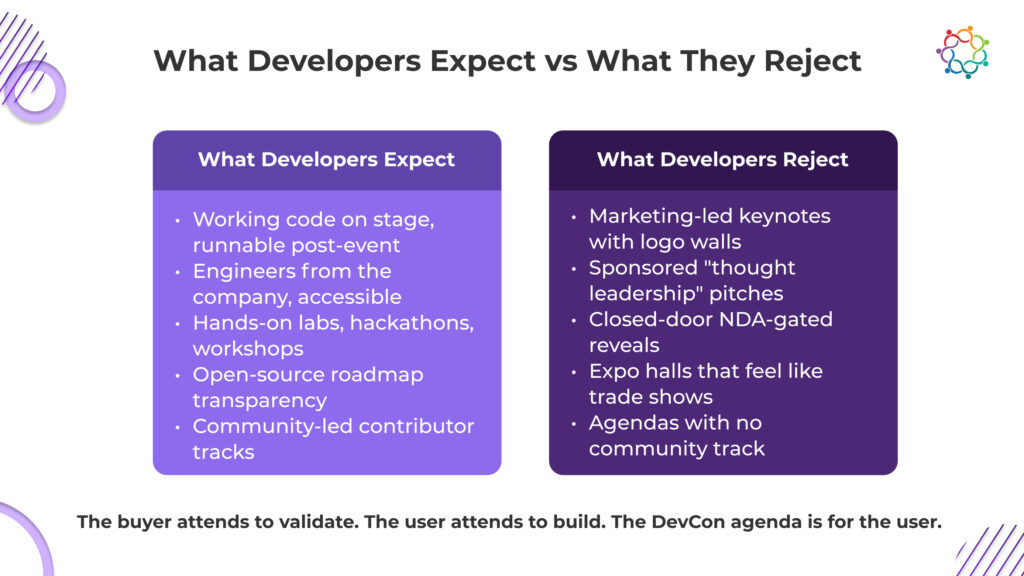
What developers expect at a DevCon.
What developers reject at a DevCon.
The same list, in two directions, decides whether the conference earns the room. Half the audience comes in skeptical. The other half comes in hopeful. Both groups read the agenda the same way.
Common trap: designing for the buyer instead of the user.
Most DevCon agendas get designed for the buyer of the product, the CTO or VP Engineering who signs the contract, instead of the user, the engineer who actually writes code with the tool. The buyer attends to validate. The user attends to build. The DevCon agenda is for the user. Buyers can attend the sessions designed for users without losing anything. But designing the agenda for buyers loses the user audience entirely, and the user audience is the one whose word of mouth determines whether next year’s conference happens at all.
Stage decisions decide the conference. The wrong opening keynote burns the audience’s credibility before lunch on day one, and no afternoon recovery saves it.
The opening keynote rule.
At a user conference, the CEO or CMO opens. They set the year’s vision and narrate the business momentum. At a developer conference, the CTO, the founding engineer, or the head of product engineering opens with a working demo of the most interesting technical thing the team shipped this year. Vision is welcome. Slides about ARR are not.
The speaker portfolio.
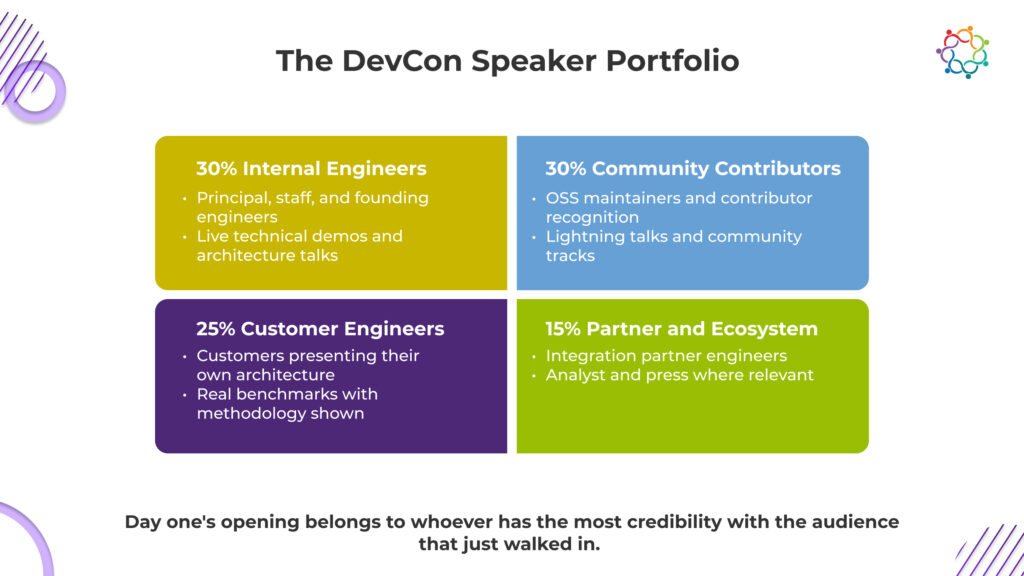
At a user conference, the rough mix is 60 percent internal speakers (product, customer success, marketing), 30 percent customer panels, and 10 percent analysts and partners. At a developer conference, the mix shifts to 30 percent internal engineers, 30 percent community contributors and open-source maintainers, 25 percent customer engineers presenting their own architecture, and 15 percent partner engineers and ecosystem voices. Outside voices outnumber internal ones at a DevCon. That is the design, not a compromise.
Session formats that work at a DevCon.
Session formats that empty the room.
Common trap: the CEO in the opening keynote slot.
The CEO gives the closing remarks at the community celebration on day two. The opening of day one belongs to whoever has the most credibility with the audience that just walked in. At a DevCon, that is almost always not the CEO. The user-conference default is the canonical mistake.
Surface-level content at a DevCon is a credibility tax that compounds across every subsequent year. Once a community decides a vendor’s content is shallow, every future session has to outperform that label.
The depth standard.
At a user conference, session content gets pitched to the buyer: outcomes, ROI stories, and before-and-after metrics. Surface-level technical references are fine, sometimes preferred. At a developer conference, session content runs deep. Architecture diagrams, code that compiles, benchmarks with methodology shown, and postmortems of what broke and how it was fixed. Surface-level content is the failure mode, not the safety mode.
The honesty standard.
Talks that show what did not work earn more credibility than talks that present polished success. Open admission of tradeoffs: “This works well at scale X, here is why it breaks at scale Y.” Public benchmarks with the methodology shown, never claim without numbers. Roadmap honesty: what is shipping, what is behind schedule, what has been deprioritized. The community reads roadmap evasion faster than it reads roadmap accuracy.
The reproducibility standard.
Every code-forward talk publishes its repo or gist within twenty-four hours of the session. Workshops have working starter repos and end states available before, during, and after the session. Architecture deep-dives include enough detail that a competent engineer in the room could reproduce the approach on the flight home.
Common trap: marketing review for messaging consistency.
A talk that has been sanitized for marketing-approved language has lost the technical authenticity that earned it stage time. The review path for DevCon content is engineering-led. Marketing review is a credibility leak, not a brand check. The brand benefits from technical accuracy. It does not benefit from the polished consistency that the audience reads as marketing-curated.
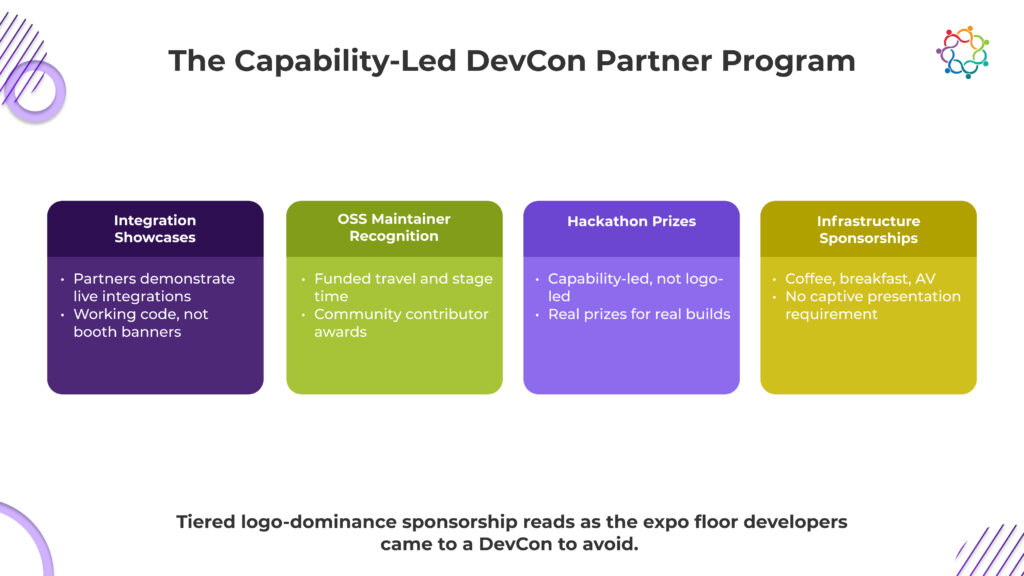
Most DevCons either over-monetize sponsorships and turn the conference into a vendor expo, or under-leverage the partner ecosystem entirely. The middle ground is partner-led, not sponsor-led.
The sponsorship structure.
At a user conference, tiered sponsorship packages, expo halls, sponsor sessions, and lanyard sponsors all generate meaningful revenue. Aggressive monetization is acceptable. At a developer conference, the touch is lighter. Partner booths qualify only if partners contribute working integrations or open-source tooling. Sponsor sessions qualify only if the slot is technical and chosen by the program committee, not bought.
The partner ecosystem mechanic.
The right partner program for a DevCon centers on integration showcases, not logo placements. Live integration areas where partners demonstrate working integrations with your platform. Funded travel and stage time for open-source maintainers in a community contributor track. Hackathon prize sponsorship rather than logo-driven sponsorship. Coffee, breakfast, and infrastructure sponsorships rather than session-buy sponsorships. The pattern is partner-led ecosystem value, not sponsor-led commercial revenue.
The pricing logic.
DevCon sponsorships generate less revenue than user-conference sponsorships per partner. Accept this. The right partner mix produces ecosystem credibility that drives platform adoption, and the indirect ROI is far higher than the sponsorship revenue. Avoid the temptation to pad the budget with sponsor revenue. The credibility cost is higher than the revenue gain every time.
Common trap: tiered “Diamond / Platinum / Gold” packages with logo-dominance benefits.
The developer audience reads tier-based logo placement as expo-floor commercialism, the exact thing they came to a DevCon to avoid. A flat, capability-led partner program produces more ecosystem value than a tiered sponsorship grid. A booth with a working integration is worth more than a logo on the lanyard.
Most DevCon failures trace back to who is running the program. The team that makes a great user conference does not automatically make a great DevCon. The skills overlap is smaller than it looks.
The team composition.
At a user conference, the events team leads are supported by marketing program managers, customer marketing, and product marketing. Session content gets reviewed for messaging consistency. At a developer conference, the events team is joined by DevRel leadership, an engineering program manager, and a technical content team. Session content gets reviewed by engineers for accuracy. The shift in the reviewer is the shift that determines whether the content earns the room.
The production team specs.
Technical video producers who understand multi-camera capture for live coding. Audio engineers who can isolate keyboard sounds from speaker audio cleanly. Live captioning producers for accessibility, which is table stakes at modern DevCons. An engineering team member is available for AV troubleshooting during live coding sessions, because demos break and the AV team cannot debug them alone.
The content review path.
The program committee includes at least 50 percent technical members: DevRel, principal engineers, and open-source maintainers. Talk submissions get reviewed for technical depth and accuracy, not for messaging fit. Marketing input stays limited to logistics, distribution, and post-event content. Marketing does not review what is said on stage.
Common trap: same team, same agency, same vendors.
Running DevCon planning out of the same events team that runs the user conference, with the same agency and the same production vendors, produces a DevCon that is a user-conference clone with a developer audience nameplate. The team has to be different because the rules are different. Inherited muscle memory is the failure mode.
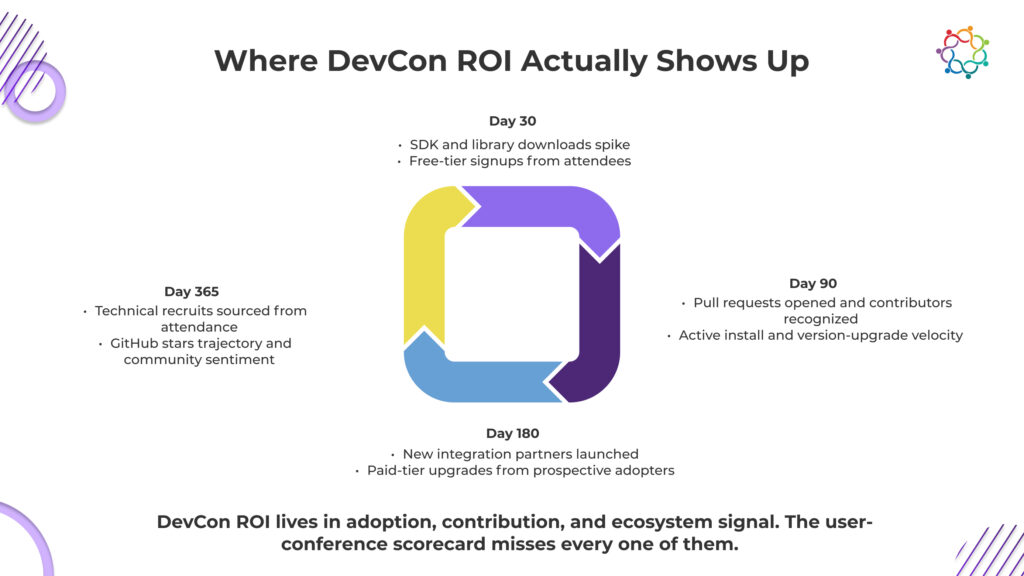
DevCon ROI is real, but it does not show up in standard event metrics. The CFO defense for a DevCon requires a different scorecard from the one used for the user conference, and the team that prepares the wrong scorecard loses the next budget cycle.
The metrics that don’t translate.
At a user conference, the headline metrics are registration count, session attendance, NPS, pipeline created, and NRR lift on the attending customer cohort. At a developer conference, registration and attendance still matter, but NPS is a poor proxy for value, and pipeline-created is the wrong primary metric. The cohort behavior the DevCon needs to drive is adoption, not procurement.
The DevCon-specific metrics that do matter.
The commercial layer.
Pipeline created from prospective adopter attendees still matters, but the volume is smaller than at a user conference, and the cycle to revenue is longer. Expansion revenue from existing customer attendees flows from adoption depth, not from relationship moments. Hiring impact is often the highest-ROI metric for early-stage DevTools companies, where technical recruits sourced from conference attendance routinely justify the program on their own.
Common trap: reporting DevCon results in user-conference metrics.
A CFO who sees “lower NPS, fewer registrations, less pipeline created” without the developer-specific metrics will conclude the DevCon underperformed. The reporting framework has to surface SDK adoption, contributor activity, and ecosystem signal. That is where DevCon ROI actually lives, and that is where the budget defense gets won.
Every DevCon decision is a credibility test. Audience-led agenda. Engineer-opened keynote. Technical content with no marketing review. Partner-led sponsorship. Dev-fluent production team. Ecosystem-led metrics. The B2B tech companies whose DevCons developers attend year after year aren’t the ones with the biggest budgets. They’re the ones whose conference still feels like it was planned by engineers, even after the company hit a billion in revenue.
If your team is planning a first-time DevCon and the budget conversation still treats it as a variant of the user conference, the gap usually sits in the metrics framework. Samaaro is built for the reporting layer that closes it.