Samaaro + Your CRM: Zero Integration Fee for Annual Sign-Ups Until 30 June, 2025
- 00Days
- 00Hrs
- 00Min


Key Takeaways (TL;DR)
1
2
3
→
Bottom Line:
InsurTech marketing wins on continuity across eighteen months, not on lead velocity across ninety days.
You met the Head of Innovation at a Top-20 carrier at ITC Vegas. Three demos, two pilot conversations, and an architecture review later, the deal is sitting in security review at the carrier’s IT council. Eighteen months have passed. Your CRO wants a forecast update. Marketing’s last touch was nine months ago because nobody knew what to send.
This is what InsurTech event marketing looks like under the surface. The flagship event got sponsored. The demos got run. The conversations were real. But the deal went quiet, the CRM auto-closed it at month seven, and nobody noticed when the carrier’s committee finally aligned in month fifteen.
InsurTech sales cycles run long because insurance buying is risk-averse, committee-driven, and regulator-watched. Marketing’s job in this environment is not to drive faster conversion. It is to stay visible, credible, and in-context across a window where the buyer disappears for stretches at a time. That requires a fundamentally different event strategy.
This is that strategy: five parts built around carrier buying reality, applied across the event portfolio, targeting, content, nurture, and pipeline instrumentation.
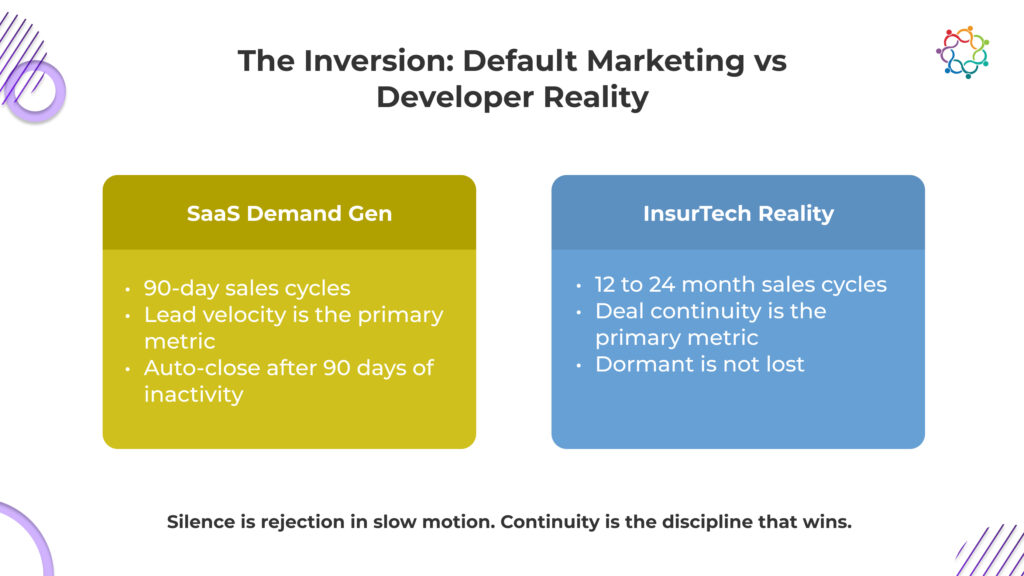
Most InsurTech marketing programs fail because they apply SaaS demand gen muscle to a buying environment that operates on insurance time.
The structural reality.
Carrier buying typically involves six to nine stakeholders across underwriting, claims, IT, security, risk, procurement, and legal. Any single stakeholder can stall the deal for ninety days without rejecting it.
The cycle reality.
Carrier sales cycles consistently run a year or more from the first qualified conversation to a signed contract. Eighteen months is the working assumption across the InsurTech operator community and the figure on which this guide is built. Core systems and underwriting tools commonly stretch to twenty-four months or longer. Bolt-on point solutions, conversational AI, and claims automation fall on the shorter end of the range.
The implication.
Marketing’s primary metric is not lead velocity. It is deal continuity across the long dormant stretches when sales have nothing to push.
The cultural reality.
Insurance is a relationship business, not a product business. Events are the relationship infrastructure that holds long-cycle deals together when nothing else is happening.
Common trap: applying SaaS lead-stage models to InsurTech pipeline.
A deal that has been dormant for six months gets auto-marked “Closed Lost” by a CRM rule designed for 90-day cycles. Sales gives up. Marketing never re-engages. The deal that would have closed in month fourteen dies in month seven of internal neglect.
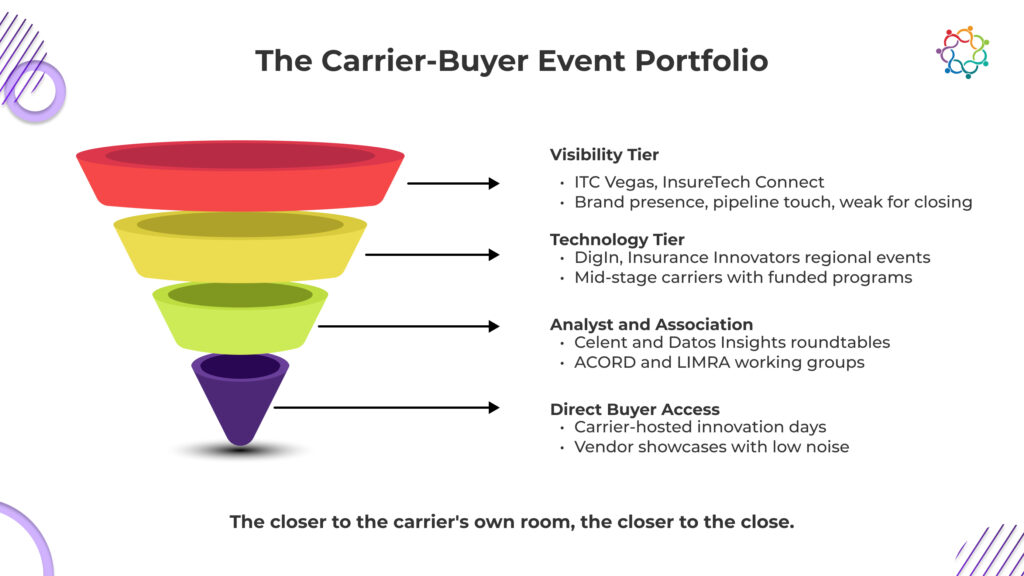
The default InsurTech event budget allocation is overweight on ITC Vegas. The default is almost always wrong. ITC is a brand presence and pipeline-touch event, not a closing event, and the budget redeployment is one of the highest-leverage decisions an InsurTech CMO can make.
The major industry events and what each is actually for.
The under-leveraged event categories.
The portfolio principle.
A portfolio that produces an eighteen-month pipeline movement leans toward an even split: meaningfully reduced spend at the flagship show, redeployed across analyst-led roundtables, carrier innovation days, and association events. The right split varies by ACV, ICP segment (Tier 1 carriers, MGAs, greenfield insurers), and current pipeline composition. The principle matters more than the precise percentage.
Common trap: defaulting the budget to ITC.
The reason ITC dominates the budget is institutional comfort, not pipeline math. Reallocating budget to smaller, higher-trust events is the conversation that builds an eighteen-month pipeline. ITC stays in the portfolio. It just stops eating it.
With eighteen-month cycles and committee-based buying, targeting individual leads is the wrong unit. The unit is the account, mapped at the committee level, and maintained across the full cycle.
Building the carrier target list.
Maintain the list across eighteen months, not ninety days. Accounts move between tiers as priorities shift, new leadership arrives, and modernization budgets are approved or paused.
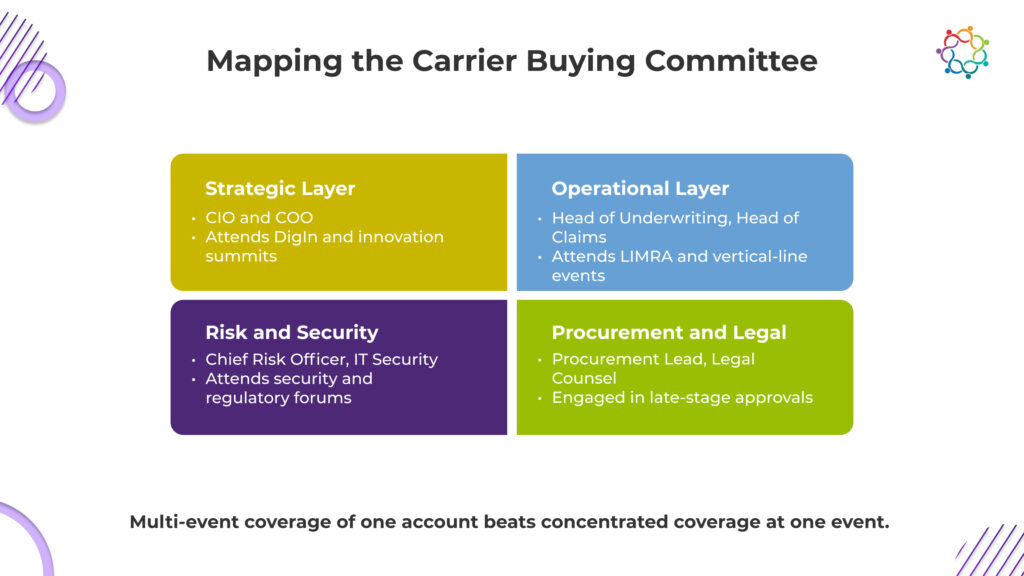
Mapping the carrier buying committee.
The named committee per account typically includes the CIO, the COO, the Head of Underwriting, the Head of Claims, the Chief Risk Officer, IT Security, the Procurement Lead, and sometimes the CEO. Each role attends different events. The CIO at DigIn. The underwriting lead at LIMRA. The innovation lead at ITC.
Multi-event coverage of the same account across twelve months is meaningfully more effective than concentrated coverage at one event. A Top-20 carrier deal is rarely closed because the CIO loved the demo. It closes because the COO, the Head of Underwriting, and IT Security all encountered the vendor across multiple touchpoints over a year.
The pre-event account brief.
For every Tier 1 account attending a target event, prepare a one-page brief: current relationship state, last meaningful touch, dormant deal status, committee members attending the event, and the conversation goal for this event.
Distribute the brief to the AE, the marketing lead, and the exec sponsor seventy-two hours before the event. This single document prevents the “we met them last year, what’s the status?” failure mode that quietly destroys the long-cycle pipeline.
Common trap: targeting individual leads instead of mapping the committee.
A great conversation with the CIO that does not loop in the COO and the Head of Underwriting moves a deal nowhere. Insurance buying is consensus-driven. One champion alone is rarely enough.
Carriers consume content differently from SaaS buyers, and most generic InsurTech content fails on contact. The content that moves a carrier through the cycle is content that respects the legacy reality, the regulatory weight, and the committee nature of the decision.
The content hierarchy that works for insurance buyers.
The content that does not move carriers.
“Top 5 InsurTech trends” articles. Generic AI-in-insurance ebooks. Webinars hosted by marketing leaders pitching the platform. Anything that ignores legacy systems, regulatory constraints, or the actual carrier-side workflow. Each of these reads as written by someone who has never sat through a carrier IT council meeting.
The content-event flywheel for long cycles.
Pre-event (sixty days out): peer case study published and distributed to target accounts. Event week: live deployment story or carrier customer panel. Let the customer tell the story. The vendor’s job is to set up the conversation, not to deliver it.
Post-event (across twelve months): regulatory update content, new analyst recognition, integration milestones. The drumbeat that keeps the account warm during the dormant stretch.
Common trap: ignoring the legacy reality.
A piece of content that does not acknowledge Guidewire, Duck Creek, or the carrier’s existing tech stack reads as if the vendor does not understand insurance. That is the fastest way to lose credibility with an IT buyer or a COO.
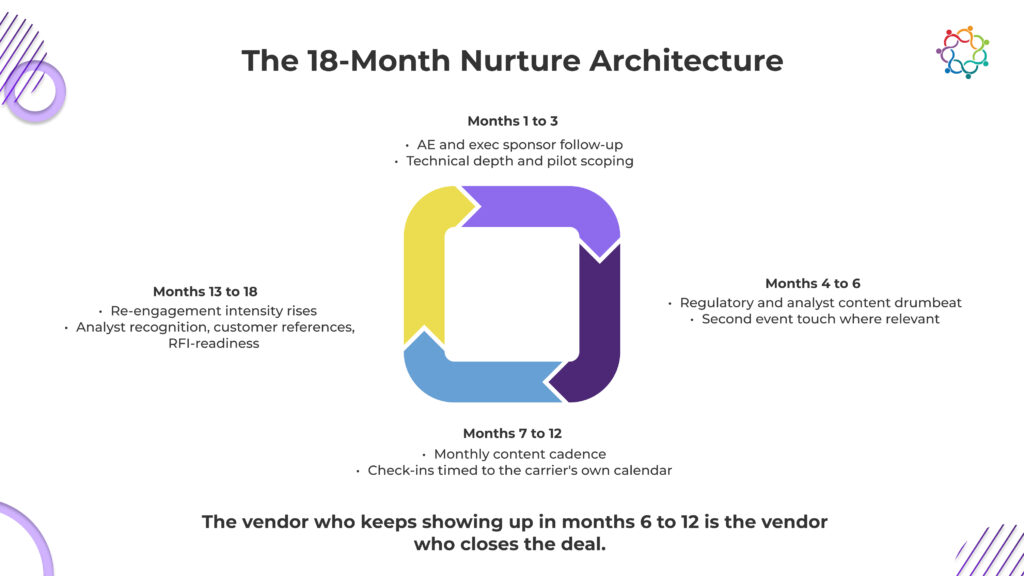
The eighteen-month nurture is the discipline that separates InsurTech vendors with healthy pipelines from those with hibernating ones. Most teams build a strong first ninety days and a strong final ninety days. The middle nine months go quiet. The middle is where the deal is actually won or lost.
The eighteen-month nurture architecture.
The “stay visible” principle.
In our experience working with InsurTech vendors against long carrier cycles, the strongest predictor of deal closure is not the intensity of the early or late push. It is whether the vendor stayed visible through months six to twelve, the dormant middle stretch where most teams disappear.
Carriers consistently report buying from vendors who showed up across the cycle, not the vendors who pushed hardest in the final ninety days. The middle-of-cycle nurture is the discipline that wins the deal.
The exec sponsor cadence.
Exec-to-exec touch every ninety days during dormancy. A single email. No demo ask. A relevant industry observation or a customer milestone. The exec name on the inbox is what gets the email opened during quiet stretches. AE names get filtered.
Common trap: stopping marketing touches when a deal goes dormant.
The instinct is to stop bothering the carrier while they figure it out internally. The reality is that the vendor who keeps showing up, without pressure and with relevance, is the vendor who stays in the consideration set when internal alignment is finally reached. Silence is rejection in slow motion.
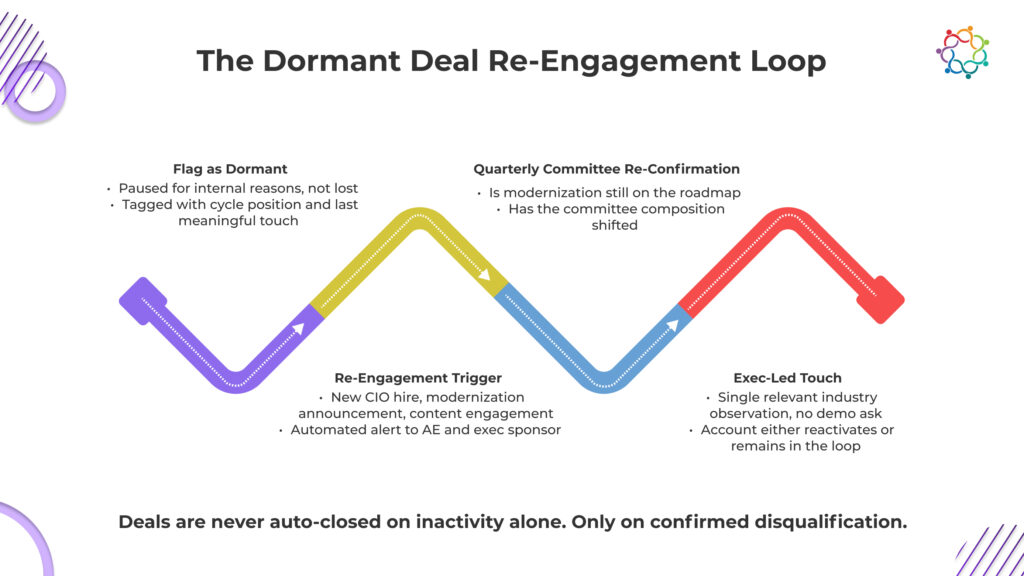
A long-cycle pipeline is invisible to standard SaaS tooling. The deals that will close in month fourteen are mismeasured at month six, and the standard CRM workflow quietly buries them. The fix is operational.
The CRM custom field set for InsurTech.
The reporting framework that survives a long-cycle review.
Pipeline aging report by cycle position, not by stage age. Account-level engagement view across every touch: events, emails, content downloads, meetings. Automated alerts when a dormant account engages with content, hires a new CIO, or announces a modernization initiative. The re-engagement triggers are what tell sales when to wake a deal back up.
This is the operational layer Samaaro is built for: account-level engagement tracking across long carrier cycles, native CRM sync, and reporting that does not lose dormant deals to standard inactivity rules.
The forecast logic.
Pipeline probability tied to cycle position and committee coverage, not to standard SaaS stage probabilities. Quarterly committee re-confirmation: is the account still pursuing modernization, has the committee changed, has internal priority shifted? Deals are never auto-closed based on inactivity duration alone, only on confirmed disqualification.
Common trap: standard CRM hygiene closing out InsurTech deals.
A nine-month dormant account in a SaaS-tuned CRM gets auto-marked “Closed Lost” and falls out of every report. In InsurTech, that is the account that closes in month fourteen, but only if marketing was still nurturing it during the dormant stretch the CRM had given up on.
InsurTech marketing’s job is not to compress the cycle. It is to keep the deal alive across eighteen months of dormant stretches. A portfolio built for carrier buyers. Account-level targeting. Carrier-relevant content.
Exec-led nurture across the dormant middle. Pipeline instrumentation that doesn’t auto-close hibernating deals. The InsurTech vendors who win Top-20 carrier deals aren’t the loudest at ITC. They’re the ones who were still showing up in month eleven, when everyone else had moved on.
If your team is running ITC, DigIn, and four analyst roundtables a year, and the reporting cannot tell you which carrier conversations are dormant versus genuinely lost, the gap sits in the long-cycle attribution layer. Samaaro is built for the reporting layer that closes it.