Samaaro + Your CRM: Zero Integration Fee for Annual Sign-Ups Until 30 June, 2025
- 00Days
- 00Hrs
- 00Min

In the past, event success was basically based on foot traffic, registrations and social chatter. Fast forward to 2026, marketing leaders are no longer tasked with just building awareness, they need to show revenue impact, which means you will need to connect event marketing KPIs to commercial metrics.
Modern event strategies require more than a great creative and full house. Smarter data is needed, not just after the fact, but while the event is happening. The point is not to just tabulate who was there, but what they did, and more importantly, how they moved along the funnel. This is the point where you should stop talking vanity metrics and use event performance metrics that enable better strategic decisions, better targeting, and ultimately, better ROI.
With 2026 fast approaching, if you will be planning or measuring events consider these 7 KPIs that truly matter:
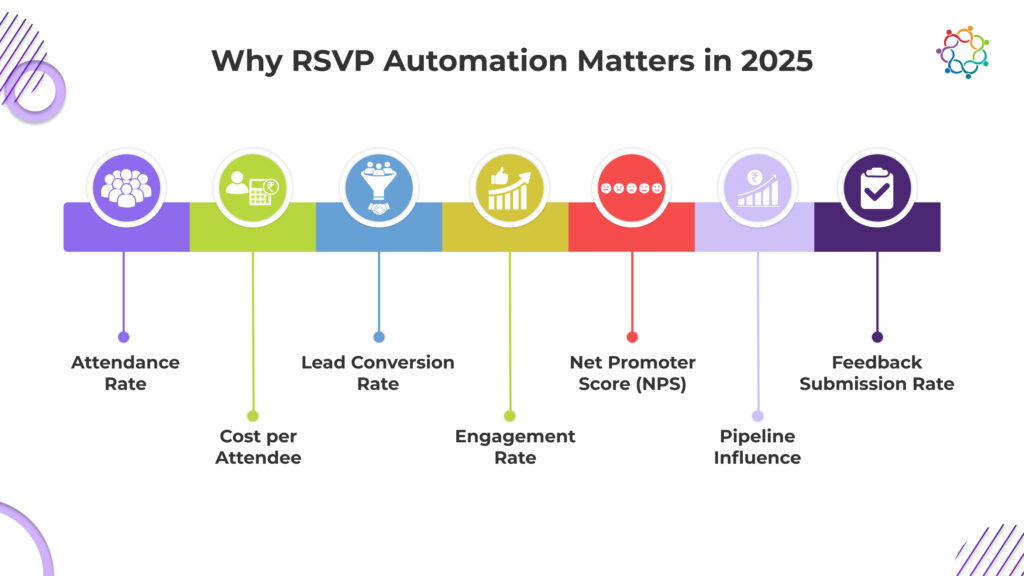
1. Attendance Rate (%): Formula: (Actual Attendees ÷ Registrants) × 100
This simple percentage is a direct measurement of how compelling or worthwhile your event was to your intended audience. A low attendance percentage can signal real problems – weak message, weak target, too many invites etc. In 2026, since every registration will represent a real marketing spend investment, this will give a sense for effectiveness in message-to-action commitment.
2. Cost Per Attendee: Formula: Total Event Cost ÷ Attendees
This KPI speaks directly to fiscal responsibility or budget efficiency in context – was the cost per invitee efficient in line with other events/format types. Whether you have do an investor dinner, or a 5-city road show, knowing your cost per attendee, and budgeting relative to the past can keep you in control of your spending and measure benchmarking across formats.
3.Lead Conversion Rate
Formula: (Leads from event ÷ Total attendees) x 100
Among the top event ROI measures, this measures how effectively participants engaged beyond passive attendance and translated to pipeline. If you create a CRM sync, this is where the real attribution begins.
4. Engagement Rate
Instead of a passive headcount, ask: how involved were they? Track metrics below, including but not limited to:
High engagement metrics indicate your event content resonated with the audience. If the numbers are low, this is your signal to revisit your agenda design or channel execution.
5. Net Promoter Score (NPS)
Event post-surveys that ask the question, “How likely are you to recommend this event?” give you a clear, quantifiable measurement of brand development and attendee sentiment. NPS is a great way to get an immediate and powerful sense of long-term brand value and impact.
6. Pipeline Influence or Revenue Attribution
This is the holy grail for CMOs. Use your CRM (Customer Relationship Management) tool and event platform integration for any of the three tracking aspects below, including but not limited to:
Tools like Samaaro make it easy to sync these touchpoints into your Salesforce or HubSpot dashboards.
7. Feedback Submission Rate
This one might be overlooked, but how many attendees filled out your feedback forms? No matter how you ask for feedback, this is a measurement of attendee investment to the event.It also indicates how effectively you prompted to encourage post-action events, which is a fundamental component of any event cycle.

Today’s event marketing success relies on utility and seamless tracking from tool to tool. Here’s how the best-performing teams create the configuration required:
CRM Platforms – (Salesforce, HubSpot)
Tracking lead status, revenue influence, and continued nurture post-event is CRUCIAL for event ROI measurement and lead scoring from your event.
Event Tech Platforms – (Samaaro, Cvent)
Provide live dashboards displaying attendance, engagement, check-in status, and session drop-off rates. Some platforms, like Samaaro, take it a step further by integrating directly with marketing automation and feedback tools.
Analytics Suites – (Google Analytics, Mixpanel)
Used for tracking traffic source, conversions from the promotional page, and post-event web actions like demo requests or resource downloads.
Survey Tools – (Typeform, Samaaro Feedback Manager)
Used for tracking NPS, speaker feedback, content rating, etc. The Samaaro Feedback Manager was built for enterprise-level data capturing and dashboard integration.
Unlike most platforms that focus only on pre-event workflows, Samaaro gives equal importance to performance analytics and post-event insights helping you measure success every step of the way. Here’s how Samaaro drives real-time event KPI tracking for your campaigns:
This level of visibility enables event marketers to make data-driven decisions in real time, refine strategies while events are still live, and generate actionable post-event insights that validate every decision with measurable impact.

Tracking event KPIs is not just about reporting, but also about every event becoming progressively smarter. In 2026, marketing teams can’t rely just on gut instinct or guesswork for your post-event insights. Every single touchpoint is there for a reason, every indicator has a story, and every insight can help shape our next big win.
As a reminder, marketers using an event platform like Samaaro for tracking KPIs can much more than a singular event metrics measures, and imaging true clarity from overall impact from KPI, from invite to impact (i.e. deployment of invitation for either demand generation roadshows or investor networking dinners). Real-time dashboard, CRM syncing, audience insights, visuals, etc. are now baseline expectation, not an enhancement or add on.
So why guess when you can just start tracking event performance to get the real measures of success?
The most important event marketing KPIs to track in 2026 are: registration conversion rate, attendance rate, session engagement rate, lead-to-pipeline conversion, cost per qualified lead, NPS, and event-influenced revenue. These seven cover the full funnel from interest to revenue. Avoid stopping at vanity metrics like total registrations or social impressions, because those don’t tell your CFO whether the event was worth running.
Businesses connect attendance metrics with pipeline influence and revenue attribution by syncing every attendee record directly into the CRM. Once registrations, check-ins, session attendance, and engagement scores live in Salesforce or HubSpot, sales can see which deals were touched by which event, and finance can attribute revenue. Without this CRM sync, attendance numbers and pipeline live in separate worlds and the ROI question never gets answered.
For evaluating campaign performance across email, social media, paid ads, and partnerships, the KPIs that matter most are: registrations per channel, cost per registration per channel, channel-to-attendance conversion rate, and pipeline contribution per channel. This lets you compare a $5,000 LinkedIn ad campaign against a free partner co-promotion on equal footing and see which actually built pipeline.
Event marketing KPIs help optimise engagement, lead quality, and conversion at every stage. Before the event, registration KPIs show which segments are converting and which need a nudge. During the event, engagement KPIs like session attendance and poll participation surface high-intent leads in real time. After the event, lead quality and conversion KPIs tell you which attendees became pipeline, so next time you target more people like them.
For corporate and B2B events, the best tools for tracking event marketing KPIs in real time are AI-powered event marketing platforms with built-in dashboards that pull data from registration, on-site, app engagement, and CRM into one view. Samaaro is built for this exact use case, with real-time dashboards, AI insights, and native integrations into Salesforce, HubSpot, Marketo, and Microsoft Dynamics 365.
Event marketers avoid vanity metrics by asking one question of every KPI: does this number help leadership decide whether to invest in the next event? Total impressions don’t. Pipeline influenced does. Cost per lead does. NPS from your target accounts does. Strip your dashboard down to 5 to 7 metrics that connect event spend to business outcomes, and let everything else be supporting detail.
The blog highlights seven KPIs worth tracking in 2026: attendance rate, cost per attendee, lead conversion rate, engagement, NPS, pipeline influence or revenue attribution, and feedback submission rate. Together they cover the full journey from showing up to driving revenue. The key shift is moving past vanity metrics toward numbers that show real business impact.
The most important KPIs connect attendance to revenue. Watch registration and attendance rate, engagement, lead-to-pipeline conversion, cost per lead, NPS, and event-influenced revenue. These tell leadership whether the event was worth running. The blog warns against stopping at vanity metrics like total registrations or social chatter, because those do not answer the ROI question your CFO actually cares about.
They form a connected story across the event journey. Before the event, registration and traffic KPIs show which audiences are converting. During the event, engagement KPIs like session attendance and poll participation surface high-intent leads. After the event, lead quality, conversion, and revenue KPIs prove impact. Tracked together across the lifecycle, they give a complete picture instead of isolated snapshots.
Two core metrics matter here. Attendance rate, which is actual attendees divided by registrants, shows how compelling your event was and flags weak messaging or targeting. Cost per attendee, total cost divided by attendees, shows budget efficiency and lets you benchmark across event formats. Watching both before and during the event keeps your spending and your turnout under control.
Engagement metrics show how involved attendees really were, beyond just showing up, by tracking participation in sessions, polls, and Q&A. High engagement means your content resonated, while low engagement signals you should revisit the agenda. NPS, from asking how likely people are to recommend the event, gives a quick, quantifiable read on satisfaction and long-term brand value.
Lead conversion rate and pipeline influence are the critical post-event KPIs. Lead conversion, leads from the event divided by attendees, shows how well attendance turned into real interest. Pipeline influence and revenue attribution, tracked by syncing event data into your CRM, reveal sourced revenue and influenced deals. These are the numbers that connect the event directly to business outcomes.
Website traffic and registration conversion KPIs show whether your pre-event promotion is working. Using analytics tools, you can track which channels send qualified traffic to your promotional page and how many of those visitors actually register. If traffic is high but conversions are low, your page or offer needs work. These KPIs help you fix pre-event marketing before spend is wasted.
ROI compares what the event cost against the revenue it influenced. By pairing cost per attendee with pipeline and revenue attribution from your CRM, you can show real value for money rather than just activity. This is the metric leadership cares about most, because it proves whether the event was a worthwhile investment and helps justify the budget for the next one.
Feedback submission rate, how many attendees actually filled out your feedback forms, is easy to overlook but revealing. A high rate signals genuine investment in the event and shows you prompted people effectively for post-event action. A low rate suggests weak engagement or poor follow-up. Since collecting feedback is central to improving every event, tracking this rate is genuinely useful.
Real-time tracking turns data into action during the event, not just after it. Live dashboards show registrations, check-ins, engagement heat maps, session attendance, and drop-offs as they happen. So you can spot a fading session, redirect traffic, or adjust messaging on the spot. Instead of waiting for a post-event report, you fix problems while there is still time to matter.