Samaaro + Your CRM: Zero Integration Fee for Annual Sign-Ups Until 30 June, 2025
- 00Days
- 00Hrs
- 00Min

AI is not just on the horizon of event marketing; it’s already built into event marketing
In the last few years, what started as a hodgepodge of automations, is now the invisible infrastructure behind how brands plan, market, and measure their events. From predicting attendee behaviour, to building personalized campaigns, AI is now a stealth partner to event marketers at every stage of the event marketing cycle.
Enterprise marketers have moved on from asking if AI is an appropriate strategy for them to how deep they want to go into AI. AI is not just optimizing operations, it is changing how event marketers look at intent, design experiences, and link engagements to business outcomes. However, despite all the hype, most marketing teams still struggle to conceptualize what “AI in events” truly looks like, beyond a superficial understanding of automation.
This blog dives into that gap, evaluating how AI is changing the full event marketing lifecycle, before, during, and after the event, and what the next evolution of this technology means for enterprise growth.
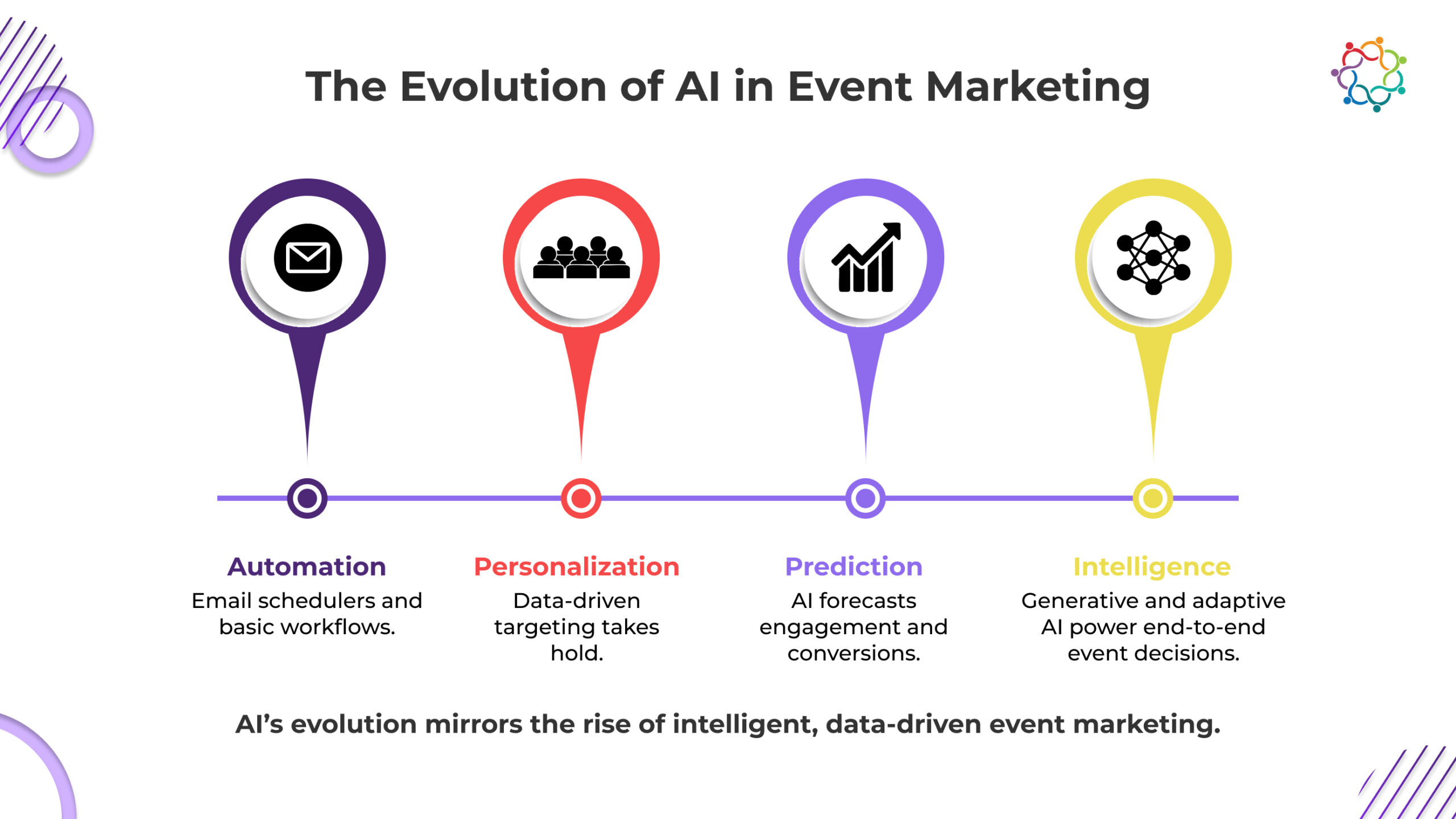
Initially, when artificial intelligence was first brought into the realm of event marketing, it was essentially regarded as a tool to convenience tasks. The first use cases involved automating tasks that had being repetitive and time consuming: scoring leads in a spreadsheet, segmenting people based on list, and scheduling follow up emails. With efficiency as the motivator.
As the practice of data collection matured, marketers began to recognize a tangible opportunity. Every digital interaction – website visits, registered sessions for events, submitting feedback forms – all were insights into a behaviour. The second wave of AI allowed the ability to read these signals algorithmically and at scale. Marketers could now predict which profiles were most likely to convert, engage, or disengage, and not just categorize an attendee.
That was a major tipping point; going from AI as a back-end tool to AI helping act as a compass for strategic direction. Platforms began using predictive analytics, natural language processing, and recommendation engines to help teams understand the whys behind an audience’s behaviour.
By 2025, industry reports expect that 60% of the worlds enterprise organizations are using AI to help make decisions at various levels of event marketing execution; from planning a campaign to creating content.
AI has gone from automation to augmentation. AI isn’t just doing the work faster, it’s learning from every action – and translating those learnings into measurable outcomes for the business.
But beyond buzz words and technology claims, really the only question that matters: What is truly working today?
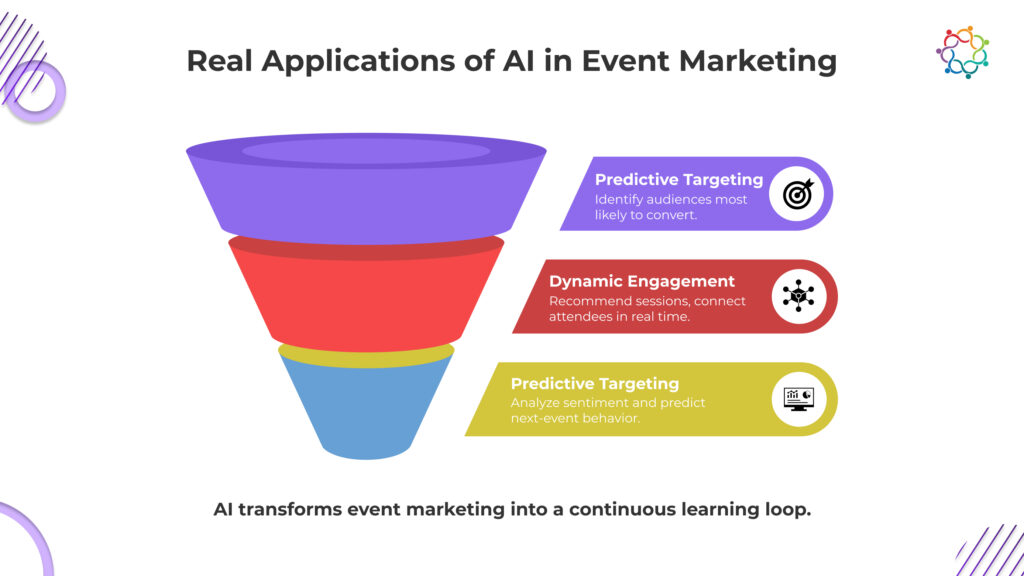
AI’s real power reveals itself when mapped across the three stages of the event marketing cycle: pre-event, during the event, and post-event. These aren’t isolated phases anymore, they form a continuous loop of learning, prediction, and optimization.
All events begin with the same question. Who do we target, and how?
Artificial intelligence is changing how marketers can respond to that question.
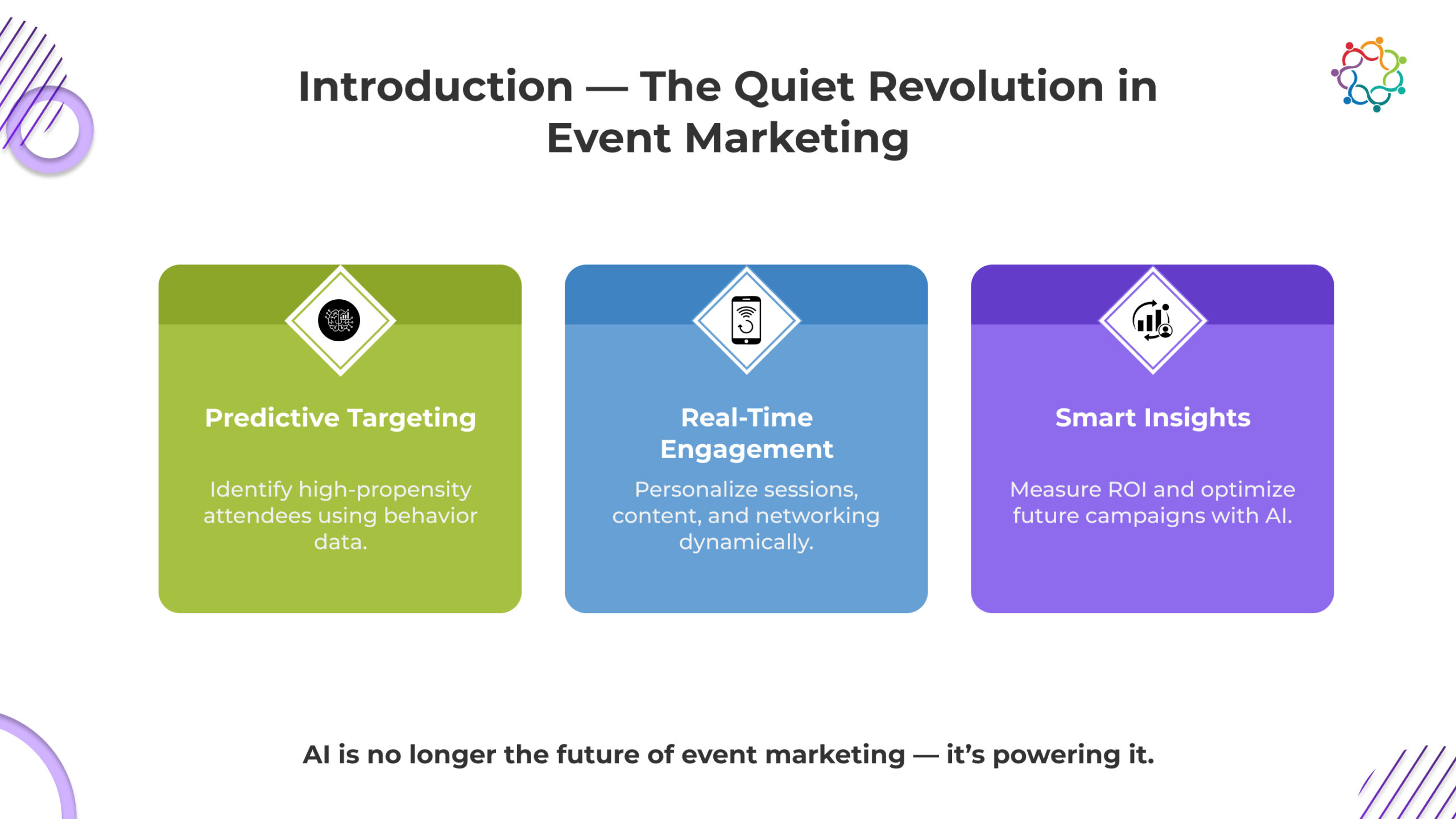
Instead of merely analysing historical attendance or manually segmented attendee lists, AI systems can generate attendee profiles that are both dynamic and predictive. Attendee profiles include references to both demographics and intent, illustrating and identifying which audiences are most likely to (1) register, (2) engage, and (3) convert.
Predictive targeting has become one of the most valuable tools available in pre-event marketing. Based on behavioural data and historical outcomes, AI can flag the top twenty percent of prospects that will yield the most conversions. With multi-million-dollar marketing budgets, every campaign cycle must be well-targeted, and it is increasingly risky to spread marketing spend too thin, targeting audience segments with little to no probability of conversion.
This intelligence is also valuable for illustrating the importance of personalized strategies and personalization. Generative AI models can both produce and facilitate adaptive campaign content, from email templates to ad copy. As a result, personalization is not solely about better open and click through rates but relevance at scale.
Another key application is smarter budget allocation. AI can analyse historic performance and predict, based on past channel performance (e.g. ad conversions to sales) where every rupee in marketing spent represents the best ROI where materials are deployed to “winning prospects.” That means smart teams can leverage AI to determine when to invest both time and resources into tripling down on LinkedIn ads or pull the spend on paid search based on reasonable probability or historical conversion rates, not gut instinct from 5 years ago.
For example, a global technology brand was able to use predictive analytics based on past attendee registrations and behaviour to understand who its highest propensity attendees without using the gut instinct of targeting 50,000 prospects. Instead, it was able to target most effectively the top 10,000 and, ultimately, produced 1.6x as qualified registrations and no increased marketing budget.
We’ve seen other similar examples in our ecosystem with Samaaro. One case with an enterprise organizer used predictive analytics, enabled through Samaaro’s campaign management application and component tracking tools, improved its in-person event registration and attendance ratio from registration for 100 to an actual registration and attendance ratio of 30%. They were also able to substantially illustrate the point that targeting precise audiences or segments is an effective tool.
Once attendees check in, the AI’s functions shift from predicting what might happen to orchestrating activities in real-time.
Real-time engagement is one of the hallmark capabilities of AI-driven event experiences. Algorithms can track behaviours across touchpoints – app logins, session check-ins, networking engagements, etc – and respond accordingly in real-time.
Imagine an attendee browsing through a session topic track within an event app. The AI observes that behaviour, and as a result, using a combination of a base algorithm and the data collected on their behaviour, the AI can make recommendations of session or exhibitors in real-time based on that interest. So, what you have is a living personalized journey throughout the event that shifts as the attendee shifts.
The real-time dynamic delivery of content is the same concept. Personalized agendas, push reminders, and real-time recommendations on the go helps each attendee operate efficiently in any event. AI’s potential can shift event apps in real-time from passive directories to an active engagement platform.
Smart networking is another purposeful function. Machine learning algorithms explore attendee profiles including job title profiles correlating to what sessions attendees are engaging to make high value recommendations to connect with a fellow attendee. Rather than productive meetings with random fellow attendees, they depart with connections to peers, partners or leads that contribute to contingencies during the event in accordance with their intended purpose.
In one specific enterprise summit with multiple networking meetings, AI matchmaking alone increased meeting success rates by 45% across simply aligning on the attendee profile information and credential priorities.
Samaaro’s ecosystem subtly and efficiently allows for this. The Attendee App’s recommendation algorithms and smart networking functions immediately allow event marketing teams to capture engagement data in real-time turning spontaneous attendee behaviour on-site but through the event journey into structured marketing intelligence.
Real-time sentiment analysis is another layer of understanding. Pulling based on daily polls, post-event feedback forms, and/or posts made on social media captured daily and during the event AI can sense as it relates to sentiment and may be changing with the collective presence of people in the event. It also means that marketers can engage the flexibility of making an adjustment on site, be prepared to extend a session, or adjust a tone in an announcement, and development of event in-event inducements to action plans based on the signals of attendee engagement and participation.
Historically, the post-event phase was where data went to die. With the rise of AI, it can be turned into a feedback engine.
With natural language processing, we can now analyse feedback forms and survey responses at scale. Through sentiment detection, teams are better able to understand tone and context, and learn what resonated and what did not, going beyond the mere numerical ratings.
Predictive models can now be used to forecast future attendance, lead quality, or churn risk by looking at historical engagement. These insights allow marketers to design follow-up campaigns that feel personalized, as opposed to generic or cursory.
AI has also created a gap that did not exist, by connecting post-event insights back into the enterprise’s customer relationship management (CRM) system. Instead of receiving a static report on an event’s success, marketers now receive dynamic intelligence on which sessions impacted pipeline growth, which attendee segments delivered the best ROI, and which content themes drove the best conversions.
With AI dashboards, marketers can easily summarize these insights with AI power. In the past, it would take the teams days to put together reporting, but now they receive visual narratives of performance with next steps included.
AI doesn’t necessarily change how we measure success but influences the system feedback loop. Like processing the requests of an algorithm, the next time a campaign is run, a recommendation to the next campaign’s planning phase will be present and based on what it learned about attendees and engagement at the summit.
The integration of Artificial Intelligence into event marketing is not an isolated development, it is insulated so as not to be one of a growing range of technologies that make data more accessible and insight more immediate.
Predictive analytics platforms have emerged to be the nervous system of event intelligence. In fact, they can accurately predict campaign activity before it activates to allow the team to deploy resources and focus on areas with mathematical reasoning when millions of rupees of investment is on the line. This predictive layer has removed some uncertainty and applied measurable impact for enterprise marketing teams.
Natural Language Processing (NLP) has emerged as the interface from AI to human. Chatbots and voice assistants can handle thousands of attendee conversations at one time, and free up event teams to focus on strategic and mission-driven work. AI moderators can summarize live Q&As, categorize audience questions, and provide contextual answers in real time.
Computer Vision is entering large scale events. Cameras can read locations and crowd density, facial expressions, or movement patterns. These insights can help event organizers make decisions around layout, security measures, and engagement. Computer Vision must be approached in a responsible manner, but the upside for safety and personalized engagement for large scale events is compelling.
Generative AI is changing the creative flow. Event teams can use generative AI to generate personalized content, create marketing assets of every size, and write micro-copy for all different voice tones for every flavour of audience. In fact, generative AI can support iterative speed without replacing human creativity along the way; event marketers can ultimately push refinements for their idea(s) instead of manually creating thousands of emails, social or campaign outputs.
AI and IoT Integration is the next frontier. Smart badges and heat-mapping sensors can track measures around how attendees are moving through physical space – in terms of where booths, sessions or planners, where are the most desirable places for attendee engagement? Insights collected would lead to next level insights and predictive models to turn physical behaviour into digital outcomes.
When combined, this technology offers to marketers what they often seek as professional event marketing professionals – a more accurate understanding of audience intent. Technology does not replace the role of creating to steward intention, it compounds accuracy to the creation,
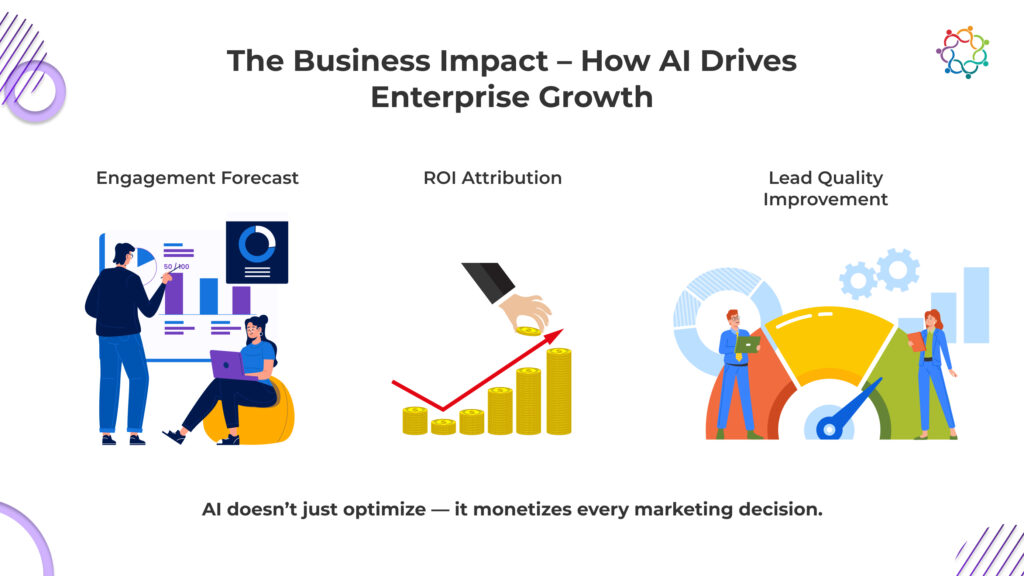
At its core, the use of AI in event marketing is not a technology story – it’s a business story.
Predictive targeting reduces wastage in marketing. Instead of focusing on large campaigns, the use of AI allows for resources to be invested in leads with a high probability of conversion, thus limiting budget waste.
Personalization drives engagement, and engagement drives ROI. When attendees feel known and appreciated, they tend to engage more with the event content. Engagement is converted and retained in the brand ecosystem.
AI-driven insights speed up decision making. Dashboards and bursts provide marketing decision makers the confidence to pivot their strategy nearly in real time, rather than relying on a post-event report.
And perhaps most importantly, AI breaks down silos. Event data once siloed between marketing, sales, and operations can now be viewed through a framework in which intelligence is shared among teams. Everyone is working off the same information, which removes the speed of feedback loops and aligns teams around results, vs. opinion.
An enterprise working with AI technology embedded in their event marketing strategy realized a 37% improvement in lead quality and a 28% improvement in conversions post-event. These were not abstract improvements. They were tangible growth in revenue attribution, and overall acceleration of the pipelines they experienced.
AI does not simply optimize events. AI changed these events from an expense on the marketing budget, to profit center.
With the introduction of any evolving technology, comes an element of shared responsibility. This is especially true for AI in event marketing.
Data privacy is still the primary concern. If systems are analysing on a personal and/or behavioural basis, it is important that the marketer is transparent as to how attendees’ data will be used. Attendee consent is a signal of trust, not just compliance.
Another risk relates to over reliance. When every decision is made based on algorithmic output, people may lose creative judgement. The best event marketing is based on human intuition, sensitivity, tone, and emotional nuance, these qualities cannot yet be replicated by AI.
The regulatory frameworks such as GDPR and the soon to be passed AI Act will change how data is collected, processed, and stored. Enterprises need to develop AI strategies that are compliant by design, not reconstituting an approach in post-facto.
The future of AI in event marketing will have a long trajectory based on how the technology is responsibly managed today.
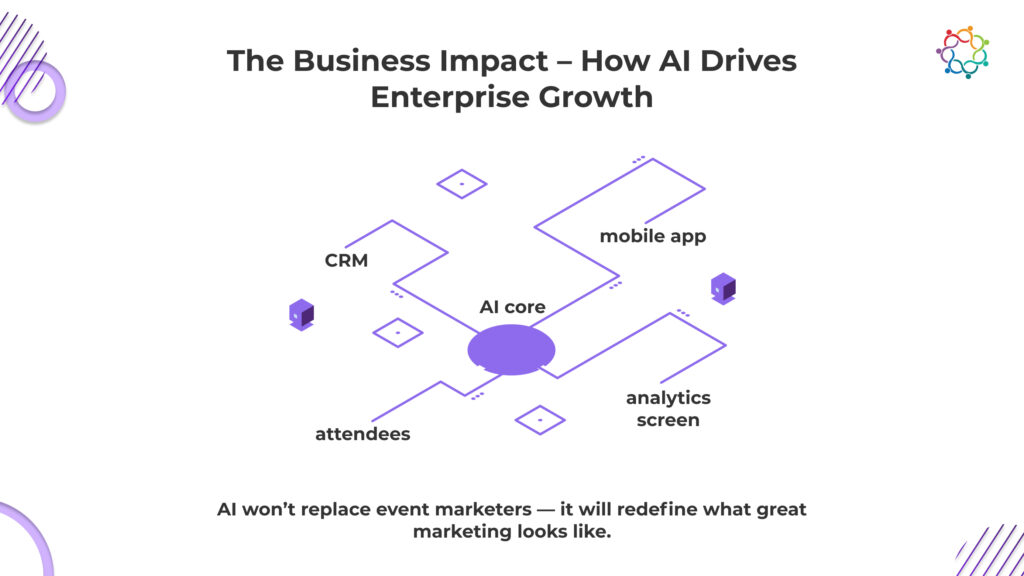
The future of artificial intelligence, or AI, in event marketing is not only going to enhance how campaigns run but also predict how they should be designed.
Predictive planning will enable marketers to model entire event concepts prior to launch, testing the viability of themes, formats, or audiences. AI will enable marketers to simulate potential outcomes and optimize planning strategy before the first campaign launches.
Conversational AI will mature from merely being reactive chatbots to being proactive co-pilots. They will handle registration, surface audiences and guide them through feedback, and even help marketers decipher real-time engagement data during the event.
But perhaps the most significant difference will be the concept of continuous learning. AI systems will refine strategies for events on-the-fly, aggregating insights from many past events to apply to real-time recommendations made for the next event. Campaigns will no longer live in isolation, as the user would be granted an intelligence loop that encompasses geographies, audiences, and time, and will continue to learn.
These ideas have already been a part of Samaaro’s road map.
In 2025, we focused on deeper CRM intelligence, cross-channel insights, predictive recommendations and aggregating all this information across the entire event portfolio, that provides marketers with an Elephants Eye view of engagement.
The next frontier is not going to be automation; it is going to be augmentation. AI will not take the job of event marketer; it will eventually define what great marketing looks like.
(If you’re thinking about how these ideas translate into real-world events, you can explore how teams use Samaaro to plan and run data-driven events.)