Samaaro + Your CRM: Zero Integration Fee for Annual Sign-Ups Until 30 June, 2025
- 00Days
- 00Hrs
- 00Min


1
2
3
→
Bottom Line:
Buy the platform that consolidates the seven, not the one with the longest feature list.
Most teams pick event software backwards. They book a few demos, get walked through features they did not know they needed, and choose whichever rep was most convincing. Then the next trade show arrives, and they are still exporting leads into a spreadsheet at midnight, because the tool got bought before anyone wrote down what it actually had to do.
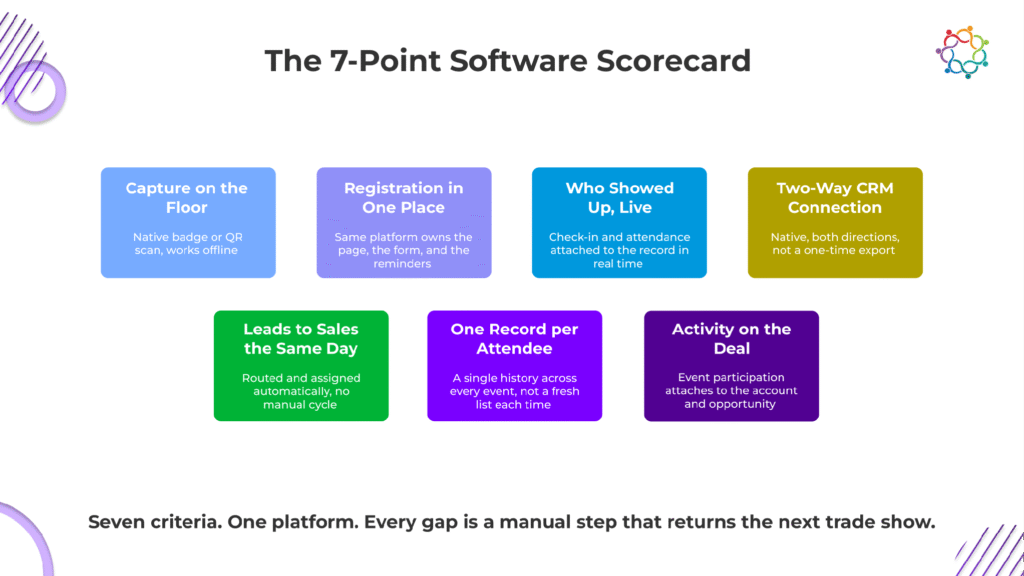
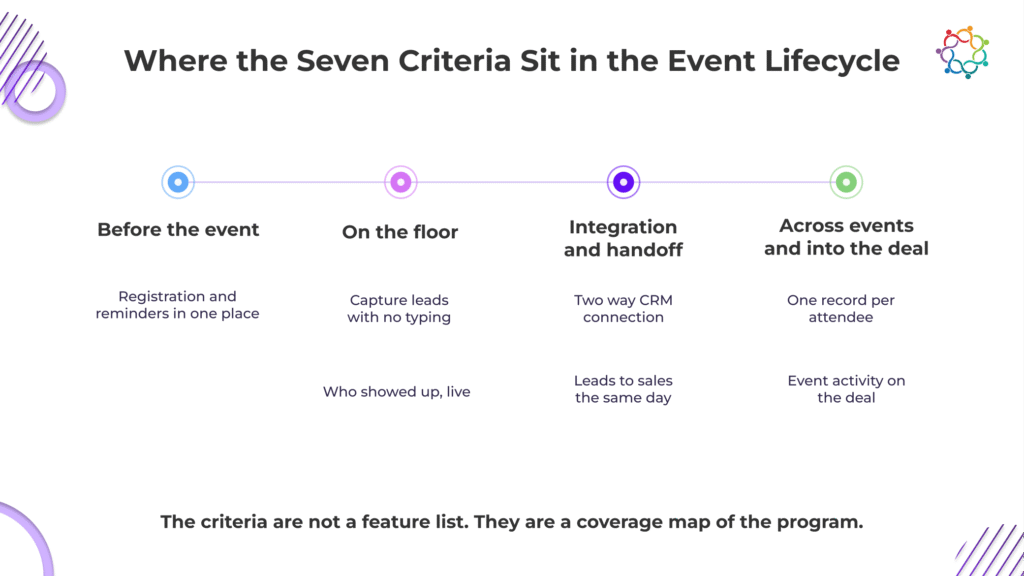
So, before you shortlist B2B field marketing software, write down what it has to do. The brand comes later. For a trade show, that comes down to seven things one platform should handle so you stop stitching tools together: capture leads on the floor with no manual entry, run registration and reminders in one place, show who showed up as it happens, connect both ways to your CRM, get leads to sales the same day, keep one attendee record across events, and land that activity on the deal.
This guide turns each of the seven into a question you can put to any vendor. Walk in with the checklist, and the demo stops being a feature tour and starts being a test of the platform, either passes or fails.
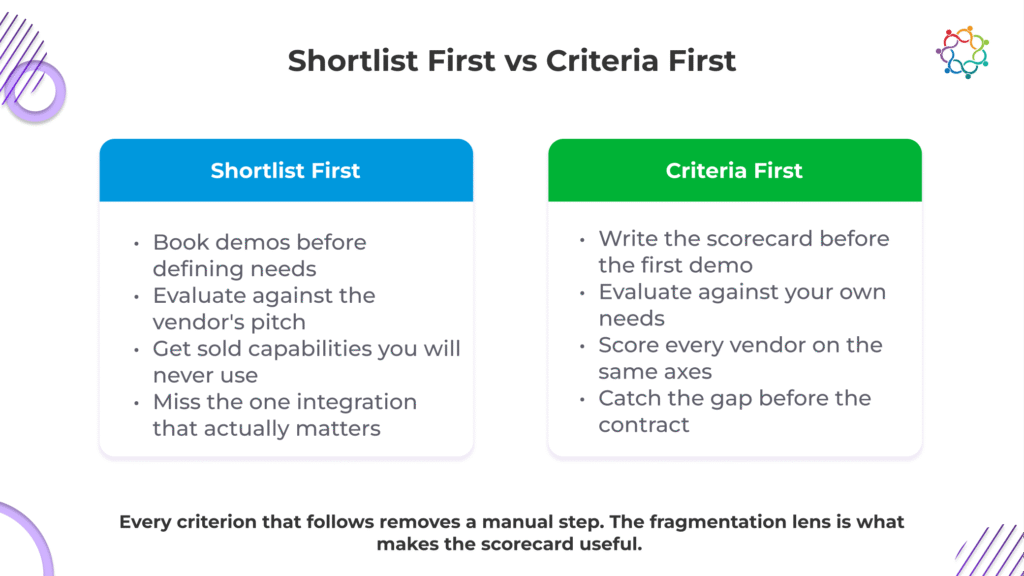
The wrong order is to shortlist first and get sold second. You end up evaluating each tool against the vendor’s pitch, and you walk out wanting features you will never use. The fix is to write your criteria first, so you arrive at every demo with a scorecard rather than a blank page. That is the core of how to evaluate event marketing software: you measure each tool against what you actually need.
What should drive those criteria is the reason you are buying at all. Across the buyer conversations behind this guide, the same picture kept surfacing: running a single event meant juggling a handful of systems that did not talk to each other, with someone reconciling the lists by hand once it was over. The data shows how common that is. Airtable’s 2024 Marketing Trends Report found that 43 percent of marketers have between 30 and 50 percent of their data duplicated across separate platforms like spreadsheets, documents, and apps, with most B2B marketers reporting redundant tools. So, the question to bring is a consolidation question: what should one platform handle, so you stop stitching tools together for every event? Feature counts are beside the point, and every criterion below removes a manual step.
The trade show is the hardest case: a lot of leads, fast, often on bad venue wifi, with a tight follow-up window. Software that holds up there holds up anywhere. For the wider program this checklist ladders into, see our B2B Field Marketing Playbook.
The booth is where leads are won or lost, so start with capture. You want native on-site lead capture, the kind of trade show lead capture that works the moment someone walks up, in three forms:
The reason this matters is speed and data integrity. If capturing a lead means typing into a form or collecting cards to enter later, you lose both, and you create a separate list to reconcile. Thirty seconds after a scan, you want an actual record in the system rather than a row to clean up next week.
To test it, ask a vendor to show capture working with the wifi off, and ask what a captured lead looks like immediately after. The trap is a slick capture demo on perfect convention-center wifi. Watch it run on a dead network, the condition you will actually use it in.
Spinning up a separate site builder, a form tool, and an email tool for every event is the pre-event version of the stitching problem. You want registration, the event landing page, and reminder emails handled in the same platform. The catch is connection: when those live in three tools, the records do not join, so the person who registered is a different record from the lead you scan at the booth, and you are matching them by hand afterward.
To test it, ask whether registration data and on-site capture share one record, or sit in separate systems you reconcile later. This is one of the field marketing software requirements people most often get wrong: assuming “has registration” means connected. Plenty of tools take registrations perfectly well and then hand you a CSV.
One scope note worth stating plainly: this criterion covers the mechanics of taking and managing registrations. Driving attendance is a separate job, and no registration feature solves it. Judge this one on whether the registration, the page, and the reminders run as a single connected record, and leave filling the room to your demand and field programs.
Registration tells you who said they would come. Check-in tells you who actually did, and you want that captured live: who walked in, which sessions or booth moments they hit, visible during the event rather than reconstructed days later. If you are asking what event marketing software should do on the day itself, this is it. The two numbers are never the same, since plenty register and fewer show, and the gap between them is the data that actually matters.
If you only learn who attended after the event, by exporting and reconciling, you cannot act while the event is still happening, and by the time the data is clean, it is also stale. The point of live visibility is that you can act on the day, routing a hot booth visitor to a rep or flagging a key account that just checked in, while it still counts.
So when you test this, ask to see the live check-in view in action, and confirm that attendance attaches to each attendee record automatically rather than landing in a separate report you stitch back in later. A registration count dressed up as an attendance count is the quiet failure here.
Three of these seven criteria touch your CRM, and this is the foundational one: whether the connection exists at all and runs both ways. You want native, two-way integration with the CRM and marketing tools you already run on, so data flows in both directions rather than as a one-time export. This is the heart of event software, lead capture, and CRM integration, and it decides whether your event data joins the rest of your systems or sits on an island.
When you test it, do not accept a wall of integration logos. Ask specifically:
The trap is a marketplace page full of logos that turn out to be one-way exports, or third-party connectors you have to build and maintain yourself. A logo means a connection is possible. A field map means it is real.
Where the two-way-connection criterion asks whether the link to your CRM exists, this one asks how fast a lead crosses it. You want captured leads to route to the CRM and to the right rep automatically, the same day, with no manual export, clean, upload, and assign cycle in between. Same-day, automatic handoff is what separates the best event marketing software for trade shows from the tools that merely claim to integrate.
The reason is decay. Lead value drops fast after an event, so a multi-day handoff leaks pipeline, and the export cycle is precisely the gap where leads go cold. A tool can technically connect to Salesforce and still leave you exporting, deduplicating, and uploading by hand. The connection is one thing; the connection doing the work for you, automatically, is another, and only the second one saves the leads.
To test it, ask a simple question: how long between a booth scan and that lead landing, assigned, in a rep’s queue, and is that automatic or does someone do it on Monday? If the honest answer involves a spreadsheet and a Monday, the leads have already cooled by the time sales sees them.
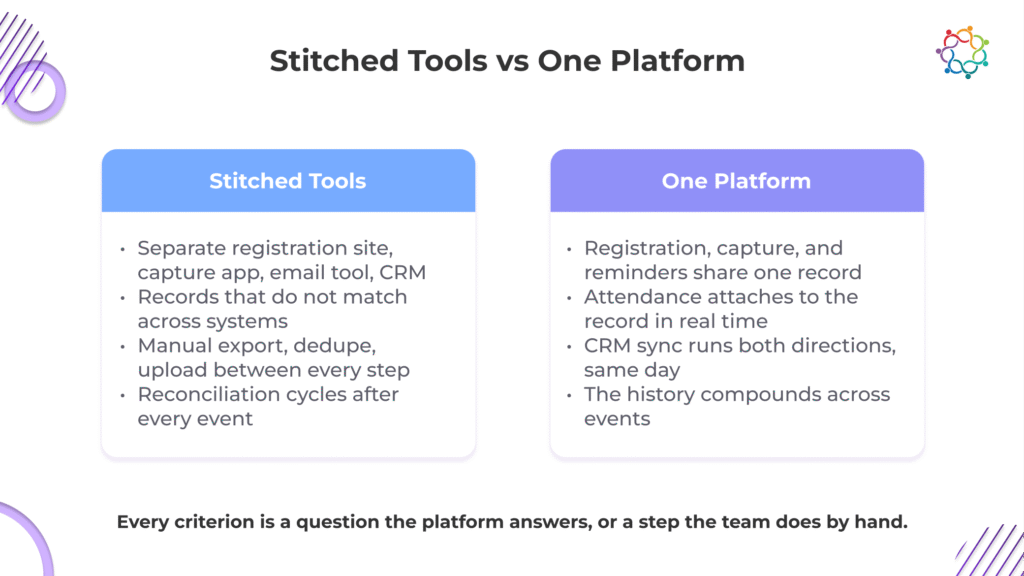
You want one attendee database across all your events, so the same person is one record with a history, rather than a fresh siloed list every time. This is what field marketing tech stack consolidation looks like at the data layer: one record per person, carried across every event. Without it, you cannot see that an account hit three of your events in a year, and you cannot retarget the right people for the next one, because every event starts from zero.
To test it, ask whether someone who attended last quarter’s roadshow shows up as the same record at this quarter’s conference, with their history intact, or whether they arrive as a brand-new contact you would never connect to the earlier visit.
Picture the cost of getting this wrong. A target account sends someone to your webinar in March, your booth in June, and your dinner in September. With one record per attendee, that is a clear three-touch story you can hand to sales. With per-event silos, it is three unconnected rows in three exports, and the pattern stays invisible. The platform either accumulates that history or throws it away each time.
The last of the three CRM-related criteria comes after a lead has crossed into the system: Does the event activity actually land on the deal record? You want event participation to attach to the CRM account and opportunity, so the show feeds the pipeline instead of dead-ending in a spreadsheet.
This matters because event activity that never reaches the deal record is invisible to the rest of the business. Sales does not see that the account attended, finance cannot connect the show to the revenue, and you are back to matching lists by hand to prove that the event did anything.
To test it, open a sample opportunity and ask whether you can see, right there, that the account attended the show, without anyone matching lists manually first. The trap is treating this as a reporting add-on. This is a consolidation question: Does the event activity land where the deal lives? Whether the tool also has a dashboard is beside the point if the underlying data never reaches the opportunity. What happens to that data once it lands in the single-event recap and the quarterly roll-up is the next part of the story.
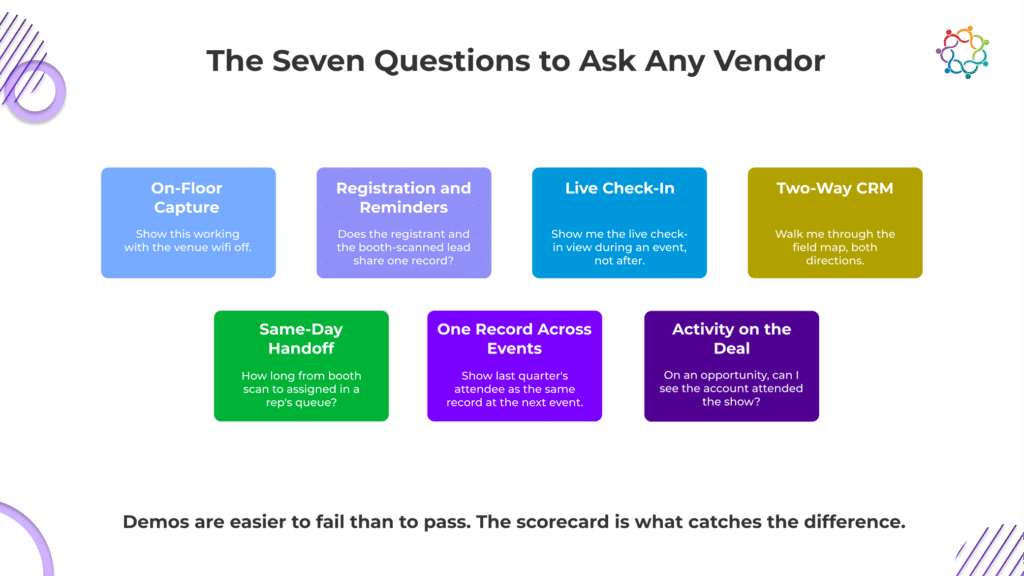
The seven criteria are really one question asked seven ways: what should a single platform do so you stop stitching tools together to run a trade show? Capture, registration, live attendance, the two-way CRM link, same-day handoff, one record per attendee, and activity on the deal are all the same instinct: keep the data in one place as the event runs.
The best field marketing software is not the one with the longest feature list. It is the one that does these seven things in one place, so your next trade show does not end with you exporting leads into a spreadsheet at midnight.
Take the seven into your next demo and see which platform actually passes. If you have not yet decided whether to sponsor or host that event, our sponsor-versus-host framework comes first. Or, to watch all seven run in one place, book a 30-minute walkthrough.