Samaaro + Your CRM: Zero Integration Fee for Annual Sign-Ups Until 30 June, 2025
- 00Days
- 00Hrs
- 00Min

1
2
3
→
Bottom Line:
The strongest programs sequence both: sponsor to find accounts, host to advance them.
Every budget cycle, the same line item comes up for debate. Do we spend it sponsoring the big industry conference again, or pull it back and run our own roundtable series instead? One side argues reach, the other argues relationships, and usually whoever is more senior in the room wins. The call gets made on instinct rather than on what each format actually does for the business.
The honest answer to the event sponsorship vs hosting question is that there is no universal winner. The two build different kinds of pipeline. Sponsoring buys reach and net-new volume from an audience someone else assembled. Hosting builds depth, intent, and late-stage relationships in a small room you choose.
So, the decision turns on your situation: whether you are after new logos or expansion, broad reach or a named-account list, and how cleanly you will need to prove what the spend returned. This piece gives you a framework to decide between the two for your actual goal, rather than a verdict that one always wins. Pick up the variables, weigh your quarter against them, and the right format for right now becomes clear.

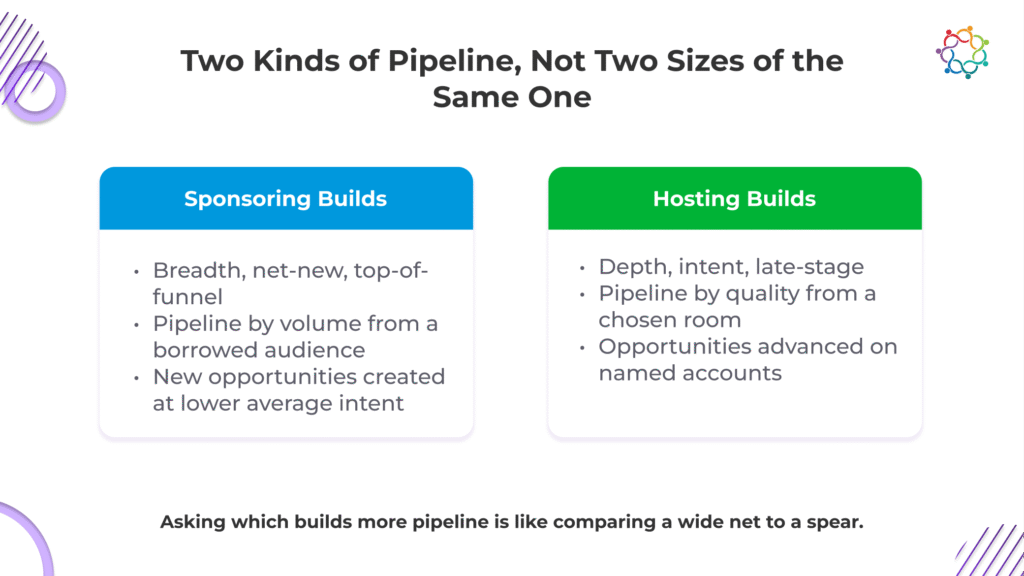
The question hides a flawed assumption. “Which builds more pipeline?” treats sponsoring and hosting as the same output at different volumes. They produce different outputs. Sponsoring produces breadth: net-new contacts at the top of the funnel. Hosting produces depth: intent and movement late in the funnel. Asking which makes “more” is like asking whether a wide net catches more than a spear. It depends entirely on what you are trying to land.
That is also why the debate never resolves. Each camp counts for a different thing. The team that loves sponsoring counts new contacts and reach. The team that loves hosting counts deals, advanced, and accounts moved. They talk past each other every budget cycle because they are scoring two different games and calling both “pipeline.”
So, replace the question. Instead of “which format is better,” ask “which format builds the pipeline I need this quarter.” That version has a real, answerable shape, and the variables that decide it are coming next. This is the B2B event format comparison that actually leads somewhere. For how sponsoring and hosting fit together over a full event calendar, see our B2B Field Marketing Playbook.
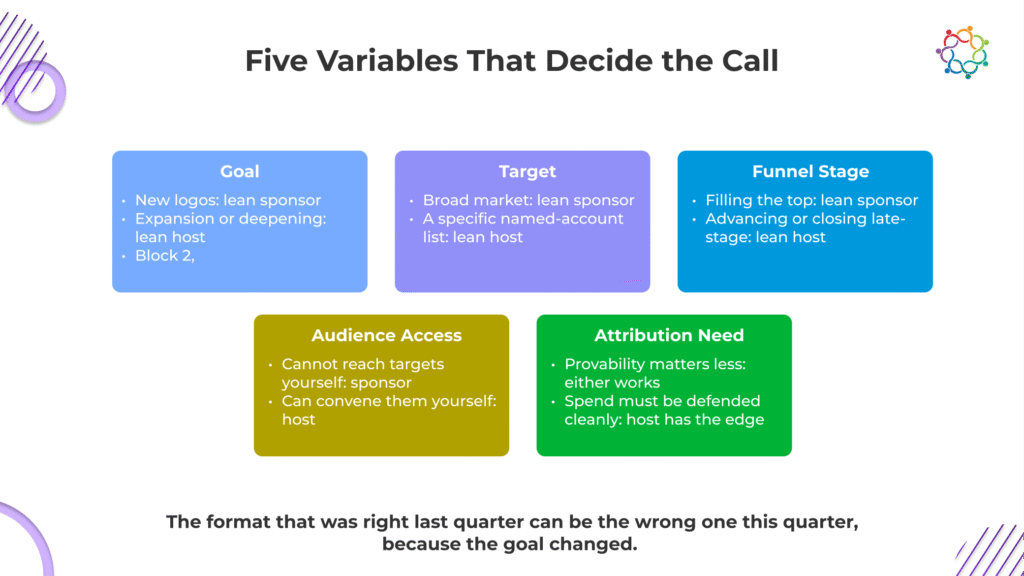
The trap is letting the loudest or most senior voice settle what is really a situational call. The format that was right last quarter can be wrong this quarter, because the goal changed. The decision is a reading of what the business needs now, and it should change when the need does.

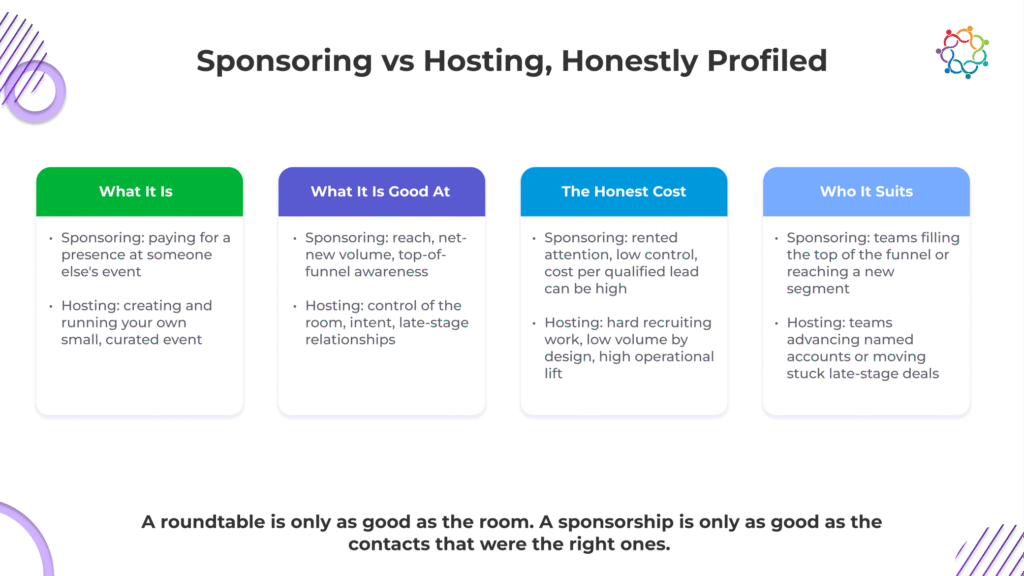
Start with sponsoring, which means paying for a presence at someone else’s event, in front of an audience they have already assembled. Done for the right reasons, it is genuinely powerful:
The honest costs are just as real. The attention is rented rather than owned, and you are one of many sponsors competing for the same eyeballs. A meaningful share of the contacts are low-intent, badge scans, and swag-grabbers. One demand generation leader at a large B2B company described the booth reality as attendees “bombarding the registration desk,” a rush of scans that looked impressive and converted poorly. You do not control the experience or own the relationship afterward. Industry cost-per-lead benchmarks put trade shows and in-person events at the highest cost per lead of any B2B channel, around $840, well above most digital channels, once you net out the noise. Our 2026 B2B Event Marketing Benchmark Report sets that cost in the wider event-spend picture.
Sponsoring suits teams that need to fill the top of the funnel, reach a new segment, or get in front of a market they do not yet have access to. Whether conference sponsorship is worth it for B2B comes down to one discipline: do not judge the whole thing by raw scan count. Volume at a booth is the easiest number to inflate and the weakest signal of pipeline. What matters is how many of those contacts were the right ones.
Where sponsoring rents a crowd, hosting means you build the room yourself. This is creating and running your own small, curated event: a roundtable, an executive dinner, an invite-only forum.
Its strengths are the mirror image of sponsoring’s. Because you build the guest list, you control exactly who is in the room, which means you can put your actual target accounts in it. The conversations are real, and the intent is high, because people accepted a personal invitation to a small room on a subject that matters to them. It works late in the funnel, where relationships get deepened, and stuck deals get unstuck. You own the experience and the data outright. And the attribution is clean, because you know precisely who attended and what moved afterward, a small, known room with a clear before and after.
The honest costs are just as real, and the biggest is the bottleneck: you have to recruit the audience yourself, which is the hard part, and the place where hosted events usually fail. Volume is small by design, so this is never a top-of-funnel reach play. Operational lift is high because you are running the whole thing. Set against a large conference, hosting simply does not generate net-new reach at scale.
Hosting suits teams trying to advance or close specific named accounts, deepen strategic relationships, or move late-stage deals that have stalled. That is the heart of the hosting a roundtable vs sponsoring a conference pipeline question. The trap is assuming the format guarantees the outcome. A roundtable is only as good as the room. Get the wrong people, or too few, and the intimacy that was supposed to be the advantage becomes an expensive dinner with nothing in the pipeline.

Now the title’s literal question: which one actually builds pipeline? Answer it on two axes, because a single number hides the truth.
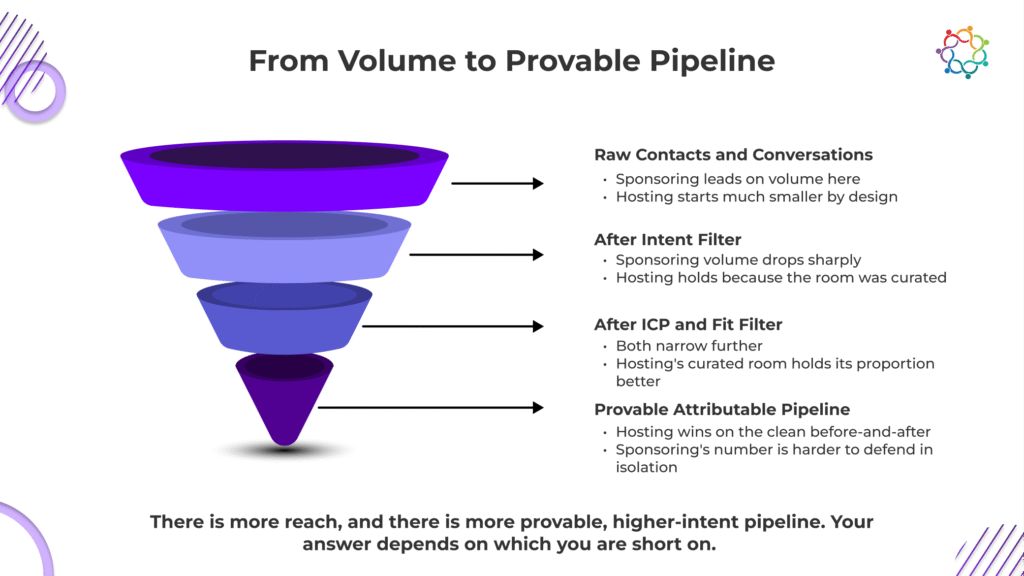
On pipeline type, sponsoring tends to produce more by volume, weighted to the top of the funnel and net-new, at a lower average intent. Hosting tends to produce less by volume, but at higher intent, further down the funnel, concentrated on the accounts you chose. So “more” depends on what you count. Count new opportunities created, and sponsoring’s reach usually wins. Count opportunities advanced or closed on target accounts, and hosting usually wins. Comparing a sponsor a B2B conference vs host a roundtable on one volume figure misses this entirely.
The second axis is provability, and the two are not equally measurable. Sponsoring’s pipeline is harder to attribute: you were one of many touches, and the booth was rarely the moment a deal actually turned. Hosting is cleaner, a small, known room with a clear before and after on named accounts. So hosting often wins on provability, even when sponsoring wins on volume, which matters a great deal when you have to defend the spend later. This is exactly the gap our Event Sponsorship Measurement Framework goes deeper on measuring sponsorship specifically.
The honest conclusion is that there is no single “more.” There is more reach, and there is more provable, higher-intent pipeline, and your answer depends on which you are short on. The trap is the conference sponsorship vs hosted event pipeline comparison done on one number with no adjustment for intent or provability, which always flatters the higher-volume option and quietly buries the quality and attribution gap.

Here is the framework the opening promised, and it is how to decide between sponsoring and hosting events for your real situation. Five variables, each pulling one way:
To use it, weigh your quarter across these five. They will rarely all point the same way, but the balance of them points to a format for this quarter’s goal. That is the answer to when to sponsor vs host an event: a choice made for the goal in front of you, revisited when the goal changes.
The trap is choosing the format you are comfortable running instead of the one your goal calls for. The team that always sponsors because hosting is operationally hard, and the team that always hosts because it feels differentiated, are both optimizing for habit. The framework exists to interrupt the habit and put the goal back in charge.

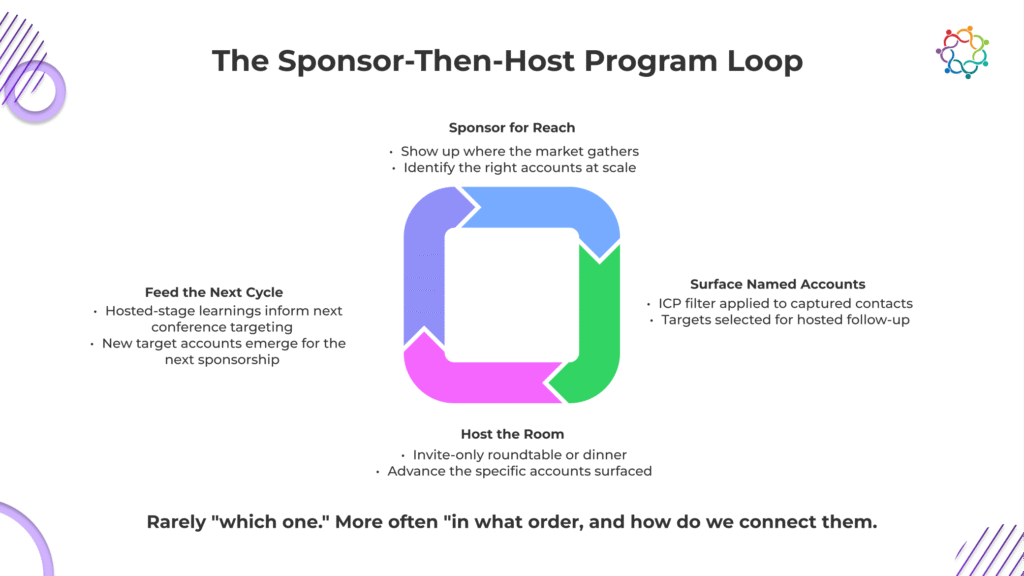
Step back from the either-or, and the strongest programs do not choose once and forever. They sequence the two. Sponsor to reach a wide audience and identify the right accounts at scale, then host to advance the specific accounts you surfaced. Sponsoring feeds hosting.
It works because each format covers the other’s weakness. Sponsoring’s reach feeds hosting’s depth, and hosting’s intent converts the volume sponsoring brought in. A healthy funnel needs both a top and a middle, and these two formats supply them in turn.
The operational catch kept honest: running both well means one audience and one pipeline view across formats, rather than two disconnected motions living in separate tools. When the conference and the roundtable run on one platform, the account you met at the booth and later invited to the dinner is one continuous story, instead of two records you stitch together by hand a quarter later. Whichever format produced a given quarter’s results, it lands in the same quarterly QBR roll-up deck and, per event, in the same single-event recap.
So the real question is rarely “which one.” It is more often “in what order, and how do we connect them,” which is the practical version of the event sponsorship vs hosting ROI question. The trap is treating sponsor and host as rival budgets fighting over the same dollar. In a healthy program they are two stages of one motion, and the dollar moves between them as the goal moves.
They build different kinds of pipeline, the framework points to the right format for the goal in front of you, and the strongest programs sequence both rather than picking a side for good.
Sponsor or host is not a values debate; it is a goal question. Pick the format that builds the pipeline you are short on this quarter, then run it well enough that you can prove it did.
Either way, you will have to show what it returned. Our CFO Event Budget Question Bank covers the numbers you will be asked for in the budget meeting. Or, to see how a sponsored booth and a hosted roundtable run as one connected program rather than two separate scrambles, book a 30-minute walkthrough.

Samaaro is an AI-powered event marketing platform that enables marketing teams to turn events into a measurable growth channel by planning, promoting, executing, and measuring their business impact.
Location


© 2026 — Samaaro. All Rights Reserved.