Samaaro + Your CRM: Zero Integration Fee for Annual Sign-Ups Until 30 June, 2025
- 00Days
- 00Hrs
- 00Min


Key Takeaways (TL;DR)
1
2
3
→
Bottom Line:
Training events only succeed when customers can apply what they learned independently, not just understand it in-session.
Most training events look successful for the wrong reasons. Customers attend, engage, ask questions, and leave with confidence. The environment is controlled, explanations are guided, and answers are immediate. Everything feels clear in the moment.
This is where the Customer Clarity Gap begins.
The confidence built during these sessions is situational, not transferable. It depends on structured guidance, not independent understanding. Remove that structure, and the clarity collapses. Customers return to real workflows and realize they cannot interpret, apply, or navigate the product without support.
Organizations mistake in-session confidence for real comprehension. They measure engagement and assume understanding. But what customers experienced was assisted clarity, not owned clarity.
Training events create the appearance of understanding. They rarely ensure it.
This blog explores why this gap exists, how it forms, and why it continues to undermine real product understanding.
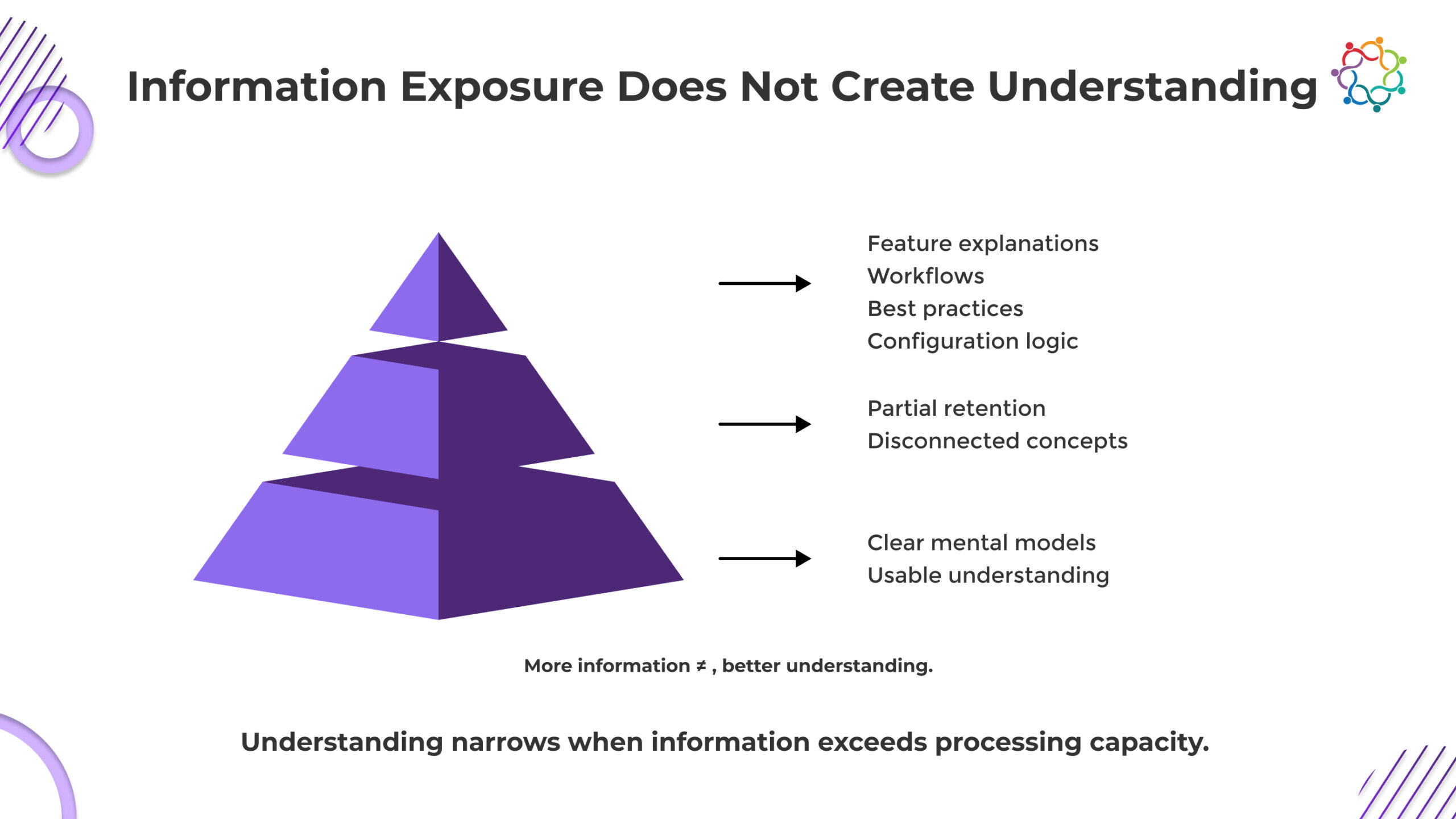
You are overestimating what your customers actually take away from training events.
Exposure feels like progress. Features are demonstrated, workflows are explained, and best practices are presented. Customers see everything. They follow along. It looks like learning is happening.
It is not.
Seeing a feature explained is not the same as knowing how to use it.
Understanding requires customers to connect concepts, interpret situations, and make decisions without guidance. That does not happen at the pace most training events operate. When information is delivered faster than it can be processed, the brain does not build understanding. It stores fragments.
Customers leave with scattered knowledge, not a working model of the product.
If your training is optimized for how much you show rather than how much they can apply, you are not educating. You are overwhelming.
And the moment customers try to use the product alone, that gap becomes impossible to ignore.
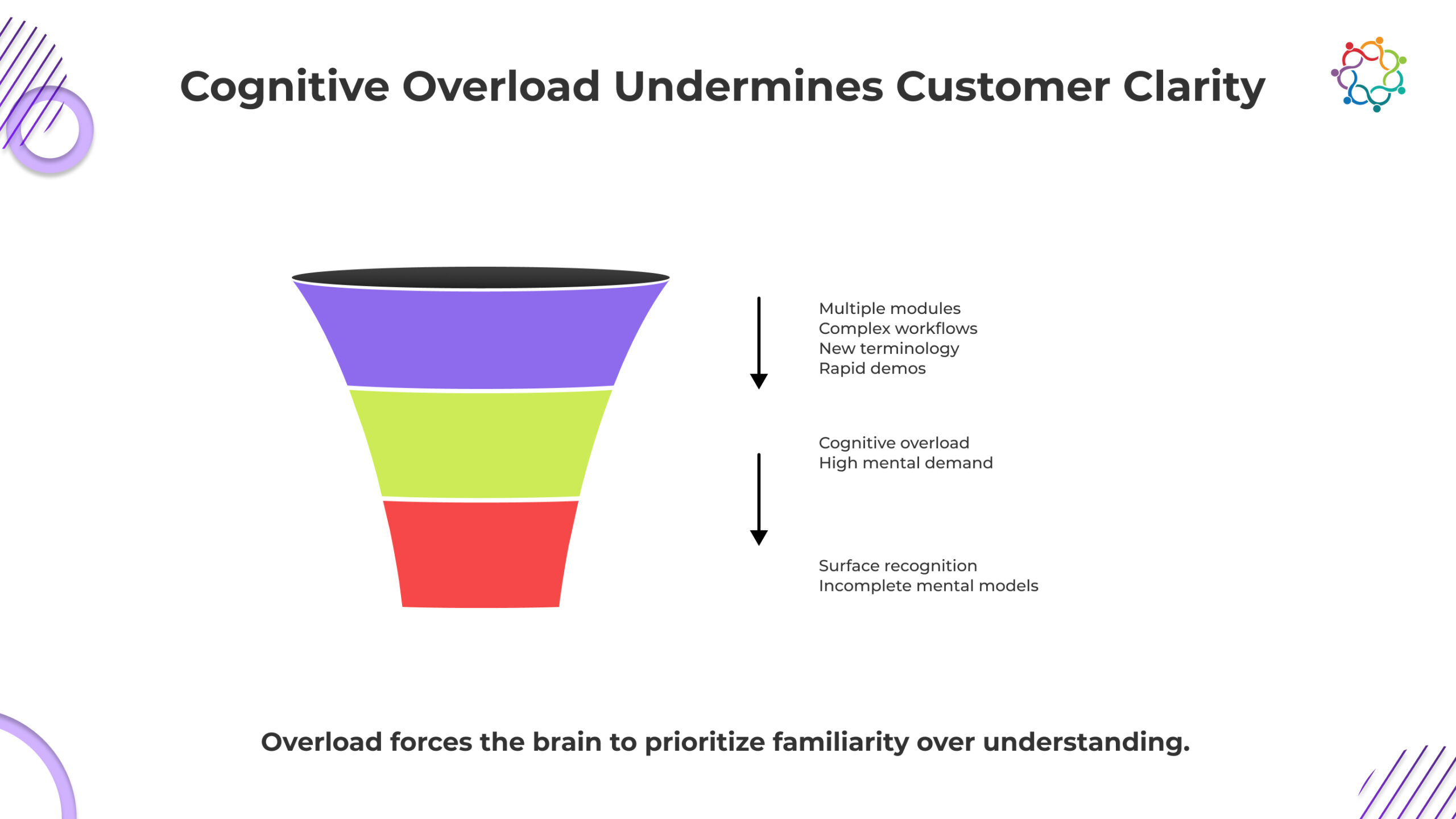
Cognitive overload is not an edge case in training events. It is the default condition you are creating.
You introduce multiple modules, layered workflows, new terminology, and rapid demonstrations in a compressed window, then expect customers to walk away with clarity. They will not. The brain does not process volume into understanding. It filters, shortcuts, and settles for surface recognition.
That is where the real damage happens.
Cognitive overload does not just reduce learning. It creates false confidence. Customers feel they understand because everything looked familiar during the session. But familiarity collapses the moment they try to act without guidance.
This is not a minor gap. It is a structural failure.
If customers leave your training recognizing features but are unable to use them, the overload has already done its job. You did not just fail to create clarity. You actively replaced it with the illusion of understanding.
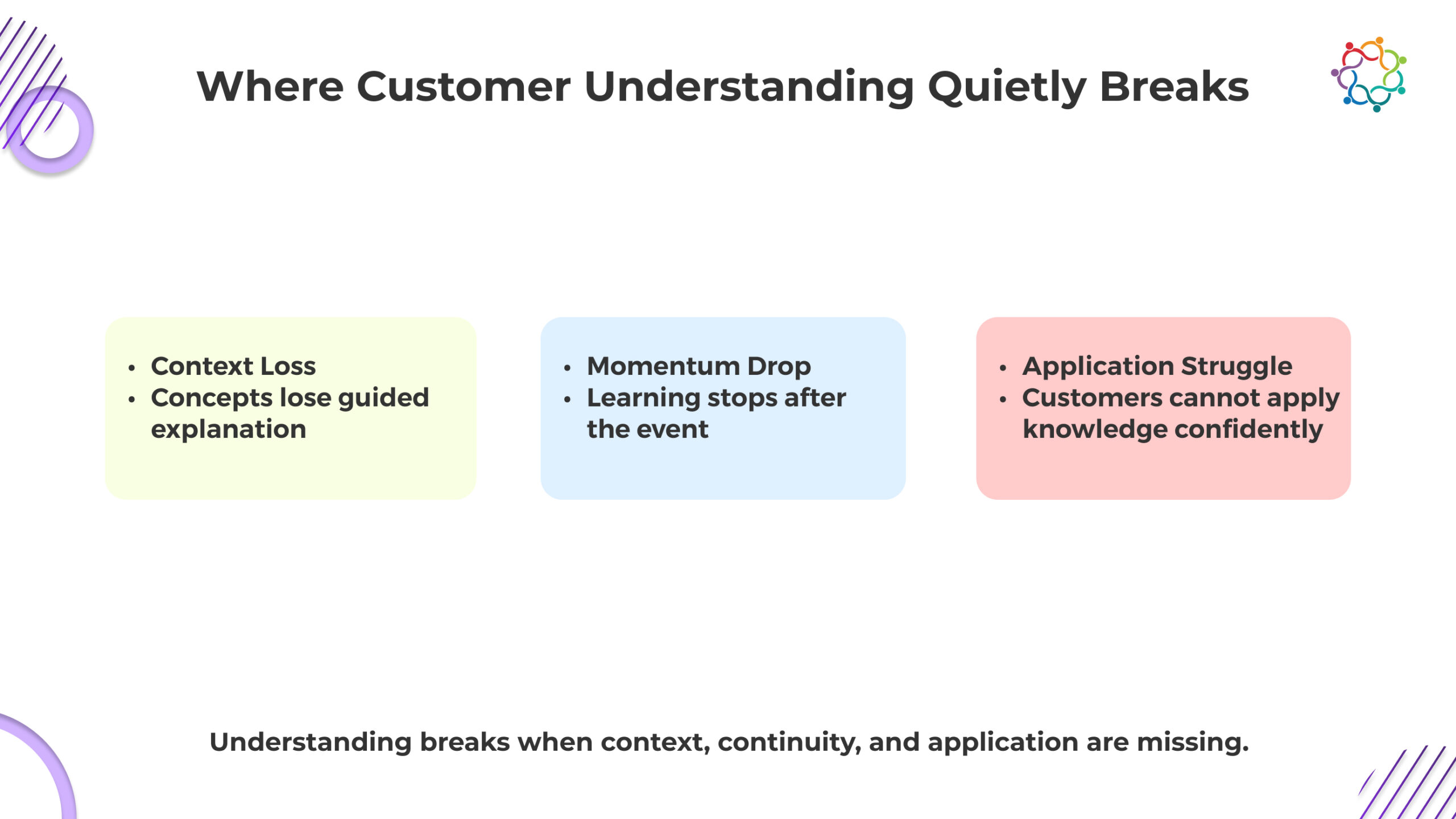
Customer confusion does not appear immediately after training. It unfolds in a predictable chain of breakdowns that most organizations fail to recognize until it is too late.
During training, concepts are presented with structured guidance. Examples are explained step by step. The logic behind workflows is made explicit. Customers rely on this context to make sense of what they see.
Once the event ends, that context disappears.
Customers are left to interpret product concepts on their own. Without reinforcement, the connections between ideas weaken. What once seemed clear becomes ambiguous. The absence of guided context exposes how fragile the initial understanding was.
Training events concentrate learning into a short burst of activity. This creates temporary momentum. Customers are immersed, attentive, and focused.
But comprehension does not develop in bursts. It requires repetition and reinforcement.
When the learning environment stops, the momentum collapses. Without continued exposure, retention declines rapidly. Customers lose access to the mental pathways they briefly formed during training.
Application is where understanding is tested. And this is where the breakdown becomes visible.
Applying product knowledge requires:
Customers who have only experienced guided learning are not prepared for this shift. They hesitate. They second-guess. They avoid using features they are unsure about.
This is the full breakdown chain:
Guided learning → Independent usage → Confusion → Support dependency
The Customer Clarity Gap is not theoretical. It becomes operational at this stage, where customers move from passive learning to active usage and realize they were never truly prepared.
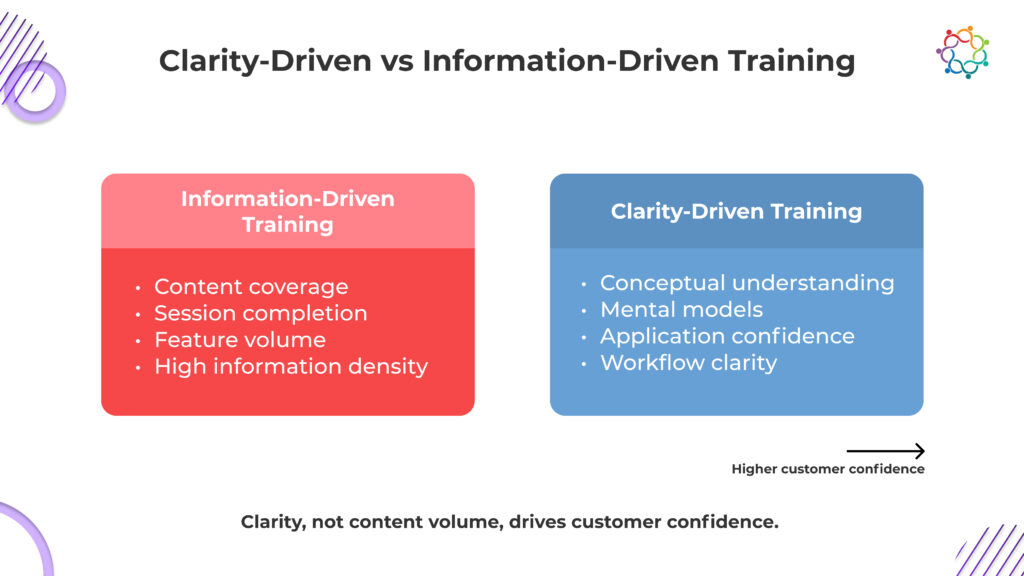
Most training events are not designed to create clarity. They are designed to prove coverage. More features explained, more sessions delivered, more content completed. It feels productive. It is not.
Every additional layer of information without resolution increases ambiguity. Customers leave with more to remember but less ability to decide. They recognize more, but understand less. And that confusion does not stay contained. It shows up the moment they try to use the product without guidance.
If your training is increasing information faster than it is reducing uncertainty, you are actively widening the Customer Clarity Gap.
This is the uncomfortable truth. Your training is not neutral. It is either simplifying the product in the customer’s mind or making it harder to use.
If customers still hesitate after training, the problem is not them. It is the ambiguity you left unresolved.
Customer confidence is often treated as a byproduct of training exposure. This is incorrect.
Confidence is a direct outcome of clarity, not exposure.
Customers feel confident when they understand the logic of the product. When they know how features connect, when to use them, and what outcomes to expect. This clarity allows them to act without hesitation.
Without it, behavior changes immediately:
This is not a capability issue. It is a clarity issue.
Training events directly influence this outcome. If the event builds clear mental models, customers leave ready to act. If it only delivers information, customers leave uncertain.
The Customer Clarity Gap translates directly into confidence gaps.
Organizations that ignore this connection misdiagnose the problem. They assume customers need more training, more sessions, more exposure. In reality, customers need a clearer understanding, not more information.
Confidence does not come from seeing more. It comes from understanding deeply enough to act independently.
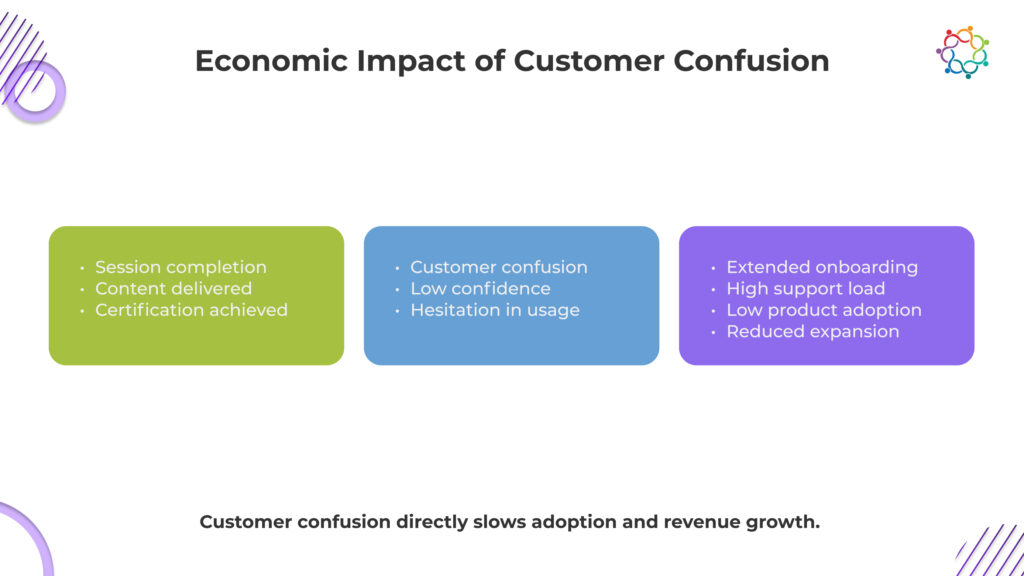
Customer confusion is not just a learning problem. It is a revenue problem.
When training events fail to close the Customer Clarity Gap, the consequences extend across the entire customer lifecycle.
Onboarding timelines extend because customers take longer to reach functional proficiency. Support costs increase as customers rely on assistance for tasks they should be able to perform independently. Product usage remains shallow because uncertainty limits exploration.
This is the hidden cost of ineffective customer training events.
Organizations often focus on the cost of delivering training. They rarely measure the cost of confusion that follows it.
Clarity accelerates adoption. Confusion delays it.
Every unresolved gap in understanding translates into delayed value realization and lost revenue potential. Training events are not just educational touchpoints. They are economic levers that directly influence customer lifetime value.
If the problem is so clear, why do organizations continue to design training events that overload customers?
The answer is uncomfortable.
Organizations reward what is measurable, not what is effective.
Training success is often defined by metrics such as the number of sessions delivered, the features covered, and the completion rates. These metrics are easy to track, easy to report, and easy to scale.
But they do not measure understanding.
As a result, training programs evolve in the wrong direction. More content is added to demonstrate value. More features are included to justify the program. More sessions are created to increase engagement.
Each addition increases information density but does nothing to improve clarity.
The system reinforces the behavior because it produces visible outputs. Content delivery becomes the goal, not customer comprehension.
This is why the Customer Clarity Gap persists. Not because organizations are unaware of the problem, but because their measurement systems reward the wrong outcomes.
Until success is redefined around customer understanding, training events will continue to expand in volume while failing in impact.
Training events are not failing because customers are disengaged. They are failing because organizations confuse exposure with understanding. High attendance and engagement only prove that information was delivered, not that it was absorbed, connected, or applied.
The Customer Clarity Gap persists because training environments create temporary confidence that collapses under real-world usage. When customers cannot act independently, training has not succeeded, regardless of metrics.
Customers don’t struggle because they weren’t trained. They struggle because they never truly understood.
Until clarity becomes the measure, training will continue to underdeliver where it matters most.
For teams trying to understand whether customer education is actually driving product clarity, the approach must shift from tracking participation to interpreting how customers engage, process, and retain learning beyond the event.
Because customer education is not complete when the session ends. It is complete when clarity translates into confident product usage.