Samaaro + Your CRM: Zero Integration Fee for Annual Sign-Ups Until 30 June, 2025
- 00Days
- 00Hrs
- 00Min

Key Takeaways (TL;DR)
In 2026, B2B events rarely begin with an event website or a registration form. They begin with a scroll. Buyers learn about events through discussions they witness, people they trust, and ideas that speak to issues they are already concerned about. Long before a decision to register is made, LinkedIn has subtly emerged as the true front entrance to business-to-business gatherings. This shift has forced teams to rethink LinkedIn event marketing strategy as a core growth lever rather than a promotional add-on.
Event websites still matter, but they no longer create first impressions. Email still drives reminders, but it rarely builds conviction. Buyers now arrive at event pages already influenced by what they have seen on LinkedIn: who is speaking, who is engaging, and how the event shows up in public discourse. This is especially true for complex buying committees where trust must be earned collectively, not sold individually.
For field and event marketing leaders, this means ownership extends beyond promotion. LinkedIn shapes who trusts the event, who shows up informed, and who is open to conversation afterward. The platform affects downstream pipeline impact, engagement depth, and attendance quality. Using LinkedIn as a lifecycle channel recognizes the true behavior of contemporary B2B buyers and lays the groundwork for events that are more revenue-aligned and believable.
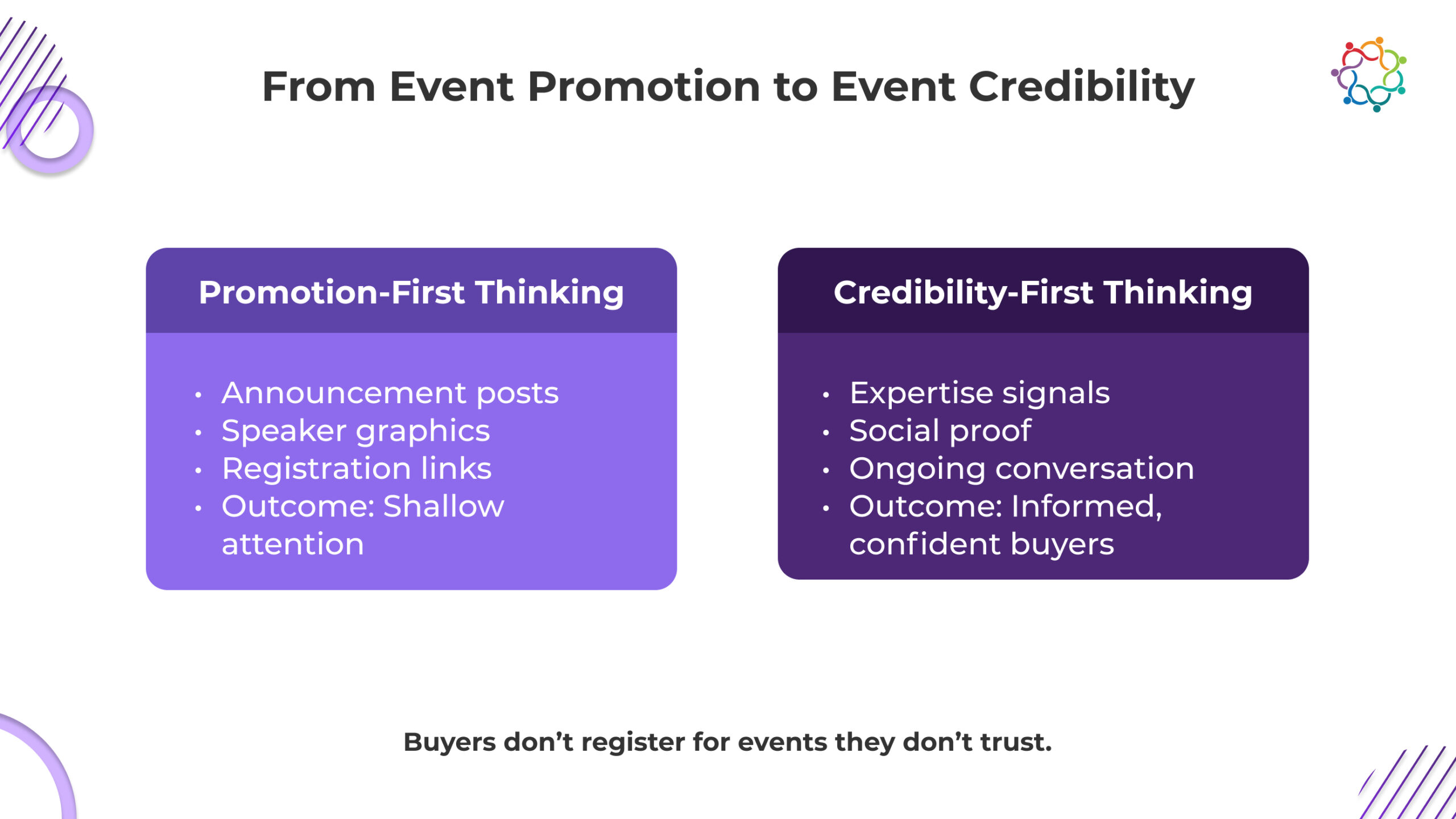
In 2026, B2B buyers do not decide to attend events based on how often they see a registration link. They decide based on whether the event feels relevant and worth their time. This shift requires teams to rethink how they use LinkedIn and reposition LinkedIn event marketing strategy around trust rather than promotion. The change can be understood through four core ideas.
Why promotion-first thinking no longer works
Announcement posts and speaker graphics create awareness but rarely conviction. Buyers are overwhelmed with event invitations and have learned to ignore anything that feels purely promotional. Without visible substance, promotion blends into background noise.
Credibility is the real driver of registration decisions
Buyers register when they believe an event will deliver insight. Credibility reduces perceived risk and increases confidence. On LinkedIn, credibility is built through thoughtful perspectives, consistent expertise, and visible seriousness around the topic.
How LinkedIn enables trust before buyers take action
LinkedIn allows buyers to observe quietly. They evaluate who is involved, how they communicate, and how others respond. Comments, discussions, and peer engagement act as social proof long before registration happens.
What changes when credibility leads the strategy
Registrations may decline when trust is prioritized, but attendance quality increases. Conversations get deeper, attendance rates rise, and follow-up after an event becomes more organic.
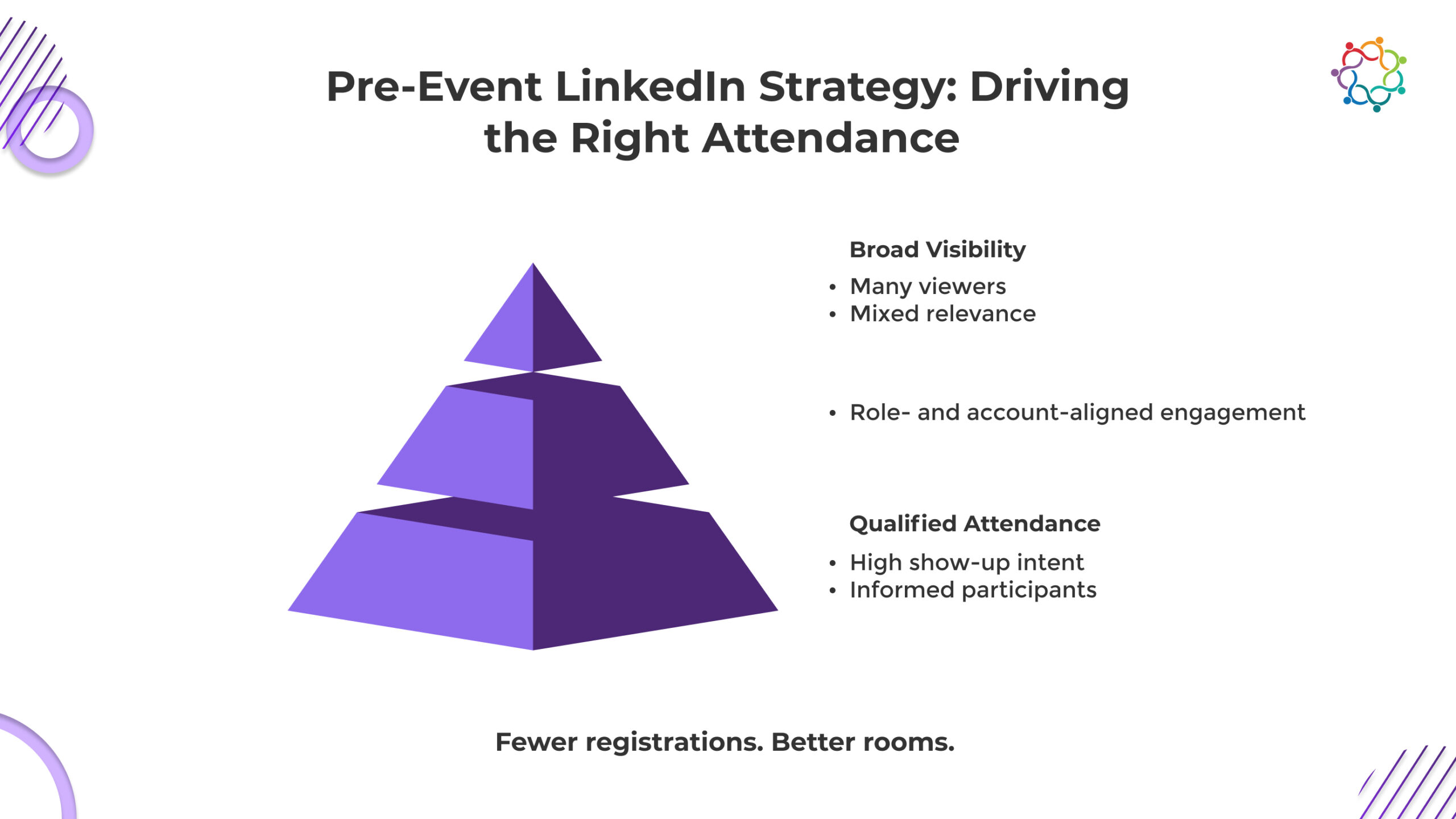
A strong pre-event LinkedIn presence is not about awareness. It is about setting expectations early and shaping who chooses to show up. In 2026, effective event teams use LinkedIn as a qualification layer long before registration opens.
Pre-event content should make it immediately clear who the event is for – by role, seniority, and problem context. When buyers recognize their own challenges in the language used, they self-select in. When they don’t, they quietly opt out. This reduces poor-fit registrations and increases confidence among ideal attendees.
Insight-led posts act as the first filter. Opinions, trade-offs, and practical observations attract buyers who already understand the problem space and disengage casual interest. That filtering improves attendance quality before a landing page is ever visited.
LinkedIn also sets expectations around depth. Serious discussion signals that the event will prioritize substance over surface-level promotion. This leads to better show-up rates, stronger on-site engagement, and more productive conversations.
The objective is not volume. It is predictable, relevant attendance that marketing and sales teams can actually use.
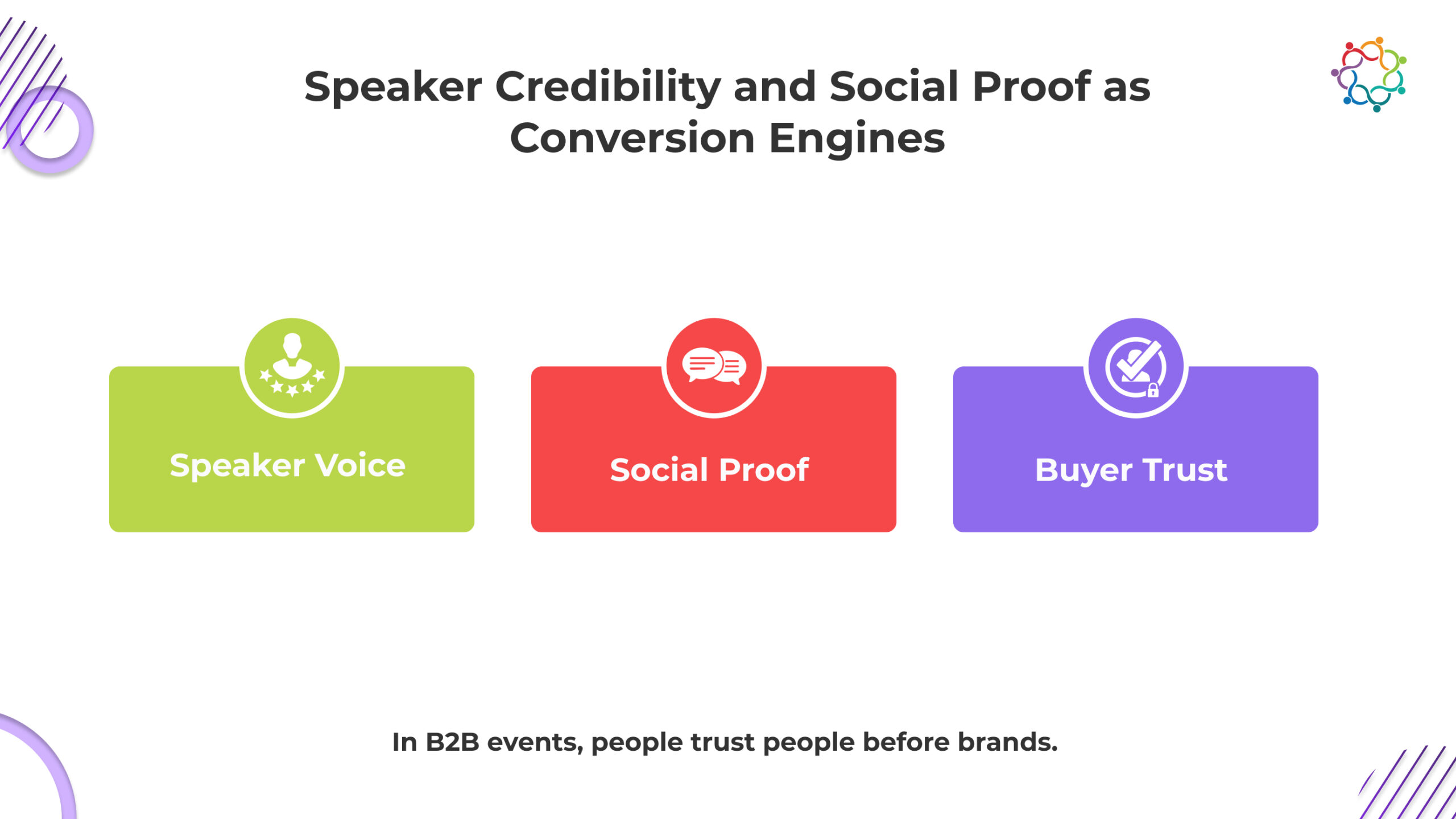
In B2B events, speakers often matter more than the hosting brand. Buyers trust people before logos, especially when evaluating whether an event will deliver meaningful insight. This makes speaker presence on LinkedIn one of the most powerful drivers of registration confidence within any LinkedIn event marketing strategy.
When speakers actively share their perspectives on the event topic, they create borrowed trust. Their existing credibility transfers to the event, which reduces perceived risk for potential attendees. This trust cannot be manufactured through corporate promotion alone. It must be visible, authentic, and sustained over time.
Activating speaker voices means encouraging them to engage in genuine conversation around the themes they will address. Their posts, comments, and interactions serve as social proof that the event will offer depth rather than surface-level discussion.
Peer validation amplifies this effect. When other respected professionals comment thoughtfully or reference the speaker’s ideas, it creates a visible credibility loop.
This approach positions speakers as educators, not promoters, and makes the event feel like a natural extension of an ongoing professional conversation.
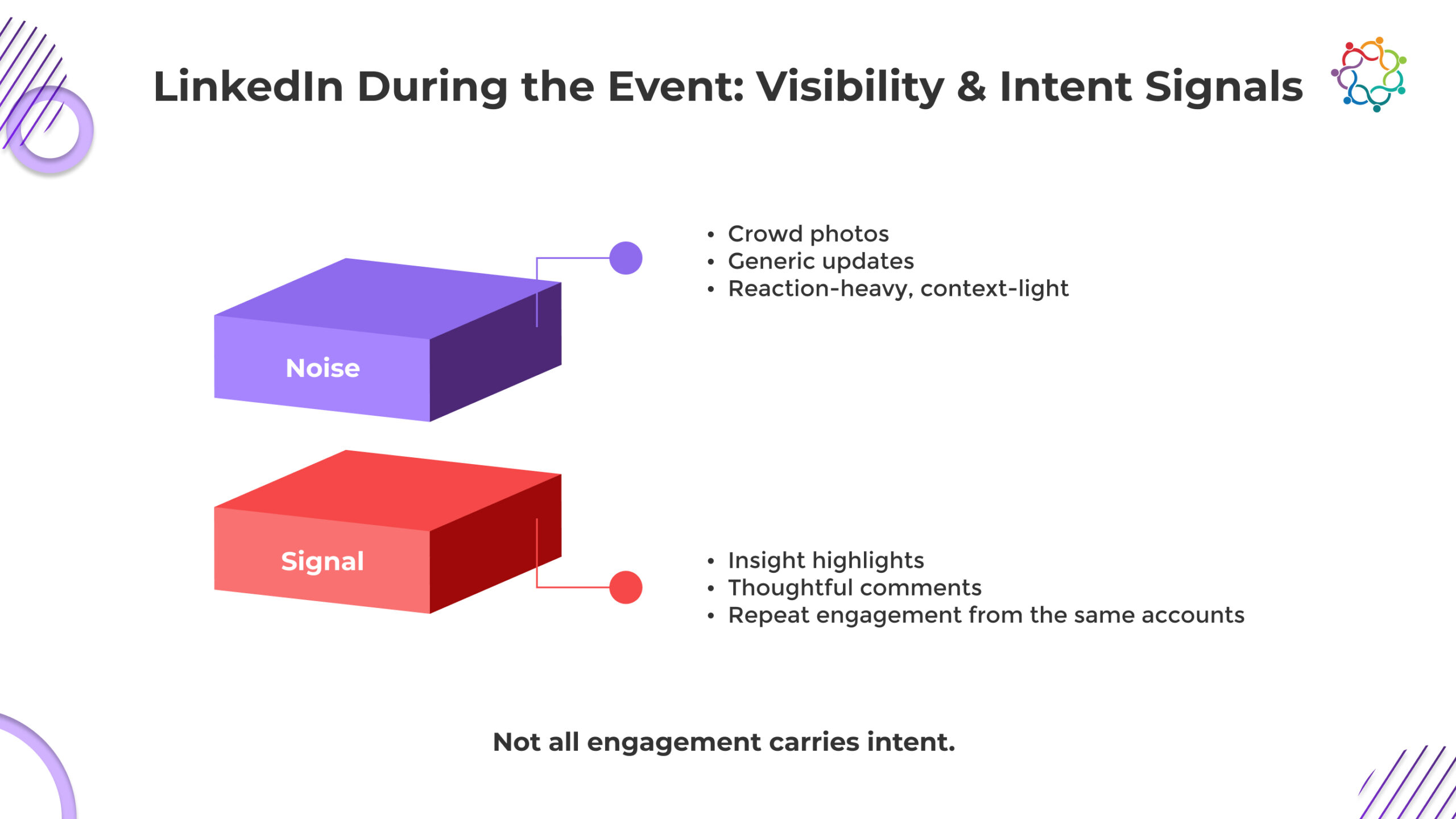
Live posting during events is often misunderstood. Many teams default to high-frequency updates that add noise without insight. In contrast, a mature LinkedIn event marketing strategy treats live visibility as signal amplification, not real-time documentation.
During the event, LinkedIn should surface moments that matter, not everything that happens. Buyers following along are not looking for proof that the event exists. They want evidence that meaningful conversations are taking place. This requires restraint and intentionality.
Effective live content highlights ideas, not attendance. A single post capturing a compelling insight can create more impact than dozens of generic updates. This also respects the experience of attendees, allowing them to stay present rather than feeling pressured to perform online.
Refrain from flooding feeds with images, hashtags, or vague enthusiasm. Posting too much can lower engagement quality and weaken credibility.
The impression that the event itself prioritizes content over spectacle is strengthened when LinkedIn content from the event seems deliberate and measured.
LinkedIn engagement during an event provides valuable context when interpreted carefully. Reactions and comments are not direct attribution metrics. Instead, they act as directional signals that support relationships and sales intelligence. A realistic LinkedIn event marketing strategy focuses on patterns instead of numbers.
Who engages matters more than how many engage. Comments from relevant roles, repeat interactions from the same accounts, and thoughtful responses indicate genuine interest.
A detailed comment often reflects deeper engagement than a reaction. When the same individuals engage multiple times across event-related posts, it suggests sustained interest rather than casual browsing. Sales teams can use this information responsibly by treating it as context, not triggers.
This approach avoids intrusive outreach and supports more informed dialogue. LinkedIn becomes a shared layer that helps marketing and sales understand engagement depth without overclaiming causation.
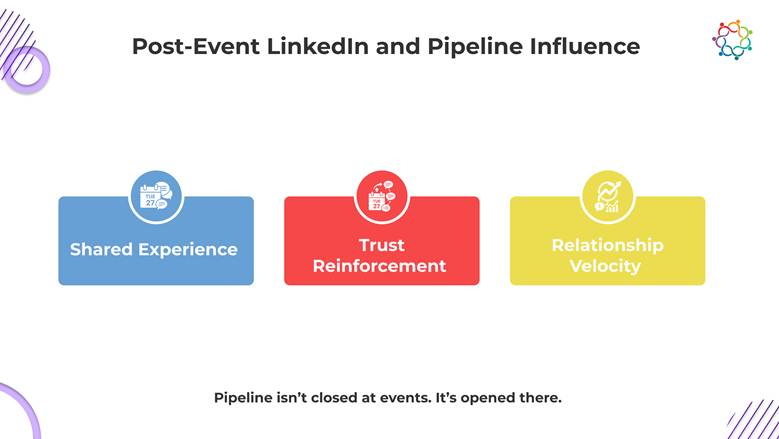
For many B2B teams, the event ends when the booth is packed up or the venue clears. In reality, this is when LinkedIn’s influence becomes most valuable. Post-event activity is where relationships mature, and pipeline influence takes shape. A strong LinkedIn event marketing strategy prioritizes continuation over recap.
Generic event summaries rarely move deals forward. What matters is extending the conversations that began during the event. This includes sharing follow-up insights, responding to public comments, and opening private dialogues grounded in shared context.
Post-event content should support follow-up. Buyers are more receptive when discussions feel like a natural next step rather than a sales pitch. Sales teams can reference event themes, shared moments, or public exchanges to reopen the conversations with relevance and respect.
When trust continues to build after the event, pipeline influence becomes more efficient. LinkedIn supports this by keeping conversations contextual and connected to real interactions.
Events rarely create immediate pipeline in B2B. Their value lies in influence over time, not attribution. LinkedIn is what allows that influence to persist across long sales cycles, multiple stakeholders, and delayed decisions.
Post-event LinkedIn activity keeps key ideas visible during gaps in the sales process. When buyers continue to encounter familiar themes, speakers, or discussions in their feed, momentum is reinforced without forcing premature outreach.
This visibility also reactivates dormant or passive accounts. Engagement with event-related content signals renewed curiosity without a formal hand-raise, creating a natural and contextual re-entry point for sales.
Most importantly, LinkedIn extends event influence across the buying committee. Different stakeholders engage at different moments, allowing trust and relevance to build asynchronously rather than all at once.
Attribution oversimplifies this reality. Influence reflects it. Teams that measure progression instead of credit align event strategy with how revenue actually forms.

Want to see how this would work for you?
See how Samaaro pulls LinkedIn engagement into your event funnel and CRM, directly.
Book a tailored walkthroughMisalignment between marketing and sales often undermines event ROI. Depending on how teams collaborate, LinkedIn can either widen this gap or help close it. A shared LinkedIn event marketing strategy creates clarity around roles, signals, and behavior.
Sales teams need visibility into what marketing activity means, not just what it produces. This includes understanding which engagement signals matter and how to use them without resorting to spammy outreach. Marketing, in turn, benefits from knowing what context sales finds useful.
When marketing and sales operate from the same assumptions, LinkedIn becomes a trust-building environment rather than a lead-harvesting tool.
In 2026, LinkedIn should be considered a strategic environment. Teams planning events must decide when LinkedIn deserves priority and when other channels may suffice. Asking the right questions matters more than choosing the right tools.
Before planning an event, teams should reflect on whether the target audience actively builds trust on LinkedIn. For senior, committee-based buyers, the answer is often yes. In these cases, depth of presence matters more than frequency of posting.
Answering these honestly helps teams design events that align with how buyers discover, evaluate, and engage in 2026.
(Also Read: Mastering Event Promotion on LinkedIn: A Comprehensive Guide)
B2B events no longer compete on agendas alone. They compete on trust. In 2026, that trust is built in public, through visible expertise, credible voices, and sustained conversation. LinkedIn is where this process unfolds.
Attendance follows belief. Buyers show up when they are confident the event will respect their time and intelligence. That confidence is shaped long before registration, influenced by what they see and who they trust.
A modern LinkedIn event marketing strategy treats the platform as an end-to-end growth environment. It supports discovery, credibility, engagement, and pipeline influence without forcing artificial metrics or shortcuts.
Events that win in 2026 earn relevance before they start, reinforce it during the experience, and extend it long after. LinkedIn is not a distribution channel in this context. It is where B2B events prove they matter.
(If you’re thinking about how these ideas translate into real-world events, you can explore how teams use Samaaro to plan and run data-driven events.)