Samaaro + Your CRM: Zero Integration Fee for Annual Sign-Ups Until 30 June, 2025
- 00Days
- 00Hrs
- 00Min

Key Takeaways (TL;DR)
Enterprise attention has become one of the scarcest resources in 2026. Buyers are better informed, calendars are tighter, and decision-making groups are larger and harder to coordinate. In this environment, the assumption that event success depends on scale is starting to fracture. Leadership teams are increasingly questioning why large, expensive events generate so much activity but so little clarity.
For years, event strategy was built around visibility. More attendees meant more relevance. Bigger rooms implied greater impact. Yet enterprise teams now see a growing disconnect between attendance numbers and business outcomes. Sales conversations are rushed. Engagement diffuses across too many interactions. Feedback exists, but rarely points to a clear next step.
What is emerging instead is a shift toward deliberate, smaller formats that prioritize relevance over reach. These are not scaled-down flagship events or budget-driven compromises. They are intentional investments designed to improve alignment, learning, and decision movement. The rise of micro-events reflects a broader change in how enterprise teams think about engagement, attention, and return on effort.
Success is being redefined. With the right participants in the room, fewer voices often lead to better discussions, faster insight, and greater confidence in decisions. This blog explores why that shift is happening and why it matters now.
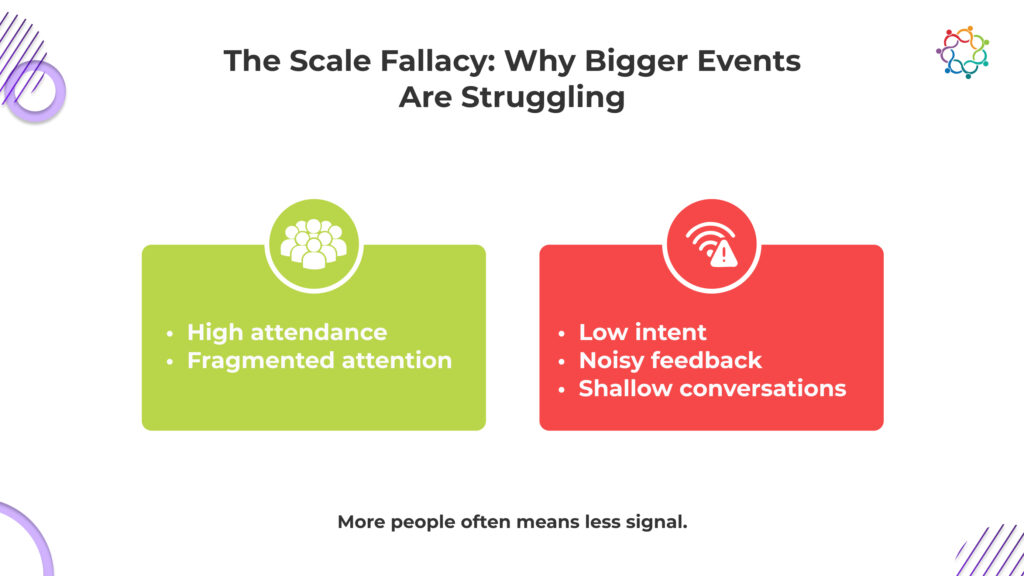
Large events are not failing because teams lack ambition or effort. They struggle because scale introduces friction that enterprise organizations can no longer ignore. As events grow, attention fragments, conversations compress, and the conditions required for meaningful engagement quietly disappear.
At large events, attendees are constantly pulled in multiple directions – parallel sessions, back-to-back meetings, networking zones, side conversations. Focus becomes transactional. Conversations that require context, continuity, and time are cut short or deferred indefinitely. The event may look busy, but cognitive bandwidth is thin.
This fragmentation is especially damaging in enterprise buying environments. Complex deals depend on trust, nuance, and sustained dialogue across multiple stakeholders. One-to-many formats struggle to accommodate layered concerns or align different decision-makers in a coordinated way. The result is surface-level interaction where depth is required most.
Scale also creates a signal problem. High activity produces impressive volume – booth scans, session check-ins, survey responses, but very little clarity. Teams leave with dashboards full of numbers that are difficult to interpret and harder to act on. Intent, readiness, and next steps remain ambiguous despite the apparent success of the event.
All of this comes at a rising cost. Venue size, travel, production, and sponsorship expenses escalate quickly, while attribution remains murky. When outcomes are unclear, leadership stops asking how to improve the event and starts questioning whether the scale itself is worth defending.
The core issue isn’t execution. It’s the assumption that size guarantees impact. That assumption no longer aligns with how enterprise buyers make decisions or how revenue teams are expected to operate today.
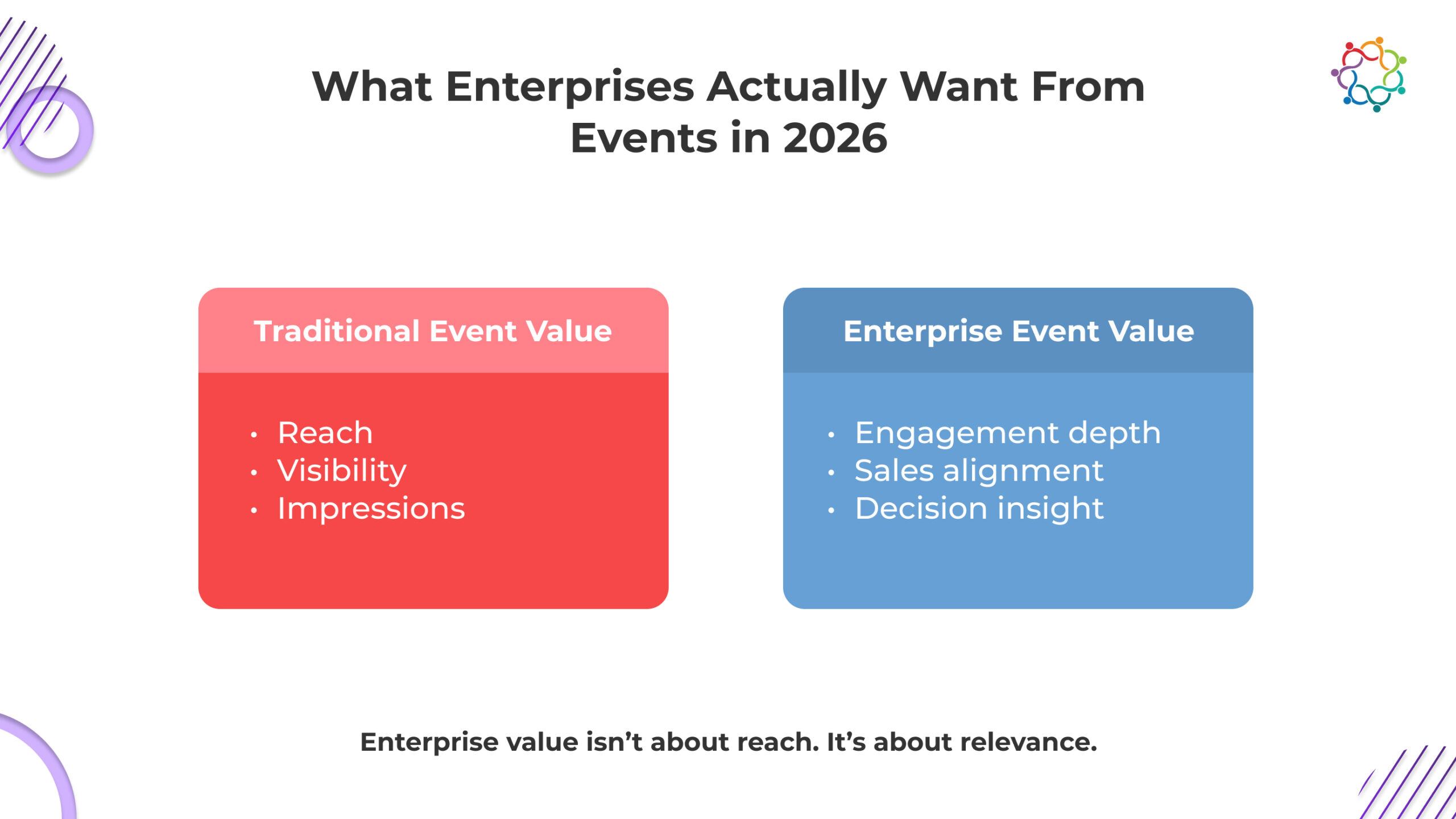
Enterprise teams are no longer satisfied with events that simply generate awareness. They expect events to move decisions forward. In 2026, value is defined less by how many people attend and more by what changes as a result of those interactions. What enterprises are actively looking for includes:
Teams want conversations that surface real priorities, objections, and constraints, not surface-level engagement that ends when the event does.
Events should help align multiple decision-makers in the same context, reducing the need for weeks of follow-up to reconstruct intent and consensus.
Leadership expects quick, actionable feedback on messaging, positioning, and product relevance. Events must generate signals that inform decisions without long delays.
Events deliver value when sales teams can engage directly, learn from buyers, and influence outcomes without competing for attention in crowded environments.
These expectations naturally favor smaller, more focused formats. They align with enterprise priorities around engagement depth, audience precision, and revenue clarity. Micro-events are not a passing trend. They are a direct response to what enterprises actually need from events today.
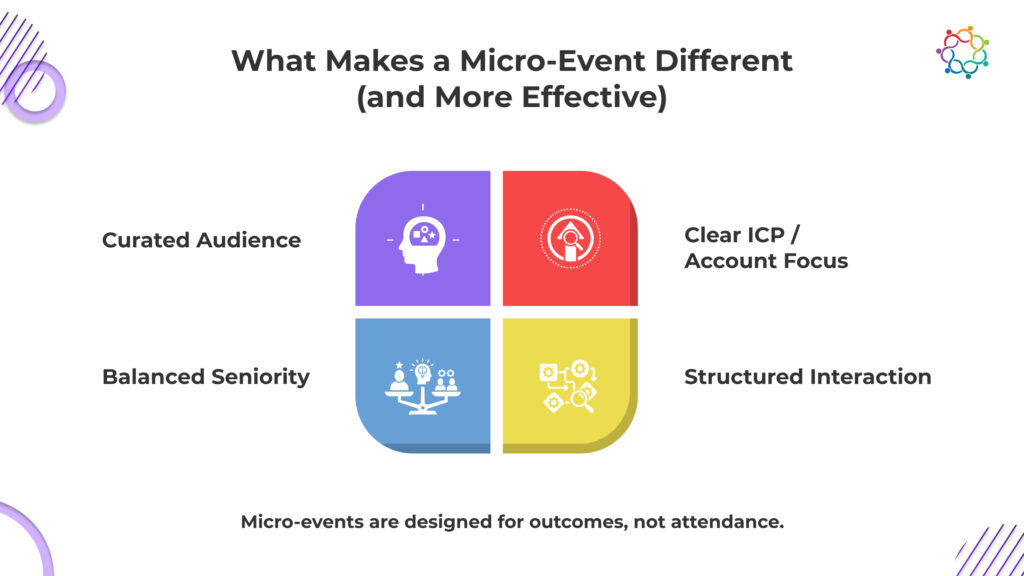
Micro-events are often misunderstood as simply smaller versions of traditional events. In reality, they represent a different design philosophy altogether. Their effectiveness comes from intentional constraints that force clarity and focus.
At the heart of this approach is curation. Attendance is defined by relevance, not availability. Audiences are selected based on clear criteria such as role, account fit, or buying stage. This makes sure that conversations are immediately meaningful and aligned.
Another defining feature is structure. Micro-events prioritize interaction over passive consumption. Sessions are designed to encourage discussion, debate, and shared problem-solving. This creates space for deeper engagement and more honest exchanges.
Key characteristics typically include:
This is where the micro-events strategy becomes critical. Success depends on intentional design choices that align audience, content, and outcomes. These events are not about filling seats. They are about creating environments where the right conversations can happen efficiently and effectively.
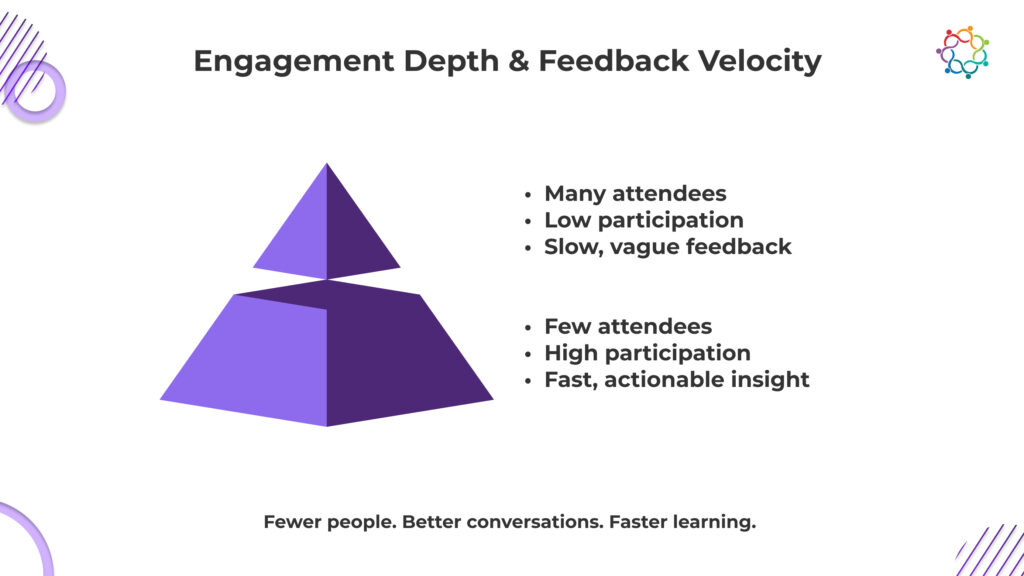
As the room gets smaller, engagement changes fundamentally. Distractions drop and accountability rises. Participants are no longer anonymous attendees; their presence carries weight. Contribution is expected, not optional. Events shift from being attendance-driven to participation-driven, which is where meaningful value begins.
Smaller groups reduce social hiding. People speak more freely, ask sharper questions, and listen more closely because the conversation depends on them. Dialogue becomes two-way rather than performative.
This environment also changes the quality of discussion. Without the pressure of stagecraft or promotion, buyers are more willing to surface real constraints, competing priorities, and unresolved concerns. Conversations last longer and move beyond surface agreement into nuance.
When multiple stakeholders are present, buying dynamics become visible. Alignment, hesitation, and influence can be observed directly instead of inferred later. For sales teams, this visibility is often more instructive than hundreds of disconnected interactions. Depth replaces guesswork with understanding.
One of the most practical advantages of micro-events is how quickly teams learn from them. In smaller settings, feedback is immediate, contextual, and specific. Teams don’t need to interpret meaning from aggregated surveys or stitched-together notes.
Because discussions are more candid, patterns emerge faster. Objections repeat. Interests cluster. Priorities sharpen. This accelerates learning not just for sales, but across marketing, product, and leadership teams.
The timing matters as much as the content. Feedback is often processed while the experience is still unfolding, sometimes in the same room. Assumptions can be tested and reframed immediately, rather than weeks later in a post-event report.
This shortens learning cycles and increases confidence in decisions. In contrast, high-volume environments often delay insight until momentum is already lost.
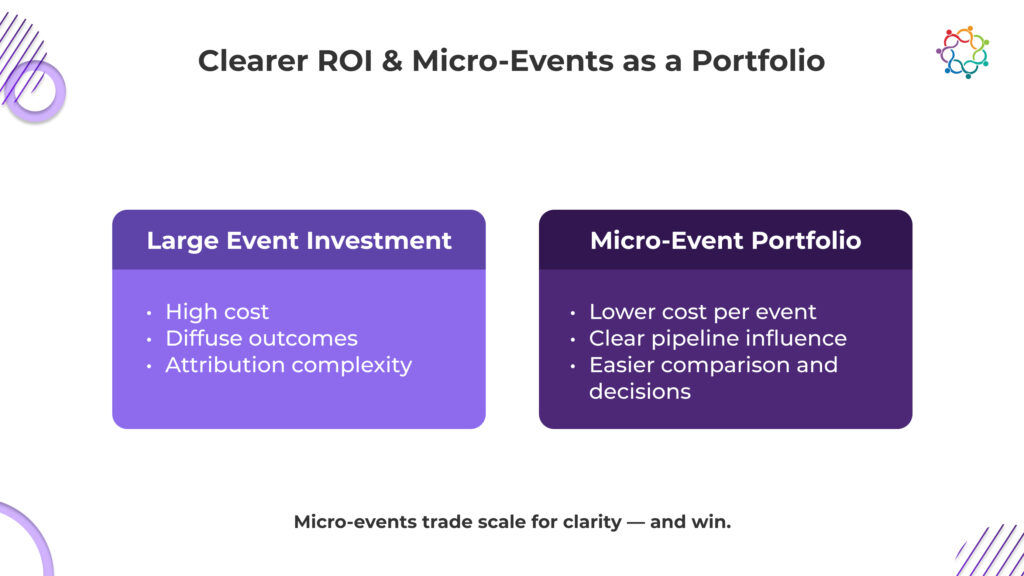
Large events generate numerous touchpoints that are difficult to isolate and even harder to interpret. Measurement has always been challenging at scale, particularly when goals are diffuse. Micro-events reduce this complexity by narrowing focus and variables.
When attendance is intentional and objectives are explicit, it becomes easier to connect participation to pipeline movement or deal progression. Teams can identify which conversations mattered and why, leading to more honest evaluations of impact.
While micro-events may cost more per attendee, they often cost less per meaningful interaction. This reframes ROI discussions away from volume justification and toward outcome credibility.
Measurement becomes less about defending activity and more about understanding influence. The goal isn’t perfect attribution. It’s realistic clarity. When noise drops, insight rises, and decisions improve as a result.
Treating micro-events as isolated experiments limits their value. Enterprises that see the strongest results think in terms of portfolios rather than individual events. Each micro-event serves a specific purpose within a broader engagement strategy.
Different formats can support different stages of the pipeline. Some may focus on early-stage education, while others facilitate late-stage alignment or customer expansion. Sequencing these events creates momentum and continuity.
This portfolio mindset also allows teams to compare investments more objectively. Micro-events and large events become options within a spectrum, evaluated based on expected outcomes rather than tradition.
Opportunity cost is an important consideration. Defaulting to scale can crowd out more precise investments. A thoughtful micro-events strategy confirms that resources are allocated where they can create the most impact.
By viewing micro-events as a strategic asset rather than a tactic, enterprises elevate their role from experimental to essential.
Adopting micro-events is not just a change in event format. It requires a fundamental shift in how teams define success. For years, visibility and scale were treated as a replacement for impact. In 2026, that equation no longer holds. Enterprise teams need to prioritize clarity, alignment, and decision support over reach. That shift begins before planning starts, with more deliberate thinking about purpose and outcomes.
Not every event needs to be widely seen to be valuable. Teams should focus on whether an event advances understanding, alignment, or momentum rather than how many people it attracts.
Leaders must decide when focused engagement delivers more value than broad exposure. Certain audiences and buying stages benefit far more from smaller, curated interactions.
Micro-events only work when sales and marketing agree on objectives, audience selection, and success criteria. Misalignment undermines focus and outcomes.
Fewer, well-aligned events often outperform a packed calendar. Discipline in what not to do is as important as execution.
When micro-events are intentional, aligned, and measured honestly, they reward teams with insight, confidence, and clearer decision-making.
As buyer behavior shifts, enterprise events are being forced to evolve with it. Attention is no longer granted by scale or visibility. It is constrained, selective, and governed by relevance. In this environment, precision consistently outperforms presence.
Micro-event strategies are not a reaction to budget pressure, nor are they a tactical compromise. For teams that understand the cost of distraction, they represent a structural advantage. By prioritizing engagement depth, feedback quality, and ROI clarity, organizations can design events that actively move decisions forward rather than merely support awareness.
A well-executed micro-event strategy accepts a hard truth: under the right conditions, fewer participants produce stronger outcomes. Being everywhere will not earn attention in 2026. Presence no longer earns attention. Precision does. Attention is earned in focused, high-intent settings where conversations shape decisions.