Samaaro + Your CRM: Zero Integration Fee for Annual Sign-Ups Until 30 June, 2025
- 00Days
- 00Hrs
- 00Min


Bottom Line:
Sales kickoff events fail when inspiration is treated as transformation instead of being embedded into operational systems that enforce behavior change.
Sales kickoff events are remembered as high points in the revenue calendar. Energy peaks. Leadership clarifies direction. Product and marketing align around a shared narrative. For a few days, the organization feels synchronized and focused.
Then everyone returns to the field.
Within weeks, selling patterns look familiar. Qualification remains inconsistent. Messaging drifts. Forecast variability continues. The intensity of the moment does not translate into sustained execution change.
This is the paradox. The experience feels successful. The behavior does not materially shift.
The issue is not effort, budget, or production quality. It is structural design. Inspiration is treated as transformation. Alignment is mistaken for adoption. Applause is interpreted as progress.
Sales kickoff events rarely fail in the room. They fail in the weeks that follow.
(Read: The Ultimate Guide to Integrating Sales Enablement and Event Marketing)
This blog covers why motivation decays, why execution resists inspiration, and what must structurally change for sales behavior to actually move.
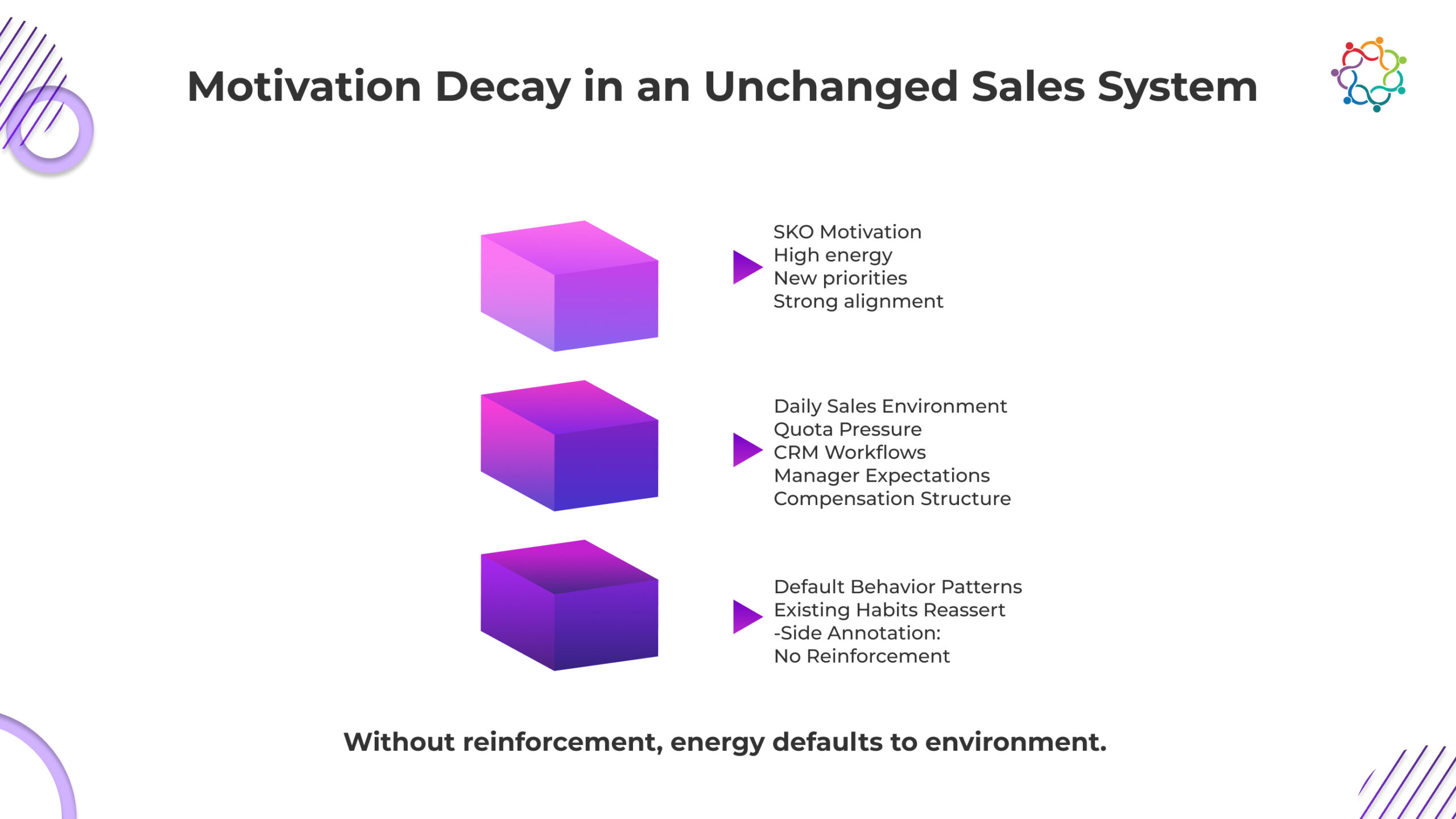
Motivation reliably spikes during the kickoff. The problem is that you expect that spike to survive in an unchanged environment. It will not.
Sales behavior is not shaped by how inspired your team felt for two days. It is shaped by quota pressure, compensation design, CRM workflows, pipeline scrutiny, and manager inspection. If none of those changed after the event, why would behavior change?
Motivation is temporary and context-bound. The context during the event is controlled, focused, and emotionally charged. The context back in the field is chaotic, metric-driven, and unforgiving. When those two environments collide, the operational one wins every time.
Reps do not abandon new priorities because they disagree. They abandon them because the system does not require adoption. Forecast calls still prioritize volume. Managers still coach the old way. Incentives still reward the same behaviors.
If the operating environment remains intact, old patterns will reassert themselves. Energy fades. Habits remain.
If you did not redesign how behavior is reinforced after the event, you did not design change.
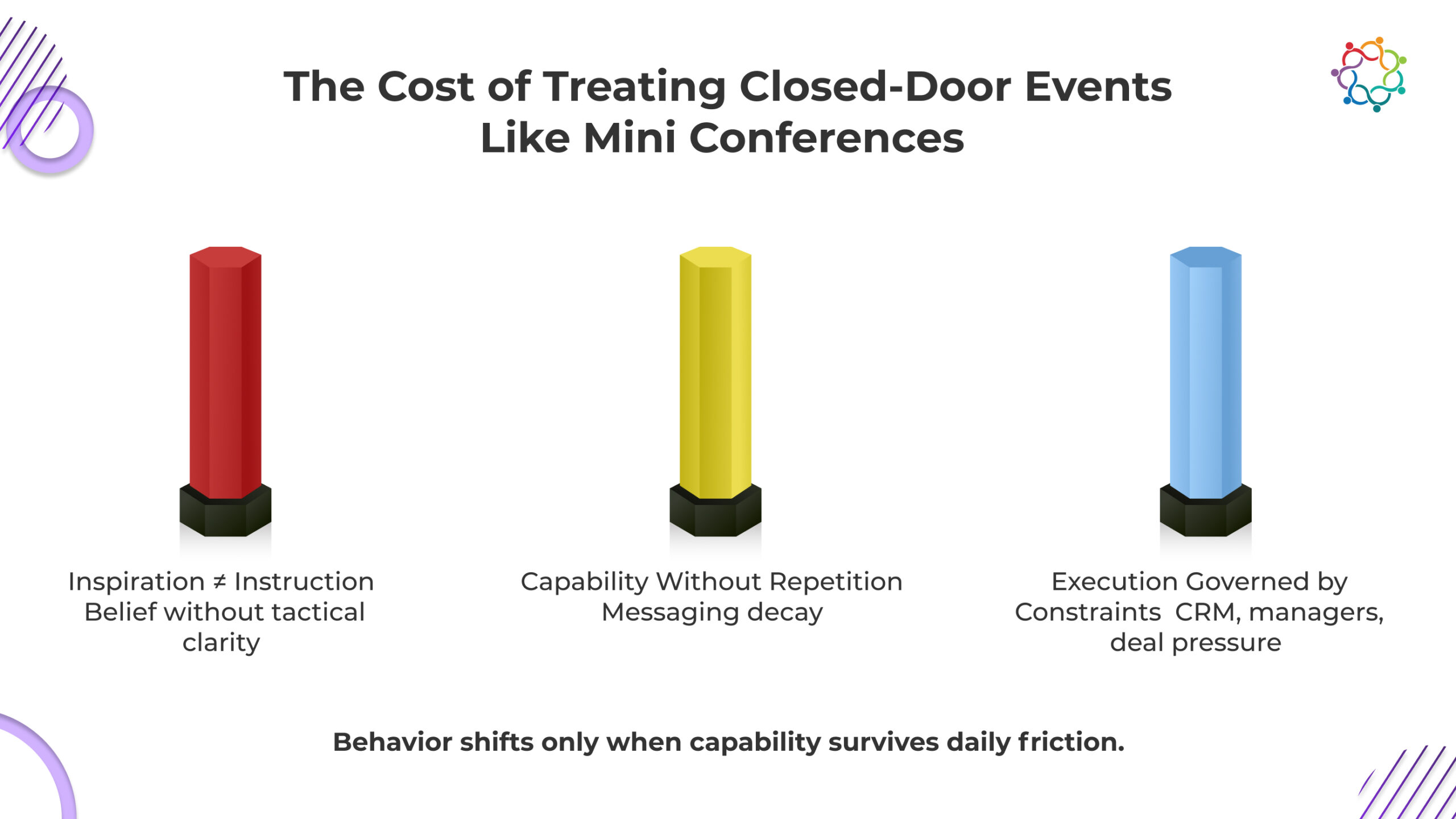
Sales kick-off events often blur the line between belief and behavior. Teams leave convinced the strategy is right. That conviction is mistaken for readiness. Agreement is not execution. Until priorities are translated into enforced daily actions, nothing materially changes.
Vision creates belief. It does not create skill. Reps may understand the new direction but remain unclear on what to do differently in live deals.
Key gaps typically include:
Without procedural clarity, sellers default to familiar routines. Alignment without instruction produces confidence, not capability.
Even when new frameworks are introduced, they fade without repetition. Memory weakens. Confidence drops. Quota pressure pushes reps back to proven scripts.
Common failure points:
What is not reinforced is not retained.
Selling behavior follows incentives and inspection. If CRM stages, pipeline reviews, and compensation plans remain unchanged, priorities remain unchanged.
Execution responds to:
If the system does not move, behavior will not move.
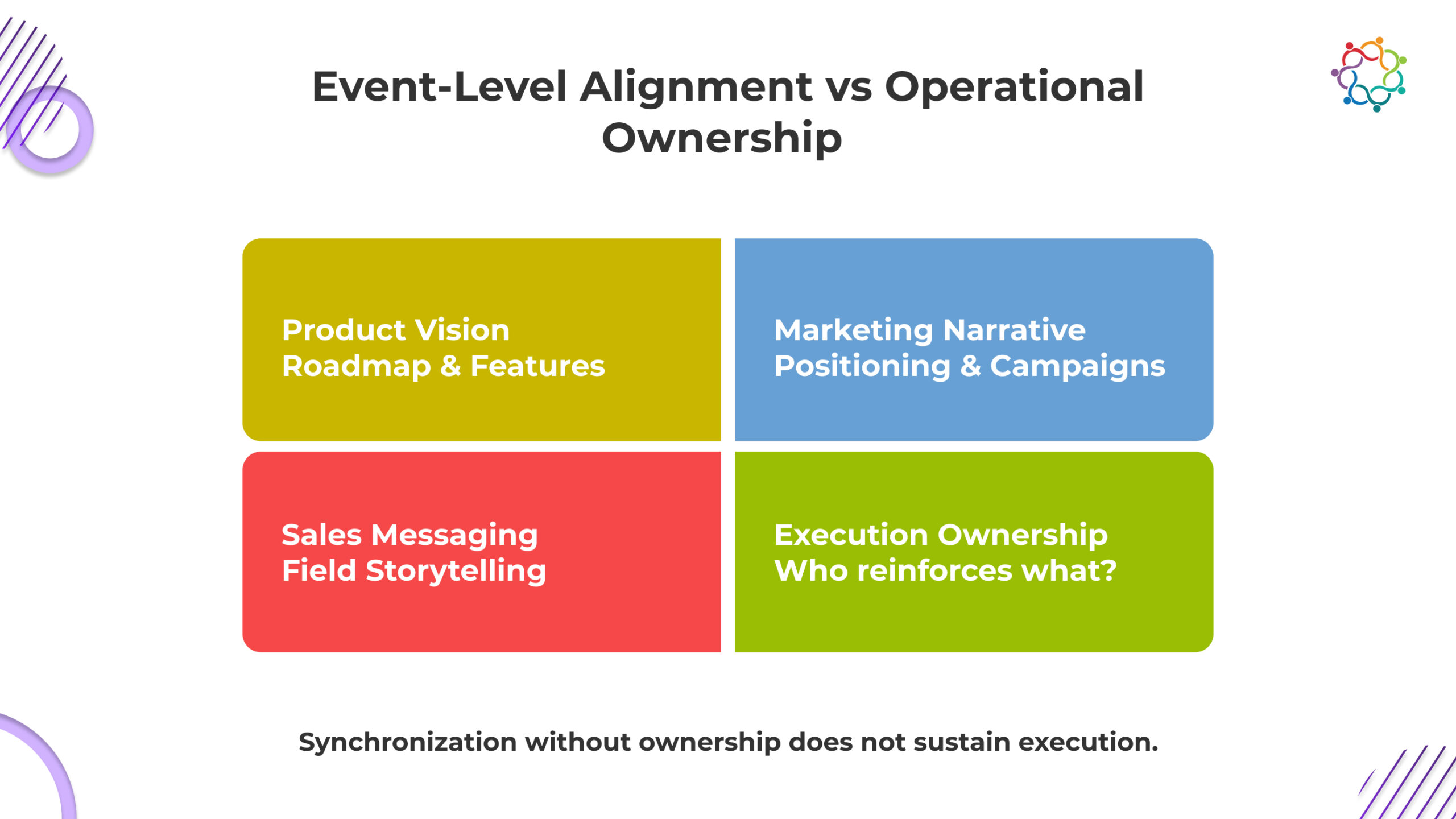
Alignment is frequently declared at the end of the event. Messaging appears unified. Strategy feels shared. Teams leave believing they are synchronized. But alignment inside a ballroom does not guarantee alignment inside a live deal. When cross-functional priorities are not translated into execution ownership, fragmentation resurfaces quickly.
Product roadmaps are often presented in terms of innovation and differentiation. What is missing is direct mapping to customer objections, competitive pressures, and pricing resistance. Without translating vision into field-level conversations, reps struggle to operationalize what they heard.
Marketing introduces refined positioning and value propositions. However, if those narratives are not tested against real buyer pushback, they remain theoretical. Messaging must survive scrutiny in live calls, not just on stage.
Leadership may announce new target segments or deal strategies. If CRM stages, qualification criteria, and compensation models remain unchanged, those priorities lack enforcement. Process must reflect strategy.
True alignment requires ownership beyond presentation. Product, marketing, and sales must co-own reinforcement. Without coordinated follow-through, alignment dissolves at first friction.
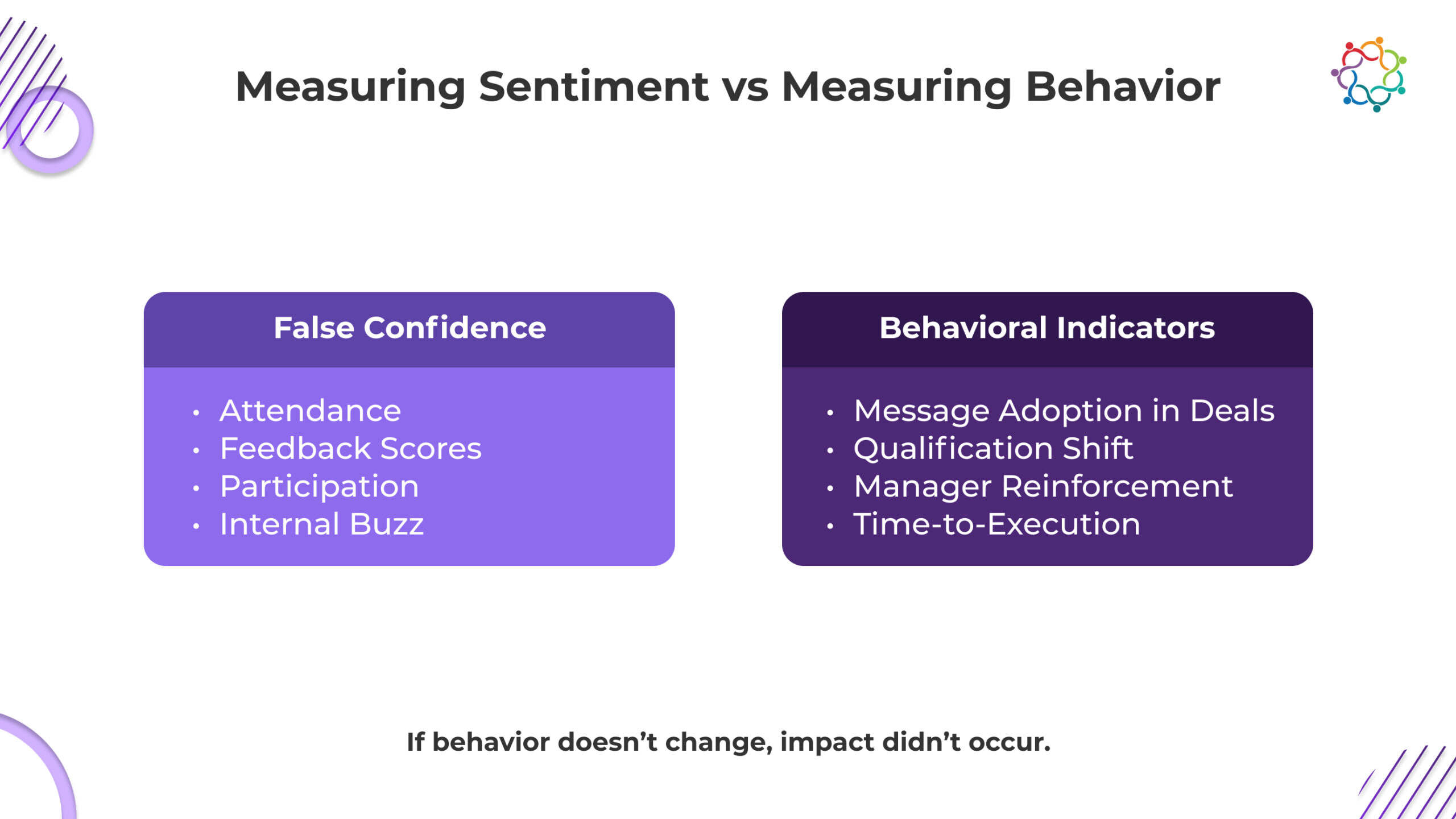
Organizations often measure what is visible during the event rather than what changes afterward. Attendance rates, participation levels, and session feedback scores create a perception of success. They capture sentiment. They do not capture adoption.
High attendance is expected. Positive feedback is common when events are well produced. Internal social sharing generates visible enthusiasm. These indicators feel reassuring because they are immediate and quantifiable.
However, they reflect emotional response, not behavioral shift. A rep can rate a session highly and never apply the content. Satisfaction does not equal implementation.
When leadership reviews these metrics, it reinforces a flawed assumption that energy equates to impact. This is signal versus sentiment confusion. Sentiment is easy to capture. Signal requires behavioral evidence.
If measurement frameworks stop at participation, the organization creates false confidence. The absence of behavior tracking ensures that adoption gaps remain invisible.
If the objective is sales behavior change, measurement must move closer to execution. Are new messaging frameworks appearing in call recordings? Has the opportunity qualification improved in consistency? Are managers reinforcing the new standards during pipeline reviews?
Time to execution after the event is a critical indicator. If new plays take months to appear in live deals, reinforcement is weak. Manager reinforcement consistency is another leading signal. When coaching sessions incorporate new priorities, adoption strengthens.
Changes in opportunity qualification patterns reveal a deeper impact. If teams are targeting different profiles or adjusting deal criteria as instructed, structural alignment may be taking hold.
If selling patterns remain identical, the event did not influence execution.
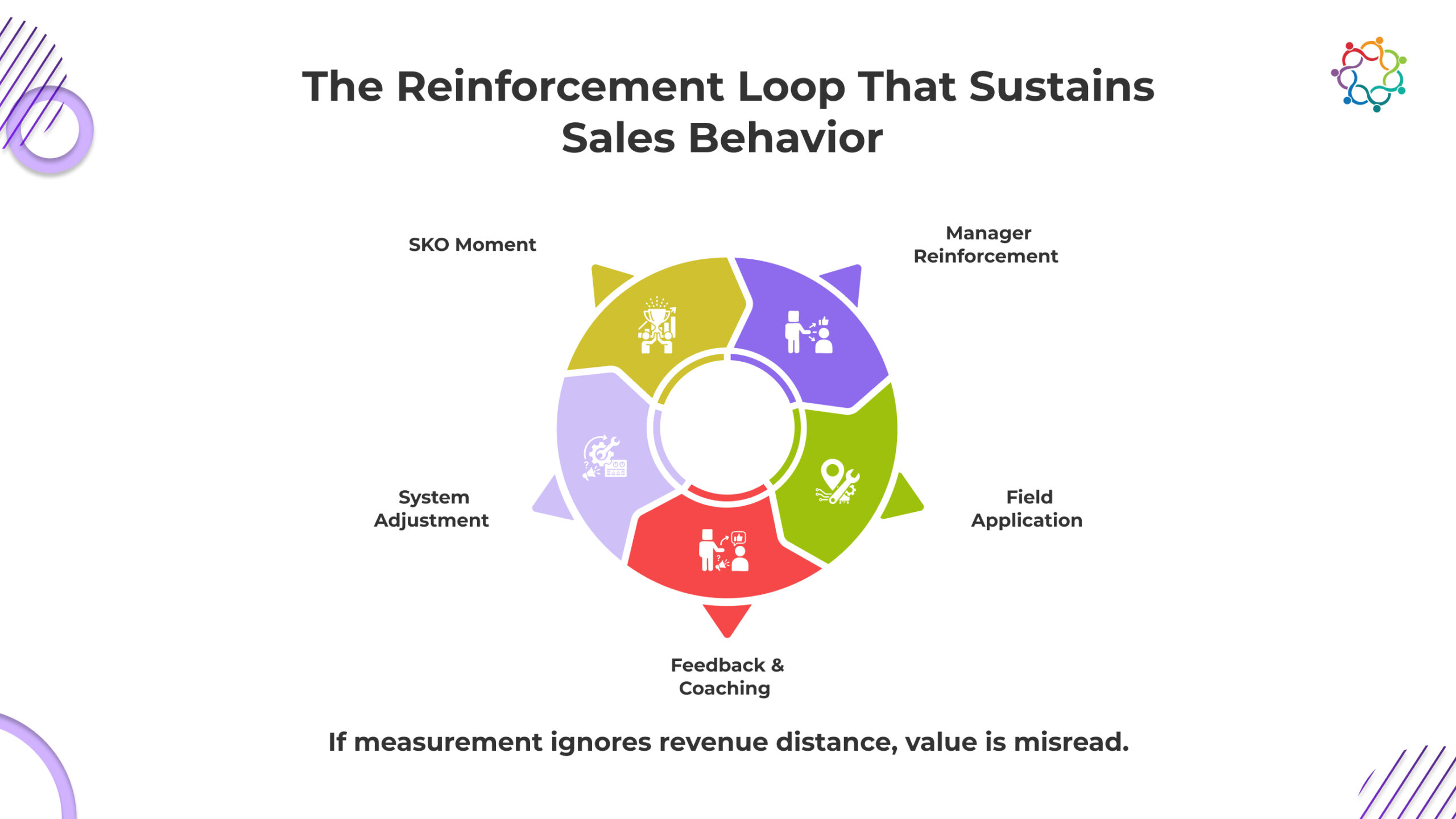
If you treat the kick-off as the peak of effort, you have already guaranteed its decline. Learning does not stabilize because people were attentive. It stabilizes because systems force repetition. Without structured reinforcement, what felt urgent on stage becomes optional in the field within days.
Reps do not ignore new priorities out of defiance. They ignore them because nothing in their daily environment requires adoption. Forecast calls do not reference the new qualification standard. Coaching sessions do not audit the updated messaging. Deal reviews do not penalize old patterns. In that vacuum, the familiar wins.
Post-event learning loops are not supplementary. They are the only mechanism that converts exposure into execution. Repetition inside real deals, manager-enforced feedback, and measurable application checkpoints determine whether behavior shifts. If reinforcement is inconsistent, decay is immediate.
Event excellence cannot compensate for operational neglect. If the weeks after the kick-off look identical to the weeks before it, the outcome will be identical as well.
This problem persists because the organization rewards the wrong outcome. You are measuring how the event felt, not what the field did afterward. As long as morale, attendance, and internal buzz are treated as proof of impact, you will continue mistaking energy for execution.
A high-energy room creates psychological relief. It feels like progress. But morale is not a leading indicator of pipeline quality or forecast accuracy. When you equate excitement with improvement, you avoid asking the harder question: Did selling behavior actually change?
If enablement teams are evaluated on session quality and participation rates, they will optimize for experience. Adoption tracking requires structural follow-through. If no one is accountable for behavioral reinforcement, the decay is inevitable.
Frontline managers shape daily execution. If they are not explicitly measured on reinforcing new priorities, they default to familiar coaching patterns. Without manager accountability, kick-off messaging becomes optional.
After the event ends, ownership becomes diffuse. Sales assumes enablement will follow up. Enablement assumes managers will coach. Leadership assumes alignment already happened. When reinforcement lacks a clear owner, motivation predictably collapses.
Sales kick-off events succeed as moments. They rarely succeed as systems. Energy peaks during the gathering because the context supports it. Behavior persists afterward because systems reinforce it.
If daily workflows, incentives, coaching rhythms, and metrics remain unchanged, selling patterns will remain unchanged. Motivation without reinforcement is temporary. Capability without repetition decays. Alignment without ownership fragments.
Sales leaders, revenue operations heads, and enablement managers must confront a direct question. Did anything structurally change after the event? If the answer is no, then execution will revert.
These events do not fail because they lack ambition. They fail because organizations overestimate the power of inspiration and underestimate the power of systems.
If nothing changes in how reps are coached, measured, and supported, nothing will change in how they sell. And if selling behavior does not change, revenue outcomes will not either.
Energy is easy to generate. Structural behavior change is not.
If nothing changes in how the system reinforces selling behavior, the kick-off changed nothing.
For organizations reassessing how their sales kickoff translates into execution discipline, the conversation can continue here.