Samaaro + Your CRM: Zero Integration Fee for Annual Sign-Ups Until 30 June, 2025
- 00Days
- 00Hrs
- 00Min



Few places have redesigned event marketing quite like the United Arab Emirates. Once characterized by a focus primarily on global expos and major summits, the UAE continues to evolve and become a hotbed for innovation based, experience-focused marketing. Events in Dubai, Abu Dhabi and Sharjah have progressed beyond one-off brand activations into the overall engagement plan reflecting the UAE’s transformation to a global creative economy, one of the main drivers of the UAE’s success in hosting global events, conferences and forums.
Becoming a global creative economy didn’t happen in one day. It has been the carefully curated policy design, ongoing investment into tourism and technology and a cultural penchant for being hospitable and connection. In the UAE’s Vision 2031 Action Plan and the National Innovation Strategy, the leadership continued to proclaim experience industries as key contributors towards the goal of GDP diversification. And, with that, we stimulated an ecosystem of creativity and commerce as a way for global businesses to try new ways to engage.
More importantly, the UAE was creating events to change narratives more than make events in new and different ways. A corporate conference at Expo City Dubai, an experiential launch event in Downtown Dubai to sustainability conversations in Abu Dhabi, every experience was designed in a way that resonates with audience cohorts of younger, mobile and globally connected humans. Their investment into venues, digital infrastructure and further investments into design and content expedited the experience transformation.
This blog will take a closer look into the details that differentiate event marketing in the United Arab Emirates. It will explore the array of forces igniting change, the products that AI and data are introducing to enhance experiences, and experience-led brand strategies that are engaging new forms of enterprise marketing for the future of the region. As a platform that observes experiences and has industry connections with the marketing teams throughout the MENA region, Samaaro will continue to observe and write up the evidence to strengthen and position a way of testing the insights from the quickly maturing UAE context into smarter, more connected event marketing solutions.
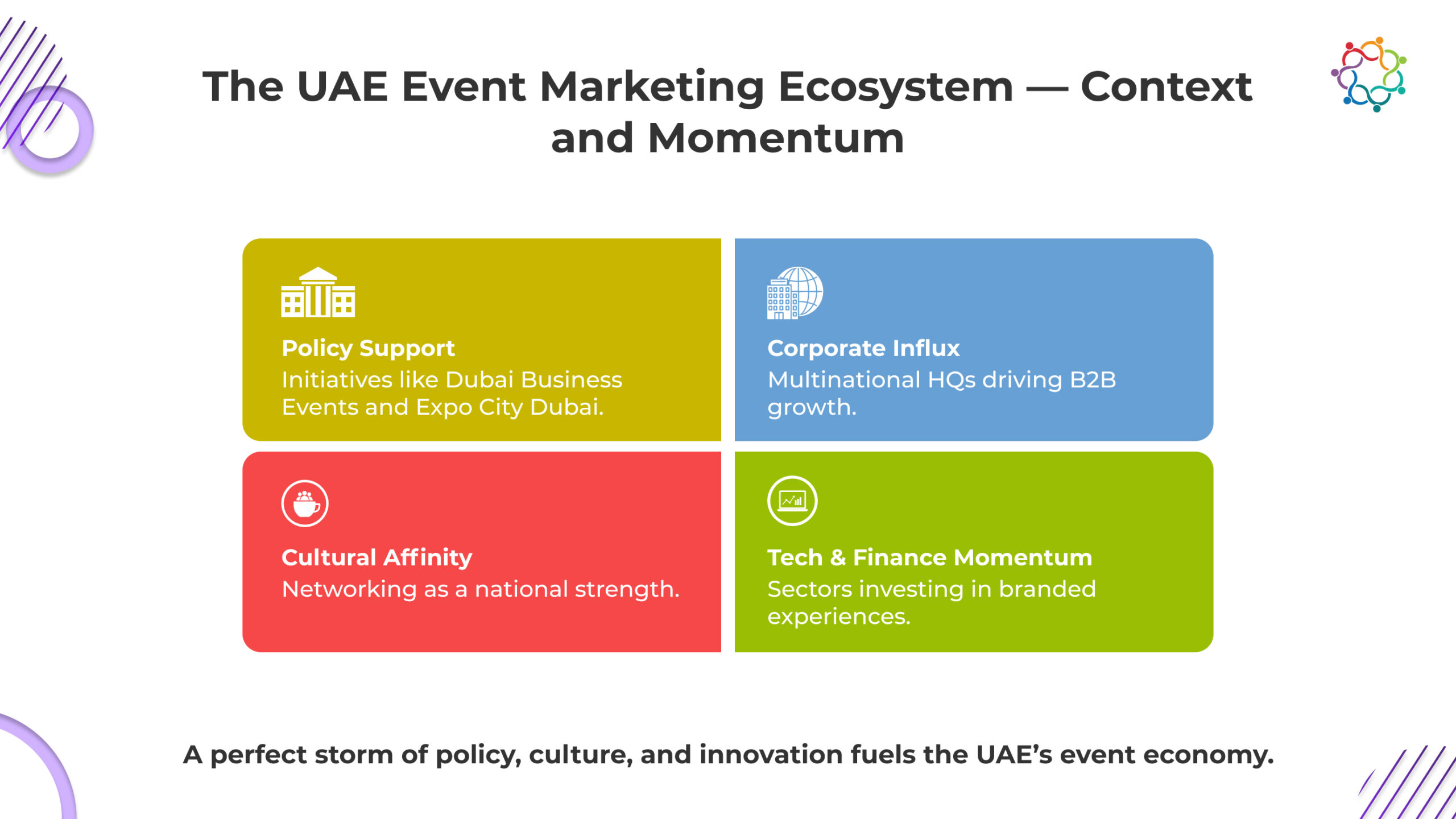
The UAE’s event marketing landscape has reached a point of global recognition, not just for its scale but for the sophistication of its approach. The country has built an ecosystem where policy, private enterprise, and culture align to support continuous innovation in live experiences.
The expansion is built on the bedrock of government backing. Organizations like Dubai Business Events and the Abu Dhabi Convention and Exhibition Bureau have intentionally and systematically sought to position the UAE as the MICE (meetings, incentive travel, conferences and exhibitions) capital of the Middle East. These organizations do much more than attract events, they are also building a knowledge-based economy in which industry, education and innovation intersect with cultural and social areas.
The legacy of Expo Dubai and the development of Expo City Dubai, as a sustainable, smart and event space, demonstrates the UAE ambition to be a front-runner in the global event economy.
There is substantive consideration of infrastructure, but the support of national governmental policy initiatives focused on sustainability, digital transformation and trade diversification have incentivized enterprise brands to invest in an experience-based regionally focused event. The evolution of new regulation and licensing process for enterprises and work and residency permits have not only improved conditions but resulted in increased interest from multinational enterprise brands to deliver large conferences and exhibitions internationally from Dubai and Abu Dhabi.
The economic structure of the UAE plays an important role in defining event marketing trends. The presence of thousands of multi-national headquarters in Dubai and Abu Dhabi has led the country to be seen as the nerve center for B2B events across a number of sectors, including finance, technology, real estate, and logistics. Corporate events are no longer viewed as transactional, they are means of showing brand philosophy. From fintech expos to real estate showcases, businesses in the UAE invest heavily in lively experiences, resulting in immediate engagement and long term loyalty.
The cultural foundation of the UAE enhances the reach of experiential marketing. Hospitality, community, and shared experiences are at the core of the region’s identity. Even in a largely digital and disconnected world, in-person networking is the cornerstone of the business relationship. The cultural preference for in-person relations promotes the continued championing of physical events, combined with hybrid options that allow it to retain a local edge.
The result is an event ecosystem that considers tradition and novelty, balancing the warmth of Arabic hospitality with the promise of modern digital interaction.

The UAE’s event marketing momentum is not accidental. It is driven by three interconnected forces: audience diversity, technological maturity, and supportive infrastructure.
There are few markets as demographically diverse as the UAE; more than 85 percent of the population consists of expatriates, presenting an exceptionally global audience mix. Attendees have high expectations for personalization, inclusivity, and convenience due to that diversity. They are multilingual, technologically savvy, and have come to expect seamless digital experiences in all aspects of their lives.
Thus, event marketers need to customize messaging, content, and design for multiple cultural and linguistic processes. A single approach does not work anymore. Successful campaigns in the UAE are now centered on segmentation, behavioral understanding, and cross-channel personalization that resonates with the audience’s global thinking.
In the UAE, technology is not a must-have, it is the baseline. Everything from onsite registration powered by AI to interactive mobile event apps, attendees in the region expect a seamless digital layer built into every experience. Event organizers are now using real-time dashboards to track engagement returns and ROI live at their event. Marketers are no longer focused on simply footfall, but now track dwell time, participation, and attendee retention of sessions.
This shift is indicative of the UAE’s changes from valuing engagement for visibility over engagement that can be measured. Brands are no longer investing in events to simply be seen, they are investing to achieve measurable impact.
The UAE’s long-term ambitions for a knowledge-driven and sustainable urban landscape influence event marketing. Its smart city programs (e.g., Dubai 10X, Abu Dhabi’s Smart Hub) have driven innovative digital tools and data usage in the event economy. Facilities such as the Dubai World Trade Centre and Abu Dhabi National Exhibition Centre incorporate advanced connectivity and data infrastructure to assure that the largest events can be delivered to exceptional and unique technical delivery.
These structural, strategic advantages permit the UAE to be an industry context in which global best practices are not only matched in quality but also positioned.

The essence of how UAE marketers have approached audience engagement is entirely driven by artificial intelligence. From predictive modeling to communicating in different languages, AI tools provide brands with important information and the ability to project future attendee behavior. Marketers can now find the most beneficial audience segments, tailor outreach as a result of engagement data, and modify campaigns beforehand, immediately after or even during an engagement.
Companies are even taking it a step further with AI to make better decisions concerning scheduling, personalize recommendations, and automate much of the post-event communication. These data-driven insights, and insights into other key performance indicators, ultimately lead to better satisfaction of the attendee and lead to measurable accountability for brands.
In the UAE, the future of marketing is increasingly defined by what happens after the event. Marketers are increasingly looking beyond simple metrics involving attendance only, to using measures of the depth of engagement, spend time at booths, amount of times they interacted with an exhibitor, and content downloads. This change reflects a wider move in the industry towards strategy based on analytics that are rich in information.
Data has certainly become the basis for making post-event marketing decisions. Event managers are now using engagement reports to leverage insight into not only refining their messaging, but also re-targeting attendees with personalized offers, and considering potential partnership opportunities for future events.
The fast-paced business environment in the UAE creates a demand for operational agility. The time frames across the initiatives are shrinking, and marketing teams are challenged by managing multiple touch points in parallel with goodwill. Thus, automation has become critical for both consistency and scalability.
Workflow automation for registration, communication and post-event nurturing, enables teams to carry out campaigns that would otherwise take a complex staffing model, with substantially fewer resources. Automated workflows also provide timely reminders, personalized confirmations, and relevant follow-ups, all while creating a consistent brand experience.

Events held in the UAE have shifted from being campaign tools to experiential activations of brand identity. Brands today are less concerned with simply talking about their products and more focused on curating experiences that embody their values and purpose.
This creative and psychological shift has created a new definition of success. Consumers and attendees don’t want to merely observe; they want to engage, and contribute, and connect. Therefore, experience design is central to contemporary brand storytelling.
Tech companies collaborate with innovators and give delegates an opportunity to experiment and play with cutting-edge technology. Luxury brands curate immersive environments inviting delegates to visit and experience craftsmanship for themselves. Even business-to-business (B2B) summits utilize gamification of learning and sensory storytelling to drive engagement and participatory outcomes.
What distinguishes the UAE market is the willingness of brands to measure emotional resonance alongside performance metrics. The measure of an event’s success is no longer the parameters of a connection experienced during the event, but also to the level of post-attendance retention it creates, as opposed to the one-and-done event, which the marketer can count on to create some level of brand interaction.
Data platforms become the bridge to give marketers the visibility they need to connect experience to outcome, while also providing some proof that creative expenditure achieves some kind of return on investment (ROI).
While the UAE’s event landscape is rich with opportunity, it is not without complexity.
Challenges
Opportunities
The balance of these challenges and opportunities reflects a market that rewards sophistication. Enterprise marketers that integrate strategy, creativity, and data fluency are the ones most likely to thrive.

The UAE’s event ecosystem is poised for another phase of transformation. Several trends will define its trajectory over the next half-decade.
The UAE is not simply following global workplace trends; it is defining them. It has achieved a unique combination of ambition, infrastructure, and inclusivity, which has made it a model for the way that modern event marketing should work. Here, art, and analytics, as well as experience and data, come together in a way that crafts events that are emotionally impactful, and operationally smart.
From government policy down to corporate creativity and purpose, each layer of the UAE’s ecosystem is purposely supporting one observable end goal: to create engagement that is measurable, sustainable, and deeply human.
As the transformative era of event marketing continues to evolve, the lessons that will arise from the UAE will increasingly challenge global organizations to consider how to balance creativity and technology for the purposes of engagement.
Samaaro will continue to document and learn and contribute to this journey, particularly with organizations who are interested in building smarter and more connected and impactful experiences to event marketing inspired by the UAE.