Samaaro + Your CRM: Zero Integration Fee for Annual Sign-Ups Until 30 June, 2025
- 00Days
- 00Hrs
- 00Min

Heading into 2026, audiences in the B2B space are more fragmented than ever. Decision-makers don’t just reside in one space online, they are consuming industry news, browsing LinkedIn, skimming newsletters, and engaging with private communities. This means only promoting an event on one channel, is no longer sufficient.
An effective B2B event promotion strategy involves a multi-channel mix that balances reach, trust, and conversion power. Internal channels are the foundation, organic channels add credence, paid campaigns increase reach, and partner programs offer a third-party validation. When combined in a multi-channel event promotion strategy, these 4 components offer a maximized ROI while ensuring no audience segments are left behind.
The real question is not which channel is best, but which mix of channels will work best to achieve your event goals. Let us evaluate the best suited B2B event promotion channels at this stage of events in 2026, and ways you can use them purposefully.
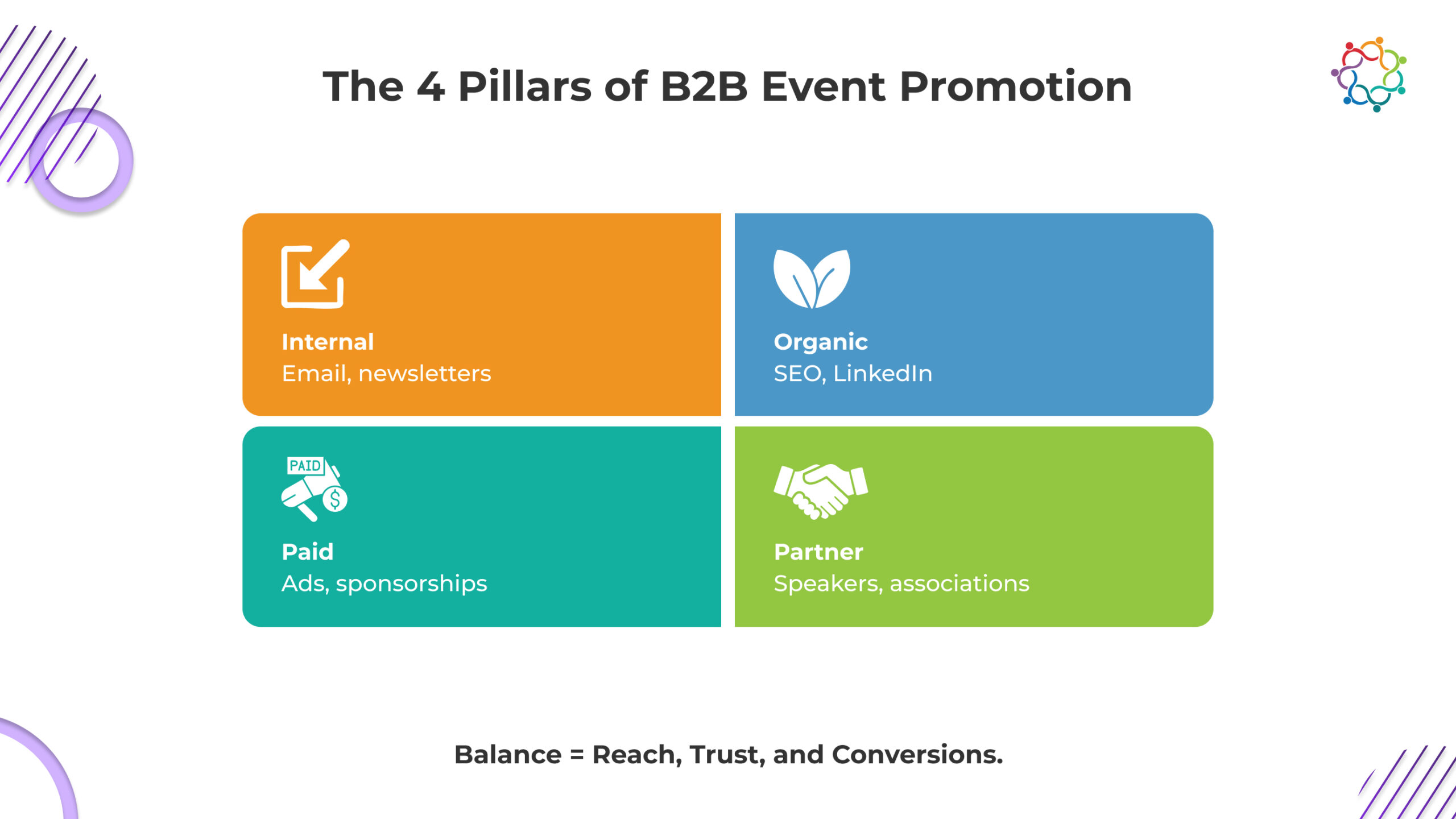
Internal channels are often overlooked, however, they are the best place to promote B2B, and they are already owned assets. It comes down to your existing CRM, employees, and customer channels.
Email is still one of the best ROI channels for B2B events. The ROI is even better if you segment your lists based on prior attendee history, position, or engagement level so you can do more personalized outreach. Example: “Hey, since you attended our AI Summit last year we would love to invite you to this year’s on enterprise automation. ”
Your employees, and especially your leaders, provide trusted voices to reach on LinkedIn. Ask your employees to share event media, speaker announcements, blog posts, or behind the scenes event prep and this can really grow your organic reach and create authenticity.
B2B buyers are already viewing updates from you via these channels. If you make a habit of promoting your events consistently in your monthly newsletters, and via a customer portal, this will stay top of mind without cost or management of a promo campaign.
How Internal Channels Are Better: They’re trusted, personalized, cost-effective, and an easy environment to generate a base of registrations before advancing to external campaign promotions.
Organic channels require time to produce results but communicate sustainable visibility and credibility, which are both core foundations of B2B events.
Publishing SEO optimized articles that closely relate to your event theme means organic traffic towards your subject and all whilst attracting industry authorities/stakeholders looking for answers. This is justified in the example article, “The Future of Enterprise AI in 2026,” that recently published, a mixture of thought leadership but by also providing a promotion for the event, AI Summit.
Following speakers, executives, and subject-matter experts provide a massive value. Using previews of your sessions, industry insights, outlining “why we are excited about this event” previews, building authority, and developing anticipation leads into your event.
Besides LinkedIn, I believe Twitter (X) & Instagram Stories (and other platforms) can provide previewing utility; feeding into social-media-saturation while sharing and documenting behind-the-scenes of your preparation, interviewing speakers, or teasing your event. This provides additional touch points for continued familiarity.
The Power of Organic Channels: For B2B marketing in lead generation for examples, one of the biggest strengths of organic channels is the authority and inbound discovery, with leads being generated and attracted by your content even after the event concludes.
Paid channels are the fast track to your campaign, giving speed and precision at scale.
The gold standard B2B targeting mechanism there is. Filter by role, seniority, industry, geography, and company size; it’s guaranteed every rupee you spend will be delivered to the right audience. Best used for lead gen campaigns connected to early-bird registrations.
Great for providing a reminder to warm leads that visited your event home page but didn’t register. Think of your ad as a friendly reminder, bringing prospects back into the funnel as they consider registration or ticket purchasing.
Most industries have trusted newsletters or media outlets that provide high engagement traffic. Use sponsored placement in these newsletters to focus your advertisement and develop some credibility and relevance around your event and promoted content to come. This strategy is especially effective when engaging niche verticals.
Advantages of Paid Channels: Offers scalable reach and measurable ROI but does take some discipline to manage your budget and not overspend.
Trust is currency in B2B. Partner channels lend credibility and can broaden access to audiences outside of your normal reach.
Often, invited speakers come with large professional followings. If you can enlist invited speakers to share promotional content they will effectively bring your event into trusted peer networks.
These stakeholders have skin in the game. With a coordinated campaign (a co-branded post, an email blast, etc.) they amplify your promotional stakes.
Associations and trade media carry authority credibility. Their endorsement signals credibility, and that attending your event is a must-attend for industry -it creates event FOMO in your audience.
Importance of Partner Channels: They provide a combination of third-party validation and reach, which is critical in establishing your event as an industry leader.
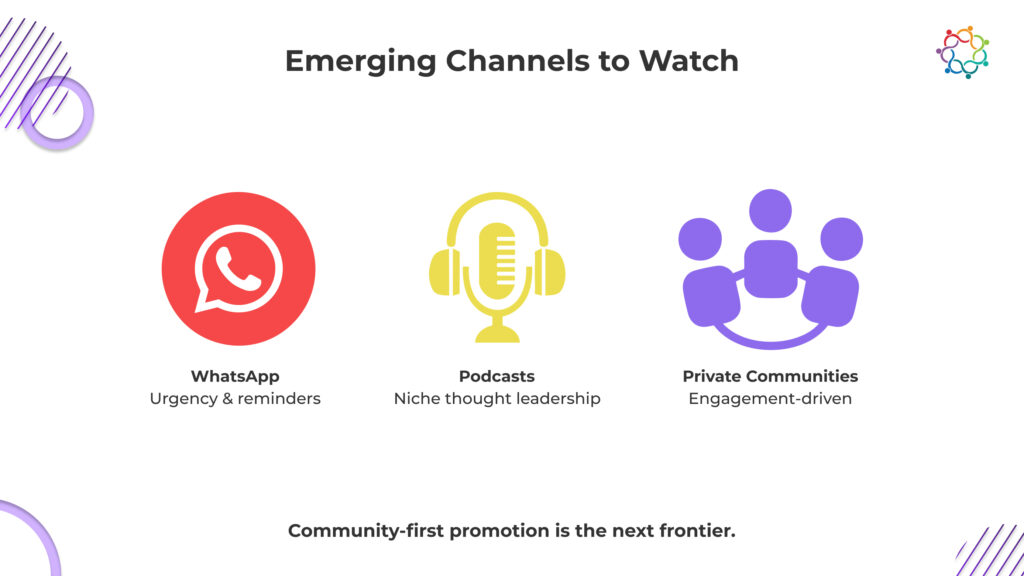
While the four pillars are key, there are many new channels that are changing the way B2B marketers will promote their events.
Direct- it’s personal and urgent. Ideal for reminders (“Only 48 hours left to register”!) or VIP invites.
Podcasts provide a great opportunity to engage with decision makers through storytelling and thought leadership. For example, have a featured guest appearance from the CEO based on the event theme.
Closed, high-value communities are the final frontier for B2B engagement. Simply taking an authentic (emphasis on authentic) role in these spaces begins to build relationships that will translate into registrations.
Trend: A focus on community-first outreach, which is driven by peers, as opposed to “mass push” tactics.
Since every event has its own goals, audiences, and budgets, determining the best channel mix involves matching the channels to your event type and goals.
The key is balance: budget, audience, and event type should dictate how much weight you give to each channel.
As 2026 approaches, there still isn’t a “best” B2B event promotion channel. The winners are the teams that effectively blend owned trust, organic credibility, paid precision, partner amplification, and experiment with new frontiers like WhatsApp, podcasts, and private communities.
The message is simple: diversify or risk being irrelevant.
When building out a multi-channel strategy with the right tools to measure effectiveness, B2B marketers can ensure their event will not only reach the right audience but will also be able to demonstrate measurable ROI.
Interested in a further breakdown of internal, organic, paid, and partner promotion strategies? Please, download our Event Promotion white paper or explore Samaaro’s channel attribution capabilities today.
The best channels to promote B2B events in 2026 are LinkedIn (organic and paid), targeted email campaigns to your CRM database, WhatsApp Business for personalised follow-ups, partner co-promotion through sponsors and speakers, SEO content that brings in organic traffic, and account-based retargeting ads. Pick four and execute well. Trying to be active on ten channels at once produces noise, not registrations.
In a successful B2B event promotion strategy, internal channels (sales outreach, employee LinkedIn) warm up known accounts, organic channels (blogs, SEO, social) build broad awareness, paid channels (LinkedIn ads, retargeting) accelerate visibility at key moments, and partner channels (sponsors, speakers, associations) extend reach to audiences you don’t own. Each plays a different role in the funnel, and the magic happens when their messages stay consistent.
For B2B event registrations in 2026, the highest-ROI digital channels are email to existing CRM contacts (lowest cost per registration), LinkedIn organic posts from executives and speakers, LinkedIn ads with precise targeting, and partner co-promotion. Paid social ads on Meta and Google work for top-of-funnel but rarely beat LinkedIn for enterprise B2B. Track CPL per channel for your specific audience, because benchmarks vary.
LinkedIn drives awareness and credibility through speaker posts and targeted ads. Email marketing converts known contacts with personalised invitations. WhatsApp lifts attendance with same-day reminders and last-minute nudges. Content marketing (blogs, whitepapers, podcasts) brings in new top-of-funnel audiences who become future event attendees. Together, they cover the full journey from first touch to event day.
Beyond traditional paid ads, B2B event marketers in 2026 should prioritise: speaker and sponsor co-promotion (massively underused), WhatsApp Business API for personalised reminders, niche industry communities and Slack groups, podcast guest appearances by executives, and ABM-style account targeting through LinkedIn. These channels reach decision-makers in a less crowded space than the LinkedIn feed.
Choose your channel mix by event type and audience size. Webinars need fast-cycle channels (email, LinkedIn, paid social) because the promotion window is short. Conferences need a 6-to-10-week mix across email, LinkedIn, partner co-promotion, and paid retargeting. Closed-door executive roundtables need direct outreach (email + LinkedIn DMs) and partner referrals, not broad ads. Match the channel intensity to the event’s audience and intent.