Samaaro + Your CRM: Zero Integration Fee for Annual Sign-Ups Until 30 June, 2025
- 00Days
- 00Hrs
- 00Min

1
2
3
4
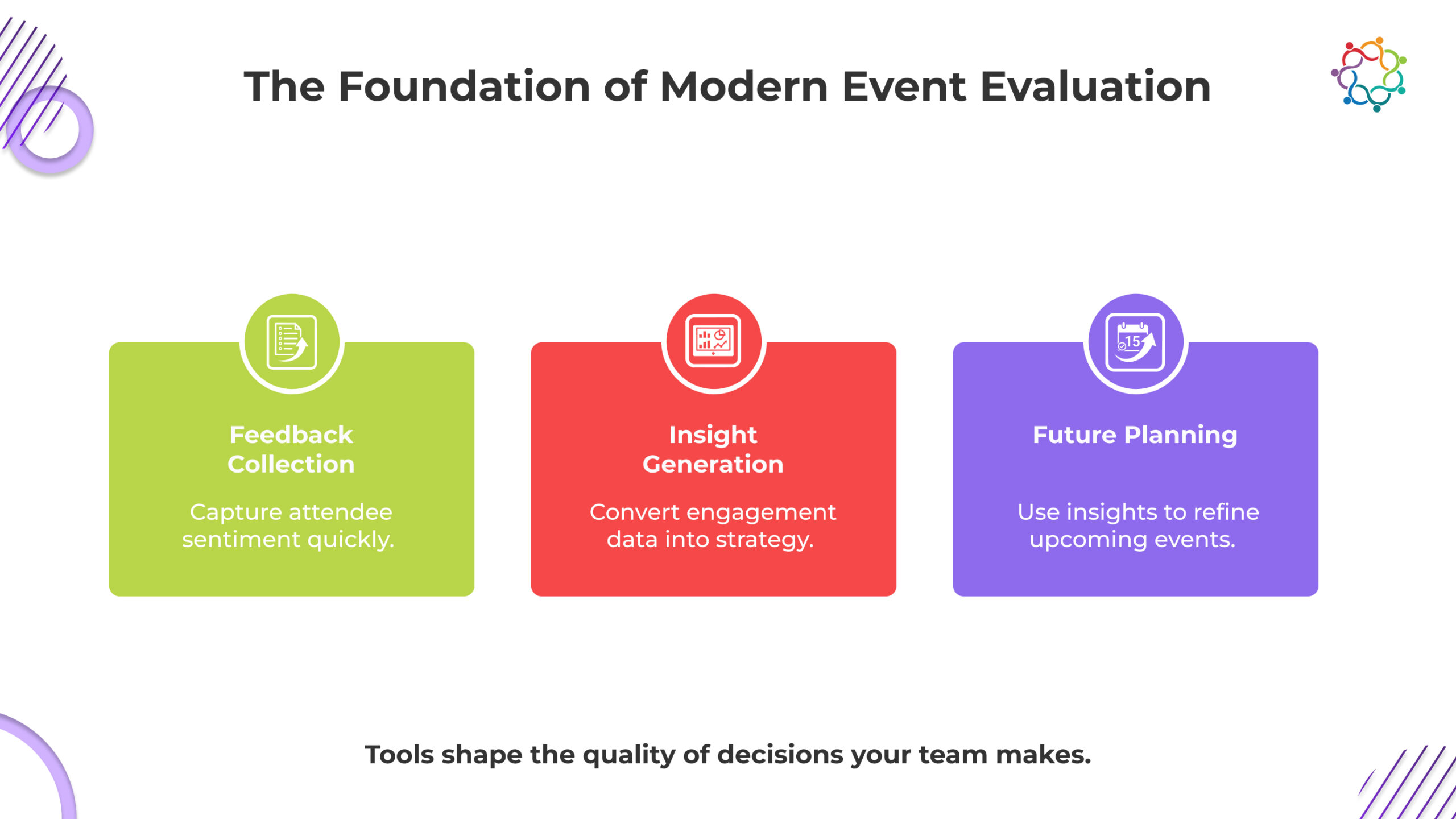
The evaluation of events is no longer reliant on manual effort or disparate data points. Today, the tools you leverage will determine the insight you capture from your audience. A strong evaluation platform does more than collect feedback – it weaves together audience insight, session engagement, and revenue implications into a coherent story. When teams grow up to leveraging strong evaluation tools, evaluation elevates from being an operational piece that provides insights to a strategic function that informs planning and investment decisions. On the other hand, when teams do not use a good evaluation product, reporting becomes a slow, fragmented process with limited data points and learnings.
This blog compares top event evaluation tools across four areas, so enterprise teams can determine the best tool for their needs considering size, integration needs, and depth of analytics.
Feedback plays a major role in organizations creating insights and actions plans. Tools like Type form, SurveyMonkey, and Google Forms easily allow organizations to collect attendee sentiment quickly. They are easy to use, inexpensive, and appropriate for organizations that need a lightweight feedback loop and action plan, usually without complex analytics.
But they are not without limitation. They will gather what the attendee says but will not capture what they do. They will not track attendee behaviour in sessions, in session dwell time, or heat mapping. They also rely on manual compilation when scaling. They can be valuable for small teams or standalone events. But in many cases for enterprise class analysis, they are insufficient.
Best for: Indications of quick sentiment, simple surveys, SMB scale events, simple NPS gathering.

Want to see how this would work for you?
30 minutes on how Samaaro replaces 4-5 separate evaluation tools with one connected workflow.
Book a tailored walkthrough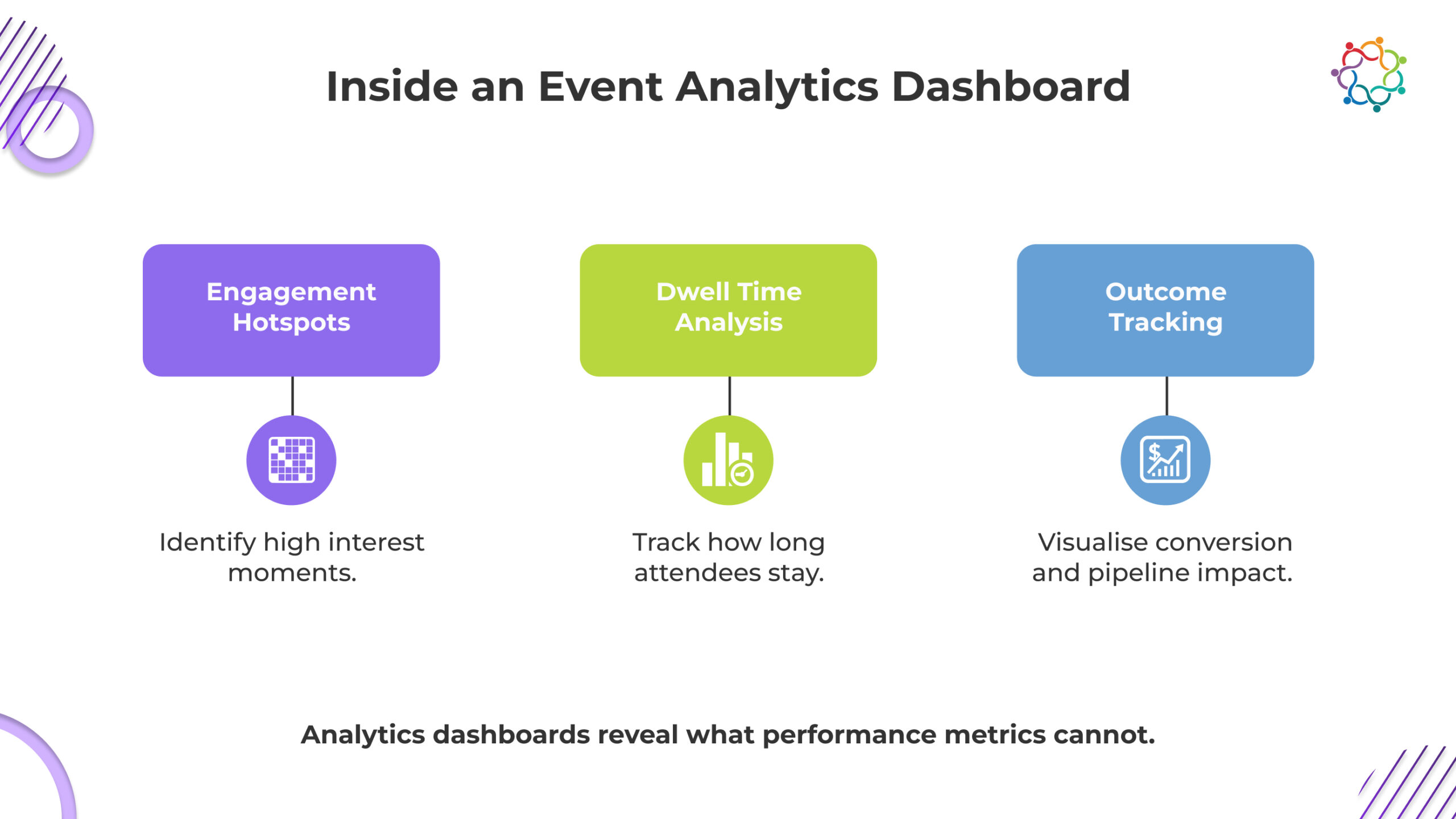
Analytics dashboards provide visibility into engagement, performance and outcomes. Platforms such as Samaaro and Bizzabo offer dashboards where teams can engage and track attendee movement, session attendance, booth visits, content engagement, and lead quality. They transform raw numbers into visual intelligence to help stakeholders discern what worked and why.
Analytics dashboards also automate manual work. Data will flow from registration, engagement tools, mobile apps, and the CRM system. Teams can measure conversions; segment based on high intent and compare session attendance and engagement by format or group.
Best for: Enterprise events, multi session conferences, exhibitions, engagement tracking, ROI tracking, year over year tracking.
CRM-integrated tools connect the activity from events to the revenue engine directly. Event evaluation platforms powered by Salesforce, HubSpot integrations, and specific connectors create a connection; they connect attendee engagement to the sales pipeline. It gives you a clear line of sight with the connection you are making from the interactions at the event to a business outcome.
When events’ data is housed inside a CRM, sales teams can see the engagement with intent. They can view which prospects attended specific sessions, downloaded resources, and visited exhibitors. This allows for more contextual follow ups and strengthens conversion opportunities. For marketing teams, CRM integration gives attribution a reality and gives insight in forecasting a pipeline.
Best for: revenue focused organisations, account-based marketing, making sellers’ lives easier, and high engagement B2B events.
AI-powered assessment platforms make sense of feedback data in ways that manual review at scale cannot. They can review open text feedback, identify sentiment trends, and surface themes cross thousands of responses. Some systems can even recommend changes to strategy based on what they’ve observed.
But AI can do more than evaluate feedback. It can identify audience segments, assess intent, or flag engagement drop off within the timeframe of their session. Meaning, event teams can modify content, targeting, and messaging in the moment, or during a future planning cycle. As an example, AI platforms are most valuable when supporting teams’ possess events at scale with a diverse audience.
Best suited for: Large enterprise, events with a lot of data, organisations who want to leverage predictive analytics, or teams who want to automate the review of qualatative insight instead of a one-off event.
Your data workflows maturity will influence your choice of evaluation tool.
A simple breakdown:
Feedback Tools are best for quick surveying, simple events and shallow sentiment analysis.
Analytics Dashboards are best for end-to-end insights, visualizing engagement, and tracking return on investment.
CRM Integrated Solutions are best for revenue attribution and sales alignment.
AI Platforms are best for predictive recommendations and processing high- volume data.
Organizations at the enterprise level typically implement two or more categories. Small and mid-sized organizations typically adopt feedback tools as a starting point. Once the events become more complex, they begin upgrading to analytics dashboards.

Most tools solve just one slice of evaluation, surveys, dashboards, or CRM sync. Samaaro eliminates that fragmentation by combining behaviour tracking, feedback capture, engagement analytics, and revenue attribution into a single evaluation layer.
Instead of jumping between registration exports, survey spreadsheets, mobile app reports, and CRM dashboards, teams get one system that shows:
Samaaro doesn’t just present numbers. It produces interpretation-ready intelligence, giving organisers and marketing teams a unified, high-intent profile of every attendee. Evaluation becomes faster, deeper, and grounded in business outcomes rather than activity logs.
Samaaro’s strength is simple:
It replaces four separate tools and gives teams a single source of truth that scales.
Don’t pick event evaluation software just because it is popular or the right price. Does it align with your organisation’s data goals. And how deep do those insights need to go? For some teams doing quick feedback mechanisms is enough. While others need real time dashboards that link behavior to revenue. In the end, the right choice is the tool that best enable your desire to develop a smarter and more strategic decision-making process.
Learn how Samaaro’s unified analytics can change event evaluation from being reactive to predictive.
The best event evaluation tools and software in 2026 combine feedback collection, real-time dashboards, CRM-integrated attribution, and AI-driven insights in one platform. Samaaro is purpose-built for this, with built-in feedback managers, registration and attendance dashboards, native CRM sync for pipeline attribution, and AI-generated post-event reports. Standalone survey tools work for basic feedback but miss the ROI side.
Feedback tools like SurveyMonkey collect attendee sentiment. Analytics dashboards show what happened (registrations, attendance, engagement). CRM-integrated systems connect attendees to pipeline. AI-powered platforms add the layer that synthesises all three into recommendations. The four together give you the full picture: what happened, why it happened, what it was worth, and what to change next. Tools that handle only one layer leave gaps.
For tracking attendee engagement, ROI, and post-event performance together, event marketing platforms like Samaaro outperform single-purpose tools because they capture engagement signals (session attendance, poll responses, networking activity) and tie them to CRM data in one system. Without that integration, ROI calculations become a manual spreadsheet exercise that takes weeks.
AI-powered event evaluation tools improve feedback analysis by synthesising thousands of open-text survey responses into themes within minutes, scoring engagement signals to predict which attendees are highest-intent for sales follow-up, and flagging anomalies in real-time dashboards. Predictive insights extend this further: AI benchmarks each event against your historical performance and surfaces what’s drifting before it becomes a problem.
For enterprise and B2B events, look for these features in evaluation software: native CRM integration (Salesforce, HubSpot, Marketo, Dynamics), customisable dashboards by stakeholder (CMO, marketing ops, sales), AI-generated post-event summaries, NPS and feedback management in one place, role-based access control, and ISO 27001 and GDPR compliance. The last three matter most for enterprise procurement.
Integrated event evaluation platforms connect attendee behaviour with revenue attribution by syncing every signal (registration, check-in, session attendance, poll responses, booth visits) into the CRM, mapped to the contact and account. When that account becomes pipeline or closes as revenue, the platform attributes it back to the event. Without integration, this connection is theoretical. With it, your CFO sees event-influenced revenue in the same dashboard as the spend.
The best tools in 2026 bring feedback, analytics, CRM data, and AI insights together in one place instead of forcing you to juggle separate apps. Simple survey tools work for quick feedback, but they miss the bigger picture. Platforms that combine attendee behavior, engagement, and revenue, like Samaaro, give you a complete view of how your event really performed.
Different tools fit different needs. Quick survey tools suit small events that just want fast sentiment. Analytics dashboards suit big conferences that need to track engagement and ROI. CRM-connected systems suit revenue-focused B2B events. AI platforms suit large events with lots of data. The right choice depends on your event size, your tech setup, and how deep your insights need to go.
For quick attendee sentiment, lightweight survey tools like Typeform, SurveyMonkey, and Google Forms do the job well. They are easy to use, inexpensive, and great for simple feedback or a fast NPS score. The catch is that they capture what people say but not what they do, so they suit small events more than large enterprise ones.
Platforms built around analytics dashboards give you end-to-end analysis. They pull data from registration, engagement tools, the event app, and your CRM into one view, so you can track attendee movement, session attendance, and lead quality. Tools like Samaaro turn these raw numbers into clear visuals, helping you see what worked and why across the whole event.
The best reporting tools build the report for you automatically. Analytics dashboards and AI-powered platforms pull your event data together and turn it into clear, visual summaries, instead of leaving you to stitch spreadsheets by hand. Samaaro auto-generates evaluation-ready reports, so your key metrics and insights sit in one place ready to share with your stakeholders.
Match the tool to your needs. Smaller teams running simple events can start with basic survey tools. As events grow more complex, move up to analytics dashboards that link engagement to revenue. Large enterprises often use two or more categories together. Ask how deep your insights need to be, then pick the tool that supports that ambition.
CRM-integrated tools connect what happens at your event directly to your sales pipeline. When event data lives inside your CRM, sales can see which prospects attended sessions, downloaded resources, or visited booths. That lets them follow up with real context. For marketing, this connection makes attribution real, so you can show which deals your event actually influenced.
AI-powered platforms read large amounts of feedback in ways manual review cannot. They can scan thousands of open-text survey responses, spot sentiment trends, and surface common themes in minutes. Some can even flag where attendees dropped off and recommend changes. For large events with lots of data, AI turns messy feedback into clear, useful insights quickly.
Look at your event size, how complex your workflows are, and the tools you already use. Decide how deep your insights need to go. Do you only need quick sentiment, or do you need to link attendee behavior to revenue? Also check how well a tool fits your CRM. The best fit supports smarter, more strategic decisions, not just popularity.
The tools you use decide how much you learn from your event. A strong evaluation platform does more than collect feedback. It weaves audience insight, session engagement, and revenue together into one clear story. Weak or scattered tools leave you with slow, fragmented reporting and shallow learnings, so evaluation becomes a chore instead of a strategic advantage.